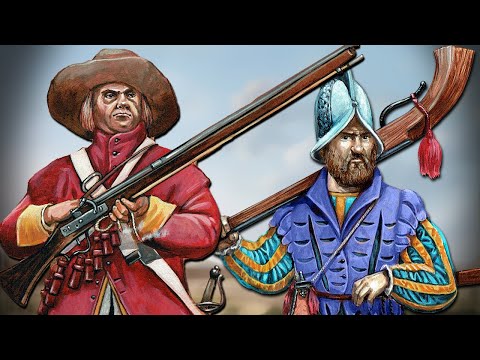
The battlefield was changing. In the late medieval and early modern period, a new weapon system swept across Europe, altering the armament of armies drastically and lastingly. The handgun made its appearance, and although the earliest firearms were rather ineffective, military artisans were fascinated by them. As time passed and technical improvements justified using the handgun on the battlefield, handgunners quickly overhauled and almost completely replaced archers and crossbowmen. This is how contemporary historiography explains the rise of the handgunner.
According to historian Clifford J. Rogers, firearms became the predominant shot weapon on European battlefields by the middle of the 16th century. People at the time were well aware of this change. In 1591, Robert Barrett wrote: “Time altered the order of war with many new inventions daily; then was then and now is now; the wars have much altered since the fiery weapons first came up.” Handguns didn’t simply push through because they were inherently superior to other weapons. There are two important pull factors that made the handgun a very attractive choice of weapon in the early modern period.
There was an overall increase in population and revenue. At the same time, the traditional martial classes such as men-at-arms stagnated in numbers. It follows that to defend more people, more fighting men were needed. This created a demand for weapon systems that required less training and thus allowed to arm more men more easily. Two weapon systems came out on top: the pike and the handgun. Although they required training—particularly group training—to use them well, a soldier had not to be raised and accustomed to their use from early youth as was the case for example with the longbow or to some extent the lances of the knights. A mere fortnight’s drill was considered sufficient to make a pikeman or an arquebusier ready for service. Humphrey Barwick, another military writer of the 16th century, mentioned a minimum training of six days for pikemen and Albert Ears and 60 days for handgunners. But even 60 days of training were a small investment compared to the years of practice required to perfect the martial skills of a man-at-arms or an archer.
The second pull factor boosting the adoption of firearms was the technical development of armor. Around 1500, smiths improved the effectiveness of steel plate armor drastically. They quenched the armor pieces similarly to etched weapons instead of letting them air cool. This process of production was very difficult to master, but it increased the protective value immensely. However, because this high-quality armor was very expensive, only a small amount of the armor used in battle was of this fine quality. Nevertheless, even mediocre plate armor was hard to overcome with muscle-powered weapons. Only heavy windlass crossbows and extraordinarily powerful bows such as the English warbows could penetrate mild steel plate. However, even these weapons could only pierce thick brass plates or bascinet tops from a close range and with an ideal angle of impact. A well-made quenched harness of high-carbon steel was an entirely different matter. It could reach a Vickers hardness of around 350 as opposed to 150 for air-cooled medium-carbon steel. Body protection like this could resist about two times the kinetic energy than an old-style harness. Even the strongest longbow or crossbow could hardly cause a severe injury through such a breastplate.
In contrast to these arms, handguns were not limited by the capabilities of the human body. Modern tests comparing the kinetic energy of their respective projectiles suggest that an arrow shot by an exceptionally strong archer had a kinetic energy of 130 to 150 joules, while a heavy steel bow crossbow reached up to 200 joules. A well-charged 1.5-ounce musket ball, on the other hand, could leave its barrel with 3100 joules; a one-ounce arquebus ball with around 2700 joules; even a cavalryman’s pistol could deliver over 1000 joules.
However, scholars vividly debate the implications of these numbers. Indeed, it is difficult to interpret them for practical purposes because of the complexity of ballistics. For example, the round bullets used at the time have a higher friction with the air than streamlined arrows so that they lose energy quicker. In addition, they were made of soft lead and thus less suited to penetrate armor than hardened steel arrowheads. This meant that a lead bullet fired from a pistol couldn’t do much harm at 200 yards even on the cheapest vambrace, while an arrow could still punch through the armor easily at this distance. When fired from a short distance, a pistol had a good chance to kill a mediocrely armored man while an arrow or bolt could not do that. A musket, in contrast, had a much greater reach: a well-charged musket ball could penetrate a cuirass of highest quality at 200 yards, one of average quality at 400 yards, and kill an unprotected man even at 600 yards. This outranged even the best bowman by far.
In addition to this, the round bullets fired by the early modern handguns usually caused much more severe wounds than arrows. Modern tests suggest that a bodkin arrowhead punching through its target would have created a wound cavity of around 45 cubic centimeters; a wound caused by a much blunter arquebus ball could have been three times that size at 100 meters and eight times at nine meters. According to Clifford J. Rogers, it was very unlikely that a man could go on fighting when hit by an arquebus ball, while it was not uncommon that combatants who were hit by multiple arrows or bolts could still go on fighting.
However, firearms had their disadvantages too. Even a skilled handgunner with a well-made weapon couldn’t match a good bowman when it came to long-range accuracy. In Tudor times, archers were trained at a minimum range of 220 yards and aimed at round targets of 18 inches in diameter. By contrast, arquebusiers in 1560 exercised themselves at just 120 yards and aimed at butts measuring 20 feet wide and 16 feet high with target circles of 54 inches in diameter. Modern tests indicate that even an excellent gunner couldn’t hit a standing man at this distance consistently owing to the Magnus effect—which you might know from several viral YouTube videos—the unpredictable spin of a smoothbore musket ball causes it to curve unpredictably from its target line. Precision suffered further under the common practice of using balls significantly smaller than the bore of the gun.
On an early modern battlefield, however, precision was not the most pressing issue since the target would usually be an enemy pike formation dozens of meters wide. But even against such a large target, the effective range was quite limited. Various contemporary sources such as Leonard and Thomas Digges mentioned that “our common shot if they discharged not within 100 pace they will waste their powder and do too little to no hurt to their enemies.”
In addition to that, early modern handguns had an even bigger disadvantage: while an archer could loose as many as 9 or 10 arrows in a minute, the reloading process of early guns was very time-consuming and complex. The soldier had to remove and secure his match, then he made sure to remove any sparks from his firing pan before priming it with a special fine powder. After tamping the pan with his finger, he recharged his piece with regular gunpowder, a bullet, and wadding, which he then tamped with his ramrod. Now he was ready to his mechanism, blowing his match to life and fixing it in the matchlock’s jaws. Now the gun was ready to fire. According to a Dutch drill manual, this procedure required 42 motions, while the contemporary military writer Humphrey Barwick suggests a fire rate of 40 shots per hour on a practice ground by a skilled handgunner. Many 16th-century captains expected no more than 10 shots in an hour from their arquebusiers. Clifford J. Rogers considers one shot per two or three minutes for a common arquebusier acting in formation under combat conditions realistic. For larger caliber muskets, the fire rate was probably even slower because they required a rest which had to be managed additionally.
However, in the end, it was better to deliver one deadly ball piercing even high-quality armor than to lose numerous arrows with little effect. By the middle of the 16th century, firearms had become the predominant shot weapon for European soldiers. Among many reasons, two stand out: it was easier to equip and train soldiers with handguns, and handguns were more effective against well-made armor. Additionally, quick urbanization, cheaper prices for saltpeter, higher prices for yew staves, and finally technical improvement of handguns themselves played into its rise on European battlefields. Generally, missile-firing troops rose drastically in importance in most armies, the exception being those in which the shot already played a key role. But no matter where, it was something new to 16th-century people that “many times battle have been won by shot only without push or stroke stricken.”
Yet the handgun’s triumph was never merely a story of better technology. It was a story of economies, of states growing richer and populations swelling, of smiths quenching steel to Vickers 350 while captains counted the cost of every yew stave. The arquebusier, drilled for a few weeks, could stand in ranks and deliver a ball that no breastplate could reliably stop. The longbowman, trained from boyhood, could shoot farther and faster, but he was a vanishing breed—and his king knew it.
“Then was then and now is now,” Barrett had written, and the phrase captured the age’s mood. What mattered was not that the handgun was superior in every measure, but that it was good enough—and cheap enough, and fast enough to field—to remake the order of war. The pike and the shot together became the twin pillars of the early modern army, and the missile troops who had once been auxiliaries now decided battles.
By the century’s end, the debate over bow versus gun had largely faded, settled not by argument but by the drill square and the ledger book. The handgunner had not replaced the archer because he was a better soldier; he had replaced him because the world around them both had changed, and the handgun changed with it. What, then, do you think—was the rise of the handgun true progress in the art of war, or simply the cheapest answer to a growing state’s most expensive problem? Share your thoughts below.






