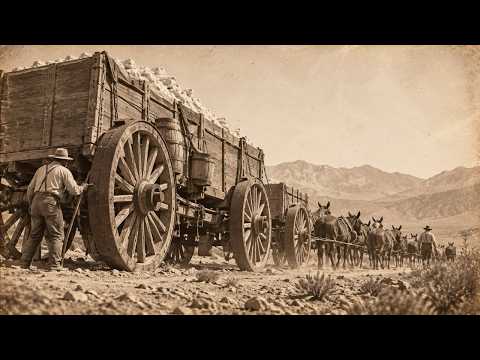
At 3:00 in the afternoon, the dust cloud appeared first—a rolling wall of ochre that swallowed the horizon. Then came the sound: the creak of iron tires on hardpan, the jingle of chains, and the low, rhythmic grunt of twenty animals pulling a load that should have been impossible. Eighteen mules and two horses, strung out in pairs for over a hundred feet, dragged two wagons with wheels seven feet tall and a rattling iron water tank—36 tons of borax and wood and iron—into the railroad town of Mojave, California. They had been on the road for ten days. They had crossed 165 miles of desert with only three springs. And they did it over and over for five years, until the man who paid for it all went broke anyway.
This is the story of how they did it—and why the answer wasn’t steam, or rails, or money. It was mules. And the two men who bet everything on them: a druggist named J.W.S. Perry, who designed the biggest freight wagons in the West, and William Tell Coleman, a San Francisco merchant who wagered a fortune that you could pull a factory’s worth of white crystals out of the lowest valley in North America. Their haul had six problems to get past, and the first one showed up before a single wagon was built.
In 1881, a prospector named Aaron Winters and his wife Rosie were living in a dugout at Ash Meadows, east of Death Valley—a room cut half into the hillside with a roof of tule reeds. A traveling prospector named Henry Spiller stopped for the night and showed them a lump of something he called a cotton ball, a soft white knot of borate crystals. Winters had seen that same white stuff lying all over the salt flat near Furnace Creek. So he went back with Rosie, gathered some up, and waited for dark because the test he had been shown only works when you can see the color of the flame.
You put the crystals in a saucer, pour on acid and alcohol, and strike a match. Ordinary salt burns yellow. Borax burns green. The writer John Spears, who went out to that country for a book published in 1892 and heard the story from people who knew the Winters, says Winters held the match to the saucer with a shaking hand and shouted, “She burns green, Rosie. We’re rich.”
I can’t swear those were the exact words. I can tell you the flame was green because soon afterward a San Francisco company paid about $20,000 for the claim. That company was William T. Coleman & Company. And this is where the trouble starts because the claim sat on the floor of Death Valley, close to 200 feet below sea level, more than 160 miles from the nearest railroad by any road a wagon could use.
A green flame tells you borax is there. It doesn’t tell you how to get it out. And the first man who tried to work that valley floor found out the hard way that the desert had a problem nobody had planned for, and it had nothing to do with roads. His name was Isidore Dauney. He was a Frenchman who had come to San Francisco as a boy, wandered the deserts for years, and nearly died crossing Death Valley in 1880. When he heard what Coleman had bought, he went back, found the same white crust farther south near a place called Bennett’s Well, and in 1882, he and two partners started the Eagle Borax Works.
The idea was simple enough. You scrape up the cotton ball, you dissolve it in hot water, and you let the water cool in big vats. As the water cools, the borax comes out of it as clean crystals, the way sugar comes out of a syrup if you leave it on the counter overnight. Donnet’s crew could do the first two steps. The third one beat them. In Death Valley, the water in the vats would not cool down enough for the crystals to form properly. They got crude salts, not clean borax. And you can’t sell crude salts for the kind of price that pays for hauling them all the way to a railroad.
Think about that for a second. The hottest place in the country was not too hot for the men. Or not only that, it was too hot for the chemistry. The crystals needed cold, and Death Valley did not have any to give. The Eagle Works failed. The Park Service says it lasted only until 1884, when the bad business and his personal setbacks ended in Donnet taking his own life. He was in his early 30s.
Coleman’s own plant was going up about 25 miles to the north, on the same kind of salt crust, and it was much bigger. And they had the same problem coming for them the first summer they ran. Coleman called his plant the Harmony Borax Works. It went up near the mouth of Furnace Creek, and it started boiling borax late in 1883. Water came down a pipe from a spring about 3 miles away. Out on the flat, the crews shoveled up the cotton ball and hauled it to the plant in carts and on sleds. Most of those men were Chinese. A Park Service survey of the site says what little evidence survives points that way. And it is one of the few places in this story where the record admits it barely wrote the workers down at all.
At full strength, Harmony had about 40 men and turned out about 3 tons of finished borax a day. The fuel for the boiler was mesquite, gathered off the desert by local Indians and a few white men. Everything else—the pans, the vats, the lumber, the pipe—had to come across the desert from the outside. And then the first summer arrived, and Coleman ran straight into the problem that had killed the Eagle Works. The vats would not cool. His answer tells you a lot about him. According to the National Register file on Harmony, he had the works wrapped in some kind of cloth and had water played over it to bring the temperature down. It’s the same trick as hanging a wet towel in a hot window. The water evaporates, and evaporation steals heat. It helped, but not enough.
So, Coleman did something only a rich man could do. He built a second plant. The Amargosa Borax Works went up near what is now Tecopa, east of Death Valley, where the summers ran a little cooler. When the heat on the valley floor got too much for the crystals, the work moved there. Now, Coleman had borax coming out of two plants in two valleys, and every pound of it was worthless until it reached a railroad. The nearest railroad that could take it was the Southern Pacific at Mojave, about 165 miles away by the road the teams would use.
For the first season, the company did what everyone did. It hired the hauling out. Spears says a local rancher named Charles Bennett, who kept horses and mules on a ranch in Pahrump Valley, took the contract. The Park Service file says the early loads went in ordinary wagons behind eight to 12 animals. It didn’t last. Before the end of that first year, the company decided it could do the hauling better with its own teams than by contract. And here the story takes a turn I didn’t expect. Coleman did not hire a famous freighter. He gave the whole job to the man who kept the time in his Mojave office, J. W. S. Perry, a trained druggist.
Perry’s orders were to design the wagons, lay out the road, and get every pound of borax in Death Valley to the railroad. What he came up with is the reason anybody remembers this at all. And the first thing he did was something no teamster would have thought of. Perry started with paper. He went after the measurements of every great freight wagon working on the Pacific coast by looking at them himself where he could and by writing letters where he couldn’t. Then he spread those numbers out next to the load each wagon was carrying and he worked out what a wagon would have to be to do this job. The target he set was 10 wagons, every one of them able to carry at least 10 tons of borax.
Spears, writing a few years later, stops the story here to make a comparison and I think it’s the best way to feel what Perry was asking for. Railroad freight cars in those days had their capacity painted on the side. 28,000 pounds was common. 50,000 was a good modern car. Perry wanted two wagons hitched together to carry what one of those modern cars carried and to carry it with no rails under them through sand and over the Panamint Mountains.
So here is the wagon he drew. The back wheels stood 7 feet tall. The front wheels were 5 feet. Every wheel wore an iron tire 8 inches wide and an inch thick. That width is the first trick. A narrow wheel on loose sand works like a knife. It cuts down until the axle drags. A wide wheel works more like a snowshoe. The same weight spread over more ground sinks less. 8 inches of iron was the difference between rolling across a wash and digging a trench in it.
The hubs were a foot and a half across and almost 2 feet long. The spokes were split oak, 5 and a half inches wide where they met the hub. The axles were solid steel bars about 3 and a half inches square, and the bed of each wagon was a box 16 feet long, 4 feet wide and 6 feet deep. Each wagon weighed 7,800 pounds empty.
Now here’s the part that sounds wrong when you first hear it. Spears compared those wagons with the best freight car of the day. That car weighed about 27,000 pounds and carried 50,000. So the car alone weighed more than half of what it hauled. Two of Perry’s wagons together weighed 15,600 pounds. According to Spears, they very often carried 45,000 pounds of cargo and sometimes 46,000. The wagons weighed about a third of their load.
Think about what that means. A wagon pulled by animals, rolling on dirt, was a more efficient carrier, pound for pound of its own weight, than a railroad car rolling on steel. Every extra pound of wagon was a pound the mules had to drag up a mountain for nothing. So Perry built them as light as they could be and still survive.
And they had to survive a lot. That load is where the famous number comes from and it’s worth getting straight. Add the two loaded wagons to the water tank that rode behind them and the company’s own history puts the whole train at 73,200 pounds, about 36 and a half tons. That’s the whole rolling outfit, wood and iron and water and borax together. The borax itself, by Spears’s numbers, was about 22 tons a trip.
Perry did not hire a wagon company to build them. The work was done right there in the village of Mojave by men paid by the day, and the National Register file names the man who put them together as J.T. Delemeter. The 10 wagons came to about $900 apiece. And then they did something that, if it’s true, is the real wonder of the whole operation. According to Perry, as Spears reported it, all 10 were in constant use for 5 years without a single breakdown.
The Park Service repeats it. Wheels took a beating and had to be fixed, but the wagons themselves held. I can’t check every trip of every wagon and nobody can. What I can tell you is that when Spears went out there, two of those same wagons were still working hauling borax on a different desert road, and that a set of them is still standing in Death Valley today.
So Perry had his wagons. But a wagon that can carry 20 tons is no use if the animals pulling it die of thirst on the second day. And on the road Perry had to lay out, thirst was the whole problem. Spears lays out that road from the Mojave end, and his numbers are brutal. Between the railroad and the valley, there were exactly three springs. Leave Mojave heading east toward a peak the early prospectors called Pilot Butte, and you go 50 and a half miles across open sand before the first water, a spring called Blackwater. Six and a half miles past that sits Granite Spring at the foot of the Butte. Then 26 miles to a spring called Lone Willow under one of the peaks of the Panamint Range. And then the worst stretch of all, 53 miles with nothing all the way to a place called Mesquite Well near the lower end of Death Valley.
Now put that next to how fast a loaded team could move. Spears says 15 to 17 miles a day. So the 50-mile gaps were three-day gaps. Three days of hard pulling in the desert with no spring at the end of the first day or the second. You can’t carry three days of water for 20 working animals on top of 20 tons of borax. The weight would eat the load.
So Perry did something that I think is the cleverest decision in this whole story. And it’s not the part anyone puts on a box. He chopped the road into days. Perry set up 10 stations along the route where a loaded team coming in toward Mojave would stop for the night. He set up a separate string of stops for the empty teams heading out, spaced farther apart, because a team with no load can go farther in a day. Where a station sat on a spring, his men cleaned out the spring and dug it bigger. Where the good water was up a side canyon away from the wagon road, they laid pipe and ran it down to tanks by the trail. Where there was no water at all, they made a dry camp and brought the water to it.
That’s what the tank at the back of the train was for, and here’s another number that gets told wrong. You’ll read in a lot of places that it held 1,200 gallons. That figure comes out of a magazine piece from 1940. Spears, writing while the system was still fresh, says the tanks were made to hold 500 gallons each, and the company’s own history and the Park Service say the same kind of iron tank. They had to be iron. Spears explains why in one line. A wooden tank would dry out and fall to pieces as soon as it was partly empty, the way a wooden barrel left in the sun opens up at the seams. In that air, a half-empty wooden tank was a leaking tank.
The tanks rolled on wheels, a lot like the street sprinklers that wet down dusty town roads. Teams towed them from the springs out to the dry camps, left them, and towed the empties back to be filled again. And the same went for food. The desert doesn’t grow anything a mule can live on. At every station, Perry built feed boxes out of lumber, each one big enough to hold four bales of hay and six sacks of barley.
Here’s the part that made the whole thing work. The teams heading out to Death Valley were empty, or close to it. They were carrying supplies for the men at the borax works, and not much else. So every outbound team filled the feed boxes along the road as it went. The team coming back the other way, loaded down with borax, emptied them. So the trip out did real work. Every mile an empty team covered was a mile of road stocked for somebody else’s loaded team days later.
That also made the whole system exactly as strong as its weakest box, and the boxes had an enemy Perry hadn’t counted on. The desert was full of prospectors in those years, men chasing lost mines with a burrow and a sack of beans. To them, Perry’s stations looked like a gift. Spears says that more than a score of times, somebody cleaned out the feed boxes, carrying off the hay and barley to some hidden spring the teamsters didn’t know about, so that a team pulled in at night and found nothing to eat.
That was theft, and you can almost understand it. What came next is harder. Spears says, “Some of them opened the faucets on the portable water tanks, and let the water run out onto the ground, so that a team and its drivers, nearly dying of thirst after a hot day, arrived at a tank and found it empty. Others broke the pipes that led down from the springs, and smashed the tanks themselves.” The company never took anyone to court over it. The manager told Spears he didn’t dare. One prospector with a grudge could leave a team without water at the end of a three-day dry stretch, and Perry knew better than anyone what an empty tank meant out there, because it nearly killed him.
Spears got this story from Perry directly, and he tells it without a date. When the two men met, Perry was running the company’s works near Daggett. The story was about a trip he had made, looking for a shorter way over the mountains east of Death Valley, riding from a place called Leeches Point with one workman. One of his horses got sick. Perry spent 7 hours in the full sun trying to save it, and it died anyway. Now the two men were on foot, more than 50 miles from the nearest water Perry knew of. They emptied their water keg into a bucket, and it filled one small canteen and half the bucket.
At nightfall, they started walking toward a place called Hidden Springs. Along the way, about 26 miles off in Windy Gap, there was a small wagon standing by the trail. If they could reach its shade by sunrise, they might live through the day. They were taking one swallow at a time. They’d had maybe two drinks when Perry heard a rattlesnake beside the trail and jumped. He cleared the fangs. He landed on jagged rock, fell, and spilled almost all the water. They had one pint left, and 40 miles to the spring.
They walked all night across the foot of Death Valley and just after the sun came up over the mountains, they reached the old wagon, wet their lips from the canteen, and lay down underneath it. They couldn’t sleep. They lay as still as they could with just enough water to keep their tongues from swelling and waited. Spears asked Perry what a man thinks about when he’s dying of thirst like that. Perry said he kept seeing a wagon he had watched roll into a town in Missouri years before piled high with watermelons, and he spent the whole day imagining breaking them open.
Here’s how it ended. Just before night, a team came along that trail, a full day ahead of when it was expected. Perry lived. Spears says that night Perry sat up until 1:00 in the morning drinking water. It’s a strange story to read right after the feed boxes and the iron tanks. Perry had built a road with water waiting at the end of every day’s drive. Out on a shortcut off that road, nothing was waiting for him. And he lived because a team came along early, and luck was not going to build the road itself.
Before any of those teams could roll, somebody had to make a road for 7-foot wheels across ground that had never carried one. Part of that road already existed. Years earlier, after a silver strike at a place called Chloride Cliff, freighters had worn a trail over a gap in the mountains at the south end of Death Valley and the borax road took it over. That gap is Wingate Pass. Nobody is completely sure where the name came from. One story says an army officer named Benjamin Wingate. The other says the teamsters called it Windy Gap or Windgate for the wind that came roaring through it, and the name just stuck.
The hardest piece of road to build was down on the flat south of Harmony on a stretch of salt the Park Service describes as ground that looked churned up, twisted, and bent into the most fantastic shapes. Today it’s called the Devil’s Golf Course. If you’ve never seen it, picture a plowed field that turned to rock salt. Every clot a jagged knob you couldn’t walk across in boots without turning an ankle. A wheel 7 feet tall cannot roll over that. So the salt had to be smashed flat.
The Park Service survey of Chinese-American history in California says it is said the job was done entirely with sledgehammers by Chinese laborers taken off their regular work gathering cotton ball at Harmony and paid a dollar and a quarter a day. I want to be careful with that because the survey itself says it is said. It’s a tradition, not a payroll. But it fits everything else we know about who did the hard ground work at Harmony.
There’s an awkward detail in the background here and I don’t think I should skip it. In 1877, during riots against the Chinese in San Francisco, Coleman had organized a citizens’ force armed with pick handles to put the riots down. A few years later, Chinese crews were shoveling his borax and, if the tradition is right, beating his road flat through the salt.
Once the road was cut, the wagons were built and the tanks were out on the trail, Perry still needed the one thing that would pull all of it. And the answer he used was not the answer everybody remembers. Everybody calls it the 20-mule team. It wasn’t 20 mules. Spears, the Park Service, and the company all agree on the makeup: 18 mules and two horses.
Even where the idea came from is shaky. The popular story credits a young teamster named Ed Stiles who supposedly noticed that a driver with 12 mules was hauling twice what another man hauled with eight and simply hooked two teams together, added a second wagon and a water wagon, and invented the whole thing on the spot. The National Register file tells that story, then says almost in the same breath that it rests on Stiles’ own interviews from the 1930s, that the beginning of the 20-mule team is fraught with vagueness and contradictory evidence, and that later research suggests the Death Valley teams may have run with 18 mules, not 20.
What isn’t in doubt is how the team was put together once it was on the road. The two horses went at the back, right at the wagon tongue. Spears describes them as a great handsome pair, weighing about 2,800 pounds together, gentle and strong. Their job was the hardest pull of the day, the first one. Getting a loaded train to move from a dead stop takes raw weight in the collar, and the horses had it. In front of them stretched the mules in pairs, all hitched to one long chain that ran forward from the front axle of the lead wagon. The company says that chain was 80 feet long.
So why mules for the rest? The men who drove them were blunt about it. The Park Service’s own retelling of a teamster’s day has him saying a dumb mule is a whole lot smarter than a smart horse. In the desert, they held up better, and they could be trained to do things a horse would not. And one of those things is the reason this team worked at all.
But first, you have to know how one man steered 20 animals. He didn’t use reins. You can’t hold 20 pairs of lines. Instead, a single rope ran from the bridle of the lead mule on the left side, back through rings on each mule down that side of the team, to the driver. Spears says it was braided cotton, half an inch thick, and close to 120 feet long. It was called the jerk line. The driver sat on a perch at the front of the wagon box, 8 feet off the ground, or rode the left-hand horse, depending on the man. A steady pull on the jerk line turned the leaders left. A series of short jerks turned them right. Everything behind the leaders followed.
The lead pair, Spears says, were the most civilized mules in the team. The pair just ahead of the tongue were the next smartest. And in between, in his words, went the sinful, the fun-loving, and the green ones.
Now here’s the problem the jerk line couldn’t solve on its own, and it’s the moment I’d most like to have seen. Picture a string of beads laid around the corner of a table. Pull the front bead, and the whole string doesn’t follow the corner. It snaps tight and cuts straight across. A team hitched to one long chain does the same thing. Swing the leaders around a sharp bend in a canyon, and the chain wants to pull into a straight line between the leaders and the wagon, dragging every mule in the middle off the inside of the curve, and the wagons with them.
The mules fixed it themselves. The pairs nearest the wagon tongue, the ones the teamsters called the pointers, were trained to step over the chain as the team came into a curve and pull outward, away from the bend, keeping the chain swung wide so the wagons tracked around the corner instead of cutting across it. Spears watched it happen. He wrote that span after span, often without a word from the driver, would jump over the long chain and pull away on a tangent so the heavy load could be dragged around. On some of the sharpest turns, he said, “The leaders were pulling in one direction while the wagons were moving almost the opposite way.”
A steam engine can’t step over a chain. That’s the first half of the answer to why mules. The animals got very little fussing over. Stiles remembered that the teams started at sunrise and stopped around noon to feed and water the mules standing in their harness, then kept going until sunset. At night, the grain went into boxes hooked to the wagon tongue and between the wheels, and the hay went on the ground. Spears says the mules groomed themselves by rolling in the sand so hard that a team let loose for a roll raised a cloud like a dust storm, and then hollered about it.
Running all this were two men. The driver earned $100 to $120 a month, which was very good money then. His helper, the swamper, earned about 75. The swamper rode the back wagon to work its brake going downhill, threw rocks at any mule that slacked off going uphill, gathered brush for the fire, and did the cooking and the dishes. They paid for their own food. Back at Mojave, Perry had his own view of what the drivers did with those wages. There was a faro game running in town most of the time, and Perry told Spears it was a good thing for the company because a teamster could go broke in one night and be ready to go out over the road in the morning.
Out on the road, there was no faro game. There was the grade. Spears says the road left Death Valley through Windy Gap, and the gap was really a wash, the bed of the floods that come down out of the mountains after a cloudburst. People out there told him about walls of water 20 feet high pouring down it. When a flood passed, it left boulders scattered everywhere, fresh gullies cut across the track, and at best a bed of loose sand for the wheels. And that sand went uphill.
Spears gives the grade as an average of 100 feet of climb for every mile, for 40 miles, with short stretches four times as steep. Say that out loud and it doesn’t sound like much. 100 feet in a mile. But think of it as 40 miles of pulling a loaded cart up a gentle ramp made of beach sand. Every step, all day, for days, with the wheels sinking and the chain never going slack. The mules weren’t climbing a mountain so much as grinding up one.
So the outbound teams, running empty, could cover more ground, and Perry’s stations were spaced for it. Spears says the longest day any team made was 22 miles, empty, downhill, in cool winter weather. The shortest run, in hot weather, was about 14. The floor of the valley had its own way of stopping them, and it came from the same clouds.
Ed Stiles, the teamster from that disputed origin story, remembered a cloudburst in the mountains that sent water pouring out onto the valley floor and turned it to mush. His wagons sank in the mud up to the hubs. He unhooked the mules. He hitched them to the back of the train and pulled the two rear wagons out backward, clear of the one that was stuck. Then 15,000 pounds of borax had to be unloaded by hand so the mules could drag the empty wagon out of the mire and load it again. By his account, it cost him one day. One day on a schedule built to the hour.
I’ll come back to that schedule because it’s the most surprising thing in the whole record. There was one season the schedule didn’t cover at all. Spears is flat about it. For about 3 months, from the middle of June to the middle of September, no teaming was done. Neither the men nor the animals could stand the heat, not even out on the Mojave side, never mind the valley. Nobody had a thermometer reading from those years that I could find, but the same ground at Furnace Creek recorded 134 degrees on the 10th of July, 1913, and that number still stands as one of the hottest air temperatures ever measured on Earth. That’s the kind of summer the mules sat out. So the calendar had a hole in it every year, and the borax piled up at the works until the fall.
And as hard as the climb was, the trip down the other side was more dangerous. Coming out toward Mojave, there was a long descent below Granite Spring, and Spears says the roadbed there was hard as a turnpike and steep. A loaded train couldn’t stop on it and couldn’t be allowed to run. So at the top of the grade, the driver threw his weight on the brake of the front wagon, the swamper worked the brake on the rear one, and the whole thing went down creaking and groaning and sliding with 36 tons trying to push 20 animals faster than they could walk.
If the brakes held, everything was fine. Spears describes what happened when a brake block gave way. The team was whipped into a gallop to stay ahead of the wagons. The driver tried to swing them up the side of the hill to slow the load. Then an animal fell, or a wheel hit a rock or a rut, and over went the wagons with the teamster who stayed at his post going over with them. He says some of the graves on that desert held men killed trying to guide a runaway freight team down a mountain. He doesn’t give names or dates for those, and I couldn’t find any for the Death Valley teams. I’m not going to invent a body count. But the brake was the one piece of equipment on the whole train where a single failure could kill a man in under a minute.
The other danger was slower, and it lived in the men themselves. A driver and a swamper spent 20 days at a time alone together on that road with a half day in Mojave between trips. Spears says they hardly talked. Each man lived a solitary life sitting a few feet from the other one. The heat and the bad nights made them sullen and mean, and the company learned it had to ask each man separately every time a team came in whether he was satisfied with his partner. If either one showed the least ill will, they got a new swamper before one of them killed the other out on the desert.
It didn’t always work. Spears tells of a team coming in from the borax works in the Amargosa Valley that stopped for the night at Saratoga Springs. The teamster and swamper quarreled. The swamper hit the teamster on the back of the head with a shovel as he sat by the fire and killed him. Then he buried the body by the spring, lay down beside the grave, and slept. In the morning he tried to drive the team in himself. He was no teamster. He got the mules in a tangle and turned the big wagons over, and the fall broke his leg. He crawled among the animals, turned all of them loose but one horse, got himself onto it, and rode back over the long hot divide to the works with the broken leg swinging. He told a story that made everyone sorry for him until they dug up the teamster to move him away from the spring and saw he had been struck from behind. Spears says the men wanted to lynch him, and that the county coroner and district attorney never came out to investigate because the trip across the desert was too hard.
In that same passage, Spears lists one more thing he saw. In Windy Gap, beside the trail, a rounded pile of stones with a marker. Grave of W. M. Shadley. He doesn’t say who Shadley was. He only puts him on the list of men the desert life broke. I can’t date any of these. Spears was writing down what desert people told him a few years after the fact, and desert stories in those years grew in the telling. Ted Faye, a documentary maker who worked as a history consultant for the Borax company, wrote a whole article about newspapers around the turn of the century claiming teamsters met shrieking maniacs and steered by human skulls. But on the freighting itself, Spears’ main source was Perry, and on the schedule Perry was exact.
Five trains ran between Death Valley and Mojave. Spears says Perry’s main care was keeping them moving regularly, and he had the road divided so well that a team went out to the valley, got loaded, and came back into Mojave on the 20th day at 3:00. He calls the precision remarkable, and I agree with him. Think about everything in this story that could break that clock. A cloudburst on the valley floor. A sick mule. An empty feed box cleaned out by some prospector. A tank somebody drained into the sand. A swamper and a teamster who have stopped speaking. And still, 3:00 on the 20th day. That’s the clock that brought the train into Mojave at the start of this video. It’s the reason I can tell you what time it arrived without being able to tell you what day. The teams kept their own clocks inside that one.
Ed Stiles said one of his biggest chores was keeping watch over 80 hooves. When any of them needed work, the team turned out at 1:00 in the morning to get an early start so that once the day’s miles were done, he’d still have three or four hours of daylight left to do the shoeing. At Mojave the teamster got the rest of the afternoon and that night to himself. Spears says that next morning a good many of them rolled up onto the perch instead of climbing, blinked at the leaders and mumbled something that was supposed to be get up. The mules understood him anyway.
He tells one more story about that, and it’s the funniest line in his whole book. The mules, he says, only failed to understand a driver once. That driver had skipped the saloon, gone to hear a traveling preacher, and been converted. The next morning he climbed up and politely asked the team to go, and every mule turned its head around, cocked its ears forward, and stared at him. He had left out the customary language. That’s a desert tall tale and Spears tells it as one. But the clock was real.
The company’s history says the teams hauled more than 20 million pounds of borax out of the valley, and the whole time that clock was running, the thing that would stop it was already sitting in the ground far to the south. In 1883, the same year Harmony fired up, prospectors found a different kind of borate ore in the Calico Mountains, about 12 miles from the railroad at Daggett. It was colemanite, a hard, rich rock that came in ledges, the mineral later named for Coleman himself.
The Park Service history of Death Valley mining is very clear about what that meant. A deposit 12 miles from a railroad was a serious threat to a business that had to drag every pound across the whole desert. Coleman did the sensible thing. He bought the best Calico claims himself and he set his refinery in Alameda to work out how to process the new ore. He needed that time because the new rock was harder to use than the old cotton ball. You couldn’t scrape colemanite off a salt flat with a shovel. It had to be mined underground and it wouldn’t simply dissolve in hot water the way the cotton ball did. It needed new methods, and the same Park Service history adds the last reason he waited, which is almost funny in hindsight. His desert refineries were doing so well that he saw no hurry.
So now he had a beautiful system in Death Valley, 10 wagons, five trains, a road full of tanks and feed boxes running like a clock, and he owned the deposit that would make all of it unnecessary. He never got to use it. In 1888, Coleman’s whole financial empire came apart. The usual date given for his bankruptcy filing is the 7th of May, with losses put at over 2 million dollars. The accounts don’t agree on why. Some blame a cut in the tariff that had protected American borax. Some blame falling prices. Harmony’s Park Service file only says his financial empire collapsed, and that’s the part nobody disputes.
Harmony shut down. The Park Service says it never boiled cotton ball again. After about 5 years of work, the fires under the vats on the valley floor went out for good, and Perry’s 10 wagons, the ones that had never broken down, suddenly had nothing to carry. Somebody was going to buy them out of the wreck, and he would turn the picture of those teams into something worth more than the borax they carried.
The buyer was Francis Marion Smith. He was already a borax man. Back in 1872, while he was cutting firewood for a little borax works in Nevada, he had found a rich marsh of his own, and he’d built a business on it. Spears even describes Coleman and Smith as partners in some of their borax dealings. When Coleman’s empire fell, Smith took over his borax works and holdings, and in 1890, he rolled all of it, Death Valley, Calico, the Nevada marshes, into one new outfit, the Pacific Coast Borax Company.
He did not reopen Harmony. The richer, closer ore at Calico, at a camp they named Borate, became the company’s main mine, and two of Perry’s Death Valley wagons went with it. When Spears saw them in 1892, they were hauling borax from Borate down to the railroad at Daggett. After 5 years on the long Death Valley road, they had been put on a run of about a dozen miles. That might have been the end of the 20-mule team, a dozen miles of desert road outside a mining camp. But somebody in Smith’s company saw what the teams had become in people’s heads.
His name was Stephen Mather. He was a young man working for the company whose father ran its New York office, and Harmony’s National Register file credits him with creating the slogan 20-mule team. US Borax’s own history says the 20-mule team trademark was first used in 1891 and registered in 1894. That’s the turn I didn’t see coming in this story. The team stopped hauling Death Valley borax around 1888. The brand named after them was on boxes about 3 years later. So the picture started selling borax after the real haul had already ended.
And the picture needed a story to go with it. Chuck Lyons, writing in Wild West magazine, says it was Mather who persuaded John Spears, a reporter for the New York Sun, to write his book on Death Valley. That’s the book I’ve been quoting all along. In 1892, Rand McNally published it. If that’s right, the most detailed early account of the teams was set in motion by the company’s own promoter. So I’ve tried to lean on the parts that are measurements and timetables, the parts Perry could check, and not on the parts that sound like advertising.
So by the early 1890s, the mules were turning into a symbol. They were also still working for a living at Borate. And Smith, who was a practical man before he was a promoter, was looking at what that cost him. Mules eat every day whether they haul or not. Teamsters draw $100 a month. Wagons need wheels, and by then there was a machine that promised to do this work. A California builder named Daniel Best was making steam traction engines, iron tractors on huge wheels that could pull a train of wagons with no animals at all. In 1894, Smith bought one. It’s still sitting in Death Valley today, and it has a name: Old Dinah.
Picture a locomotive somebody has taken off its rails and set on wheels taller than a man. In 1961, a steam collector named Richard Filippi went out to Furnace Creek with a steel tape and measured her. He put her driving wheels at about 86 inches high, taller than any man on her crew. He also copied down the little story the Borax Museum displayed about her, and the same story is still quoted from the museum display today. Here is what that story says happened. Dinah went to work hauling ore from the mines at Borate to the railroad at Daggett, the same short run Perry’s old wagons were on. She burned coal, 3 tons or more a day, depending on which copy of the display you read. Every ton of it had to come from somewhere else, the same way the mules’ hay and barley did. Her speed on level ground was about 3 miles per hour, and the museum text adds, with a straight face, that this did not include the time spent stuck in the sand.
And then the line I like most: on steep grades, it says, “She slipped backward faster than she could go forward.” Remember the wide iron tires on Perry’s wagons? A traction engine moves by shoving its own weight and the load behind it through its driving wheels. So it needs grip, and on loose sand, a driving wheel spins and digs. Think of a car on ice. More power doesn’t help. The wheels just turn faster in the same hole. A mule team works the other way around, with 80 hooves each finding its own footing.
It took four men to keep Dinah running: an engineer, a fireman, a brakeman, and a mechanic who worked all night every night to get her ready for the next day’s run. Now count the men on a mule team: two. The driver and the swamper, and the swamper also did the cooking. Through all of this, the museum text says, “The mule teams had kept hauling alongside her.” After about a year of struggle, Dinah was abandoned, and the 20-mule teams took over the whole job again. One account stretches her trial to 2 years. Either way, it ended the same.
Why mules, then? Smith had the money and the machine, and he tried it. The mules won because of everything Perry had built around them. They ran on hay and barley and water, the exact things his feed boxes and iron tanks were set up to hold, stocked by the empty team going the other way. They could see a curve coming and jump the chain. The big horses at the wheel could start a loaded train from a dead stop on sand. And when one of them went lame, the team still had 19 others. A steam engine on that road needed coal it had to bring with it, water for its boiler, four men to tend it, and a mechanic up all night. It needed a different road. It needed rails.
And rails are exactly what came next. Smith built his first railroad for borax only. The Borate and Daggett was a narrow gauge line about 11 miles long, finished in 1898, with two small geared locomotives named Marion and Francis, after Smith himself. On that run at least, the mules were done. But the ore at Borate was running deeper and poorer, and Smith’s people went back to the deposits they had been holding in reserve in the hills just east of Death Valley. The new mine was called the Lila C, after Coleman’s daughter.
It was about 135 miles from the nearest railhead, so Smith set out to build a much bigger railroad, the Tonopah and Tidewater. He didn’t start it where it ended up. His first plan was to build north out of Las Vegas, on the advice of Senator William Clark, who owned the railroad through that town. Grading began there on the 29th of May, 1905, and by the middle of July, about 12 miles of roadbed were done. Then Clark’s railroad refused to let Smith’s line connect to its tracks. Clark was planning his own line to the Nevada gold fields. Smith sold the Las Vegas grade to Clark and started over from Ludlow on the Santa Fe, a route about twice as long.
The hardest part of the new line was the Amargosa Canyon, where crews and mule teams had to blast their way through rock. Some of the work that brought in the railroad, the thing that finally replaced the mules, was done by mules. The line reached Death Valley Junction near the Lila C in 1907. Here’s the detail in the Park Service history I didn’t expect. The mine started working before the railroad was finished, and the first ore that came out of the Lila C was hauled to market by 20-mule teams pressed into service one more time. The old system went back to work for the couple of years the railroad was still on its way. Then the rails arrived and the teams were done for good as working freighters.
The rest of the borax story in that country belongs to rails and then to trucks. In 1914, the company built another narrow gauge, the Death Valley Railroad, about 20 miles from new mines at a camp called Ryan to Death Valley Junction. In 1928, a big easy deposit turned up out near Kramer, the place now called Boron, close to the company’s processing plant, and the Death Valley mines went quiet. The Death Valley Railroad shut down in 1931. The Tonopah and Tidewater stopped running in 1940 and its rails were pulled up during the war.
Smith himself didn’t last as long as his railroad. In 1913, he got overextended and had to turn his assets over to his creditors. He started again with a new borax company and lived until 1931. Old Dinah had a second career, too, and it went about as well as the first. After borax, she was sold to haul supplies between the town of Beatty, Nevada, and the Keane Wonder Mine on the east side of Death Valley. The accounts disagree about how it ended. A burst boiler around 1909 in one version, a breakdown and an owner who gave up on her in another. Either way, she was left out on the trail. She sat there until 1932 when she was hauled in to Furnace Creek and parked by the road at the ranch. In 2015, the company that runs the resort moved her to a new spot on the property.
But the picture of the mules that beat her kept working long after the mules themselves stopped. Smith sent a team and two of the old Death Valley wagons to the World’s Fair in St. Louis in 1904 with a driver billed as Borax Bill. The team paraded through cities across the country, bells on the leaders. A short item in Desert Magazine in 1940 said Borax Bill Parkinson had driven one of the original wagons from Oakland all the way to New York City starting in 1917 and spent 2 years on the road doing it. Teams turned up in the Rose Parade in Pasadena and at a presidential inauguration. In 1958, when the company opened its big open pit at Boron, a 20-mule team made one more symbolic haul out of the new pit. An animal team marking the change from digging tunnels to digging an open pit.
Then the picture went on the air. In 1930, the company started sponsoring a radio show called Death Valley Days, stories of the old desert country. In 1952, it moved to television and it ran until 1970. For its first 12 years on television, the host was a character called the Old Ranger. For a couple of seasons in the middle of the 1960s, the host was an actor named Ronald Reagan, who left the show to run for governor of California. In between stories, the host sold the company’s soaps and laundry powders under the same picture of the mules.
And remember Stephen Mather, the young man credited with the slogan. He left the Borax company, made his own fortune in borax, and in 1917 became the first director of the National Park Service. He died in 1930. Three years later, in February of 1933, Death Valley itself became a national monument, and in 1994, a national park. So the man who turned the mules into a trademark ended up running the agency that now looks after the place they came from. As far as I can tell, nobody planned that.
The last time a real 20-mule team pulled those wagons in public was on the 1st of January, 1999, in the Rose Parade. The company spent about $100,000 getting wagons more than a century old back on the road for it. You can still go and see what’s left of all of this, and almost all of it is on or near the old road. Start where the trip ended, in Mojave. On Sierra Highway, there’s a state historical landmark for the 20-mule team terminus. Just west of it was the Southern Pacific loading dock where the borax went onto the cars, and where on the 20th day at 3:00 the teams pulled up.
Head northeast and you’re on the line of the old road. Out through California City, there’s a street called 20 Mule Team Parkway that roughly follows it. Somewhere past that, out in the creosote, is the site of Blackwater, the first of Spears’s three springs, 50 miles out from the railroad. Beyond it, the old road ran past Granite Spring and onto Lone Willow, and then east through Wingate Pass. You can’t follow it there. The west side of the pass is part of a Navy weapons range, and the Park Service says it has been closed except by special permission since the Second World War. The windy gap where Perry lay under a wagon with a pint of water, and where somebody piled stones over W.M. Shadley, is behind a fence.
Come at Death Valley from the other side and drive south from Furnace Creek, and you can stand on the Devil’s Golf Course and look at the salt Perry’s road had to cross. Try to imagine a wagon wheel 7 feet tall rolling over that, and then imagine the men who, by tradition, smashed a road through it with sledgehammers. From there, take the west side road south toward Bennett’s Well. Near it are the scraps of the Eagle Borax Works, Isidore Daunet’s plant, where the vats wouldn’t cool and the first borax business on the valley floor died with its owner. It’s on the National Register now, alongside the plant that learned from it.
Then go north to the Harmony Borax Works. The adobe walls are still there, and the furnace, and the boiler, and the tanks where the borax dissolved on a low hill above the salt flat. Below them stands a full set of the wagons, two ore wagons and the tank, the set the Park Service says holds the most original material of any surviving 20-mule team wagons. A short drive south at the old Furnace Creek Ranch, there’s a small borax museum in a wooden building from the 1880s that was moved down from 20 Mule Team Canyon in the 1950s. Out behind it is the outdoor collection, and Old Dinah is in it.
This is where I promised to come back to one of Perry’s wagons. Just after midnight on the 4th of April, 2024, rangers were called to a fire in that outdoor area behind the borax museum. When it was out, one of the historic 20-mule team wagons was gone. It had carried original running boards and iron hardware from more than 130 years earlier. Authorities investigated it as a possible arson. Old Dinah, standing in the same yard, escaped without significant damage. The full set out at Harmony, by the old plant, still stands.
Last, drive back west and stop at Boron on the old 20-mule team road. The open pit there is the biggest in California. Rio Tinto runs it now, and it supplies close to half the borates in the world out of a deposit the old company found in 1928, a short drive from the same Mojave railroad the mules used to reach.
Go back to the picture this all started with. A team of 18 mules and two horses stretched out along a desert track toward the horizon, the wagons and the tank behind them, the heat bending the air. That’s the picture on the box, and it’s a true one. But it only shows one line of animals on that road. There was always a second line you couldn’t see, running the other way. An empty team, a day or two or a week out, rolling toward Death Valley with nothing in its wagons but supplies for the works, stopping at every station to fill the feed boxes with hay and barley, towing iron tanks of water out to the dry camps so that the loaded team in the picture would find them full.
Perry never put that second line on a box. Mather never made a slogan out of it. The steam engine that came to replace the mules couldn’t live on it, and every 3:00 arrival at Mojave depended on it more than on any mule. Every load of borax that came out of Death Valley behind those mules rode on a road the empty teams had stocked on their way in.
So here’s what I keep coming back to. The 20-mule team wasn’t a triumph of brute force. It was a triumph of logistics—of a druggist who thought like an engineer, of feed boxes filled by teams going the wrong way, of mules trained to step over a chain. It lasted five years, hauled 20 million pounds of borax, and then vanished so completely that the brand outlived the reality by decades. The wagons are still in the desert. The springs are still there, some of them. The road is mostly gone. But the picture remains, and it’s still selling something. What do you think—was the 20-mule team the last great animal-powered enterprise in America, or just the first great marketing campaign? Let me know in the comments.






