Hollywood stars trusted their doctors, and some were left addicted, disfigured, voiceless, or dead. Gilda Radner’s symptoms were dismissed for 10 months—by the time they found the cancer, the tumor was the size of a grapefruit. Robert Walker resisted a sedative injection, joked as two doctors searched for a vein, and lost consciousness seconds after they administered it. He never woke up. And Jennifer Grey emerged from two rhinoplasties so unrecognizable that Michael Douglas looked directly at her and had no idea who she was.
These are the stories of the doctors who destroyed Hollywood’s biggest stars—not through malice, but through negligence, addiction, and a failure to heal.
Wallace Reid was injured in a 1919 train wreck while filming The Valley of the Giants, leaving a three-inch scalp wound that required six stitches. Instead of stopping production, studio doctors gave him morphine for the pain and sent him back to work. Paramount kept Reid on an assembly-line schedule, sometimes allowing only a few days between pictures. As tolerance grew, so did his dependence.
He completed film after film while losing weight, strength, and control of his body. By October 1922, on the first day of Nobody’s Money, assistant director Henry Hathaway watched him stagger toward a chair, sink to the floor, and begin crying. Crew members lifted him into the chair, but he collapsed again and was taken away by ambulance. Paramount replaced him and destroyed the footage he had completed.
Reid entered a sanitarium in December weighing under 130 pounds, down from 190. He was so weak that lifting his head could make him faint. Pneumonia and kidney complications followed during withdrawal. On January 18th, 1923, he died there at 31 with his wife Dorothy beside him.
Edith Piaf’s morphine addiction began in August 1951 after a car crash left her injured and doctors treated her pain with injections. She spent five days in hospital then returned to work before fully recovering. By 1952, she was dependent on morphine, taking cortisone for rheumatism, and sleeping pills for exhaustion. Two further crashes brought more pain and more narcotics.
Her husband, Jacques Pills, discovered her injecting morphine and took her through three detoxification clinics. The first treatment in 1953 failed. That same year, she was heckled at the Casino de Paris after appearing drunk on stage. In Las Vegas in 1955, the Riviera Casino paid out her contract but refused to let her perform. Her condition increasingly interrupted her work.
On December 13th, 1959, during a punishing French tour, Piaf collapsed immediately after her final show in Druot and underwent operations for ulcers and digestive bleeding. She returned for the 1962 Olympia concerts in a weakened state with a doctor stationed in the wings throughout the performance.
Gilda Radner spent 10 months seeking medical help while doctors misread or dismissed the symptoms of ovarian cancer. In 1985, while filming Haunted Honeymoon, she developed severe fatigue and pain in her upper legs. The symptoms continued as she consulted physicians in Los Angeles. One internist suspected Epstein-Barr virus. A gastroenterologist suggested her problems might be emotional.
Gene Wilder said several doctors dismissed her as nervous and high-strung while none took a complete family history that would have revealed ovarian cancer in her grandmother, aunt, and cousin. A CA 125 blood test was not ordered until 10 months after her first complaints. On October 21st, 1986, doctors finally diagnosed ovarian cancer.
Radner cried, then told Wilder, “Thank God, finally someone believes me.” A physician privately warned him that she had little chance. Surgeons operated 36 hours later and removed everything visible, including a grapefruit-sized tumor. The cancer had already spread beyond the ovaries and was classified as stage four. Radner died on May 20th, 1989, at 42.
Robert Cummings began seeing Dr. Max Jacobson in 1954 after friends Rosemary Clooney and Jose Ferrer recommended him for exhaustion. Jacobson told Cummings that his injections contained vitamins, sheep sperm, and monkey gonads. The injections actually contained heavy doses of methamphetamine, producing an immediate rush followed by a crash that drove Cummings back for another shot.
Cummings kept returning, later obtained the mixture from Jacobson’s son in Los Angeles, and eventually learned to inject himself. His personality swung between euphoric energy and dark crashes. His work became erratic, television roles declined, and friend Art Linkletter organized an intervention that failed.
The drug use also entered Cummings’s divorce proceedings. In 1969, his wife Mary accused him of regularly using methamphetamine, suffering wild mood swings, and allowing astrologers and numerologists to influence financial decisions. Their 24-year marriage ended in January 1970. The couple’s community property was valued at $700,000 to $800,000. Jacobson was charged with fraud and unprofessional conduct in 1973, and New York revoked his medical license in 1975.
Alma Rubens said her addiction began when a New York doctor gave her narcotics during an illness. Within months, she needed larger doses and was using morphine and heroin for real or imagined pain. By 1926, colleagues described her glassy eyes and drifting speech on set, and Greta Garbo replaced her in The Torrent. Sanitariums became routine.
In February 1929, Rubens tried to stab a physician who was taking her for treatment. A court sent her to the Spadra facility, where she escaped despite four nurses and two male guards. After another brief stay in Pasadena, her husband, Ricardo Cortez, and her mother had her committed to Patton State Hospital.
Released in December 1929, Rubens announced a comeback and received eight curtain calls at a Hollywood performance. In January 1931, federal agents arrested her in San Diego for cocaine possession and conspiracy to smuggle morphine from Mexico. She was freed on $5,000 bail, caught pneumonia, and slipped into a coma at Dr. Charles Pflueger’s home. After roughly 60 hours unconscious, she died there at 33.
Connie Francis lost her singing voice after a New York doctor promised to repair damage from an earlier nasal operation. A 1967 cosmetic procedure had narrowed her nasal passages and made singing difficult, especially in air-conditioned rooms. In 1977, another surgeon said he could correct the problem. Two weeks before the operation, Francis was recording an Italian album. Two weeks afterward, she returned to finish the overdubs and discovered that her voice was gone.
Her range had collapsed to about seven notes, too little to sing any song from beginning to end. The comeback she had planned stopped immediately. Francis underwent three more operations before she could sing again. For nearly three years, she remained unable to record normally and withdrew from regular performance while surgeons attempted to repair the damage.
By 1980, she was finally recording again, but the voice that had carried dozens of hits now required rebuilding. Her 1981 single, “I’m Me Again,” became her last song to enter Billboard’s Adult Contemporary chart, peaking at number 40.
Peter Lorre’s dependence began in 1925 when a second surgeon treated complications from a ruptured appendix with morphine, Pantopon, and other powerful opiates. The painkillers became a long-term habit as chronic gallbladder attacks kept giving him a medical reason to return to narcotics. By the time he reached Hollywood, the addiction was affecting his work.
During Alfred Hitchcock’s Secret Agent, the symptoms were visible on camera. While shooting the eight Mr. Moto films between 1937 and 1939, colleagues reported finding Lorre in his dressing room with a doctor’s syringe still in his arm. Repeated withdrawals for rehabilitation became an open secret around the studios.
He managed healthier periods at Warner Brothers, but he never fully escaped the cycle of pain, medication, and relapse. His weight eventually increased by about 100 pounds, reducing the sharp physical presence that had made him famous. In his final working years, he sometimes could not complete a take without stopping. He would leave the set for 10 minutes, steady himself enough to continue, then return and attempt the same scene again.
Freddie Prinze’s doctors gave a severely depressed 22-year-old repeated access to Quaaludes and, according to his family’s lawsuit, returned the weapon used in his death. Internist Dr. Edward Albun prescribed the powerful sedative despite Prinze’s escalating drug problems. In November 1976, police arrested the actor for driving under the influence of Quaalude.
Psychiatrist Dr. William Kroger knew Prinze was unstable and had previously taken away his .32 caliber pistol. Yet, the malpractice complaint alleged that he later gave it back. Prinze’s wife filed for divorce weeks before the final crisis.
During the early hours of January 28th, 1977, Prinze telephoned relatives, friends, his estranged wife, and Kroger, warning that he could not continue. Business manager Marvin Snyder rushed to his hotel apartment and arrived before Prinze fired the pistol at himself. He was taken to UCLA Medical Center, placed on life support, and died the next day without regaining consciousness. In 1981, Kroger agreed to pay the family $750,000. Albun paid another $200,000 to settle the malpractice claims.
Tammy Wynette’s addiction began after doctors repeatedly treated surgical complications with Valium, Demerol, and injectable painkillers. A 1970 hysterectomy caused infection, scar tissue, intestinal blockages, and years of abdominal pain. Each operation brought new prescriptions. Wynette began taking Demerol even when she was not in pain, then switched to injections when pills no longer stopped withdrawal.
One doctor trained members of her road crew to administer the drug. When physicians cut her off, she visited hospitals and doctors in different cities, sometimes scheduling overnight tour stops near emergency rooms to obtain more medication. In November 1986, Wynette canceled the rest of her appearances and entered the Betty Ford Center.
Three weeks into treatment, an intestinal blockage required an eight-hour operation that removed about a quarter of her stomach. Doctors placed her back on the same painkillers and the addiction returned almost immediately. By the 1990s, doctors had implanted a port—a catheter in Wynette’s chest—so painkillers could be injected directly while she continued touring.
Jennifer Grey’s career was derailed after two rhinoplasties left the Dirty Dancing star almost unrecognizable. Grey had resisted surgery for years, but casting pressure and repeated warnings that her nose limited her roles finally wore her down. After discussing it with her mother and consulting three plastic surgeons, she agreed to a procedure meant to fine-tune her appearance.
The first operation created an irregularity, forcing a second correction. That surgery went far beyond what Grey expected, leaving her nose shorter and dramatically different. The result was not a subtle improvement, but the loss of the face audiences knew. Grey said photographers stopped recognizing her and casting opportunities dried up.
Even people who had known her for years failed to identify her. At an airline counter, an employee accused Grey of pretending to be the actress from Dirty Dancing. At her first public appearance after the second operation, Michael Douglas looked directly at her and did not know who she was. Grey later summarized the damage in one sentence: “I went into the operating room a celebrity and came out anonymous.”
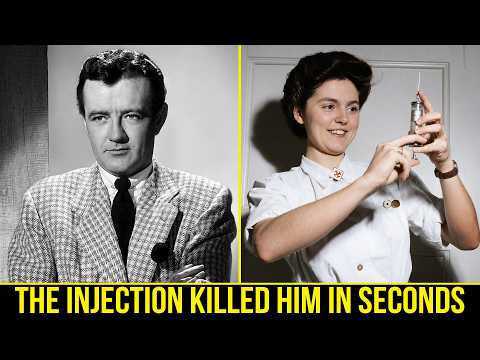
Robert Walker had just starred in Strangers on a Train when his psychiatrist gave him a fatal sedative injection. According to friend Jim Henaghan’s account, on August 28th, 1951, Dr. Frederick Hacker was at Walker’s Brentwood home during an emotional episode. Hacker and Dr. Sidney Silver decided he needed sodium amytal to sleep.
Walker refused, ran outside into the rain, then handed Hacker his glasses and joked that the doctors were not big enough to make him submit. Henaghan carried him into the bedroom and held him down as the doctors searched for a vein. Walker laughed, “You can’t even find the vein.” Seconds after the injection, he lost consciousness.
Hacker and Silver began artificial respiration and injected caffeine and a heart stimulant. Henaghan drove 10 miles in nearly 10 minutes through heavy rain to fetch internist Dr. Myron Prinzmetal. Prinzmetal examined Walker, conferred with the doctors in the bathroom, and said, “The man is dead.” Walker was 32. Henaghan returned to the bedroom, closed Walker’s eyes, smoothed his hair, and covered his face.
Hank Williams’ final decline accelerated under Horace Toby Marshall, a convicted forger who posed as his personal doctor. Marshall had bought a fraudulent medical diploma and prescribed drugs under the alias Dr. C. W. Lemon. He supplied Williams with amphetamines, Seconal, morphine, and chloral hydrate, claiming the powerful sedative could help control his drinking.
Instead, Williams mixed it with alcohol while suffering from chronic back pain and worsening heart trouble. His performances became unreliable, his band left, and the Grand Ole Opry dismissed him in August 1952. On his final trip, Williams reached Knoxville’s Andrew Johnson Hotel barely able to continue.
Dr. P.H. Cardwell was called and gave him two vitamin B12 injections containing morphine, then allowed him to resume the overnight drive to Canton. Hotel porters placed him in a wheelchair, carried him to his Cadillac, arranged him across the back seat, and covered him with a blanket and overcoat. Near Oak Hill, driver Charles Carr noticed the blanket had slipped, reached back to replace it, and found Williams’ hand stiff and cold.
Andy Warhol survived surgery for a gangrenous gallbladder, then died during a night of documented failures in post-operative care. On February 21st, 1987, surgeon Björn Thorbjarnarson removed the badly infected organ and repaired a hernia. Warhol was awake afterward, walking, making telephone calls, and watching television.
During the night, however, intravenous fluids continued while his output was not properly tracked. His estate alleged that fluid accumulated in his lungs and placed fatal pressure on his heart. New York state investigators found numerous serious deficiencies: no complete medical history on admission, conflicting records about a penicillin allergy, gaps in temperature and pulse readings despite orders for checks every four hours, and inadequate evaluation of Warhol’s private nurse.
At about 4:30 a.m., nurse Mincho noticed that he had become unusually pale. The cardiac arrest team was not called until 5:45, when he was unresponsive. The estate sued New York Hospital and 11 doctors and nurses. In 1991, the hospital settled the malpractice and wrongful death case for $8 million without admitting wrongdoing.
Judy Garland was still a teenager when MGM doctors prescribed pills to control her weight, energy, and sleep. MGM doctors used Benzedrine to keep her working, then Seconal and other barbiturates to force rest before the next call time. During Annie Get Your Gun, Garland arrived late, missed shooting days, and was fired in May 1949.
MGM sent her to a Boston hospital where doctors weaned her from the medication and restored normal eating and sleep. Months later, preparing for summer stock, she returned to pills to lose weight. The absences and delays began again. On June 17th, 1950, MGM suspended her from Royal Wedding after repeated failures to report.
Two days later, during a severe emotional crisis, Garland injured her neck with a piece of broken glass. The wound was not life-threatening, but she was placed under medical supervision. MGM ended her 15-year contract that September. On June 22nd, 1969, husband Mickey Deans found Garland behind a bolted bathroom door in their London home. Her blood contained the equivalent of 10 Seconal tablets. The coroner ruled incautious self-overdosage and accidental death.
Marilyn Monroe’s doctors treated her insomnia with a supply of sedatives that became lethal. Psychiatrist Ralph Greenson and physician Hyman Engelberg treated Monroe simultaneously while she relied heavily on barbiturates and other sedatives. Engelberg prescribed Nembutal only two or three days before her death, instructing her to take one capsule nightly.
An empty Nembutal bottle was found among roughly 15 medicine containers beside her bed. Chloral hydrate, another powerful sedative, was also in her system, and the combination with Nembutal sharply increased the risk of respiratory collapse. On August 4th, 1962, Greenson visited Monroe at her Brentwood home and told housekeeper Eunice Murray to remain overnight.
Around 3:25 a.m., Murray saw light beneath the locked bedroom door, but received no answer. Greenson arrived, broke through a window with a fireplace poker, and found Monroe on the bed with a telephone in her hand. Toxicology recorded fatal concentrations of pentobarbital and chloral hydrate. At 4:25 a.m., Engelberg called police and said, “Marilyn Monroe has died.”
Fifteen stars. Fifteen stories of trust betrayed by the very people sworn to heal them. The names changed, the decades changed, but the pattern never did—a pill for the pain, a shot for the sleep, a promise that everything would be fine. And when the bill came due, it was always the patient who paid.
Which of these stories shocked you the most—and do you believe Hollywood has truly learned from its dark medical history, or is the same tragedy still happening behind closed doors today?






