In a photograph taken around 1912, the dining room of an English country house stretches like a cathedral nave. Silver candelabras line a table set for forty guests. Footmen in powdered wigs stand shoulder to shoulder, each more motionless than the last. Above them, a painted ceiling depicts gods lounging among clouds brushed by Italian masters two centuries before. Everything in this image whispers one word: permanence.
Yet by 1955, a house like this was being demolished every five days across the British Isles. Entire wings of Baroque architecture reduced to rubble. Libraries holding first editions of Milton and Shakespeare sold to American collectors for pennies on the pound. Ballrooms where Queen Victoria once danced stripped to bare stone and left open to the rain. Since 1900, more than 1,200 country houses have been demolished in England alone. These weren’t minor manors—they were works by Robert Adam, Hamilton Palace, the physical foundations of a class that had ruled Britain for nearly a thousand years.
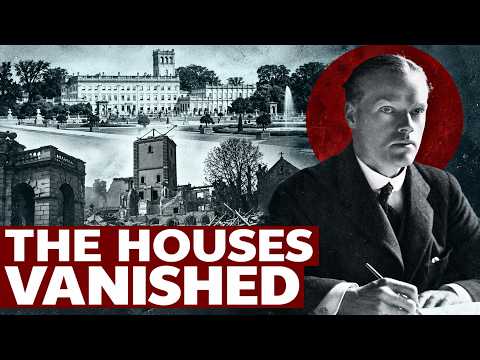
So what happened? How did an entire aristocratic class—one that at its peak controlled nearly all the land in England—lose its grip so completely? How did families that had survived civil wars, plagues, and revolutions find themselves brought to their knees by a combination of taxes, trenches, and changing times? And perhaps most importantly, what became of them after the great houses fell?
To understand the fall, you first need to understand the height from which these families tumbled. And that height was staggering. As late as 1873, fewer than 5% of British citizens owned all of the property in England. Not most of it—all of it. The landowning aristocracy didn’t just dominate politics and the economy. They were the politics and the economy.
Take the Dukes of Devonshire, the Cavendish family. By the early 1800s, they held eight major estates scattered across the country: Chatsworth in Derbyshire, Hardwick Hall, Devonshire House in London, Burlington House, Chiswick House, Bolton Abbey, Londesborough Hall, and Lismore Castle in Ireland. Eight palatial properties, each staffed and maintained simultaneously. The upkeep alone cost a fortune, but rents from vast land holdings more than covered the expense. The system was self-sustaining—as long as agricultural land kept producing revenue, these families could live like minor kings.
The country house wasn’t just a residence. It was a center of power, employment, and social order. Entire villages depended on the local estate for work, housing, and governance. The lord of the manor was magistrate, employer, landlord, and patron, all rolled into one. His sons went to Eton, then Oxford or Cambridge, then into Parliament or the Army. His daughters married into other great families, strengthening alliances and consolidating land. It was a closed loop of privilege perfected over centuries.
The grand houses themselves were monuments to this power—designed to impress, to intimidate, to project an image of unassailable permanence. Many were filled with art collections that would make modern museums weep with envy. Sculptures acquired during the Grand Tour. Paintings by Gainsborough, Reynolds, and Van Dyck. Libraries housing medieval manuscripts. The house was the family’s identity, its history, and its future, all contained within a single set of walls. To lose the house was, in many ways, to lose everything.
But they did lose them. And the process began earlier than most people think.
The first cracks appeared not with a dramatic revolution, but with something far more mundane: falling grain prices. In the 1870s, cheap wheat began flooding into Britain from the American prairies, Canada, Argentina, and Russia. Steam-powered ships and expanding railways had slashed transportation costs. Suddenly, English tenant farmers found themselves competing with producers who had access to vast fertile lands and far lower labor costs. The result was an agricultural depression that dragged on for decades.
For aristocratic families whose wealth was tied almost entirely to agricultural rents, this was a slow-moving catastrophe. Land values fell. Tenant farmers defaulted or abandoned their holdings. Estates that had generated reliable income for generations were suddenly bleeding money. The Dukes of Devonshire, despite their enormous portfolio, found themselves borrowing against their estates just to cover operating costs.
But the agricultural depression was only the beginning. What came next was far more deliberate, far more political, and far more devastating. In 1894, the Liberal Chancellor of the Exchequer, Sir William Harcourt, introduced a new tax that would fundamentally alter the course of British aristocratic life. It was called estate duty, and it replaced a patchwork of older inheritance levies with a single graduated tax on the total value of a deceased person’s estate.
The initial rate was modest—around 8% for the largest estates. But the principle was revolutionary. For the first time, the state was asserting its right to take a significant portion of inherited wealth upon death. The irony was almost poetic: Sir William Harcourt himself unexpectedly inherited a family estate and found himself punished by his own legislation.
For the broader aristocratic class, the pain was far more systematic. Because estate duty compounded. If a father died and his son inherited, the son paid the tax. If that son then died young—which happened far more often than anyone anticipated—the estate was taxed again and again. Each death eroded the capital base a little further. Each tax payment required selling off land, auctioning artwork, or borrowing against an already diminished inheritance.
And then the rate started climbing. The People’s Budget of 1910, championed by David Lloyd George, hiked land and inheritance taxes dramatically and introduced a steeply progressive income tax aimed squarely at Britain’s wealthiest citizens. The budget triggered a constitutional crisis. The House of Lords, packed with hereditary peers who saw their own interests under direct assault, voted it down. This provocation led to the Parliament Act of 1911, which permanently stripped the Lords of their power to veto money bills. In a single legislative stroke, the aristocracy lost both its wealth and its most potent political weapon.
Between 1909 and 1914, the combined effect of rising taxes and weakening agricultural revenues drove an unprecedented wave of estate sales—800,000 separate transactions in just five years. Families that had held land since the Norman Conquest were selling off fields, farms, and forests to tenant farmers who scraped together enough capital to buy what their families had rented for generations.
But none of this prepared anyone for what happened next. Because in August of 1914, the world went to war.
The First World War didn’t just kill a generation. It annihilated an entire social class. And the aristocracy was hit harder than almost anyone.
When Britain declared war on Germany, young aristocrats rushed to enlist with a fervor that reflected centuries of military tradition. This was a class raised on notions of duty, honor, and noblesse oblige. The sons of dukes, earls, and barons had been educated at schools like Eton, Harrow, and Winchester—institutions that treated military service as a natural extension of privilege. Many were already officers in reserve formations. When the call came, they answered without hesitation.
But the war they entered bore no resemblance to the cavalry charges their fathers had romanticized. This was industrial warfare—machine guns and barbed wire, poison gas and artillery barrages that could obliterate a battalion in minutes. Junior officers were particularly vulnerable. They were expected to lead from the front, to be the first out of the trench, the first to advance across no man’s land. And they died in appalling numbers.
More than 33,000 British officers were killed in the war, many of them the sons and heirs of aristocratic families. The casualties included over 1,100 former students of Eton College alone, some as young as seventeen. Twenty-four members of the House of Lords were killed in combat. Of the nineteen members of Parliament who died fighting, twelve were sons of peers.
The losses rippled outward through every great family in Britain. Viscount Haywarden, just twenty-four years old, was the first peer to be killed, dying at the Battle of Mons in August 1914. By the end of 1915, the death toll among the peerage included nine lords and ninety-five sons of lords. Six peerages faced extinction because the heirs had been killed and no brothers or near relatives remained to carry the title. Some families lost multiple sons. Others lost their only heir, leaving an aging patriarch with no one to inherit the estate, the title, or the centuries of tradition that came with them.
And here is where the financial devastation intersected with the personal tragedy in a particularly cruel way. Because every time an heir was killed, the estate faced another round of death duties. If a father died from grief or age shortly after learning of his son’s death, the estate could be taxed twice in rapid succession. If the new heir was a distant cousin who hadn’t expected to inherit, they often lacked the knowledge, the resources, or the inclination to manage a vast and failing estate. The system was designed for orderly succession, not for the random carnage of industrial war.
Meanwhile, the domestic infrastructure that had kept the great houses running was collapsing. Servants left in droves. The war offered working-class men and women alternatives that had never existed before. Men went to the factories or to the front. Women discovered employment in munitions works, offices, and transport. The social contract that had kept them polishing silver and stoking fires in aristocratic kitchens evaporated almost overnight. After the war, most of them never came back. The great houses that had once employed thirty, forty, fifty indoor servants found themselves unable to recruit even a skeleton staff.
Income tax rates soared from 6% in 1914 to 30% by 1918. The number of taxpayers nearly tripled. And then in 1919, the budget delivered another blow. Death duties on estates valued at over two million pounds rose to 40%. Forty percent. For an estate already diminished by falling rents, wartime losses, and previous rounds of taxation, this was devastating. It meant that nearly half the remaining value of an estate could be seized by the government upon the death of the owner.
The result was a tsunami of land sales. In 1919 alone, roughly a million acres of land in England and Wales were put on the market. Sales were even greater in 1920. The Times called it a revolution in land ownership, comparable to the dissolution of the monasteries under Henry VIII. Tenant farmers who for centuries had worked land they could never hope to own were suddenly buying out their landlords. The feudal structure that had defined rural England for nearly a millennium was dismantled in the space of a few years.
And with the land went the houses. The first wave of demolitions began quietly in the 1920s. Families who could no longer afford the upkeep simply abandoned their properties and let them rot. Others tried to sell but found no buyers. Who wanted a sixty-room mansion with no central heating, crumbling plasterwork, and a leaking roof that would cost a fortune to repair? The properties were liabilities, not assets. Their immense size, once a source of pride, was now their greatest burden.
Some families tried to find alternative uses. Country houses were converted into schools, hospitals, and hotels. A few were taken over by government agencies. But many were simply deemed surplus to requirements. The local councils that inherited them often lacked the funds or the interest to preserve them, and demolition was cheaper than maintenance.
By the late 1930s, the pace of destruction was accelerating. The Second World War brought another wave of disruption as hundreds of country houses were requisitioned by the military for use as barracks, training facilities, hospitals, and intelligence headquarters. Bletchley Park, the epicenter of Britain’s codebreaking efforts, was itself a country house—albeit one that survived the war with its structure intact. Many others were not so fortunate. The military’s temporary tenants often left a trail of damage behind them, and the weakened families who reclaimed their homes after 1945 frequently lacked the resources to repair the destruction.
At Chatsworth, the Devonshires’ principal seat, the situation after the war was dire. The house had been requisitioned for a girls’ school during the conflict. When the family contemplated moving back in, they faced a staggering bill. The 10th Duke died in 1950, and the death duties that followed were enormous. The family was forced to sell Hardwick Hall to the Treasury, along with Devonshire House in London and several other properties.
Piece by piece, the empire was dismantled—and the Devonshires were among the luckier ones. They at least held on to Chatsworth, partly through shrewd management, partly through sheer determination. Many other families lost everything. The trustees of Castle Howard, convinced as early as 1944 that there was no future for Britain’s great houses, had already begun selling off paintings, furniture, and porcelain to dealers and collectors around the world.
By 1955, the demolition rate reached its horrifying peak: one country house torn down every five days. These were works by Vanbrugh, Hawksmoor, Adam, and Lutyens—pulverized into aggregate for road construction, their bricks carted away to build council flats. The rubble of a Baroque masterpiece became the foundation of a post-war housing estate.
But not every family surrendered. In 1937, the National Trust Act created a mechanism for families to transfer historic houses to the Trust in exchange for tax relief—often remaining in a private wing while the Trust assumed the bills. Critics called it housing benefit for aristocrats, yet it saved hundreds of irreplaceable houses.
Others fought on their own terms. In 1949, the 6th Marquess of Bath opened Longleat to the paying public, his family working as car park attendants and tour guides. The establishment was appalled. Henry didn’t care. In 1966 he bought a group of lions for £10,000 and released them into a paddock—Britain’s first drive-through safari park. On opening weekend, roads around Longleat were jammed for miles.
The 13th Duke of Bedford followed, opening Woburn Abbey in 1955. When criticized, he replied: “I do not relish the scorn of the peerage, but it is better to be looked down on than overlooked.” Within fifteen years, 600 estates had opened their doors. A new industry was born on the remains of the old world.
The wealthiest engineered their way around the storm entirely. When the 6th Duke of Westminster died in 2016, his £9 billion estate faced a potential £3.6 billion tax bill. The family paid almost nothing—the fortune had been placed in discretionary trusts decades earlier, before the rules changed in 1986. The 25-year-old heir received it effectively intact.
What became of the rest? Many simply faded into the upper middle class, carrying ancient titles into ordinary jobs—solicitors, teachers, civil servants—living in suburban semis and driving secondhand cars. Some suffered a quieter collapse: a crisis of identity passed down through generations, veterans wrestling with guilt, families retreating into eccentricity or disappearing into ordinary life.
The houses that survive tell two stories. The National Trust properties are pristine monuments, frozen in amber—four-poster beds where nobody sleeps, kitchens where nobody cooks. The privately owned houses are messier, more alive: behind the roped-off corridors, families still argue at breakfast, children run through hallways, dogs sleep before fires that have burned since the house was built.
And perhaps that is the real lesson. The British aristocracy had every advantage imaginable—land, wealth, power, prestige—and still they were overwhelmed by forces they didn’t see coming. Each was manageable alone. Together, they were fatal. The survivors were those who recognized the old rules no longer applied and had the courage to write new ones. They swallowed their pride, opened their doors, hired professionals, and refused to go quietly.
The Dukes and Earls once looked out over their vast estates and saw a world that would never change. Then it did—completely and forever.
So here is my question for you: if permanence is always an illusion, what in your own life are you treating as unshakeable that might already be quietly slipping away? Tell me in the comments below.






