In 1700, a Spanish merchant in Mexico City sipped imported wine from a silver goblet, surrounded by cathedrals and universities, while silver from Andean mines flowed into his coffers. Meanwhile, a group of ragged English Puritans huddled around a wooden fire in Massachusetts, scraping by on rocky farmland and praying for a mild winter. If you had asked anyone in Europe which part of the Americas would dominate the next three centuries, nobody would have pointed at those shivering New Englanders.
Yet today, the United States posts a GDP per capita of around $84,500, while the average across Latin America and the Caribbean sits closer to $9,000. For every dollar earned by an American, a typical Latin American earns just 10 to 12 cents. How did a continent that started richer end up this far behind? The answer is messier, stranger, and far more human than you probably think.
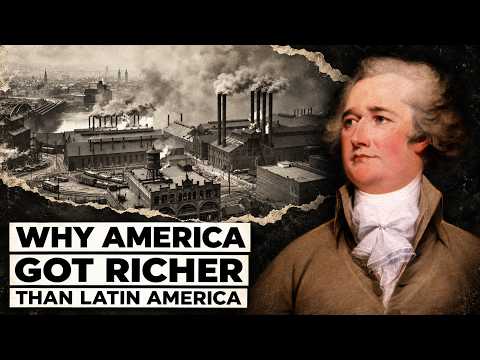
Let’s go back to the very beginning. When Columbus stumbled onto the Caribbean in 1492, Spain had just won its long war against the Moors and was desperate for income. The Spanish crown immediately staked claims to lands with populations to tax, labor to command, and precious metals to extract. In Mexico and Peru, they found all three in abundance.
The Aztec and Inca empires had already built the hard infrastructure of an extractive society: tribute systems, labor drafts, and enormous populations tied to the land. All Spain had to do was cut off the heads of those empires and slip into the vacant seats. By the 1530s, Spanish conquistadors had seized Tenochtitlan and Cusco, and the richest cities of the New World belonged to Madrid.
Then came the mountain. In 1545, Spanish prospectors stumbled onto a hill in modern-day Bolivia called Cerro Rico. Within decades, Potosí would become one of the largest cities in the Western world, bigger than London, bigger than Paris. It produced roughly 60% of all the silver mined on Earth during the second half of the 16th century, and that silver bankrolled Spain’s wars, cathedrals, and debts for generations.
But Spain needed labor to pull that silver out of the ground, and it needed a lot of it. So it adapted a pre-existing Inca institution called the mita, a rotating communal work system, and twisted it into something unrecognizable. Under Viceroy Francisco de Toledo in the 1570s, the colonial mita became a brutal forced labor draft. Every seven years, roughly one in seven adult indigenous males in a vast catchment zone had to spend a full year working in the Potosí silver mines or the Huancavelica mercury pits. Mercury, used to refine silver, causes neurological collapse, trembling, and death. Many of the men who descended into those shafts never came back out.
Alongside the mita, Spain rolled out the encomienda, which granted individual conquistadors the right to extract tribute and labor from entire indigenous communities, supposedly in exchange for Christian instruction and protection. In reality, it was feudal servitude dressed up in religious vestments. These were, in the terminology that economists now use, extractive institutions. Their entire purpose was to transfer wealth from a large indigenous labor force into the hands of a tiny Spanish elite, and from there back across the Atlantic to the crown.
Now, contrast this with what was happening up north. The British were, frankly, latecomers to the colonial party. By the time they got serious about North America in the early 1600s, Spain and Portugal had already claimed everything that looked valuable. North America had no sprawling indigenous empires like the Aztecs or Incas. The population was far smaller, more mobile, and far less amenable to being drafted into forced labor. There were no silver mountains waiting to be hollowed out. There was no gold, at least not that anyone had found. From the perspective of a 17th-century Spanish merchant, North America was a consolation prize—a cold, empty, resource-poor backwater.
Here is the delicious irony that economists Daron Acemoglu and James Robinson have spent decades hammering home. Precisely because North America had so little that was worth stealing in the short term, the British couldn’t build an extractive machine there. They tried, by the way. The Virginia Company arrived at Jamestown in 1607 with every intention of finding gold and bossing around a captive native workforce. Within a few years, half of them were dead of starvation and disease, and the local Powhatan Confederacy had made it very clear they would not be mining anything for anyone. The company nearly went bankrupt.
So the British colonies had to try something radically different. They had to attract actual European settlers, offer them land, offer them political rights, and let them produce for themselves. The merchants who ran the colonies realized that the only way to make money in this unpromising geography was to populate it with free, striving, property-owning farmers. And that, more than any founding father speech, more than any Puritan sermon, is why North America ended up with inclusive institutions, while Latin America ended up with extractive ones.
Here is the fact that always stops people in their tracks. According to the most careful modern estimates assembled by economic historians like John Coatsworth, Angus Maddison, Stanley Engerman, and Kenneth Sokoloff, in the colonial era North America was not noticeably ahead of Latin America. In some reconstructions, it was actually behind. Barbados in 1700 had an estimated per capita GDP of around 150% that of the mainland British colonies. Cuba sat at 167%. Mexico was at 89%. The real wages of a laborer in the New England colonies were on some measures roughly double the World Bank poverty line, while a laborer in Potosí or Mexico City was only slightly above it. But keep in mind that the Spanish colonies were producing enormous aggregate wealth that was simply captured by a tiny elite and shipped overseas.
This is what Acemoglu, Simon Johnson, and James Robinson famously called the reversal of fortune. The places that were richest in the 1500s became the poorest by the 1900s. The places that were considered worthless colonial dregs became the global economic superpowers. Hernán Cortés would roll in his grave if you told him that a boggy fur-trading outpost called New Amsterdam would one day make Potosí look like a village, but that is exactly what happened.
So what actually caused the flip? The answer involves several interlocking pieces, and the serious researchers almost all agree that no single factor explains it alone. There is no single villain, no single hero, and no single event. Instead, there is a chain of self-reinforcing decisions stretching across four centuries, each one locking the next one more firmly into place. Economists call this path-dependence. Historians call it the weight of the past. Either way, once you set a continent on a given trajectory, it is extraordinarily difficult to turn the ship around.
The first piece is what Engerman and Sokoloff called factor endowments. In the sugar islands of the Caribbean and the plantation economies of Brazil, soil and climate were perfect for growing commodities on massive estates using slave labor. The economics of sugarcane rewarded enormous landholdings and a small, racially stratified elite sitting on top of a huge coerced workforce. In the silver zones of Mexico and Peru, dense indigenous populations and mineral wealth produced a similar outcome with a different cast of characters. In both cases, you ended up with wild inequality, a tiny ruling class, and vast populations without property, education, or political voice.
In the northern colonies, by contrast, the soil was good for grain, livestock, and family farming. The native population was too small to coerce effectively. Scale economies in wheat and corn are nothing like scale economies in sugar. A family of five on 160 acres could outproduce a plantation per acre in the right conditions. So the north naturally produced a society of smallholders, which meant more equal wealth, more buyers in the market, more demand for education, and more political constituents demanding a voice.
The second piece is institutions. In Latin America, the Spanish crown deliberately engineered a highly centralized extractive apparatus. Trade was monopolized through designated ports and licensed Spanish merchants. Overseas commerce was theoretically illegal unless it ran through Seville or Cádiz. Entrepreneurship was blocked, innovation was blocked, even printing presses were restricted. The Catholic Church, which held enormous land and influence, formed a conservative alliance with the crown and the great landowners to keep the social order frozen.
In North America, by stark contrast, the British crown was weak, distant, and preoccupied with European wars. Colonial governors routinely ignored instructions from London. By the mid-1700s, almost every northern colony had a functioning representative assembly where property-owning men voted and passed local laws. These assemblies collected their own taxes, raised their own militias, and increasingly behaved like mini republics. When they rebelled against London in 1776, they weren’t inventing self-government from scratch. They were defending more than a century of institutional practice.
The third piece is what happened when the colonies went their own way, and this is maybe the most underappreciated part of the whole story. In 1783, the Treaty of Paris ended the American Revolution, and the thirteen colonies had to decide what they were going to be. They had bitter arguments, true, but by 1789 they had ratified a constitution, created a federal government, and set up a system of checks and balances that, with major flaws, actually worked.
Latin America had its own wars of independence, roughly from 1808 to 1826, mostly triggered by Napoleon’s invasion of Spain and Portugal, which temporarily knocked the mother countries out of commission. Simón Bolívar, José de San Martín, and others led brilliant military campaigns that broke the chains of three centuries of colonial rule. Bolívar dreamed of a single unified Gran Colombia, stretching across much of South America, modeled loosely on the United States. He imagined a continent that could rival Europe in wealth and influence. By the time he died in 1830, broken and disillusioned, he reportedly said that governing Latin America was like plowing the sea. His dream of unity shattered into a dozen bickering republics almost immediately.
To understand just how different the two post-independence trajectories were, consider the numbers. The United States has had one constitution since 1789. That document has been amended 27 times, but it has never been replaced, never been abandoned, never been overthrown. Venezuela, by contrast, has had roughly 26 constitutions since its independence. Bolivia has had more than a dozen. The Dominican Republic has had over 30. Each one of those constitutional ruptures was accompanied by a civil war, a coup, or a military intervention. Each one wiped out decades of accumulated legal practice, destroyed property rights, scared off investment, and reset the clock on nation-building.
Imagine trying to run a business, or raise children, or save for retirement in a country where the basic rules of the game change every few years. That is the environment that Latin American citizens and entrepreneurs have had to navigate for most of the last two centuries.
What followed in Latin America was a nightmare of political instability that lasted the better part of a century. Mexico alone cycled through roughly 30 presidents in the first 50 years of its independence. The country was invaded repeatedly, lost half its territory to the United States in 1848, and endured a French imperial occupation that briefly installed an Austrian archduke named Maximilian as emperor. Civil wars tore apart Colombia, Peru, Argentina, Chile, Venezuela, and almost everywhere else. Strongmen called caudillos filled the political vacuum—men like Juan Manuel de Rosas in Argentina, Antonio López de Santa Anna in Mexico, and later Juan Vicente Gómez in Venezuela, who ruled for nearly three decades after seizing power. These caudillos governed through personal loyalty, patronage, and brute force rather than through institutions. They would seize power, enrich their circle, get overthrown, flee, come back, repeat.
During the same half century, the United States was expanding westward, building canals and railroads, creating the first mass public school systems in the world, extending suffrage first to all white men, and then, after a brutal civil war, formally to black men as well. The US doubled Latin America’s product per head by 1820, and by 1870 it had more than tripled it.
Land tells the clearest story of all. In 1862, in the middle of its Civil War, the United States passed the Homestead Act. Any adult, including women and freed black people, could claim 160 acres of federal land in the West, and after five years of residence and cultivation, the land was theirs, free and clear. Over the following decades, roughly 10% of the entire land area of the United States—around 500 million acres—went to about 1.6 million small-holding families. Yes, this land had often been violently taken from indigenous nations, and that is its own moral disaster. But the economic effect on the recipients was transformative: millions of families became property owners with a direct personal stake in local schools, roads, banks, and politics.
Now compare that to Brazil. In 1850, more than a decade before the Homestead Act, Brazil passed the Land Law of 1850, which did almost the exact opposite. It explicitly forbade acquiring title to land simply by settling and improving it. From then on, land in Brazil had to be purchased with cash, which effectively locked out the formerly enslaved people emancipated in 1888, the European immigrant workers arriving by the millions, and the impoverished mestizo peasants of the interior. Land in Brazil, Mexico, Argentina, and most of Latin America stayed concentrated in the hands of a tiny class of hacendados and estancieros. Rural inequality in the region remains among the highest on Earth to this day, and you can trace a clean line back to those nineteenth-century policy choices.
The same pattern appears in education. Engerman and Sokoloff documented this in painstaking detail. The United States and Canada built mass public schooling systems in the early 1800s. By 1850, literacy in the free states of the US was close to 90%. New England towns were legally required to maintain public schools going all the way back to the 1640s. In Latin America, universal public education was not seriously achieved until the second half of the twentieth century. Why the difference? Because elites in highly unequal societies have no interest in educating the poor. An educated peasant might vote, organize, demand reform, migrate to a city, or quit the hacienda for a factory job. An illiterate peasant stays put and keeps cutting cane. In a society of broadly distributed property, by contrast, educating the next generation is in everyone’s economic interest.
The same logic applies to suffrage. By the 1850s, universal white male suffrage was the norm in the US. In Latin America, voting rights were restricted by literacy requirements and property qualifications for decades longer, which conveniently excluded most of the population that elites did not want voting.
Now, let’s talk about the thing that is often raised to challenge all of this. What about geography? Is it just a tropical disease problem? Jared Diamond famously argued in Guns, Germs, and Steel that the Americas had less favorable crops and animals compared to Eurasia and that tropical climates breed diseases that stunt development. There is something to this, but it crumbles the moment you compare specific pairs of neighbors. Haiti and the Dominican Republic share an island. Haiti is one of the poorest countries in the Western Hemisphere with a GDP per capita of under $2,000. The DR is pushing $11,000. North and South Korea share a peninsula with identical geography. One is a prosperous democracy with a per capita income near $35,000. The other is a starving dictatorship. The United States and Mexico share a 2,000-mile border with similar climates on each side. The US side is twelve times richer. Geography matters, but it is not destiny. What matters is what humans do with the geography they have.
The pattern was reinforced by something economic historians call the resource curse, though the term was not coined until much later. When a country’s wealth is concentrated in a single exportable commodity—whether that is silver, sugar, oil, or copper—political power tends to concentrate alongside it. Whoever controls the mines, the plantations, or the oil fields effectively controls the country. There is no need to build broad-based industry, no need to educate a mass workforce, no need to let the common citizen have a say. Why bother developing a middle class when you can just dig stuff out of the ground and sell it to Europe? Spain discovered this trap first and exported it to its colonies. By the time Latin American countries became independent, their political and economic elites were deeply addicted to commodity rents and built their new nations around protecting those rents rather than diversifying away from them. Venezuela with oil, Chile with copper, Bolivia with silver and tin, Peru with guano and later minerals, Brazil with sugar, then coffee, then rubber. The commodity cycle produced boom after boom and bust after bust, enriching a few families and leaving the broader population no better off than before.
By the second half of the nineteenth century, the gap had become enormous and self-reinforcing. The US was industrializing at breakneck speed. The railroad network exploded from basically nothing in 1830 to more than 160,000 miles by 1890. Steel production, practically nonexistent in the US in 1860, surpassed Britain by the 1890s. The country attracted roughly 25 million European immigrants between 1865 and 1914, who provided cheap, hungry, upwardly mobile labor for the factories of Chicago, Pittsburgh, and New York. Patents poured out of American laboratories, from the light bulb to the telephone to the assembly line. The country was becoming what the economist W. Arthur Lewis would later call the first mass production economy.
Latin America, in contrast, mostly doubled down on commodity exports. Argentina shipped beef and wheat. Brazil shipped coffee and rubber. Chile shipped copper and nitrates. Mexico shipped silver and oil. These exports made some people fabulously wealthy, including a thin stratum of modernizing elites in Buenos Aires, Rio de Janeiro, and Mexico City. Argentina in 1900 was, in fact, one of the ten richest countries in the world on a per capita basis, roughly comparable to Canada. There was a brief moment, right around 1890 to 1914, when it looked like at least the Southern Cone of South America might catch up and converge with the North Atlantic economies. But the structure was fragile. That fragility was exposed when commodity prices crashed during the First World War and again during the Great Depression.
Latin American economies, which had built everything around exporting a few primary products, suddenly found themselves staring into an abyss. In response, country after country turned toward what economists call import substitution industrialization. The idea was to build local factories, protected by tariffs, to produce the manufactured goods that could no longer be imported. For a while, it kind of worked. Brazil, Mexico, Argentina, and Chile all industrialized to some extent. But the model had deep flaws. It created inefficient, politically protected industries that could never compete in global markets. It fueled chronic inflation, massive government debt, and crony relationships between businessmen and politicians. By the 1970s and 1980s, most of these experiments ended in debt crises, hyperinflation, and the brutal structural adjustment programs demanded by the International Monetary Fund. The 1980s became known as Latin America’s lost decade. Argentina alone experienced inflation above 3,000% in 1989. Peru’s economy collapsed. Mexico defaulted. Brazil’s inflation at one point ran above 2,000% annually. Meanwhile, up north, the US economy was being reshaped by Reaganomics, personal computers, financial deregulation, and the slow grinding rise of what would become Silicon Valley.
Running quietly underneath all of this was another factor, and it is one we have to talk about honestly. The United States was not a passive bystander in Latin America’s troubles. Starting with the Monroe Doctrine in 1823 and ramping up massively after the 1898 Spanish-American War, the US treated Latin America as its own backyard. The Roosevelt Corollary of 1904 declared that the US had the right to intervene militarily in any Latin American country whose behavior it disapproved of. In the early twentieth century, US Marines occupied Haiti, Nicaragua, the Dominican Republic, and Cuba for years at a time, often in defense of specific American business interests like United Fruit, which effectively ran its own foreign policy in Central America. The term banana republic was coined precisely to describe these arrangements.
In 1954, the CIA engineered the overthrow of the democratically elected Guatemalan president Jacobo Árbenz, in part because his land reform threatened United Fruit’s holdings. In 1973, Washington actively supported the military coup that toppled Salvador Allende in Chile and installed Augusto Pinochet. In the 1980s, the US armed and funded the Contras in Nicaragua and backed death-squad-linked governments in El Salvador and Guatemala. These interventions did not create Latin American underdevelopment on their own. The institutional problems ran much deeper and much older. But they certainly did not help. And in several cases, they actively destroyed promising political experiments that might have changed the trajectory of a given country.
Argentina deserves a closer look because its story is maybe the single most tragic economic cautionary tale of the twentieth century. In 1913, on the eve of the First World War, Argentina was one of the ten wealthiest countries on Earth. Buenos Aires had electric trams, a subway, grand boulevards modeled on Paris, and an opera house that rivaled anything in Europe. European immigrants were pouring in by the millions, convinced that Argentina was the land of opportunity, not the United States. The country was shipping beef and wheat to a hungry industrializing world and getting rich fast.
Then came the great reversal. A succession of military coups—starting in 1930 and repeating in 1943, 1955, 1962, 1966, and 1976—systematically dismantled Argentine democracy. Populist governments printed money. Military governments defaulted on debt. Trade protection shielded a few politically connected industries at the expense of the broader economy. Inflation hit 20,000% in 1989. By 2024, Argentina’s per capita GDP, when expressed in current dollars, was roughly one-fifth that of the United States—almost exactly the opposite of where it stood in 1900. A country that was once compared to Canada now compares to Mexico. If institutions are destiny, Argentina is exhibit A for how badly things can go when a country allows those institutions to decay.
Add it all up, and here is where we stand today. In 2024, US GDP per capita is roughly $84,500. Canada is around $54,000. Chile, the richest major Latin American economy, is around $17,000 to $18,000. Mexico sits near $14,000. Brazil is around $11,000. Colombia, around $7,000. Honduras around $3,500. Haiti around $1,700. The World Bank calculates that the entire Latin America and Caribbean region’s constant per capita GDP in 2024 was about $8,870. One of the most striking facts in all of comparative economics is this: the ratio of US per capita GDP to Latin American per capita GDP has been roughly constant since about 1900. Which means that for 125 years, Latin America has not even been slowly closing the gap. It has mostly just been running in place while the US accelerates. Yes, there has been real growth in Latin America. People live longer, eat better, and own more than their grandparents did. But in relative terms, the two Americas are drifting further apart in absolute dollar terms, even as the ratio stays the same. And this gap has consequences beyond economics. It shapes migration patterns. It shapes politics. Right now, the single largest source of immigrants to the United States is Latin America, driven in part by exactly this income gap. It shapes who holds hemispheric power. It shapes the drug trade, remittances, foreign policy, and the rising instability of US-Mexican relations.
So, if we zoom out and ask who really wins and who really loses in this long divergence, the answer is uncomfortable. The clear winners were the North American small farmer, the European immigrant to the US, the mass industrial worker of the twentieth century, and the modern knowledge economy professional. These groups benefited enormously from the inclusive institutions that spread property, education, suffrage, and legal protection to a wide population. The clear losers were the indigenous peoples of Mexico and the Andes, who paid for Spain’s silver with their lives, and whose descendants still live in the poorest regions. The enslaved Africans who built the sugar and coffee wealth of Brazil and the Caribbean, and their descendants. The landless peasants of Latin America, locked out of property by laws designed to protect haciendas. And in a strange way, even the Latin American elites were losers in the very long run because the extractive systems they built captured enormous rents in the short term but strangled the broader economic growth that would have made their descendants even richer. The oligarchs of Potosí got fabulously wealthy in 1600. Their descendants, by and large, do not run the world. The Boston merchant family of the same era had a far more modest start, but by 1900 their descendants were competing with the Rothschilds and Rockefellers.
What does this story mean for the viewer sitting at home right now? A few things, actually. First, it demolishes the lazy explanations we often reach for. It is not about race, since Latin America and North America have both long been mixtures of indigenous, European, African, and Asian populations. It is not about religion, since Protestant countries like Germany and Catholic countries like France and Italy are both prosperous, and plenty of Protestant-majority nations are poor. It is not purely about geography, since neighboring countries with identical climates have wildly different outcomes. It is overwhelmingly about institutions—about the slow, often invisible rules that determine who can own what, who can vote, who gets educated, who can start a business, and who the courts actually protect.
Second, it tells us that institutional choices made centuries ago cast very long shadows. The decisions that Spanish and British colonial administrators made in the 1600s are still shaping the daily lives of hundreds of millions of people today. That should give us pause when we think about the institutional choices our own societies are making right now, because our great-grandchildren will inherit them, whether they like it or not.
And third, it offers a sliver of hope, because institutions are not fixed. Spain itself was a dirt-poor dictatorship for most of the twentieth century and is now a prosperous European democracy. South Korea went from desperate poverty in 1960 to a per capita income higher than Spain’s. Chile has pulled dramatically ahead of its Latin American neighbors, in part through hard-won institutional reforms. Nothing about the current gap between the US and Latin America is predestined. It is the product of specific human choices made over 500 years, and future human choices can change it in either direction.
The next time you hear someone glibly explain the wealth gap between North and South America with a single factor—whether that is Protestant work ethic, tropical laziness, Yankee ingenuity, or evil American imperialism—you can safely tune them out. The real answer is more interesting and more unsettling than any of those slogans. Spain found gold and silver, and it built a machine to extract them. Britain found cold forests and rocky soil, and it accidentally built a society. The machine made a few people fabulously wealthy for a few generations, and then slowly ground down the countries unlucky enough to be built on top of it. The society was messy and violent and unjust in a hundred ways, but it rewarded ordinary people enough to keep improving itself. Centuries later, one side is sending rockets into space and dominating global finance, and the other is sending its young people north by the millions in search of the same opportunities the first side figured out how to generate at home. Understanding why that happened is not a dry academic exercise. It is one of the most important lessons about human civilization that we have.
Now here’s a question worth chewing on: if institutions are the invisible architecture of prosperity, what rule—written or unwritten—in your own country would you tear down first, and what would you build in its place?






