In 1943, a photograph from a Michigan factory floor captured the soul of American power: row after row of half-built bombers, women in coveralls riveting fuselage panels, men hauling engine blocks on chains. Every square foot of that building was moving, breathing, producing. That single plant—Henry Ford’s Willow Run—was rolling a finished B-24 Liberator bomber off the line every 60 minutes, around the clock. One bomber every hour. That was America: a country that flipped a switch and became the most terrifying production machine the world had ever seen.
By 1945, the United States was manufacturing more than half of all the goods produced on the entire planet. Half. One country producing more than the rest of the world combined. The factory wasn’t just a building—it was a cathedral, and the American worker was its most devout believer.
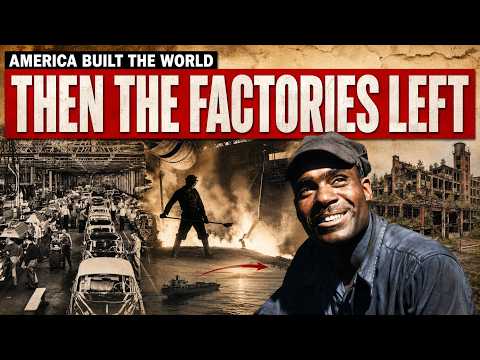
So here’s the question that should haunt every single person watching this: if America built the most powerful manufacturing economy in human history, if it literally armed the free world and then rebuilt it, if it created a middle class so prosperous that it became the envy of every nation on Earth—then why did the factories leave?
Because make no mistake, the factories didn’t just vanish. They didn’t evaporate into thin air. They were moved. They were closed. They were dismantled, shipped overseas, and rebuilt in countries where labor was cheaper, regulations were looser, the bottom line was all that mattered.
And the communities left behind didn’t just lose jobs. They lost their tax base. They lost their schools. They lost their hospitals. They lost their identity. In some cases, they lost their will to survive.
To understand how America lost its manufacturing base, you first have to understand how it built one. And to do that, you need to go back much further than most people expect—all the way to the late 1700s, when a young Englishman named Samuel Slater did something that was, technically speaking, a crime.
Britain guarded its manufacturing secrets the way a country guards nuclear codes today. British law explicitly forbade the export of textile machinery or even the immigration of anyone who knew how to build it. The machines were the weapon. The knowledge was the ammunition. And Britain intended to keep both locked up tight.
But Slater had other plans. He had spent years working in English cotton mills, and he memorized the designs of the water-powered spinning frame—one of the most advanced pieces of industrial technology in existence. In 1789, he disguised himself as a farm laborer, boarded a ship to New York, and carried those designs across the Atlantic entirely inside his own head. No blueprints, no stolen documents—just memory.
Within a year, he had built America’s first successful water-powered cotton spinning mill in Pawtucket, Rhode Island. The British called him Slater the traitor. Americans called him the father of American manufacturing. And the factory he built became the seed from which an industrial empire would grow.
Over the next several decades, that seed turned into a forest. The textile industry spread across New England. The iron industry took root in Pennsylvania. The meatpacking industry centralized in Chicago. And then came the railroads, stitching it all together into a national market where goods produced in one city could be sold in another a thousand miles away within days.
By the mid-1800s, the United States was no longer a frontier agricultural economy clinging to the edge of a continent. It was becoming an industrial power—and the pace of that transformation was unlike anything the world had ever seen.
But it was the Civil War that truly ignited the engine. Between 1861 and 1865, the Union’s industrial capacity proved to be its decisive advantage over the Confederacy. Northern factories churned out rifles, uniforms, ammunition, and railroad equipment at a pace the agrarian South simply could not match. The war demonstrated, in the most brutal terms imaginable, that the nation that could outproduce its enemy would outlast its enemy.
And when the war ended, that industrial infrastructure didn’t just wind down—it accelerated. The decades that followed, the so-called Gilded Age, saw an explosion of manufacturing growth that transformed the country almost beyond recognition. Steel production soared under men like Andrew Carnegie. Oil refining became a monopoly under John D. Rockefeller. The railroad network expanded to connect every major city in the nation. And a new class of industrial titans emerged—men who wielded more economic power than some governments.
By 1890, the United States had surpassed Britain as the world’s leading manufacturing nation. By 1900, it was producing roughly a third of the world’s total industrial output. And it was only getting started.
Then came the early 20th century and with it a single innovation that would change everything. In 1913, Henry Ford installed the first moving assembly line at his Highland Park plant in Michigan. The idea was deceptively simple. Instead of having skilled workers build an entire car from start to finish, Ford broke the process into 84 discrete steps and had each worker perform just one of them over and over again as the car moved past on a conveyor belt.
The result was staggering. The time it took to build a single Model T dropped from over 12 hours to about 93 minutes. The price of a car fell from $850 to under $300 within a decade. Suddenly, an automobile wasn’t a luxury for the wealthy. It was a product for the masses.
Ford’s innovation didn’t just transform the car industry—it transformed manufacturing itself. The assembly line became the template for how everything was made, from refrigerators to radios to rifles. And Ford did something else that was equally revolutionary. He paid his workers $5 a day, nearly double the going rate at the time. It wasn’t charity, it was strategy. Ford understood that if you wanted people to buy your products, you had to pay them enough to afford them.
This idea—that workers were also consumers, that production and consumption were two sides of the same coin—became the foundation of what would eventually be called the American middle class. The factory job wasn’t just employment; it was a ticket to a house in the suburbs, a car in the driveway, and kids who could go to college. That was the promise. And for a while, America kept it.
Then came the war and everything shifted into a gear that nobody thought was possible.
When Franklin Roosevelt declared in December of 1940 that the United States would become the arsenal of democracy, most people assumed it was rhetoric. The country was still technically at peace. Its military was ranked 17th in the world—behind Romania. Its factories were building cars and washing machines, not tanks and bombers.
But within 18 months of Pearl Harbor, the entire American economy had been reorganized for war production, and the results defied belief. The automobile industry led the charge. General Motors converted its assembly lines to produce tanks, aircraft engines, machine guns, and amphibious vehicles. Chrysler built the Detroit Tank Arsenal, which would eventually produce over 22,000 tanks. And Ford’s Willow Run became the largest factory under a single roof anywhere on Earth—employing over 42,000 workers and producing a bomber every 63 minutes.
But it wasn’t just the car companies. The entire manufacturing ecosystem pivoted. A piano company started building glider components. A corset manufacturer switched to producing grenade belts. Singer, the sewing machine company, started making navigation equipment for bombers. By late 1943, the United States was producing almost as many munitions as all of its allies and enemies combined.
In one year alone, American shipyards built more tonnage than Japan had in its entire naval history. The Kaiser construction firm on the West Coast built a Liberty cargo ship from bare keel to finished vessel in 4 days and 15 hours. 4 days.
The war ended, and here’s what most people miss about what happened next. Those factories didn’t close down. They pivoted again. The same assembly lines that had been building Sherman tanks started building Chevrolets. The same workers who had been welding bomber fuselages were now installing chrome bumpers on sedans.
Because millions of returning soldiers had savings from their military pay and access to low-interest loans through the GI Bill, there was suddenly an enormous demand for consumer goods. Cars, refrigerators, televisions, washing machines, houses. Americans had been saving an average of 21% of their disposable income during the war years, compared to just 3% in the 1920s. That pent-up demand exploded into the greatest consumer boom in history.
And here’s the thing that made the post-war period so extraordinary for American manufacturing. It wasn’t just that the factories were running. It was that there was virtually no competition. Europe was in ruins. Japan was devastated. China was in the middle of a civil war. The Soviet Union was rebuilding behind an iron curtain. The United States was, quite literally, the only major industrial economy left standing.
By 1950, manufacturing accounted for roughly 27% of the country’s entire gross domestic product. Nearly a third of the American workforce held manufacturing jobs. And the wages those jobs paid were good enough to support a family, buy a home, and put children through school on a single income.
This was the golden age. This was the era when a high school graduate could walk into a steel mill or an auto plant, get hired on the spot, and know with reasonable certainty that he could work that job for 30 years, retire with a pension, and live comfortably for the rest of his life.
It wasn’t perfect. It was segregated in many places. Women were often pushed out of the factories they had run during the war. Labor disputes could be violent and bitter. But in terms of sheer economic output and broadly shared prosperity, there had never been anything like it. Not in America, not anywhere.
So, what happened? The decline didn’t arrive like a hurricane. It crept in like a slow leak, and it came from so many directions at once that it was almost impossible to see the full picture until it was too late.
The first cracks appeared in the 1950s and ’60s. And ironically, they were a byproduct of America’s own success. You see, the very dominance that made American manufacturing so powerful also made it complacent. When you control the market, when there’s no serious competition, when demand for your products seems bottomless, there’s very little incentive to innovate, to invest in new equipment, to rethink your processes.
And that’s exactly what happened. American manufacturers got comfortable. They rested on their laurels. And while they were resting, the rest of the world was rebuilding.
Germany and Japan, in particular, emerged from the ashes of the war with something that American manufacturers had lost: a burning hunger to compete. Both countries rebuilt their industrial bases from scratch, which meant they started with modern equipment, modern techniques, and modern management philosophies.
The Japanese, in particular, pioneered what would become known as lean manufacturing—a system built on continuous improvement, waste elimination, and relentless attention to quality. While American car companies were building bigger, flashier, less reliable vehicles, Japanese companies like Toyota and Honda were building smaller, more efficient, and more dependable ones.
The 1973 oil crisis brought this contrast into sharp focus. When the price of gasoline quadrupled almost overnight, American consumers suddenly found themselves stuck with gas-guzzling behemoths that cost a fortune to fill up. Japanese cars, which were smaller and far more fuel-efficient, started flying off the lots. American auto manufacturers, who had spent decades dismissing Japanese competition as irrelevant, were blindsided—and they never fully recovered.
But the oil crisis was only one symptom of a much deeper structural shift that was already well underway. Throughout the 1960s and ’70s, a series of forces converged that would fundamentally alter the landscape of American manufacturing.
The first was automation. As technology advanced, machines began replacing workers on the factory floor. This wasn’t entirely new, of course. Machines have been displacing labor since the dawn of the Industrial Revolution. But the pace accelerated dramatically in the postwar decades. Robots could weld faster than humans. Computer-controlled lathes could cut more precisely. Automated conveyor systems could move materials without a single pair of hands.
And the result was a paradox that would define the next half century of American manufacturing. Output kept going up, but employment kept going down. In 1980, it took about 25 workers to produce $1 million worth of manufactured goods. By 2015, that number had dropped to roughly six workers. The factories were still producing. They just didn’t need as many people to do it.
The second force was geographic redistribution within the United States itself. Starting in the 1950s, manufacturers began moving their operations from the high-cost, heavily unionized industrial cities of the Northeast and Midwest to the lower-cost, right-to-work states of the South and Southwest. The reasons were straightforward. Labor was cheaper in the South, unions were weaker, land was more available, taxes were lower, and state governments were eager to attract industry and willing to offer generous incentives.
So factories that had been rooted in places like Detroit and Cleveland and Pittsburgh for decades packed up and relocated to places like Charlotte and Atlanta and Houston. For the regions gaining those factories, it was a boom. For the regions losing them, it was the beginning of the end.
This internal migration is often overlooked, but it was devastating. Cities built around a single factory found themselves hollowed out almost overnight. The tax base collapsed. Schools deteriorated. Young people left. And what remained was aging populations, crumbling buildings, and a deep, grinding poverty that persists to this day.
This is the origin story of what we now call the Rust Belt—a stretch of former industrial heartland running from western New York through Pennsylvania, Ohio, Indiana, and Michigan, where the rusting hulks of abandoned factories stand as monuments to a prosperity that once was.
But even as factories migrated within the country, a much larger migration was beginning to take shape. And this one wouldn’t stop at state lines. Globalization didn’t just happen. It was engineered. A series of deliberate policy decisions made by specific people and institutions for specific reasons—and the consequences reshaped the global economy in ways still playing out today.
So where does that leave us? With a country that still makes things, but no longer organizes its economy around the act of making things. With communities built around factories that now have nothing to replace them. With a generation promised the American dream on the factory floor, who watched that floor collapse beneath their feet.
The factories of Willow Run are gone now—torn down in 2013. But the question it represents is more alive than ever: can a democracy organize its economy to serve all its citizens, not just its shareholders?
What do you think—can America ever bring the factories back, or is that dream gone for good? Tell us in the comments below.






