The cold, misty waters of the Norwegian Sea, April 8th, 1940. A lone British destroyer, HMS Glowworm, cuts through the fog, her crew alert for any sign of the enemy. They are far from reinforcements, and the rumble of distant guns hints at the German invasion of Norway. Little do they know that they are about to sail into one of the most lopsided naval battles of World War II—a fight that will become a legend.
Lieutenant Commander Gerard Broadmead Roope, Glowworm’s captain, is a seasoned officer. He knows his ship—a 1,350-ton G-class destroyer—is no match for the heavy cruiser Admiral Hipper, a 16,000-ton behemoth with 8-inch guns. Yet when the enemy appears out of the mist, Roope doesn’t hesitate. “Open fire!” he orders, and the tiny destroyer challenges the giant.
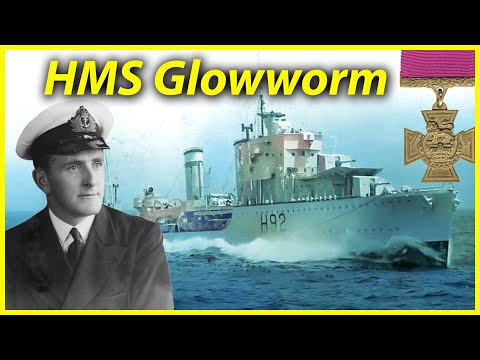
The first salvo from Hipper’s main guns screams toward Glowworm. One shell slams into the bridge, killing several key personnel and shattering communications. Another destroys the forward gun, leaving the destroyer with only a fraction of her firepower. Fires erupt across the decks, and smoke billows into the grey sky. But Roope rallies his men, shouting encouragement over the roar of battle. “We’re not done yet!” he cries, and the crew responds with grim determination.
Despite the devastating hits, Glowworm fights on. Roope orders a smoke screen to confuse the enemy, but Hipper’s radar-guided guns track her through the haze. With his ship crippled and burning, Roope makes a desperate, almost suicidal decision: he will ram the cruiser.
At a range of just 800 meters, Glowworm fires five torpedoes, but Hipper’s captain skillfully evades them. Roope then turns the destroyer hard to starboard, aiming directly at the cruiser’s bow. The collision is catastrophic—Glowworm’s bow shears off, but not before tearing a gaping hole in Hipper’s hull. The cruiser takes on 500 tons of water, though she remains operational.
Glowworm, however, is mortally wounded. She drifts away, ablaze and sinking. Moments later, her boilers explode, and she slips beneath the waves, taking 109 of her brave crew with her. Only 40 survivors are pulled from the freezing water, and nine of them later die. Roope himself, exhausted and clinging to a rescue line, loses his grip and drowns—a tragic end to a heroic stand.
But the story doesn’t end there. Hipper’s captain, impressed by the destroyer’s incredible bravery, sends a letter via the Red Cross recommending Roope for the Victoria Cross. It is a rare gesture of respect between enemies, and Roope is posthumously awarded the VC—the first of World War II. The men of Glowworm, outgunned and alone, chose to fight on, leaving an indelible mark on history.
The survivors of Glowworm were taken aboard Admiral Hipper, where they were treated with a surprising measure of dignity. German sailors offered them blankets and hot drinks, and many later recalled that their captors seemed genuinely moved by the destroyer’s defiance. One German officer reportedly told a British prisoner, “Your ship fought like a lion. We could not believe she kept coming.”
For the Royal Navy, the loss of Glowworm was a bitter blow, but news of her final battle spread quickly through the fleet. Sailors who had never met Roope or his crew spoke of the destroyer that had charged a cruiser, and the story became a rallying cry in the dark months that followed. If a single destroyer could fight like that, the men reasoned, then perhaps Britain itself could endure.
Yet the full truth of what happened that day emerged only slowly. The Admiralty, initially uncertain of Glowworm’s fate, listed her as missing and presumed lost. It was not until survivors’ accounts and captured German records were pieced together that the astonishing sequence of events—the smoke screen, the torpedo attack, the ramming—became known. The story seemed almost too extraordinary to be true.
When the recommendation for Roope’s Victoria Cross arrived through the Red Cross, it caused a stir at the Admiralty. A recommendation from the enemy was unprecedented in modern naval warfare, and some officers questioned whether it could be trusted. But the details were corroborated by British survivors, and the citation was eventually approved. Roope became the first naval officer of the Second World War to receive the Victoria Cross.
Captain Hellmuth Heye of the Admiral Hipper went further than the letter. In the months that followed, he spoke openly to his own officers about the engagement, using it as an example of courage under fire. He reportedly said that if he ever commanded a ship half as well as Roope had commanded his, he would consider his career a success. The remark, passed along by prisoners and later confirmed in German records, underlined the strange fellowship that sometimes grows between men who fight on opposite sides.
Back in Britain, the families of the lost sailors received the grim telegrams that every wartime household feared. For Roope’s widow and young children, the news was shattering—but the posthumous award, and the story of the German captain’s tribute, brought a measure of comfort. He had not died in vain, and the enemy himself had said so.
As spring turned to summer in 1940, the war grew darker. Norway fell, France collapsed, and the threat of invasion loomed over Britain’s shores. Yet in the corridors of the Admiralty and the mess halls of the fleet, the name Glowworm was spoken with a kind of reverence. New recruits heard the story and wondered if they could ever match such courage.
The legend of Glowworm did not fade with the passing months. In the shipyards and training depots, instructors used the story to teach young officers a simple lesson: a captain’s duty is not measured by the size of his ship, but by the resolve he inspires in his crew. Roope’s decision to turn toward Hipper rather than flee became a case study in command—controversial to some, inspiring to many.
There were quieter echoes, too. Among the survivors held in German captivity, bonds formed that would last a lifetime. One stoker recalled how a German petty officer had quietly slipped him a cigarette on the voyage to a prison camp, muttering that he had watched Glowworm’s final charge through a rangefinder and would never forget it. “We were enemies,” the man later said, “but in that moment, we were simply sailors.”
As the war stretched on, the fate of the survivors became a matter of quiet anxiety for their families. Letters were slow, and news was scarce. Yet some of the German crew of Hipper, when later transferred to other duties, carried the story with them. In ports from Wilhelmshaven to Brest, the tale of the little destroyer that rammed a cruiser circulated among German sailors as a caution against underestimating a cornered foe.
It was in the summer of 1941 that a remarkable postscript emerged. A British intelligence officer, reviewing intercepted German naval correspondence, came across a reference to the Glowworm action in a training memorandum. The German document described the engagement in detail, praising the destroyer’s “fanatical determination” and warning officers that British ships, even when outmatched, could not be relied upon to retreat. The memorandum was quietly translated and circulated at the Admiralty, where it was received with grim satisfaction.
For the men who had served under Roope, the recognition meant everything. One survivor, interviewed years later, said that he had spent the rest of the war trying to live up to what his captain had asked of them that day. “He gave us something no one could take away,” the old sailor recalled. “He showed us what we were made of.”
Yet the story was not finished. The wreck of Glowworm lay somewhere in the depths of the Norwegian Sea, and for decades her exact resting place remained unknown. Divers and historians would later search the cold waters off Trondheim, hoping to find the shattered hull and perhaps answer the questions that still lingered about those final moments.
The decades rolled on, and the men who had fought at Glowworm’s side grew old. Yet the ship’s story refused to sink into obscurity. In 1990, a Norwegian diving expedition, guided by survivor accounts and German war logs, descended into the icy waters off Trondheim. There, at last, they found her—a broken hull resting upright on the seabed, her bow torn away by the ramming, her wreck a silent monument to that April morning.
The discovery renewed interest in the battle. Historians pored over the wreck, confirming details that had long been debated. “She went down fighting,” one diver reported, “and she’s still facing the enemy.” The wreck became a protected war grave, and memorial services were held above the site, attended by British and German veterans alike.
Among the artifacts recovered was a brass fitting from the bridge, later presented to the Royal Naval Museum. It sits today in a glass case, a humble fragment of a ship that made history. Visitors pause before it, reading the citation that hangs nearby—Roope’s Victoria Cross, and the words of the German captain who recommended it.
In 2001, a final chapter unfolded. A group of British and German descendants gathered in Trondheim for a joint commemoration. The grandchildren of Roope and Heye met for the first time, shaking hands on the quayside. “Our grandfathers were enemies,” one said, “but they understood each other better than most friends.” The ceremony ended with a wreath laid on the water, and a bugler sounding the Last Post across the grey sea.
The story of HMS Glowworm endures because it speaks to something deeper than war. It is a tale of courage in the face of certain death, of a captain who refused to flinch, and of an enemy who honored him. In an age of ever-larger ships and ever-greater firepower, the little destroyer remains a reminder that spirit can outweigh steel.
Today, the name Glowworm is carried by a modern Royal Navy destroyer, and her crew still learn the story of their predecessor. At the ship’s christening, a veteran’s grandson read aloud the old captain’s final order: “Turn toward the enemy.” The words hung in the air, and more than a few eyes were wet.
So the ship sails on, in memory and in legend. And somewhere in the cold Norwegian Sea, her shattered hull keeps watch—a testament to the men who chose to fight, and to the enemy who chose to remember. What would you have done, standing on that burning bridge, with the enemy looming large and no hope of rescue?






