By early 1945, Hitler’s Third Reich was entering its death throes. In the west, Allied forces had pushed to within striking distance of the Rhine; in the east, the Red Army was crossing the Polish border into Germany. As the Allies battled their way towards Berlin from east and west, the Germans fought them all the way, but it was a hopeless task. By May 1945, Hitler would be dead and Germany finally defeated.
February 1945: The Allied Forces in the west had assembled near the Rhine for the final push into Germany. In the north were the massed ranks of Field Marshal Bernard Montgomery’s 21st Army Group; to its south was General Omar Bradley’s 12th Army Group, which included the US Third Army commanded by General George Patton.
On February 8, Montgomery’s Army Group launched a two-pronged assault on German forces defending the Rhine. The northern prong had to fight its way through wooded countryside; the southern prong was delayed when the Germans released water from a series of dams, flooding the surrounding area. It would be over two weeks before the two prongs met up on the west bank of the Rhine.
By early March 1945, Montgomery’s forces were in control of some 60 miles of the west bank of the river. The next task was to cross it. South of Montgomery, Bradley’s armies were also moving eastwards, looking for a route across the river. On March 7, 1945, they reached the Rhine at Cologne, but Hitler had ordered all the bridges to be destroyed. Then, as the US forces explored further south, they found one bridge still intact near the small town of Remagen.
They made a dash for it, brushing aside German resistance. Then, just as they were about to cross it, there was an explosion—but against the odds, the bridge remained standing. A small group of Americans raced across it, desperately cutting any wires that looked like demolition cables. US commanders began to push men across as fast as possible. The Allies had at last penetrated the German heartland.
In Berlin, news of the capture of the bridge at Remagen infuriated Hitler. Five junior officers were court-martialed; four were shot. In addition, the long-suffering German commander in the west, Field Marshal Gerd von Rundstedt, was sacked—it was the second time it had happened to him in less than a year. He was replaced by veteran commander Field Marshal Albert Kesselring, who had been in overall charge in North Africa and Italy.
Over the next week, the Germans launched desperate air attacks to try and destroy the bridge at Remagen. None of them succeeded. Then suddenly, on March 17, while combat engineers were repairing it, the bridge unexpectedly collapsed. Twenty-eight men plunged to their deaths. The first Allied thrust into Germany had been blocked.
Meanwhile, further north, Montgomery was preparing the first full-scale Allied crossing of the Rhine. On March 23, 1945, he launched an aerial bombardment on German forces defending the east bank of the river. Some 200 RAF Lancaster bombers virtually flattened the town of Wesel. Then British Commandos in Buffalo amphibious vehicles crossed; they met little opposition from the dazed German defenders. Other divisions followed. The crossing lasted all night.
The following day, in the largest airborne operation of the war, 17,000 men of British 6th and US 17th Airborne Divisions were dropped to seize key positions east of the river. They were met by heavy German anti-aircraft fire. More than half the gliders were destroyed or damaged before landing, but within hours the paratroopers linked up with Montgomery’s land forces and the Allied bridgehead was secured.
It should have been, for the ferociously competitive Montgomery, a moment of glory. But he’d been upstaged. The night before, his great rival General Patton had unexpectedly crossed the Rhine near Oppenheim and had already entered Germany. It was a sign of the intense rivalry between Montgomery and American commanders as they competed to be the first into Germany.
Over the next few days there were more Allied crossings. German defenses along the Rhine collapsed. In the north, Montgomery now pushed deeper into Germany towards Münster; in the south, Bradley’s forces, including Patton’s Third Army, pushed east towards Marburg and Kassel. The major German city of Frankfurt was circled and bypassed. Die-hard German troops fought back ferociously, but by now there was no question that the Germans were finished. The only issue was when they would realize it.
As the Western Allies battled their way across West Germany, Stalin’s Red Army in Poland prepared to launch a major offensive on Germany’s eastern border. Hitler’s forces in the region were poorly equipped and ill-prepared to repel an attack. Supplies of weapons had run so low they were reduced to using First World War rifles. German intelligence estimated the Red Army’s infantry outnumbered them eleven to one. The Russians also had vastly more tanks and artillery—but the Germans had nothing left. Hitler’s strategic reserve had already been used up on the Western Front.
On January 12, 1945, the Russian offensive began with the usual artillery barrage. It stretched along a 300-mile front. A week later, the Red Army drove into the devastated remains of Warsaw. They then pushed westwards towards the German border, 300 miles away. To the south, a second Soviet force took the Polish town of Kraków on January 18.
As the Soviet forces now raced westwards on a broad front across Poland, they left behind pockets of German resistance in cities like Poznań and Breslau. These would later be mopped up. By the end of January 1945, Soviet troops had crossed the German border and reached the river Oder. The Russians were now just an hour’s drive east of Berlin.
For the veteran Russian commander Georgy Zhukov, it had been a triumph. He had traveled 300 miles in just 14 days. It was one of the fastest and longest blitzkrieg advances in military history. Zhukov’s troops now paused to catch their breath and bring up supplies. They were soon joined by a second group of Soviet armies that dug in to their south on the river Neisse. Meanwhile, a third Russian force penned the remnants of the German armies in East Prussia into the Baltic port of Königsberg.
By now, Hitler had appointed the SS chief Heinrich Himmler to command his forces in the neighboring region. It was a sign of how deeply he had come to distrust his army generals. But Himmler had no military knowledge or experience. During February 1945, troops under Himmler’s command were torn apart by Russian forces moving west.
This time, Hitler could have sent reserves. A large force of German troops still occupied the Courland peninsula in neighboring Latvia, but in another bizarre decision, Hitler refused to allow it to break out and provide assistance. He was still committed to holding on to land—his Lebensraum—however irrelevant or wasteful it might now be. It meant some 200,000 German troops spent the final months of the war doing nothing.
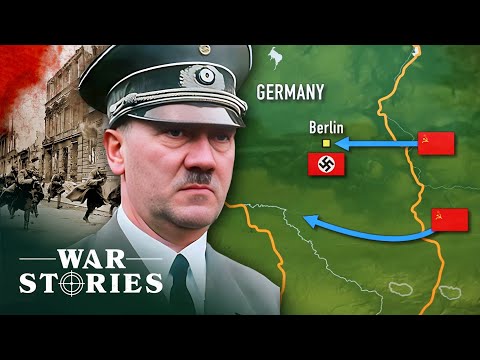
The Red Army now prepared for its final assault on Berlin. It lay less than 50 miles away. In Germany, the imminent Soviet invasion caused mass panic among the civilian population. The Russians had seen firsthand the horrors perpetrated by the Germans in the Soviet Union; they’d witnessed whole towns and villages destroyed, their inhabitants massacred. They were now very clearly looking for revenge.
There were horrific tales of Russian rape, murder, and pillage. In snow and bitter subzero temperatures, more than five million German civilians on the Eastern Front fled their homes and flooded west to seek refuge. Two million people were evacuated by sea from German-held ports along the Baltic coast. They were easy pickings for Soviet submarines. Twenty-four German passenger ships were torpedoed. They included the cruise liner Wilhelm Gustloff, which had over 10,000 people on board. Barely a thousand survived—the worst loss of life ever in a single incident at sea.
Hitler’s acting chief of staff, General Heinz Guderian, now urged the Führer to bring back any units that could be spared from the Western Front to defend Berlin. Hitler agreed and brought back the elite 6th SS Panzer Army—but he didn’t send it to Berlin. He sent it to Hungary. He had become obsessed with defending Germany’s last remaining source of oil: the Hungarian oil fields west of Lake Balaton. It was an ill-considered decision.
In Hungary, the panzers were hopelessly outnumbered by the Russians. To make matters worse, the weather conspired against them. A sudden thaw turned the ground into a sea of mud. For several days the panzers struggled to hold back the advancing Russians, but they were steadily forced back into Austria. Soon they were drawn into the defense of Vienna as the Red Army advanced towards the Austrian capital. But the 6th SS Panzer Army was a spent force. Its commander, SS General Sepp Dietrich, had no illusions. “We call ourselves the Sixth Panzer Army,” he said, “because we have only six panzers left.”
On April 10, the Red Army swept them aside and took Vienna. As they did so, the question now became: who would be the first to reach Berlin—the Red Army or the Western Allies? The race for Berlin had become not just a military but a political issue.
By March 1945, the Red Army was lined up along the river Oder awaiting a final assault on Berlin. It presented the Allied military command in the west with a dilemma: Berlin was less than 300 miles from their advanced positions, and most Allied commanders wanted to race to the city to beat the Russians. But at a conference a month earlier in the Black Sea port of Yalta, the Allied leaders had divided up Germany into zones of influence. Berlin was firmly inside the Russian zone, so Eisenhower was instructed to tell his commanders to ignore Berlin and spread out to take the rest of the country.
On April 1, US troops surrounded the German industrial cities in the Ruhr. German soldiers occupying the area put up a stiff resistance; when two weeks later the area fell, more than 325,000 troops were taken prisoner—one of the largest numbers of German prisoners taken in the war so far. The German commander, the die-hard Nazi Field Marshal Walther Model, committed suicide.
Elsewhere in the country, resistance was more patchy, and General Bradley’s Army stormed across Germany. By April 18, 1945, the US forces had punched a corridor through to the Czech border, splitting Germany in two. Meanwhile, north of the Ruhr, Montgomery’s Canadian First Army began the liberation of Holland. The Dutch had suffered horrendously during the bitter winter of 1944–1945; the German occupying force had deliberately taken supplies of food and fuel from the country to use elsewhere. There had been widespread deaths from starvation and cold.
The Dutch town of Arnhem was seized on April 15, 1945. Progress was rapid, and on the following day the Canadians had liberated Groningen, close to the Dutch north coast. That left a German army virtually intact but surrounded near Amsterdam. Soon afterwards a ceasefire was negotiated; Allied aircraft now roared over the Dutch countryside dropping food and medical supplies.
At the same time, the British Second Army, also under Montgomery’s command, pushed fast across the north German plain. Osnabrück fell on April 4; the British were soon at the German port of Bremen. Here there was fierce German resistance—it took nine days of house-to-house fighting before the port was secured. Two days later, Montgomery’s British forces reached the Elbe at Lauenburg.
As the Allies advanced across Germany, they now came across horrific new evidence of the Nazis’ Final Solution. In early April 1945, US troops overran a concentration camp at Ohrdruf near Weimar in central Germany. A visibly shocked General Eisenhower paid a visit. The SS had evacuated most of the prisoners, but they had left behind piles of bodies. Eight days later, British troops overran another concentration camp at Belsen, north of Hanover. Here they discovered over 70,000 thin prisoners; thousands were already dead, the remainder starving and disease-ridden.
A radio broadcast by the BBC correspondent Richard Dimbleby gave the horrific details: “I passed through the barrier and found myself in the world of a nightmare. The living lay with their heads against the corpses, and around them moved the awful, ghostly procession of emaciated, aimless people, with nothing to do and no hope of life… It was as though they were waiting their turn. This is what the Germans did. Let there be no mistake about it—did deliberately and slowly.”
Meanwhile, far to the south in Italy, the German front was also starting to collapse. The German forces were dug in across the Apennine mountains. Field Marshal Sir Harold Alexander, the Allied commander in the Mediterranean, now launched a spring offensive. On April 9, 1945, British troops attacked, pulling German forces in from along the front. Five days later, US troops also moved forward and swiftly reached the south bank of the river Po. The Germans retreated to the north bank, but Hitler’s commander in Italy, General Heinrich von Vietinghoff, had no illusions that he could hold back the Allied advance for long. So he now made approaches to the Allies and, on April 29, surrendered unconditionally. It would take effect from May 2, 1945. This was the first formal surrender of German forces anywhere in Europe.
The war was moving swiftly towards a conclusion. Back in Germany, American and Russian forces had by now met up on the Elbe near Torgau. “The moment the world has been awaiting so long—when a line from West meets a line from East.” The meeting was achieved on April 26 when a detachment of the American 69th Infantry Division under Major General Reinhardt was ferried across the Elbe to the Russians assembled on the far bank.
The stage was set for the final assault on Berlin. Hitler was desperate. He now turned to the old and very young for help in defending the city. His Thousand-Year Reich was preparing for its final, apocalyptic struggle to survive.
On April 1, 1945, Joseph Stalin summoned his top commanders to Moscow to receive their orders for the capture of Berlin. Marshal Georgy Zhukov, Russia’s most successful commander, would make the main assault from his bridgehead on the Oder River. A second group of Soviet armies under Marshal Ivan Konev would cross the river Neisse further south and push deep into Germany, bypassing the German capital. Between them they represented a massive Soviet force of over 2.2 million men, equipped with 6,000 tanks and self-propelled guns and 40,000 guns, mortars, and rocket launchers.
But the Germans were never going to make it easy. The city was defended by about a million troops, many dug into strong defensive positions, particularly along the Seelow Heights—a steep escarpment rising out of the Oder valley and slap in front of Zhukov’s point of assault. The defenders were a mixed bunch of combat veterans, SS fanatics, and inexperienced conscripts, some as young as 14, as well as elderly members of the Volkssturm, or People’s Army.
By now Hitler had retired to a bunker under the Reich Chancellery in Berlin. He was a heavily medicated and shambling figure who spent much of his time issuing increasingly unrealistic orders to largely imaginary armies. His public appearances were becoming ever more rare, but in early March he was persuaded to visit some of the troops preparing to defend the Oder line. Later in the same month he emerged to inspect a small group of Hitler Youth soldiers. It was his last ever appearance before the cameras.
Then, on April 13, 1945, the US President Franklin Roosevelt died of a heart attack. He had been one of the architects of the war, responsible for throwing America’s might behind the Allied offensive. The Nazi propaganda minister Joseph Goebbels seized on the event to encourage his increasingly befuddled Führer to believe the Allied alliance would collapse—a German victory could still be snatched from the jaws of defeat. But any illusions were rapidly dispelled.
Three days after Roosevelt’s death, Zhukov began his assault on Berlin. He had one gun for every 13 feet of the front, but the German defense had anticipated it and pulled back to avoid the bombardment. As a result, when Zhukov’s infantry advanced, they met unexpectedly heavy resistance. Desperate to retrieve the situation, Zhukov threw in his tanks, but they too were soon bogged down.
Meanwhile, to the south, the assault by Konev’s second group of armies had gone better. His troops had crossed the Neisse River and were well on their way to the next obstacle, the river Spree. Stalin stoked the rivalry between his two commanders by authorizing Konev to swing his tanks north towards Berlin. He was only too happy to see a race to take the city.
After three days of savage fighting, Zhukov’s troops managed to enter the eastern suburbs of Berlin. At the same time, Konev was approaching the city from the south. There was desperate German resistance, but on April 25 the Soviet armies met up and the final assault on Berlin began.
As the fighting moved on from district to district, civilians began to emerge from the cellars, but the Russians took little notice of the flags of surrender. The rape of German women and girls was widespread. After three more days of fighting, the city’s remaining defenders were pinned down in a narrow strip of central Berlin less than two miles wide. Every street and house was contested.
Then, on the morning of April 30, Soviet troops began an assault on the Reichstag, the German parliament building. Stalin regarded it as the symbol of Nazi power. They were stopped by heavy fire, so they blasted the building at point-blank range with heavy artillery. That evening the Russians stormed it. Fighting raged from room to room and up and down corridors and staircases. It would take four hours before the red flag could be hoisted on one of the towers. The next morning, on May 1, 1945, the event was restaged for the cameras. But by then Hitler was already dead.
On April 30, as fighting raged overhead, the man whose insane ambitions had embroiled the world in war, laid waste a continent, and led to the extermination of millions of Jews took his own life. His longtime mistress, Eva Braun, whom he’d married the day before, died with him. Their partially burned bodies were buried in the garden of the Reich Chancellery.
But the fighting continued. Hitler had appointed Grand Admiral Karl Dönitz his successor, and for the next few days the new leadership attempted to salvage something from its nation’s cataclysmic defeat. On May 1, 1945, the day after his death, the German people were told that their Führer had fallen in battle, but they were told to continue the fight against the Bolshevik menace. But the German leadership was falling apart. In Berlin, Joseph Goebbels and Martin Bormann tried to negotiate a city-wide ceasefire with the Russians, but the Russian commander Marshal Zhukov demanded unconditional surrender of all German forces everywhere. It was more than Goebbels and Bormann could deliver.
Fighting in Berlin continued. Later that evening, Goebbels and his wife killed their six children and then committed suicide themselves. That same night, Bormann disappeared; eventually, in the 1990s, DNA testing confirmed that a body found in Berlin was his. The next morning, Berlin surrendered. By midafternoon, all fighting in the city had stopped.
Across the country, the pace of the German surrender now gathered momentum. The following day, Dönitz sent a delegation to the British commanding officer, Field Marshal Montgomery. He offered to surrender all German forces in northern Germany. Montgomery sent a reply saying he didn’t have the authority to accept a surrender on behalf of the Americans or the Russians; he could only accept the surrender of those troops fighting him. Dönitz had no choice but to agree to Montgomery’s terms. But that left Germany still fighting in the rest of the country.
Dönitz now sent another delegation to General Eisenhower, the Supreme Allied Commander, to discuss a peace deal with the west, but it carefully avoided any reference to a surrender to the Russians. Eisenhower rebuffed him and insisted that only the unconditional surrender of all German forces was acceptable. Once again, Dönitz was forced to back down.
At 2:41 in the morning of May 7, 1945, at Eisenhower’s headquarters in France, General Alfred Jodl, Hitler’s chief of operations throughout the six years of war, signed a document of unconditional surrender. Eisenhower’s chief of staff, Walter Bedell Smith, signed for the Western Allies; General Ivan Susloparov signed for the Soviet Union.
The only member of the Allied side not happy with the arrangement was Stalin. The Soviet Union had suffered too much to miss out on its own humiliation of the Germans. So Stalin countermanded Susloparov and declared Russia would only accept a surrender in Berlin. It meant that the following day, Hitler’s former chief of staff, Field Marshal Wilhelm Keitel, signed a second surrender document to satisfy Stalin. Marshal Zhukov signed for the Soviet Union, with Air Chief Marshal Sir Arthur Tedder signing on behalf of the Western Allies.
“In January 1943, the late President Roosevelt and Premier Churchill met in Casablanca. There they pronounced the formula of unconditional surrender for the Axis powers in Europe. That formula has now been fulfilled.” In Europe and the United States, crowds began to celebrate the end of the war in Europe. From now on, the day after the German surrender, May 8, would be known as VE Day—Victory in Europe.
But as the celebrations continued, many were aware of two very sobering issues. In the East, Japan was still fighting. And in Europe, the continent lay in ruins, and huge problems needed to be solved. Millions of Germany’s concentration camp victims and slave laborers would need help to rebuild their lives. Millions of captured German fighting men had to be screened before being allowed to go home, to identify and arrest major war criminals. The SS was a particular target; it had been responsible for some of the worst atrocities of the war.
Leading Nazis like Hermann Göring, head of Hitler’s Air Force, were rounded up and paraded in front of the cameras. Other top Nazis arrested included civilian leaders like Albert Speer and military leaders like Jodl and Dönitz. They would be put on trial in the German city of Nuremberg for crimes against humanity. “You must plead guilty or not guilty.” “Rudolph Hess, you must plead guilty or not guilty.” “That will be entered as a plea of not guilty.” The Nazi leadership received sentences ranging from the death penalty to ten years in prison. Göring committed suicide before he could be hanged.
Two months after the German surrender, the Allies met in the Berlin suburb of Potsdam. Germany was divided into four zones of occupation—Soviet, British, American, and French. Berlin, although deep in the Soviet zone, was parceled up between the Allies in the same way. The peoples of Europe would also find themselves divided: some would now live under the control of the Western Allies, some under communist Russia.
But before any of this could be faced, there was still the war in the Pacific to be won. The fall of Berlin was not the end—only the closing of one terrible chapter before another opened. What do you think was the most decisive moment in the final collapse of Nazi Germany—the bridge at Remagen, the race to Berlin, or the surrender that split the Allied victory in two?






