The color film flickers to life, and suddenly we are there—on the Ober Salzburg terrace in 1939, watching Adolf Hitler pose as a resolute power politician. The camera captures every gesture, every calculated smile, as diplomats from across the globe arrive to meet the Führer. Among them is Khalid Al Hud, the special envoy of the King of Saudi Arabia, representing a Wahhabi kingdom rich with oil and fanatical anti-Semitism. The deal struck that day is insignificant—a mere arms transaction—but the image is everything: Hitler, the master of war and peace, holding the world in his hands.
But behind the scenes, darker forces are at work. Heinrich Himmler, accompanied by his accomplices Heydrich and Wolff, has also traveled to the Obersalzberg. They are planning an extermination program—not just for Poland’s intelligentsia, but for its entire Jewish population. The color film captures their arrival, their confident strides, their chilling purpose. This is not just a historical record; it is a window into the banality of evil, filmed in vivid, unflinching color.
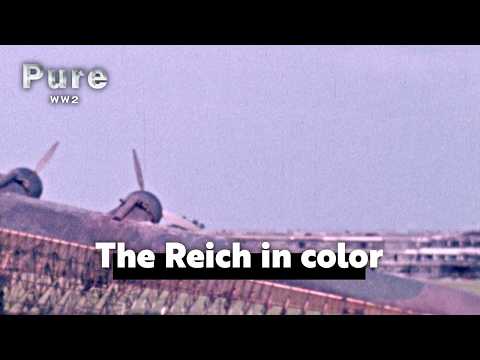
On August 12, 1939, Eva Braun secretly films from the terrace of the Berghof as Hitler awaits the Italian Foreign Minister. She is forced to withdraw into her rooms during official occasions, but her camera captures what the world was never meant to see. Count Ciano, the Italian envoy, has come to persuade Hitler to attend a new international conference. But the Führer is determined. “He has decided to attack and he will attack,” Ciano later writes, his words dripping with resignation. The color footage shows Hitler’s unwavering expression, the set of his jaw, the coldness in his eyes. Diplomacy is dead.
Meanwhile, in the small town of Offenburg, Paul Stobber films the Nazi Party’s local annual conference in vibrant color. The streets are lined with marching members of the Federation of German Girls and the Hitler Youth, their uniforms crisp, their faces young and fervent. The publisher Franz Burda, in his radio magazine, proudly declares that the town has always been “solidly German and patriotic, nationalist and socialist.” “No Jewish capital has been invested in the printing house,” he boasts, “nor are any of the company’s contributors or employees Jewish.” The highlight is the address by district leader Carl Vombach, his voice booming through loudspeakers as local military leaders in parade uniforms stand at attention. The color film captures the spectacle, the unity, the creeping darkness.
On September 8, 1939, a loudspeaker vehicle announces the Wehrmacht’s successes in Poland. The people of Offenburg gather around hastily posted maps, disbelief and excitement on their faces. “The Germans couldn’t believe that their fathers, husbands, and sons were sweeping through Poland so quickly,” the narrator notes. German tank units have reached the suburbs of Warsaw. Hitler’s first Blitzkrieg is in full swing, and the color film shows the euphoria, the pride, the blind faith in the Führer.
In Corbach, Hesse, Johannes Bleaser films everyday life during the war. On March 22, 1940, the National Socialist Public Welfare Organization invites people to Adolf Hitler Square for pea and bacon soup. Food rationing is in place, but such occasions ensure that even the poorer classes enjoy a hot meal. “Paramount, however, was the Nazi leadership’s intention to promote communal solidarity along the lines of socialism in practice,” the narrator explains. The color film shows smiling faces, steaming bowls, and the subtle machinery of propaganda at work.
Since September 3, 1939, a state of war has existed between the Third Reich and Great Britain and France. But the Allies have not come to Poland’s aid. For them, it is wait and see. Hitler, meanwhile, has been planning his campaign in the West for months. Finally, on May 10, 1940, the offensive begins. Infantry units stationed in Bitterfeld near Halle are moved west. They are to invade neutral Belgium, Luxembourg, and the Netherlands, while German tank units head through the Ardennes towards France. At his headquarters in Hundadt in the Eifel, Hitler discusses the situation with Hess and Göring. His chief pilot, Hans Baur, flies him to the front time and again. The color film captures the dictator in his element—confident, animated, surrounded by his generals.
In less than six weeks, Hitler achieves what German armies failed to achieve in four years during the Great War. France is forced to capitulate. Joseph Goebbels writes in his diary: “The Führer towers high above us all. He’s one of history’s geniuses. What a glorious era. And it will be followed by the great rest we all desire so much. The Führer perhaps more than any of us. Then we shall build the new Europe. After the war, we shall soon deal with the Jews.” The color film shows Hitler at the zenith of his power, the world seemingly at his feet.
Near the town of Commer in Northern France, Hans Baur films the wreckage of a French Air Force unit. French historian Marc Bloch later describes the disaster as a “strange defeat.” “We have just suffered a devastating defeat,” he writes. “Who was responsible? The parliamentary regime, the troops, the British, the fifth column, our generals reply. In other words, everybody but them.” The color footage shows the twisted metal, the smoldering ruins, the humiliation of France.
On June 2, 1940, the leadership of the German Luftwaffe waits at Neesiz airfield for the arrival of the Führer. The air force generals are in a jovial and victorious mood. Although their contribution to the military success has been modest, wounded German troops are quickly flown in to form the backdrop to a special ceremony. Hitler arrives in his Mercedes limousine. While he greets his troops, 150 kilometers away in Dunkirk, the last of 330,000 British and French soldiers are being evacuated across the English Channel. Exactly four years later, they will return to free France from the German yoke. The color film captures the irony, the fleeting nature of victory.
Wherever Hitler appears with his entourage, he is given a frenetic reception. The dictator is at the zenith of his power. As Wilhelm Keitel, chief of the German armed forces high command, puts it: “My Führer, you are the greatest commander of all time.” Such comments earn Keitel the reputation of being the Führer’s lackey. In his memoirs, Hans Baur comments on Hitler’s visits to the troops in France: “Hitler’s intended effect was achieved. The troops and the French population were impressed by the fact that he appeared as soon as hostilities had ceased. The commander-in-chief ate from field kitchens. The only special requirement was for any canned meat to be removed since the Führer always avoided meat.” The color film shows Hitler mingling with soldiers, a man of the people, or so it seems.
Naturally, people back home in Germany don’t get to see such scenes. Even the camera teams of the weekly newsreel rarely have the chance to observe Hitler like this. With the exception of Eva Braun’s private films, the films taken by Hans Baur are the only footage which shows the dictator from close up, unedited and uncensored. The color film captures the man behind the myth, the mundane details, the calculated gestures.
On June 13, 1940, the French government declares Paris an open city. A day later, the German army marches into the capital. One soldier, Arnold Binda, writes in his diary: “Paris has been declared an open city. We have occupied it without a fight. The heart of France is in our hands.” On June 23, 1940, Adolf Hitler visits the defeated French capital. Hans Baur has flown the dictator to Le Bourget at 5:00 a.m. and is allowed to accompany him on a tour of the city. Once again, he uses 16mm color film to document the bizarre sightseeing trip. Alongside Hitler on the observation platform of the Trocadéro are sculptor Arno Breker and architects Hermann Giesler and Albert Speer. Later in his memoirs, Speer describes the dictator’s reaction: “Wasn’t Paris beautiful? But Berlin must become even more beautiful. In the past, I often wondered whether Paris shouldn’t be destroyed. But when we’re finished in Berlin, Paris will be a mere shadow. So why should we destroy it?”
Hitler had purportedly come to Paris as an educational tourist who was very keen on culture. But in reality, the visit was his personal triumph as a commander. At Les Invalides, he spends a long time next to the tomb of Napoleon. Past and present dreams of world dominance. Finally, a visit to the Panthéon, France’s Hall of Fame. The dictator’s lifelong dream has been fulfilled, at least for the time being. The color film captures the eerie silence, the empty streets, the ghost of a city that will soon rise again. Five years later, the French will celebrate victory by dancing in the streets, and Berlin will lie in ruins. But for now, the color film keeps rolling, and the world holds its breath.
The color film keeps rolling, but the reel is nearing its end. In the flickering light, we see the faces of those who witnessed it all—the soldiers, the diplomats, the ordinary Germans who cheered and believed. History, captured in color, is not black and white. It is the warm hue of a summer day on the Obersalzberg, the cold steel of tanks rolling into Paris, the red of swastika banners against a blue sky.
Eva Braun’s private films, hidden for decades, show a man who loved children and animals, who ate from field kitchens and avoided meat. Hans Baur’s footage reveals a commander who toured conquered cities like a tourist, dreaming of building a new Berlin that would eclipse Paris. These images force us to confront the banality of evil—the mundane details that made the monstrosity possible.
Five years after Hitler’s triumphant tour, the French danced in the streets, and Berlin lay in ruins. The color film, preserved and restored, now serves as a warning. It shows us not monsters from another world, but humans—flawed, ambitious, and capable of unspeakable cruelty. The reel ends, but the questions linger.
What would you have done if you had been there, in that color-drenched world, watching history unfold? Would you have seen through the spectacle, or would you have been swept along by the tide? The film is silent now, but the past is never truly still.
What do these rare color images reveal to you about the nature of power and complicity?






