The summer of 1944: the roar of Allied planes broke the silence over Normandy, and France dared to believe the nightmare was over. The D-Day landings ignited a wildfire of hope, and across the channel, the oppressed nation finally saw its liberators arrive. But behind the jubilant crowds and the tears of joy, a shadow lingered—a whisper that the true war was only just beginning.
As French men and women celebrated their freedom, few suspected that the post-war struggles would outlast the conflict itself. It would take a decade for the country to stagger back to its feet, and in that fragile France, divisions ran deep: those who wished to forget, those who thirsted for revenge, and those too traumatized to imagine a future. This generation would fight new battles, and their history would be written in the rubble of their cities and the silence of their losses.
In the rain-soaked streets of August 1944, 17-year-old André Dan filmed German soldiers fleeing in haste. But his lens also captured a darker scene: women accused of collaboration, their heads shaved, paraded in shame. “After four years of pinpricks and favoritism, the average Frenchman’s first desire was to get his own back,” wrote war correspondent Alan Moorehead. Rough justice was swift and merciless—collaborators lynched, scores settled in the open. The Resistance, once a shadow army, emerged into the light, hailed as heroes. Yet in this frenzy of liberation, the lines between hero and villain blurred.
France was battered beyond imagination. Two-thirds of its territory lay in ruins, 74 departments scarred—compared to just 13 in the First World War. “The tide recedes, revealing the battered body of France from end to end,” wrote General de Gaulle.
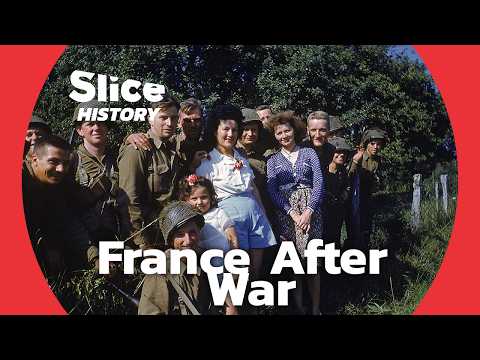
Children played in the rubble of Saint-Lô, swapping guns for licorice rolls, while their parents queued for meager rations. The Allies who had bombed their cities were now their liberators, and the French greeted them with a paradoxical mix of gratitude and relief. American GIs brought chocolate, cigarettes, and swing music—a taste of joy that the Nazis had deemed degenerate. “We were making love to freedom in their arms,” recalled writer Benoîte Groult, capturing the heady release of liberation.
But the celebrations masked a profound grief. As prisoners of war returned after years in captivity, the nation wept and rejoiced. Yet for many, the homecoming was bittersweet: families torn apart, homes destroyed, and the haunting absence of the 500,000 dead. In the cemeteries, silent rows of crosses testified to the price of victory.
Amidst the reconstruction, a new battle emerged—a battle for the soul of France. The Communist Party, its prestige forged in the Resistance, offered a new kind of faith, while the state took on a protective role, creating a welfare system that promised security for all. But the scars of war ran deep, and as the country struggled to rebuild, the dream of unity began to fray.
By 1947, the harsh winter and lingering shortages pushed the French to the brink. “Give us butter or give us back the crumbs,” protesters demanded, and strikes paralyzed the nation. The government, once seen as a friend, now faced the anger of a people who felt they had given more than they received.
Yet even as the country teetered on the edge, a new era was dawning—one of American aid, consumer goods, and the promise of progress. But would this fragile equilibrium hold? The storms were gathering, and this generation, still reeling from war, had yet to face the challenges that lay ahead.
In the spring of 1947, the strikes spread like wildfire. “CRS equals SS,” protesters chanted, as the newly formed riot police squared off against railway workers and miners. The state that had promised solidarity now sent in reservists to break picket lines. In the north, railway workers sabotaged their own trains—the same tracks they had once blown up to resist the Nazis—resulting in twenty deaths and hundreds of injuries. “The dream of unity which had sprung up after the Liberation was over,” one historian later wrote, and with it, the illusion that France could simply will itself whole again.
But even as the country convulsed, another force was rising. The Communist Party had emerged from the Resistance with immense prestige—600,000 members strong, a counter-society with its own newspapers, unions, and youth leagues. Nineteen-year-old André Piaud spoke for many when he declared, “Being a communist for me is the greatest ideal in the world. We think of ourselves as an elite, an avant-garde.” The Party’s Festival of Humanity drew a million people each year, a great carnival of working-class joy where the ballet of the grocers—a whimsical dance of shopkeepers and produce—somehow captured the era’s strange blend of politics and everyday life.
Yet the Cold War was already casting its shadow. When the Marshall Plan arrived with its crates of American aid, the same Allies who had liberated France now faced suspicion. Coca-Cola became a symbol of cultural invasion; a propaganda film compared the fizzy drink to a Trojan horse sent from across the Atlantic. “Are we to be Coca-Cola-colonized?” asked the newspaper L’Humanité. French cinemas were flooded with Hollywood movies, and quotas were imposed—the price, it seemed, for the US to write off France’s colossal war debt.
But America enticed as much as it repelled. In Paris, jazz spilled from basement clubs in Saint-Germain-des-Prés, while the Moulin Rouge clung to its old revues. A performer named Marcel Marceau, in total silence, invented the moonwalk—he called it “Walking Against the Wind”—a gesture that seemed to capture the era’s contradictions: light and serious, moving forward while stepping back.
Meanwhile, the Atlantic ports hummed with deliveries. Farmers fell in love with tractors the way they once loved their horses; their numbers tripled in a decade. In the Beauce region, Ephraïm Grenadou boasted, “I have six tractors, a combine harvester, a baler, and a corn picker. The work is being done by machines now rather than by men.” Science was changing everything. In the Limousin, prospectors with Geiger counters scoured the land for uranium, and in December 1948, Zoé—Europe’s first atomic battery—came to life. The bombs of Hiroshima and Nagasaki haunted every mind, but for France, atomic energy was the Holy Grail, a promise of future power.
By the end of the decade, the French could finally breathe. In the winter of 1949, rationing disappeared for good. Cafés buzzed with talk of productivity, and a new duty emerged: to buy, and keep buying. The first self-service stores opened with the promise of low prices, and meat came wrapped on shelves, milk pasteurized in bottles. “You save time, you don’t waste time quarreling with the surly sales assistant,” rejoiced Le Parisien. In 1952, a photograph of an ordinary family in front of all they consumed in a year spoke volumes: 120 kilograms of bread per person, 143 liters of wine, but only 74 of milk.
Owning things became the new horizon. A Renault 4 or the new Citroën 2CV—three years of a worker’s salary, a pipe dream for some, a reality for others. Journalist Jean Fourastié wrote, “With my driving license in my pocket, we spent our first Sunday on the road. I realized I never really knew what freedom was before getting behind the steering wheel.” With cars and two weeks of paid holidays, the French discovered the family vacation on the Côte d’Azur or the Atlantic coast. The war seemed a long time ago. Children played hide-and-seek in the D-Day bunkers, and in 1953, child mortality was half what it had been a decade earlier.
Yet as the baby boom swelled and the country rose from the rubble, a question lingered in the quiet moments: did this generation have any idea of what still lay ahead? The new equilibrium was still fragile, and the gathering storms—in Algeria, in the factories, in the shadow of the bomb—would soon test whether the hope of 1944 could truly hold.
André Dan, the boy with the film camera, had become a man by the time the 1950s settled over France. He kept his reels in a metal box under his bed, and sometimes, late at night, he would thread one through the projector and watch the ghosts move again—the fleeing soldiers, the shaved heads, the tanks rolling past weeping crowds. “I filmed because I was afraid of forgetting,” he would later say. “But I never imagined how much there would be to remember.”
For the men who had come home from the camps, forgetting was not an option. They wore their silence like a coat, and the country, eager to move on, let them. The 76,000 French Jews deported to the death camps had yielded only 2,500 returns—a mere three percent. Bernard Dégallier, who had served in an American uniform, walked to the Marais and found the curtains of his family’s shop drawn. “I found out that my two grandmothers had died and that Grandfather Blum, aged eighty-five, had been arrested and sent to Drancy,” he recalled. The apartments of the deported had been confiscated, handed to others during the Occupation, and the injustice compounded the horror.
Most survivors, to whom no one was willing to listen, simply blended into the mass of other victims, withdrawing into a long silence. The work of remembrance would come later—much later.
In the red suburbs of Paris, a different kind of faith was taking root. At the Festival of Humanity, a million people gathered each year beneath banners of red, and the air smelled of grilled sausage and cheap wine. The Communists had built a counter-society with its own newspapers, its own unions, its own heroes—the martyrs of the Resistance, the immigrant laborers, the political deportees in their striped uniforms. “Yesterday our weapon was sabotage,” declared Maurice Thorez, the Party’s leader. “Today it’s productivity.”
But the Party’s dream of revolution ran headlong into the American century. The Marshall Plan’s crates arrived at the Atlantic ports, and with them came not just grain and machinery but a way of life. Coca-Cola, Hollywood, jazz—the French devoured and distrusted it all at once. When Walt Disney received a prize from the French Minister of Commerce and Industry, the cultural establishment shuddered. In the winter of 1948, Jean Marais and Simone Signoret joined thousands of professionals marching to defend a certain French exception, while Parisian audiences flocked to see the American films they claimed to despise.
Progress, meanwhile, was remaking the landscape with astonishing speed. In the Alps, dumbfounded locals watched gigantic turbines arrive, soon to submerge their valleys under artificial lakes. Every corner of the countryside would have electricity—progress flooded entire villages, and the memory of them lingered only in the minds of the displaced. “This obliteration of the past was the price to pay for new hope,” one engineer wrote, and few dared to argue.
By 1953, the ration cards were gone, the cafés were full, and the French were learning to be consumers. Yet the old divisions had not vanished—they had merely gone quiet, waiting for the next storm to stir them awake.
The storm came from Algeria. In November 1954, bombs and ambushes in the Aurès mountains announced a war that would divide the nation all over again. “The rebellion was inevitable,” one veteran of the Resistance wrote, recognizing the same hunger for dignity he had once felt. But this time France was the occupier, and the paradox would tear families apart.
André Dan filmed the trains leaving for the front, then the young conscripts returning hollow-eyed. “I had filmed liberation,” he said. “Now I was filming its opposite.” In Paris, the cafés still hummed, the 2CVs still rolled toward the sea, but beneath the calm, a new reckoning was gathering.
Ten years after the Liberation, France had risen from the rubble—modern, restless, and still haunted. The dream of unity was gone, but something stubborn remained: the will to keep going, to remember, to argue, to live.
And you—if you had stood in the rubble of 1944 with a camera in hand, what would you have chosen to film: the joy, or the silence?






