Long Island, New York, October 14th, 1905. Dust hangs over the dirt roads. Crowds press against the course, and a 24-year-old Italian named Vincenzo Lancia is running away from all of them. His first lap: 71.3 mph. No other driver will match it all day.
For seven laps, nobody can catch him. Then Lancia rolls back onto the course. Walter Christie is coming flat out. The flagman screams, “Too late.” Metal folds. The rear wheels crush. The race is gone.
That young man would go home to Italy and build cars of his own. His company would win almost everything there was to win. By 1969, it would be sold for a single lira. By 1992, it would own more World Rally Championships than any car maker in history.
The genius that won every trophy was the same genius that made it impossible to survive. This is the story of the Italian brand that won everything, then lost itself.
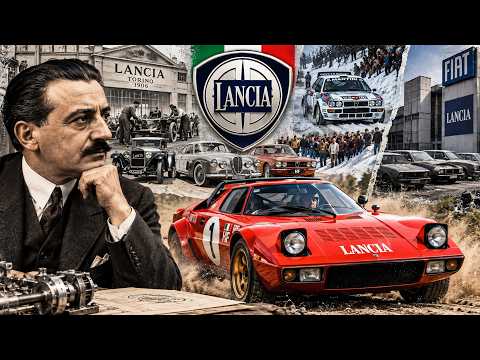
To understand the man who crashed on Long Island, you have to go back to a village in the mountains. Fobello sits high in the Val Sesia in Italy’s Piedmont region, a few miles from the Swiss border. Stone houses, steep slopes, cold rivers running down from the Alps.
On August 24th, 1881, Vincenzo Lancia was born there, the third of four children. His family was not poor, not even close. His father, Giuseppe Lancia, had built one of the first modern food businesses in Italy. He made canned soup and broth, and he made a fortune doing it.
The Lancias kept a home in Turin and a villa outside the city. They had money, standing, and a clear plan for their youngest son. Vincenzo would be a professional, a lawyer perhaps, at the very least a man who kept the books. So, the boy was sent to the Turin Technical School to study bookkeeping.
On paper, it was a sensible future, respectable, safe. Vincenzo hated it. He had no patience for ledgers and very little for the humanities. What he loved was anything that moved, anything with gears and grease and noise. And in Turin at the end of the 19th century, noise was coming.
Here is the twist that changed everything. The Lancia family owned property in Turin and they rented part of it to a young man who repaired bicycles. His name was Giovanni Ceirano. Ceirano was not just fixing bicycles. He was experimenting with engines. He was building something new.
Vincenzo could not stay away. He badgered his father until Giuseppe gave in. The boy could work at Ceirano’s shop, but only as the bookkeeper. It was a compromise that satisfied no one for long. Vincenzo kept the accounts during the day and spent every other minute on the shop floor, watching, asking, taking machines apart.
That is where he learned the basics of engineering, not in a classroom, in a rented workshop owned by his own family. Around the same time, a friend named Carlo Biscaretti di Ruffia acquired a Benz. It was the first serious automobile in Vincenzo’s life. He saw what one could do. He wanted more.
Then in 1899, the ground shifted under all of them. A group of Turin investors founded a new company called Fiat. One of its early moves was to buy Ceirano’s business as a going concern. The workshop, the designs, and the people inside came along with it. That included an 18-year-old bookkeeper who was obviously not a bookkeeper.
Fiat saw what Ceirano had seen. Despite his age and his brief experience, Vincenzo Lancia was made chief inspector at the new factory. His job was to test what Fiat built, find what was wrong, and make it right. And testing meant driving.
He was a big man, broad and heavy, but behind the wheel he was fearless. Soon Fiat was entering him in races. In 1902 at the Sassi Superga Hill Climb outside Turin, he won. It was his first victory. It was also Fiat’s. More followed. Over the next few years, he collected more than 20 wins and became one of the most famous drivers in Europe.
He was fast, brutally fast, and he had a habit that would follow him for the rest of his career. He would lead. He would dominate. And then something would break.
At the first Targa Florio in Sicily in 1906, he was leading the race when his fuel tank started leaking. He was out. A teammate took the win. That was the pattern on Long Island, too. In 1905 and again in 1906, Fiat shipped him across the Atlantic for the Vanderbilt Cup, the biggest motor race in America. American crowds loved him. He was loud, he was quick, and he drove like a man with nothing to lose.
In 1905, he set the fastest lap of the entire race. Then came the collision with Walter Christie, and his race was over. In 1906, he came back to try again. This time he simply could not match Louis Wagner in the Darracq. Twice he crossed an ocean to win in America. Twice he went home without the cup.
By then, Vincenzo Lancia was 25 years old. He had fame. He had a salary from the most important car company in Italy. He had a reputation as both a driver and an engineer. Most men would have stayed right there. But Lancia had spent years testing other people’s machines. He knew exactly where they failed, and he had started to believe he could build something better. Not faster for a single lap. Better.
There was only one problem. To do it, he would have to walk away from Fiat. He did not walk away alone. At Fiat, Vincenzo Lancia had a friend named Claudio Fogolin. Fogolin was 9 years older, another test driver, another man who understood exactly how cars broke and why. The two of them talked about what they would build if they ever had the chance. In 1906, they stopped talking.
Each man put down 50,000 lire. That was their entire starting capital. With it, they rented a small workshop on Via Ormea on the south side of Turin. On November 27th, 1906, the company was officially born. Lancia & C. Fabbrica Automobili. The division of labor was simple. Vincenzo would handle engineering and production. Fogolin would handle sales. They had a name on the door. They had a workshop. They had a design in Vincenzo’s head. What they did not have was a car.
So, they started building one. Through the winter, the drawings piled up and the first parts came together on the bench. Then, in February 1907, the factory caught fire. The flames tore through the workshop. Drawings burned. Parts were destroyed. Months of work gone in a single night. For a young company with no products and no income, it could have been the end.
Vincenzo started over. By September 1911, the first prototype was ready for its test run. There was just one problem. The car was too wide to get out of the building. Its wheel hubs fouled the door frame. So, they took the door off. The car rolled out into the street and it worked. Not just worked, it impressed. A second prototype was built right away so development could move faster.
And all this time, Vincenzo Lancia was still racing for Fiat. That same year, 1907, he drove a Fiat to second place at the Targa Florio. He was running a car company by day and racing for his old employer on weekends. Which brings us to the strangest decision of his career.
Vincenzo Lancia was one of the most famous racing drivers in Europe. Racing was his life. Racing had made his name. And he refused to let his own company race. Motorsport was expensive. It burned money and it burned cars. Vincenzo believed a manufacturer should build the best machine possible and let the machine speak for itself. Racing could wait.
For a man who lived for speed, it was an almost unbelievable act of discipline. Remember it because the people who came after him would not share it.
In 1908, the first Lancia went on public display at the Turin Motor Show. It was called the Tipo 51 or the 12 HP. Soon it would get a new name, the Alpha, the first letter of the Greek alphabet. Every major Lancia that followed would carry a Greek letter, too. Beta, Gamma, Delta, Lambda. It was a statement of order, a progression of a man who intended to build a long line of cars.
And the Alpha was a statement in its own right. It had a 2,544 cc four-cylinder engine making 28 horsepower. It weighed only about 1,140 lb. It could reach around 56 mph. It used shaft drive at a time when chains were still common. Its engine revved higher than most of its rivals. Some critics complained. The car was too low, they said, too light, too fast. Buyers did not agree. In a little over a year, Lancia delivered 108 cars. The bet had paid off.
Vincenzo Lancia had built a car better than the ones he used to test. Now he had to prove he could do it again, and again, and again. The Alpha was a promise. Now Vincenzo Lancia had to keep it.
In 1909, the Alpha was replaced by the Beta. Then came the Gamma, the Delta, the Di Delta, the Epsilon. The Greek alphabet marched forward one letter at a time, and each car was a little more refined than the last. The workshop on Via Ormea could not hold this pace for long. As orders grew, Lancia moved production to larger premises in the Borgo San Paolo district of Turin. Over the coming decades, that factory would keep growing, building by building, until it covered entire city blocks.
And in 1910, something remarkable happened. Lancia components started crossing the Atlantic. An American firm called the SGV Company imported Lancia parts, assembled them in the United States, and sold the finished cars under its own SGV name. It was a small operation. It did not last, but it meant that only 4 years after Vincenzo lost the Vanderbilt Cup on Long Island, his engineering was rolling on American roads. He had not beaten America on the racetrack. He had found another way in.
Back in Turin, Lancia kept pushing. In 1913, the company introduced the Theta. On the surface, it was a large, comfortable touring car. Underneath, it carried a feature no other production car in Europe offered as standard equipment. A complete electrical system, electric lights, and electric starter. No more cranking the engine by hand on a cold morning. No more fumbling with oil lamps after dark. It sounds ordinary now. In 1913, it was the future. Built into the car from the factory at no extra cost. This was becoming the Lancia signature. Not the loudest car. Not the cheapest car. The car that solved a problem before anyone else realized it was a problem.
Then the world went to war. Italy entered the First World War in 1915, and like every manufacturer in the country, Lancia was pulled into military production. Passenger cars gave way to whatever the army needed. What the army needed was trucks. That year, Lancia built its first truck, the Jota. It was rugged, simple, and built to carry men and supplies through mud and mountains. The Jota and its successors became the foundation of an entire commercial vehicle line. One that would keep running long after the war was over.
By the time the guns fell silent in 1918, Lancia was no longer a small workshop with a famous founder. It was an industrial company, and Vincenzo had used the war years to think about what came next. In 1919, Lancia introduced the Kappa. It was a solid, capable car built on everything the company had learned so far. Vincenzo was also experimenting with bigger ideas, much bigger. He designed engines with eight cylinders and even 12 arranged in a narrow V-shape. Most of these experiments never reach customers, but in the early 1920s, one did, the Trikappa. It was Lancia’s first production V8. It displaced 4,994 cc and made 98 horsepower. For its day, it was a heavyweight, big, powerful, and expensive. On paper, it was the most impressive car Lancia had ever built, but on the road, Vincenzo was already learning a different lesson, a painful one.
During a race, a Kappa broke its axle. For a car company that prided itself on engineering, it was a humbling moment. A broken axle meant a car that could not finish. It meant a part that had failed under exactly the kind of stress a fast car was supposed to handle. Most engineers would have made the axle thicker, heavier, stronger. Vincenzo asked a different question. Why did the axle have to take that hit at all?
On almost every car of the era, both front wheels were bolted to a single rigid beam. When one wheel struck a bump, the shock traveled straight across to the other side. The whole front of the car jolted together. At speed on rough roads, that was punishing for the parts and dangerous for the driver. What if each front wheel could move on its own? What if the car could absorb a blow instead of fighting it?
He had spent his whole life watching cars break. Now, for the first time, he started to imagine a car that would not break the same way. And as he worked on that idea, he kept pulling at the thread. If the suspension could be rethought, what about the frame underneath it? What about the body sitting on top? What about the entire way a car was built? The answer would arrive in 1922, and the rest of the industry would need decades to catch up.






