At 5:00 AM on August 31, 1918, two Australian infantry battalions began climbing a fortified hill they had no business attacking. Mont Saint-Quentin rose 100 meters above the Somme River, and Erich Ludendorff had garrisoned it with his best troops: the Second Prussian Guard Division, ordered to hold until every last man was gone. The Australians climbing toward them belonged to the Second Australian Division, and they were wrecked—average battalion strength had dropped to 653 men, roughly two-thirds of a full battalion. The 21st Battalion had just 421. These were the men Lieutenant General Sir John Monash was sending against the finest Guards Division the German Empire still had.
By every tactical doctrine the British Army followed in 1918, a fortified hilltop defended by elite infantry required a corps-level assault, multiple divisions, massed artillery preparation lasting days, staged advances measured in hundreds of yards. Monash didn’t have a corps to spare, and he didn’t have the weeks it would take to plan the kind of assault headquarters expected. He had one chewed-up division that had been fighting without pause since August 8. And he had the fact that the Germans didn’t expect anyone to try what he was about to try. Behind the Prussian Guard on Mont Saint-Quentin sat elements of four additional German divisions. Five divisions across the sector dug into high ground and anchored to a walled medieval town. Monash was sending roughly 1,200 men up the slope in the first wave.
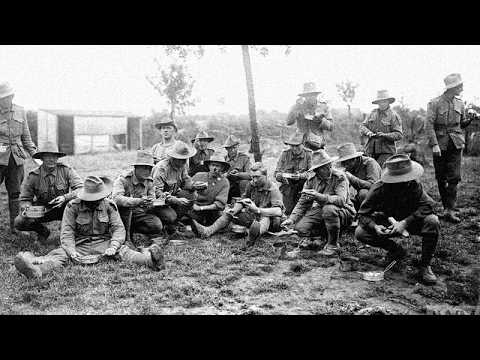
The assault battalions had crossed to the north bank of the Somme the previous evening, wading through marshland in the dark. They were tired and under strength, carrying ammunition for a fight their own numbers said they couldn’t win. Monash’s plan depended entirely on speed. He didn’t want a set-piece battle with registration fires and phased advances. He wanted a raid that hit before the defenders could react—launched from the northwest where the German outpost line was thinnest, at an hour when morning fog still sat heavy in the river valley. The order reached the assault battalions before dawn: Monash told them to scream like bushrangers when they went in, make enough noise for a full brigade even though they barely had two battalions between them.
At 5:00, the Australian field artillery opened up on the northwest slope of Mont Saint-Quentin, and two battalions of sunburnt, underfed infantrymen started running uphill into the positions of the finest guards formation the German Empire could field. What happened over the next 72 hours would later be called the greatest feat of the war by the British general who watched it happen.
Three weeks earlier, the war on the Western Front had changed direction for the last time. On August 8, 1918—the day Ludendorff later called the black day of the German army—the Australian Corps and the Canadian Corps punched through the German lines east of Amiens and kept going. The breakthrough ended four years of stalemate and turned the Western Front into a war of movement for the first time since 1914. The Australians under Monash advanced further and faster than any British Empire force had managed since trench warfare began. By the end of August, his divisions had taken 14,500 prisoners and 170 guns.
The German army was falling back across the old Somme battlefields of 1916, but it wasn’t collapsing. It was choosing where to make its stands. One of those places was the high ground at Mont Saint-Quentin, east of the Somme. The hill sat on a spur of chalk ridge roughly 2 km north of the fortified town of Péronne, overlooking the Somme from the east. The river at that point ran through low marshland, crossable only at a handful of bridges and fords, most of them destroyed by German engineers during the retreat. Péronne itself was a walled town built on the river’s south bank, with narrow streets and solid stone buildings that turned every block into a potential strong point. The combination of hilltop and town locked down the entire sector. No advance eastward toward the Hindenburg Line was possible while Mont Saint-Quentin stayed in German hands.
The Hindenburg Line was the last prepared defensive system the Germans had. It ran south from the Channel coast near Lens through Cambrai and Saint-Quentin to the Aisne—a belt of concrete bunkers, deep wire entanglements, and interlocking trench systems that German labor battalions had spent two years building. Every position the Australians had taken since August 8 brought them closer to it, and every position the Germans chose to defend was chosen to buy time for the Hindenburg Line garrisons to prepare. Mont Saint-Quentin was the lock on the gate, and the Australian Corps had to break it or watch the advance stall within sight of the final objective.
The German High Command understood the arithmetic as well as Monash did. Ludendorff had been feeding divisions into the line east of Amiens all month, trying to slow the Australian advance long enough for the Hindenburg Line to be fully manned and supplied. Most of those divisions had been chewed up and spat out. The Australians had broken through 16 German divisions since August 8. But each one bought another day. Mont Saint-Quentin was the position where Ludendorff intended to buy enough days to matter. And he’d stake the Second Prussian Guard on it because anything less would crack under the pressure the Australian Corps had been applying since Amiens.
Monash understood the problem in mechanical terms. A textbook assault on Mont Saint-Quentin, the kind Field Marshal Haig’s headquarters would have planned, meant pulling divisions out of the line, resting them, bringing up heavy artillery, registering targets over several days, and launching a phased attack with tank support across a broad front. That process would take time the Australians didn’t have. Every day of delay gave the Germans another day to thicken the defenses, rotate fresh troops into the line, and dig deeper into the chalk on the summit. Monash’s solution was to skip the preparation entirely and attack with what he had, where the Germans weren’t looking, before they were ready.
The division he chose was the worst possible pick on paper and the best possible pick in practice. Major General Charles Rosenthal’s 2nd Australian Division had been in continuous action since early August, and all three of its brigades—5th through 7th—were operating well below establishment strength. Some battalions had lost half their officers in the preceding weeks, with sergeants and corporals running platoons and junior lieutenants commanding companies. But Rosenthal’s men knew how to advance. They’d been doing it for three weeks straight, and they hadn’t lost a fight yet. Monash picked them because he needed troops who already had forward momentum, who wouldn’t hesitate at a river crossing in the dark.
The approach began on the evening of August 30. The 2nd Division’s assault battalions moved down to the Somme crossings under cover of darkness, picking their way through marshland that in places came up to a man’s chest. Engineers had thrown temporary bridges across the deepest channels, but the ground on either side was waterlogged and soft, and the men crossed carrying full combat loads: rifles, ammunition, grenades, Lewis gun magazines, and Stokes mortar rounds for the support teams. The crossing took hours. Men slipped off duckboards into waist-deep water and hauled each other out without stopping. Equipment that got wet stayed wet. There was no time to stop and dry anything. By midnight, the forward battalions were on the north bank, lying in shallow scrapes a kilometer and a half from the base of Mont Saint-Quentin, with the Somme marshes behind them cutting off any easy retreat.
The men lay in the dark and waited, listening to the German sentries on the ridge above them. The silence before a dawn assault had a specific quality to it. No talking, no smoking, no movement beyond what was needed to stay low. The only sound was the occasional crack of a German flare going up over the outpost line, throwing white light across the marshland for a few seconds before it burned out and the darkness came back.
The German outpost line sat along the lower slopes of the ridge, manned by the Second Prussian Guard Division. The Guard had fought at Verdun and on the Somme in 1916. These were experienced troops with a record of holding ground under pressure. Ludendorff had pulled them from reserve specifically because Mont Saint-Quentin couldn’t be allowed to fall, and their orders reflected the stakes. The main defensive positions ran along the crest and through the village of Mont Saint-Quentin on the summit, with fields of fire covering every approach from the west and south. The northwest approach, the one Monash chose, was the least covered because the marshland below it looked impassable for an attacking formation in any strength.
Monash’s plan used three brigades in sequence across the coming days. The 5th Brigade would make the initial assault on the ridge from the northwest, two battalions leading, punching through the outpost line and driving for the crest, while the 6th Brigade followed through to clear the village on the summit. The 7th Brigade would swing south toward Péronne when the hilltop was secure. On the flanks, the 3rd Australian Division covered the left and the 5th Australian Division covered the right, preventing German reinforcements from rolling up the assault force from the sides. The entire operation depended on the first two battalions reaching the crest before the Germans could organize a coordinated defense—a window Monash estimated at roughly two hours.
At 5:00 on the morning of August 31, the barrage opened. Australian 18-pounder field guns and 4.5-inch howitzers laid a creeping barrage that walked up the northwest slope of Mont Saint-Quentin, timed for the infantry to follow at 100 yards per minute. The two lead battalions went in behind it, moving fast and making as much noise as they could—yelling, screaming, anything to convince the German outposts that the force coming at them was larger than 1,200 men. Battalions on the right flank added to the deception by firing everything they had into the German line to create the impression of a broad-front assault. Trench mortars and Stokes mortars worked the flanks, hitting outposts that might otherwise have poured enfilade fire into the assault force as it passed.
The Australians hit the German outpost line within minutes and went through it. Small groups of two and four men worked around each strong point—one team pinning the defenders with Lewis gunfire while another closed from the flank with grenades. The Prussian Guard infantry in the outposts fought back hard, and the Australians took casualties on the lower slopes, but the speed and direction of the attack kept the defenders off balance. The assault force was coming from a direction the defensive plan hadn’t prioritized, moving faster than any set-piece would have allowed, and making enough racket to sound like twice their number.
By 6:00, the assault battalions had cleared the lower slopes and were fighting through orchards and ruined farm buildings on the approaches to the village. The village of Mont Saint-Quentin sat on the crown of the ridge—a cluster of smashed farmhouses and stone walls that the Germans had turned into fighting positions, with machine guns covering the main approaches. The Australians cleared it in small sections, working from wall to wall using rifle fire and grenades at ranges of a few meters. Lewis gunners fired from the hip into doorways and windows while riflemen pushed through the gaps. The fighting was intimate and fast, room to room in places, with the crack of Lee-Enfield rifles and the heavier thump of stick grenades echoing off the stone.
By 7:00—two hours after the barrage opened—the Australians held the village and the crest of Mont Saint-Quentin, and five German divisions in the sector had been thrown into confusion, with units falling back in disorder across the eastern slope.
The capture of the crest opened the hardest phase of the fighting. Across the morning of the 31st, the Germans pulled together counterattacks from units that hadn’t been directly in the path of the initial assault. The 2nd Prussian Guard still had battalions in reserve south and east of the ridge, and the 5th Royal Bavarian Division moved elements forward to support them. The Australians on the summit were exposed on open ground and running low on ammunition after a two-hour uphill assault, and the entire German defensive plan for the Somme sector depended on getting that hilltop back.
The first German counterattack came in before midday, pushing toward the eastern edge of the village with infantry supported by machine-gun teams working the flanks. The Australians gave ground on the eastern side but held the crest, fighting from the same stone walls the Germans had been using hours earlier. A second counterattack hit the southern approaches in the early afternoon, and this one pushed further. The Australians lost part of the village of Feuillaucourt, and for several hours the hold on the hilltop itself looked uncertain.
Rosenthal fed his reserve battalions from the 6th Brigade into the line, pushing them up the slope through the same marshland the assault battalions had crossed twelve hours earlier. Every round of ammunition and every Lewis gun drum had to be carried by hand across that crossing, with the route under intermittent shellfire. Stretcher bearers coming down passed ammunition carriers going up on the same narrow duckboards, and both had to stop flat every time a shell came close.
By nightfall on the 31st, the Australians had retaken every meter of ground they’d lost—but the cost of holding Mont Saint-Quentin was climbing faster than the cost of taking it. The night was a race on both sides: the Australians dug in and hauled ammunition across the marsh while stretcher bearers worked the slopes in darkness; the Germans pulled every available unit into Péronne to build a line that could contain the breach.
At 8:20 on the morning of September 1, the 7th Brigade attacked south off the ridge and into the northern outskirts of Péronne. The fighting changed character instantly—open slopes gave way to dense urban rubble, narrow streets, cellars, and rooftops. The Australians fought through Péronne building by building, room by room, using bayonets and rifle butts in spaces too tight for aimed shooting. Lewis gunners kicked through doors and fired long bursts down corridors while bombers cleared rooms with Mills bombs before the assault teams went in.
The street fighting lasted through the 1st and into the 2nd. The Germans contested every block, pulling back to the next prepared barricade each time the Australians cleared one. Casualties mounted steadily on both sides, and the 7th Brigade’s battalions—already under strength before the battle started—were burning through men at a rate that couldn’t be sustained for long.
By the morning of September 2, the Australians held the western half of Péronne. By the afternoon, they’d fought through to the eastern outskirts where the last organized German positions were crumbling. The final resistance in Péronne collapsed on September 3—72 hours after the first assault on Mont Saint-Quentin. On September 4, Australian patrols pushed east of Péronne and took the village of Flamicourt, advancing two miles beyond the town into open country. The Germans fell back toward the Hindenburg Line without attempting another stand in the sector.
The cost of the three-day battle hollowed out the 2nd Division. 3,000 Australians were killed or wounded between August 31 and September 3—roughly one casualty for every two men the division had fielded at the start. The Germans lost 2,600 taken prisoner, and their killed and wounded were higher still. The division’s battalions came out of the line as skeletal formations, some reduced to single-company strength, with entire platoons led by men who’d been privates a fortnight earlier.
General Lord Rawlinson, commanding the British Fourth Army, called the capture of Mont Saint-Quentin the greatest feat of the war. Monash described it as the finest example of spirited and successful infantry action conducted by three divisions operating simultaneously side by side. The Australian War Memorial’s own assessment went further: the battle is sometimes regarded as the finest single achievement of the Australian Imperial Force across the entire war.
The men who’d done it didn’t describe it in those terms. They’d spent three days fighting uphill through a town and across open ground against a force that outnumbered them at every stage. They’d screamed going up the hill because Monash told them to, and they’d kept fighting when the counterattacks hit because the alternative was going back down the slope into the Somme marshes with the Germans above them.
Private Alex Barclay of the 17th Battalion took a sniper’s round through the skull during the fighting on the ridge. The bullet entered one side of his head and exited the other. Barclay survived, was evacuated to a casualty clearing station behind the Somme crossings, and recovered over the following months in a hospital bed in England. When the next war came 21 years later, he walked into a recruiting office and enlisted again. He didn’t talk about Mont Saint-Quentin. Blokes who copped something like that generally didn’t.
So here’s what history asks of us, a century on: when the doctrine says it can’t be done, when the numbers say you’ll lose, when every rulebook in the war says wait—do you wait? Or do you scream like a bushranger and run uphill anyway?






