In the dense jungles of southern Vietnam, where rivers twisted through triple-canopy darkness and enemy supply lines slithered like snakes, two of the deadliest special forces units of the war came together not to compete, but to cooperate. The United States Navy SEALs—masters of shock, speed, and violent precision—and the Australian SAS—ghosts of the foliage who could lie motionless for hours just meters from the enemy without being seen. They weren’t built the same. They didn’t move the same. But for one mission, they shared the same trigger.
The objective was clear: a Viet Cong logistics unit, 25 to 30 strong, was expected to pass through a narrow jungle corridor near the Cambodian border. Intelligence suggested officers were among them—maps, radios, maybe even intel caches. The location was a natural bottleneck, a trap waiting to be sprung. The SAS would move first, silent and slow, setting kill zone one along a sharp ridgeline. Their job: disappear, wait, and strike when the enemy was deepest in the open. The SEALs would insert later, fast and aggressive, flanking from the rear through a dry creek bed. Their job: seal the back door. Two kill zones, one hammer, one anvil. The Australians brought the stillness; the Americans brought the violence.
The plan hinged on a delicate equation of trust. No radio calls, no countdowns—just a timing window, a movement cue, and a silent agreement. “Let them all enter the box,” one SAS trooper said softly. “Then we shut it.” The SEAL team leader nodded. “No one walks out.” There would be no second chances, no reinforcements, no fallback. Once the shooting started, it would be over in under two minutes—or it would go to hell.
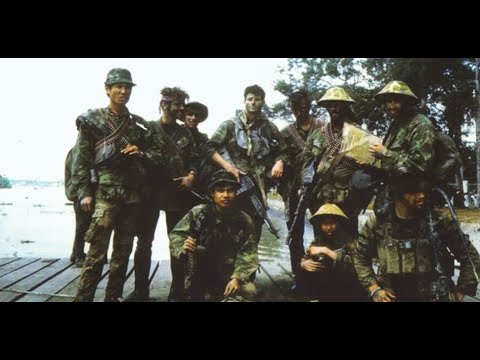
In the darkness before dawn, two squads from two nations moved into position—one to wait, one to strike. The Viet Cong column moved steadily along the trail, talking in low tones, weapons slung casually. They had no idea death was watching from both sides. From above on the ridge, the SAS waited. One trooper had been lying in position for six hours, his gloved finger resting outside the trigger guard. He could see the folds in the enemies’ uniforms, the crusted mud on their packs. Across the kill zone, the SEALs watched from the creek bed, each man a dark shape hidden behind vines and roots. One held an M60 machine gun, barrel fixed just above the brush. Another crouched behind a termite mound, thumb on the safety of his CAR-15.
Both teams had learned one truth: firing too early was death. You didn’t open up when you could kill a few—you waited until you could kill them all. The column kept moving. The box was almost full.
Now came the hard part: coordination without words. The signal would be visual—a slight movement of a hand from the SAS patrol leader, a small mirror flash in the canopy, a pre-arranged glint only visible to the SEALs downstream. The last man in the VC column stepped past the creek bed, brushing a branch aside. The enemy was now surrounded. Thirty men in the kill box. One heartbeat. One signal.
From the ridge, the SAS patrol leader didn’t move. His eyes stayed fixed through the iron sights, tracking the center of the column. He could see the radio operator adjusting his handset. A junior officer walked nearby, his uniform cleaner than the rest, a folded map sticking from his chest pocket. High-value target. But still, no one fired. In the creek bed below, the SEALs crouched in perfect silence. One had his finger on the butterfly trigger of the M60, but the barrel hadn’t twitched. Another gripped the curved body of an M79 grenade launcher, its safety off. A third counted the seconds under his breath.
The tension in the jungle became unnatural. Even the birds had gone quiet. The VC point man looked over his shoulder—paranoia, maybe, or just instinct. But he saw nothing. Just trees, just brush, just silence. The discipline was terrifying. Thirty enemy troops within meters of both fire teams, and yet the trigger remained untouched. Why? Because this was craftsmanship—a kill that had been planned, rehearsed, and now executed with surgical patience. Every second of restraint was a sharpened edge.
The SAS leader slowly, painfully slowly, raised two fingers from his grip, held them still in the air for three seconds, then dropped them. The man next to him nodded once. No sound. Just readiness. Across the jungle floor, the SEAL team leader spotted a faint reflection flash through the canopy—the mirror glint. The final confirmation. They would go. The last man in the VC column had stepped past the final trigger point. The box was closed. The SEAL gunner’s breath steadied. The SAS sniper adjusted his cheek weld. And somewhere in the center of that quiet, lethal jungle, a whisper of breath, a blink, a trigger pulled.
The first shot didn’t echo—it punched. A 7.62 mm round crashed through the jungle air, striking the VC radio operator in the throat, ripping him backward before he hit the ground. The man beside him opened his mouth, but the second shot struck him in the chest before a sound escaped. Then, everything exploded.
The jungle went from breathless silence to violent chaos in half a second. The first two shots from the SAS patrol had barely landed before the SEALs opened up with brutal force from the rear. The corridor, once a quiet trail, was now a furnace of gunfire and death. The SEAL gunner squeezed the trigger of the M60 and walked the barrel across the column, carving through bodies like a scythe. Belts of ammunition fed through his hands as brass sprayed around him. To his left, a SEAL with an M79 fired a 40 mm grenade into the cluster of VC in the center of the trail. It landed behind a fallen pack and erupted with a dull thump, sending dirt, leaves, and men into the air.
The Viet Cong tried to react. Some dove off the trail. Others fired blindly into the foliage, but they were already too deep. Running forward meant hitting the SAS kill zone. Turning back meant running into American machine guns. From above, the Australians remained surgical. No panic, no wasted fire. One round, one kill. An SAS marksman took down a man reaching for the fallen radio. Another fired two quick shots at a VC soldier crawling toward the jungle line. One missed by inches. The second snapped his spine.
Meanwhile, the SEALs didn’t stop moving. They advanced slightly with each burst, tightening the rear choke hold, calling short-range target cues through clenched teeth. “Left, two trees. Reloading. Frag out.” A fragmentation grenade landed near the base of a tree where two VC had taken cover. It detonated in a flash of shrapnel and screams. A handful of Viet Cong tried to push east, away from both lines, but one of the SEALs anticipated it. He popped up, fired two quick bursts from his CAR-15, then dropped and vanished back into the mud like a shadow.
The entire ambush lasted less than two minutes, and then silence again. Not the peaceful silence from before. This one was heavy, final—the kind that hangs in the air after something living has been erased. Smoke drifted through vines. Shell casings cooled in the dirt. Leaves fluttered down where branches had been torn by bullets. And all around the trail, bodies—still. Some twisted in positions of panic. Others frozen mid-step. The kill box had held. Two kill zones, one philosophy. Let them in. End it fast. Leave nothing. And that’s exactly what had happened.
The gunfire had stopped, but the mission wasn’t over. In fact, the most important part had just begun. Within thirty seconds of the last shot, both teams were moving calmly, efficiently, with the kind of practiced choreography that came only from experience. There was no cheering, no high-fives—only focus.
The SEALs were the first to sweep the kill zone. Two of them moved quickly through the bodies, checking for any survivors. One Viet Cong soldier groaned, half buried beneath a dead comrade. A single suppressed shot silenced him. The team leader knelt by the man they believed to be the political officer—map pouch, radio, clean boots. Intel jackpot. He took the pouch, searched the pockets, and handed the contents to another SEAL who sealed them in a waterproof satchel. Time spent on target: less than twenty seconds.
Meanwhile, the SAS were already doing what they did best—disappearing. Two of them remained behind just long enough to cover the SEALs, while the others began the deliberate task of erasing their presence. Brass casings were quickly swept into small sandbags. Tracks were scuffed with foliage. Spent magazines were accounted for, and even grenade pin rings were collected. One trooper used a bamboo branch to blur the drag marks where a wounded VC had crawled before dying. Their movements weren’t rushed, but they were fast. To any enemy patrol arriving later, the scene would look like a ghost attack. No clear direction of fire, no footprints, no cigarette butts—just bodies, scattered casings, and confusion.
Within five minutes, both teams had regrouped at the exfiltration point, a narrow LZ carved into the jungle by earlier reconnaissance. A small smoke signal was triggered—white, faint, just enough for a fast-moving slick to see from above. They didn’t speak much. A nod here, a glance there. The SEALs formed a wide perimeter, weapons still hot, eyes scanning the green wall for signs of movement. The Australians crouched low, conserving energy, already checking their gear for anything left behind.
The chopper came in low and fast, barely flaring as it hovered six feet off the ground. Rotor wash flattened the tall grass. One by one, the men climbed aboard—SAS first, then SEALs. The last man in tossed the intel satchel inside and gave a final glance to the jungle before lifting off. Within seconds, they were gone. The clearing returned to stillness. And below, on that muddy trail now littered with the dead, the only sound left was the rustling of leaves slowly returning to their natural place.
No footprints, no signs of a joint operation, no trace of who had pulled the trigger. Only the result remained. Thirty enemies dead, zero casualties, zero witnesses—just silence. And the memory of two teams that worked like opposites, but struck like one.
Back at base, there was no ceremony, no debrief with fanfare—just scribbled notes, stripped magazines, and steam rising from jungle-wet uniforms. The SEALs cleaned their weapons. The Australians cleaned their boots. And between them, quiet glances, a few nods, and the kind of silence that meant more than words.
One SEAL would later write in his notebook, “They didn’t just move with silence, they became it.” An SAS corporal, in turn, remarked, “They didn’t fight like us, but they fought like they knew exactly what we needed.” The differences that could have divided them—speed versus stillness, noise versus silence—had instead completed the trap.
That mission would never make headlines. No medals would be pinned for it. It would live only in after-action logs, some redacted, some forgotten. But for the men who crawled into that jungle together and came out with zero casualties and thirty confirmed enemy KIA, it was proof that doctrines didn’t need to clash—they could merge, if only for a moment, to create something lethally perfect.
Two kill zones, two teams, one unspoken promise. You do your job, I’ll do mine. And when the time comes, we’ll make them regret ever stepping into this jungle. That’s exactly what happened—not with bravado, not with glory, but with silence, fire, and a level of trust forged only by those who’ve shared the same trail and made it out alive.
What do you think made this unlikely partnership work—the shared discipline, the mutual respect, or something deeper that neither side ever put into words? Share your thoughts below.
Report this article
Select a reason for reporting:






