You think you know George Luz from Band of Brothers—the wisecracking radio man with the perfect impersonations, the guy who made everyone laugh. But the real George Luz? His story is far more remarkable, and his death far more tragic, than the series ever revealed.
When the credits rolled, we were told he became a handyman in Rhode Island. That’s a lie. The truth involves a beautiful love story, a family he adored, and a freak accident that shocked everyone who knew him. This is the untold story of a true American hero.
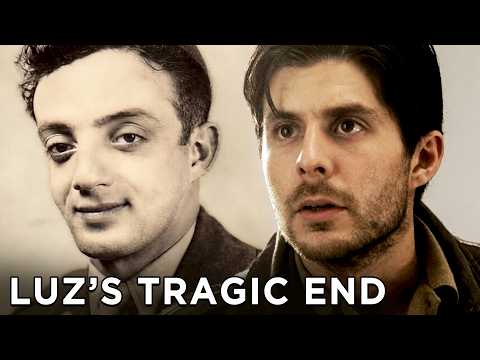
George Luz was born on June 17, 1921, in Fall River, Massachusetts, to Portuguese immigrants from the Azores. Neither parent spoke English. He was one of ten children—six girls and four boys—and grew up in poverty during the Great Depression.
As a boy, he shined shoes and hauled ice up flights of stairs to help his family survive. He quit school in his junior year to work at a textile mill. When Pearl Harbor was attacked, like so many young men, he felt the call to serve.
He volunteered for the paratroopers—the best of the best—and he later admitted the extra pay didn’t hurt. “I was making about $16 a week,” he recalled. “When they said it’s $50 a month extra, man, I just jumped at it.” His father cried. He didn’t want him to go.
George was assigned to Easy Company, 2nd Battalion, 506th Parachute Infantry Regiment, 101st Airborne Division. Training under the strict Captain Herbert Sobel, he became a radio man and rose to Technician 4th Grade.
What the series didn’t show: about three months before D-Day, Luz trained with Britain’s 6th Airborne Division. The 5’7″, 132-lb soldier made several jumps, including one from a Whitley bomber that required jumping through a hole in the floor. If you mistimed it, you’d smash your face—the paratroopers called it the “Whitley kiss.” Luz made it through okay, but nearly hit another bomber on the way down.
George bonded with the men of Easy Company. He became known for his sense of humor and his impressions. “Luz was one of my favorite guys,” recalled Buck Compton. “He could mimic people and keep a whole crowd laughing.” David Kenyon Webster wrote simply, “Everybody liked Luz.”
His skill at imitation is famous—the scene where he tricks Sobel into cutting a farmer’s barbed wire fence is based on a real incident. It happened at night, and Luz was never caught.
Dick Winters said George had “a fierce loyalty to Company E that was second to none” and described him as “tough as nails.” Babe Heffron called him “the most well-liked guy in the platoon” and “100% great American.”
During the D-Day drops, George Luz only made it out of the plane by a twist of fate. He was fifth in the stick and worried he’d never make it to the door with all his gear—a radio and batteries. He told Lieutenant Welsh, “I’ll never make the door.” Welsh told him to switch with Private Roy Cobb.
Not long after the switch, Cobb was struck in the leg by flak. He was groaning and couldn’t stand. Welsh ordered him unhooked from the static line. Had Luz not voiced his concern, it would have been him writhing in pain on the floor of the plane.
Luz kicked his leg bag out the door and jumped into the night. The prop blast tore off his equipment, but he made it safely to the ground. He didn’t find his company until 7:45 the next morning.
George fought with Easy Company in Normandy, the Netherlands, and Bastogne. Unlike what the series shows, he didn’t make it through unscathed. In September 1944, not long after jumping into the Netherlands, his ankle was crushed by a horse-drawn carriage. He was hospitalized until November and received his only Purple Heart.
In the series, Luz is shown crawling toward Skip Muck and Alex Penkala’s foxhole during a German shelling. In reality, it was Sergeant Robert Mann in the foxhole with Lipton when the dud landed. But the series did dramatize a real event—the deaths of Muck and Penkala.
George’s son read a letter his father wrote about that day. Luz had refused to share a hole with Muck and Penkala, opting to dig his own slit trench. “I’ll always thank God for my thick head,” he wrote. After the shelling, he was asked to wake them. He looked in the hole and saw nothing but dirt. He jumped in and dug with his hands. He felt their sleeping bags and pulled them out. Dead. They had taken a direct hit.
Shifty Powers approached and saw Luz’s hands covered in dirt and blood. Luz shook his head. There was barely anything left of them.
Later, Luz was with Easy Company in Haguenau, France, and entered Germany in April 1945. He was there when they explored Hitler’s Eagle’s Nest. In May 1945, he was injured in a motorcycle accident—on the day the war in Europe ended. He had commandeered the motorcycle from a German soldier, never having driven one before. He crashed into a bridge abutment after being distracted by some German girls. He was discharged from the hospital in June and honorably discharged from the army in November 1945.
Dick Winters described George Luz as one of the pillars of Easy Company. Of his time with the men, Luz said, “It was the best 3 years of my life.”
But the story doesn’t end there. After the war, George returned to Rhode Island—and his life took a turn that the series never told you about.
After the war, George Luz returned to Rhode Island and did not become a handyman, as the series claimed. His son, George Jr., explained that the error likely stemmed from a misunderstanding—his mother had told screenwriter Erik Jendreson that George was “handy around the house.” In reality, he briefly worked at a used furniture store, then as a painter, and even built houses.
But the textile industry, where he had worked before the war, called him back. He completed an apprenticeship as a lace weaver and took a job in a lace mill, where he was working as of the 1950 census.
It was during this time that George fell in love with Delvina Rogers, the younger sister of his neighborhood friend Tony. Del, as he called her, was six years younger and one of twelve children. During the war, she had worked in a factory making flight jackets for pilots, and later became a seamstress.
George and Delvina married in 1948. They would have three children—two boys, Steve and George Jr., and a daughter, Lana. Steve would eventually follow in his father’s footsteps and join the Air Force.
George became a well-known figure in his Rhode Island community. He served as a volunteer fireman, belonged to a Portuguese club, and attended mass every Sunday with his family at St. Anthony’s Church in West Warwick—a church built by Portuguese Americans after World War I.
After his time in the textile industry, he worked as a machine mechanic for the state of Rhode Island, then spent twelve years at Little Rhody Machine Shop doing preventative maintenance on pumps and motors.
In the 1970s, George made a decision that spoke to his character: he went back to school to earn his GED, making up for the high school diploma he had sacrificed decades earlier to help his family survive the Depression.
He remained close with his Easy Company brothers. His son George Jr. said the men were like uncles to him. George and Del traveled to the yearly reunions, and their kids sometimes joined them. In one photo, George is seen bear-hugging his good friend Bill Guarnere.
George’s children remembered him as never overly affectionate when they were growing up—not a “huggy kissy father,” as George Jr. put it. But as time went on, he softened. By the time he had grandchildren, it wasn’t unusual to see him crawling down the hallway on his hands and knees after them.
His daughter Lana recalled one year when her aunt was struggling to make ends meet. Her mother’s sister had six kids and no money for Christmas presents. George, who had his own family and was by no means rich, bought presents for all his nieces and nephews. “There’s no way these kids aren’t going to have toys for Christmas,” he said.
Lana remembered that her parents could always stretch a buck in a million ways. “Growing up, we always had everything we needed,” she said.
Richard Winters remarked that George raised a wonderful family and lived long enough to enjoy his grandchildren—seven grandchildren and one great-granddaughter.
After spending twelve years as a maintenance worker at Eleanor Slater Hospital in Rhode Island, George retired in 1986 at age 65. But his daughter Lana said his retirement only lasted a month or two before he went back to work. By the late 1990s, he was working three days a week as a mechanic on large industrial dryers.
On the morning of October 15, 1998, George Luz began the day like most other work days. He kissed his wife Del goodbye and told her he’d see her in the afternoon for coffee after he finished a repair.
What they didn’t know at the time was that this would be their final goodbye.
George headed to a state facilities laundry to work on a dryer. As he was working, one of the large dryers—weighing about 7,200 pounds—slipped off its supports and fell on him, killing him instantly. George Luz was 77 years old.
The accident was a shock to everyone who knew him. As stated at the end of Band of Brothers, 1,600 people attended his funeral—a testament to how loved he was. The line stretched out the door of the funeral parlor and around the block. Bill Guarnere drove out to Rhode Island from Philadelphia to be there.
“Everybody who knew my dad loved him,” said George Jr. “Our dad would do anything for anybody. He was sincere, kind, and caring. A behind-the-scenes man who shunned attention. He did things solely because they were the right things. And when he did someone a favor, he expected nothing in return.”
George had never talked much about his time in the war. His daughter Lana recalled: “Dad was buried with his medals on his chest—a Purple Heart, a Bronze Star, and others. We had no idea that he had medals. He had never told us about them.”
He was laid to rest at the Veterans Memorial Cemetery in Exeter, Rhode Island. “It’s a beautiful spot with a lot of flowers around,” said Lana. “They make it beautiful there.”
In one of his last letters to Richard Winters, George wrote simply: “It’s been a wonderful life.”
Band of Brothers premiered three years after George Luz’s passing. His son, George Luz Jr., continues to attend reunions and has dedicated much of his life to preserving the legacy of his father and the men of Easy Company—giving talks and helping lead historical tours.
“As long as we continue to talk about them, they’ll never be forgotten,” he said.
So there it is—the real George Luz. Not just a punchline or a comic relief, but a man who survived D-Day by a twist of fate, lost friends in a foxhole, and came home to build a quiet, decent life.
He never bragged about his medals. His own children didn’t know they existed until he was buried.
That’s the kind of hero the series barely scratched. A man who said, “It’s been a wonderful life,” and meant it—not because it was easy, but because he gave more than he took.
So next time you watch Band of Brothers, remember the real Luz. The one who made 1,600 people line up around the block.
What’s one small act of kindness you could do today that might make someone line up for you someday?
Report this article
Select a reason for reporting:






