Dawn had not yet broken over Henderson Field on Guadalcanal, April 18, 1943. The air hung thick with humidity and the acrid bite of aviation fuel. Eighteen young American pilots stood in the pre-dawn darkness beside their P-38 Lightning fighters, faces barely visible in the glow of cigarettes and flashlights. Most were barely out of college—kids, really. Tom Lanphier was 24. Rex Barber was 23. Yet in less than four hours, these college-age Americans would kill Japan’s most beloved admiral and alter the course of World War II forever.
But here is what made the mission extraordinary: none of them knew who they were hunting. Major John Mitchell, the mission commander, stood before them with a map, his voice cutting through the tropical night. “Gentlemen, we’re going after a VIP. That’s all you need to know.” The pilots exchanged glances. A VIP important enough to risk eighteen fighters and crews on a 435-mile mission? Important enough to strap massive fuel tanks to their aircraft that would make them sitting ducks if they encountered enemy fighters?
What they didn’t know—what they couldn’t know—was that 435 miles away, Admiral Isoroku Yamamoto was eating his final breakfast.
Yamamoto was not just any Japanese commander. He was the architect of Pearl Harbor, the man whose name Americans cursed with every breath. But here is what most people don’t know: Yamamoto never wanted this war. Picture him at Harvard University in 1920—a young Japanese naval officer studying economics and petroleum, learning to play poker with American students, touring American oil fields. He saw the vastness of this country and understood its industrial might. When Japanese leaders spoke of war with America, Yamamoto’s response was chilling: “I can run wild for six months or maybe a year, but after that I have utterly no confidence.” He was forced to plan Pearl Harbor because duty demanded it, but privately he knew Japan was signing its own death warrant.
Now, on this April morning in 1943, that prophecy was about to come true in the most personal way possible.
At Rabaul airfield, Yamamoto’s staff was nervous. His aide begged him to change the schedule. General Imamura warned him about American fighters in the area—he’d nearly been shot down himself just weeks earlier. Vice Admiral Ozawa offered a massive fighter escort. Yamamoto refused everything. Why? Because showing fear would crush the morale of his men. So the 59-year-old admiral climbed into his Betty bomber, carrying his samurai sword and a poem he’d written to his mistress, locked away in his personal safe. The poem’s final lines would prove prophetic: “The body is frail, yet the spirit is strong.”
Meanwhile, 435 miles southeast, eighteen P-38 Lightnings roared down Henderson Field’s runway at precisely 7:10 a.m. Each aircraft carried two massive fuel tanks—one standard, one oversized 330-gallon tank flown in specially from New Guinea. The math was brutal: they had exactly enough fuel to reach the intercept point with maybe twenty minutes of fighting time before they must turn back or crash into the ocean.
Major Mitchell led them at fifty feet above the Pacific, flying in radio silence. For over two hours, nothing but the roar of twin Allison engines and ocean spray on their windshields. These young pilots were flying the most technically challenging navigation mission of the Pacific War, using compass readings and dead reckoning that would challenge airline pilots today.
But here is the incredible part: American codebreakers had worked for forty-eight straight hours to decrypt Yamamoto’s itinerary. They knew his exact schedule, his precise route—even that he’d be in the lead aircraft of two Betty bombers with six Zero escorts. The intelligence was so perfect it seemed impossible.
At 9:30 a.m., the P-38s reached the western coast of Bougainville Island. Mitchell checked his watch. They were three minutes early. Absolutely perfect navigation after a 435-mile flight at wave-top level with 1940s equipment.
And then, like something from a movie, two Betty bombers appeared on the horizon exactly on schedule.
9:34 a.m. The moment that would haunt both nations forever.
“Bogeys, eleven o’clock high!” The radio crackled to life as eighteen American pilots spotted their targets. But there was immediate confusion. The intelligence said one Betty bomber, but there were two. Which one carried Yamamoto?
The Japanese formation was flying at 6,500 feet: two G4M Betty bombers with six Zero fighters providing escort. Admiral Yamamoto sat in the lead aircraft, completely unaware that his exact location had been betrayed by his own communications. In the second Betty, his chief of staff, Admiral Matome Ugaki, peered out the window, probably thinking about the inspection they were about to conduct. Neither man knew they had twenty minutes to live.
The Americans dropped their external fuel tanks and climbed, but disaster struck immediately. One of the killer flight P-38s couldn’t release its tank. The aircraft became uncontrollable, forcing both pilot and wingman out of the attack. Now only two P-38s—flown by Tom Lanphier and Rex Barber—were positioned to attack the bombers. Two college kids against Japan’s greatest admiral and his escorts.
The Zero fighters dove to intercept, but it was too late. The P-38 Lightning had been specifically chosen for this mission because of its devastating firepower: .50-caliber machine guns and a 20mm cannon. When those weapons hit the lightly built Betty bombers, the result was catastrophic.
Rex Barber’s P-38 shuddered as Japanese bullets tore through it—104 holes would later be counted in his aircraft—but his cannon was firing, sending 20mm shells into the lead Betty’s fuselage. The bomber didn’t just take damage; it disintegrated.
From the second Betty, Admiral Ugaki watched in horror as his commander’s aircraft began trailing black smoke. In his diary, he would later write: “I just said to myself, my God, I could think of nothing else. I grabbed the shoulder of the air staff officer, Muroi, pointed to the first aircraft, and said, ‘Look at the commander-in-chief’s plane.’ This became my parting with him forever.”
The entire engagement lasted twenty minutes, but Yamamoto’s Betty bomber spiraled into the jungle canopy within seconds of being hit. The second Betty, carrying Ugaki, crashed into the ocean at full speed. Ugaki somehow survived, floating in the Pacific and watching black smoke rise from where his commander and closest friend had just died.
Meanwhile, the young American pilots had no idea what they had just accomplished. They were racing back to Guadalcanal, burning fuel at an alarming rate, probably thinking they had shot down just another Japanese transport. Tom Lanphier and Rex Barber were already arguing over who fired the fatal shots—a dispute that would consume both men for the rest of their lives.
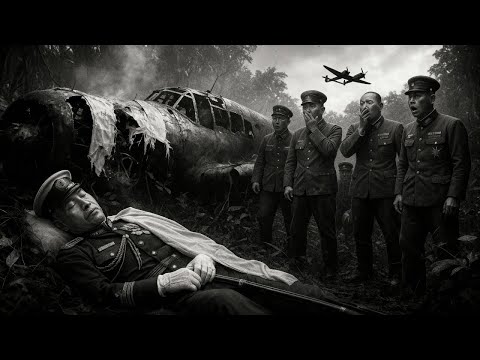
The next morning, Japanese search teams hacked through the dense Bougainville jungle, following the smoke trail from Yamamoto’s crashed bomber. What they found would haunt Japan forever.
Admiral Yamamoto’s body had been thrown from the aircraft, but he was still strapped to his seat. In his right hand, he clutched his samurai sword. An autopsy revealed two bullet wounds—one in his jaw, another in his shoulder. He had been killed instantly before the plane even crashed. The medical report described his body as being found in a state of great dignity.
Imagine the shock rippling through the Japanese recovery team. This wasn’t just any casualty. This was their greatest naval hero, the man who had delivered their most stunning victory at Pearl Harbor—the man the entire nation saw as invincible. But the Americans had reached him. In the middle of the Pacific, 435 miles from their base, flying at impossible odds, they had found and killed Japan’s most protected leader.
The psychological impact was immediate and devastating. Japan concealed Yamamoto’s death for an entire month, desperately trying to process what it meant. When they finally announced it on May 21st, the nation went into mourning unlike anything since the emperor’s father had died.
Here is what makes this story so tragically human: everyone involved was changed forever by those twenty minutes. Tom Lanphier spent the rest of his life claiming credit for killing Yamamoto. He gave interviews, wrote articles, became famous as the man who shot down Yamamoto. But Rex Barber, whose P-38 came back with 104 bullet holes, insisted he fired the fatal shots. The argument consumed both men for decades.
In 1991, four years after Lanphier’s death, the US Air Force finally conducted an official investigation. They concluded that Barber, not Lanphier, had fired the shots that killed Yamamoto. Lanphier posthumously lost his ace status, his kill count dropping from five to four.
But here is the deeper tragedy: these young men never fully understood what they had accomplished. They had killed a grandfather figure—Yamamoto was 59, old enough to be their grandfather. They had eliminated not just Japan’s greatest admiral, but a man who privately opposed the very war he was forced to fight.
For Japan, losing Yamamoto was like losing their compass in the middle of a storm. His replacement, Admiral Mineichi Koga, would later say, “There was only one Yamamoto, and no one can replace him.” Japanese naval strategy never recovered its innovative edge.
The ripple effects extended far beyond military tactics. Yamamoto’s death shattered the Japanese belief in their own invincibility. If Americans could reach their most protected leader, what was safe? The psychological warfare was perhaps more valuable than any military victory.
Admiral Ugaki, the sole witness to Yamamoto’s death, never recovered emotionally. He would go on to command Japanese battleships at Leyte Gulf, but the war was already lost. In August 1945, hours after Emperor Hirohito announced Japan’s surrender, Ugaki climbed into a kamikaze aircraft for one final mission. He was shot down and killed—the last kamikaze pilot of World War II, still trying to join his commander in death.
This story resonates today because it reveals the deeply personal cost of global conflict. In our age of drone warfare and smart bombs, we have almost forgotten that war is ultimately about individual human beings making split-second decisions that change history.
Think about the incredible chain of events: American codebreakers working forty-eight hours straight to decrypt one message. Eighteen young pilots flying the most challenging navigation mission of their lives. A Japanese admiral who knew his country was doomed but continued fighting out of duty. All converging in twenty minutes of aerial combat that shifted the balance of the Pacific War.
But perhaps most importantly, this story shows us that even in war, individual character matters. Yamamoto, despite planning Pearl Harbor, was a man of honor who privately opposed the conflict. The American pilots, despite their youth, displayed incredible courage and skill. Admiral Ugaki showed loyalty unto death. These weren’t cartoon villains or propaganda heroes. They were complex human beings caught in the machinery of global war, each trying to do their duty as they understood it.
The next time you hear about military conflicts on the news, remember April 18th, 1943. Remember that behind every strategic decision, every tactical victory, every casualty report, there are individual human stories of courage, tragedy, honor, and loss. History isn’t just about nations and armies. It’s about people.
Young American pilots who never expected to kill a legend. A Japanese admiral who died clutching his ancestral sword. A chief of staff who spent his final months trying to join his commander in death. Twenty minutes, eighteen fighters, two bombers—and the course of World War II changed forever.
The courage displayed by both sides on April 18th, 1943, reminds us that heroism isn’t about nationality. It’s about individual character under extreme pressure.
And one last image lingers: a photograph of Admiral Yamamoto’s samurai sword, recovered from the jungle crash site, now displayed in a Tokyo museum. A silent reminder of the day when twenty minutes changed the Pacific War forever.
That sword rests behind glass today, but the question it raises refuses to stay quiet. Would Yamamoto have obeyed an order he believed doomed his nation—or could one man’s honesty have turned Japan from the path to Hiroshima?
History rarely offers such clean hinges. Twenty minutes over Bougainville ended one admiral and emboldened a nation that had just proven it could strike anywhere. Yet the same raid spared countless lives by shortening a war already lost.
So we are left with the uncomfortable arithmetic of 1943: one grandfather dead in the jungle, eighteen kids flying home on fumes, and a world quietly changed.
Which matters more to you—the victory those pilots won, or the war the man they killed had tried to prevent? Tell us in the comments.
Report this article
Select a reason for reporting:






