The Pacific sun blazed down on the USS St. Lo, a speck of steel in the vast blue expanse. Sailors went about their routines, the hum of the carrier’s engines a constant companion. Then, without warning, the sky screamed. Five Japanese aircraft, Zero fighters stripped of excess weight and packed with explosives, plummeted toward the task force. On the bridge, Captain Francis J. McKenna froze as one plane, piloted by Lieutenant Yukio Seki, broke away and dove almost vertically, straight for his ship.
“She’s coming in! All hands, brace for impact!” The cry echoed across the deck, but it was too late. Seki’s plane slammed into the flight deck, a thunderous explosion that ripped through the ship. Seconds later, another kamikaze struck the exact same spot, igniting a inferno that would consume the St. Lo in minutes. Over 140 men would perish. It was October 25, 1944, and the world had just witnessed the first sinking of a ship by a kamikaze attack.
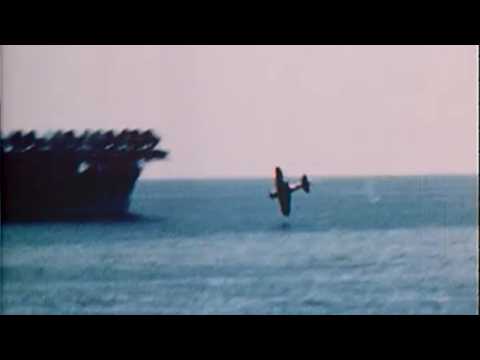
The St. Lo’s fate sent shockwaves through the Allied fleet. The kamikaze, a weapon born of desperation, had announced itself with devastating clarity. But this was only the beginning. As the Pacific War ground on, Japan’s situation grew increasingly dire. By 1944, the Allies had island-hopped across the Pacific, their fleets pounding the Japanese homeland. Conventional tactics failed; carrier strikes, once Japan’s forte, now met overwhelming Allied air power. Fuel shortages and a lack of experienced pilots crippled the Japanese air force. In this crucible of despair, the special attack units—the kamikaze—were forged.
Yet the popular image of brainwashed fanatics is a misconception. Many kamikaze pilots were volunteers, driven by a complex mix of duty, nationalism, and a desperate desire to protect their families from invasion. “I cannot say that the wish to die for the emperor is genuine coming from my heart,” wrote pilot Ichizo Hayashi to his mother just days before his final flight. “However, it’s decided for me that I do die for the emperor.” These were young men, some still teenagers, flying outdated planes loaded with explosives—human missiles in a war that had stripped away their futures.
The first official kamikaze mission took off from Mabalacat airfield in the Philippines on October 21, 1944. Lieutenant Yoshiyasu Kuno led three aircraft, ordered to attack US carriers supporting the Leyte landings. Kuno vowed to fly to Leyte Gulf if he found no targets at sea. He never returned. But not all missions ended in death; many pilots returned if they couldn’t locate a suitable target, a fact often lost in the legend.
Four days later, Lieutenant Seki’s Shikishima unit changed everything. Their orders were explicit: attack a verified enemy carrier force. With escort fighters, they approached the task force. The Zero escorts peeled away as each pilot selected a target. Seki signaled, and they dove. Chief Warrant Officer Hiroyoshi Nishizawa, flying escort, watched in horror as Seki plunged through a hail of anti-aircraft fire and smashed into a carrier—the St. Lo. Another pilot struck the same ship moments later. The carrier sank rapidly, taking 143 lives. The kamikaze had drawn blood.
In the months that followed, the attacks evolved. Pilots flew in groups, then split into smaller formations to overwhelm defenses, changing altitude and direction to confuse radar. The US Navy countered with radar picket destroyers, stationed far from the main fleet to detect incoming raids. Proximity fuses made anti-aircraft fire deadlier, and carriers circled within protective screens of destroyers, pouring ordnance into the sky. “It was quite a sight, better than the movies,” recalled sailor James Fahey of one such defense.
Ship after ship fell victim. The USS Franklin, Intrepid, Essex, Saratoga, Randolph—each took hits, yet many survived to fight again. But luck ran out for some. The USS St. Lo was the first of many sinkings. The British HMS Vestal was lost in July 1945, the only Royal Navy warship sunk by kamikaze. But amidst the tragedy, there were miracles. The HMS Sussex was struck by a kamikaze, yet the plane glanced off its hull, leaving only a perfect imprint of a Mitsubishi Ki-51 Sonia—a bizarre testament to the ship’s incredible luck.
By war’s end, thousands of kamikaze attacks had been launched. Around 4,000 Japanese pilots died, sinking or damaging hundreds of Allied ships and causing over 7,000 casualties. Vice Admiral C.R. Brown described the hypnotic fascination of watching a kamikaze plunge: “We watched each plunging Kamikaze with a detached horror of one witnessing a terrible spectacle rather than as the intended victim.”
But behind each attack was a human story, like that of Ichizo Hayashi, whose letter to his mother reveals the heartbreak beneath the horror. As the war entered its final months, the kamikaze threat only grew, culminating in the massive raids off Okinawa. The world had never seen anything like it—and the men who faced it would never forget.
Off Okinawa, the kamikaze threat reached its terrifying peak. Sixteen radar picket stations formed a ring of steel and vigilance, positioned from eighteen to ninety-five miles out from the main fleet. These destroyers, isolated and exposed, became the first line of defense—and often the first target. Sailors aboard them knew the grim calculus: every hour on station meant watching the horizon for specks that grew into diving planes.
One such picket, the USS Laffey, endured a nightmare that would become legend. On April 16, 1945, wave after wave of kamikazes descended upon her. In just eighty minutes, she was hit by no fewer than six suicide planes and four bombs. Her guns blazed until barrels melted and ammunition ran dry. Crewmen fought fires, plugged holes, and dragged wounded shipmates to safety as the deck buckled beneath them. “I saw men holding their own intestines, still firing,” one survivor later recounted. Somehow, the Laffey stayed afloat—barely. She limped back to port, a floating wreck, but she had survived.
But not every ship was so fortunate. The destroyer USS Bush was struck by three kamikazes in minutes, her crew fighting an inferno that threatened to reach her magazines. She was abandoned, then reboarded, and eventually towed to safety. The USS Pringle was not so lucky; a single kamikaze dove through her defenses and struck amidships, breaking her in two. She sank in under five minutes, taking 113 sailors with her.
The pilots who carried out these attacks were not faceless automatons. Many left behind letters, poems, and diaries that reveal their inner turmoil. One young pilot wrote, “I do not fear death, but I fear that my death will be meaningless. I want to believe that my sacrifice will save something.” Another, barely eighteen, scrawled a final message to his parents: “Forgive me for not returning. I did not want to die, but I could not bear the shame of doing nothing.”
As the battle for Okinawa dragged on, the cost mounted on both sides. The kamikaze attacks were relentless, and the American sailors grew weary, their nerves frayed by the constant watch. “You never got used to it,” recalled a gunner’s mate. “Every time you saw a plane, you wondered if it was coming for you. And when it dove, you knew.”
Yet even as the kamikaze threat intensified, the Japanese war machine was collapsing. Fuel shortages grew so severe that some pilots flew on alcohol distilled from pine roots. Training was reduced to mere hours in the air. The planes themselves were often obsolete, held together with wire and hope. But still they came—because the alternative was surrender, and surrender was unthinkable.
By July 1945, the final kamikaze strikes were launched. On the 29th, the USS Cassin Young and USS Horace A. Bass were targeted, suffering damage but surviving. Just three days earlier, British ships in Operation Livery had faced the same threat. The HMS Vestal was struck and sunk, the only Royal Navy warship lost to kamikaze. But the HMS Sussex had already had its miraculous escape—the perfect imprint of a Sonia bomber etched into its hull, a permanent reminder of how close it came to oblivion.
As the war entered its final weeks, the kamikaze pilots continued to fly, their numbers dwindling but their resolve unbroken. The world watched in horror and awe, never fully understanding the men who chose to die. And then, on August 15, 1945, the emperor’s voice crackled over the radio, announcing Japan’s surrender. The kamikaze had flown their last mission. The skies over the Pacific fell silent.
The silence was not peace—not yet. Across the fleet, sailors scanned the empty horizon, waiting for the next speck, the next scream of engines. It took days for the truth to settle in: the war was truly over. “We stood on deck and just breathed,” one veteran remembered. “For the first time in months, the sky was ours again.”
Surrender did not erase the cost. The kamikaze had sunk or damaged hundreds of ships and killed thousands of Allied sailors. Japan had lost nearly 4,000 pilots, many of them boys who never saw their twentieth birthday. Their letters home, filled with duty and doubt, became the only voices left to explain what they had done.
Some survivors struggled to reconcile the enemy they had fought with the young men they had read about after the war. “I hated them when they were diving at me,” admitted a former gunner. “Later, I read their letters and I just felt sick. They were kids, same as us.”
The kamikaze left a darker legacy too. The tactic blurred the line between soldier and weapon, a boundary the world has struggled with ever since. But for the men who lived through it, the memory was simpler: the flash of wings, the roar, the sudden quiet—and the miracle of still being alive.
In a small museum in Japan, Ichizo Hayashi’s letter to his mother sits behind glass. Its final lines still ask the question he could never answer: was his sacrifice his own, or was it decided for him? The war ended, but that question never did.
What do you think—were the kamikaze pilots victims, heroes, or something harder to name? Share your thoughts in the comments below.
Report this article
Select a reason for reporting:






