In the spring of 1940, as German tanks rolled across France, a tiny British vehicle was quietly rewriting the rules of war. It was not a tank. It was barely armored, open at the top, and powered by a commercial car engine. German officers who captured the first ones laughed. One Panzer commander stepped off his tank, walked over to an abandoned example, and kicked the side plate with his boot as if testing whether it was real. He called it a toy. He was wrong. That little machine would become the most produced armored fighting vehicle in history—over 113,000 built—serving on every major front of World War II. From the deserts of North Africa to the frozen forests of the Soviet Union, from the jungles of Burma to the beaches of Normandy, it outlasted the tank, outpaced the half-track, and proved that sometimes the simplest solution is the most powerful.
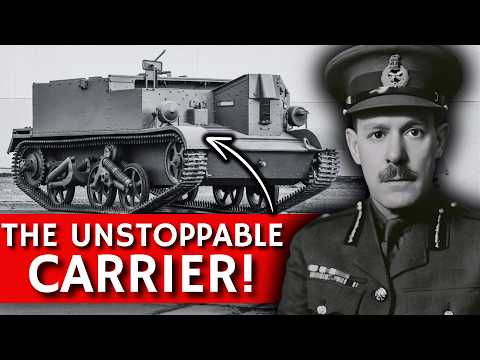
The story begins with a problem that had plagued infantry warfare since the machine gun: how to move soldiers and their heavy weapons across open ground without them being shredded by enemy fire. A full tank was too expensive, too complex, and frankly wasted on the task. What the British Army needed was something smaller, simpler, and cheap enough to build in enormous numbers—something an ordinary soldier could drive after a week of training.
The man who answered that call was John Valentine Carden, a British engineer with a gift for making tracked vehicles that were practical, affordable, and fast. Throughout the 1930s, Carden designed a series of light tankettes and carriers for Vickers, each solving a slightly different tactical problem. But the Army kept coming back to the same frustrating reality: they had too many different carriers, each optimized for a specific role, creating a logistical nightmare. In 1938, the War Office made a decision that would change everything. They commissioned a single vehicle capable of doing all the jobs at once. They called it the Universal Carrier.
The design that emerged was deceptively simple. The hull was made of rolled homogeneous steel plate, between 7 and 10 mm thick—not impressive by tank standards, but enough to stop rifle fire and shell fragments. The vehicle was barely a meter and a half tall, presenting an extremely small target on the battlefield. The top was entirely open, which saved weight and gave the crew an unobstructed view. Propulsion came from a Ford eight-cylinder flathead engine producing 85 horsepower—a commercial automobile engine, not a military power plant. That decision was not laziness; it was strategic brilliance. Ford already built millions of these engines, so the manufacturing infrastructure, tooling, and spare parts were already in place around the world. Any Ford dealer in Canada, Australia, or New Zealand could theoretically service a Universal Carrier’s power plant.
Top speed on a good road reached approximately 30 mph, while infantry could march at perhaps 3 mph. The Horstmann suspension system gave the carrier a remarkably smooth ride for such a small vehicle, and drivers described it as almost intuitive to operate. The vehicle carried a crew of two or three men, seated in a low armored compartment split into three sections by a central engine bay. This unusual arrangement kept the center of gravity as low as possible. Standard armament was a single Bren light machine gun, giving the vehicle its most common informal name: the Bren Carrier.
But the machine’s genius was its versatility. Remove the Bren and bolt on a Boys anti-tank rifle, and it could penetrate lighter enemy vehicles. Replace that with a 2-inch mortar, and it became a mobile indirect fire platform. Install a PIAT anti-tank launcher, and the tiny vehicle could threaten medium tanks at close range. Load the rear compartment with ammunition crates, and it became a resupply vehicle. Mount a stretcher frame, and it became a battlefield ambulance. Strip everything out, and it became a signals vehicle carrying radio equipment forward to positions impossible for a Jeep to reach. The carrier was, in the truest sense of the word, universal.
The Wasp variant took that versatility to its most dramatic extreme. Technicians replaced the standard armament with a Ronson flamethrower capable of projecting burning fuel to a range of approximately 90 feet. Designed specifically for assaulting prepared defensive positions, the Wasp proved devastating in the hedgerow country of Normandy, where German defenders could hold a single field against an entire infantry company for hours. A Wasp carrier could end that situation in seconds. The psychological effect was distinct from any conventional weapon—flame flows around corners, into apertures, through gaps in fortifications. German units that had held positions for hours sometimes abandoned them within minutes of a Wasp’s appearance.
But all of that was still in the future when the Universal Carrier first went to war in the summer of 1940. The Battle of France was a catastrophe for British arms. As the British Expeditionary Force retreated to Dunkirk, carriers loaded with ammunition moved forward to meet the falling back infantry, delivering the bullets and mortar bombs that kept rear guards fighting long enough for the main body to withdraw. They carried wounded men back from positions no wheeled vehicle could reach. They transported signals equipment and allowed commanders to maintain some degree of coordination in a situation where communication was constantly breaking down. Hundreds of carriers were left behind at Dunkirk, abandoned on the beach or driven into the sea to prevent capture. The Germans collected them with great interest.
This is where the story takes a remarkable turn. The Wehrmacht was not too proud to use captured equipment, and the Universal Carrier proved immediately useful. German engineers examined the vehicles with professional thoroughness and reached the same conclusion that had eluded their commanders who had dismissed them as toys. The carrier was simple, reliable, and could be maintained with ordinary mechanical skills. German units on the Eastern Front began using captured carriers as ammunition and supply vehicles almost immediately. In several documented cases, German engineers modified them further, mounting small artillery pieces and anti-tank guns on the hull in configurations the original British designers had never attempted. The Germans even assigned it a formal designation in their inventory system, calling it the Bren Carrier 731 English. They used it until the captured vehicles wore out and spare parts became impossible to source, which in several cases was not until 1943 or later.
Back in Britain, production was accelerating at a pace that pre-war planners had never imagined. The original manufacturing contract had envisioned modest numbers, but as the scope of the war became clear, the production apparatus expanded dramatically. Factories in Britain cranked out carriers around the clock, but Britain alone could not supply the demand. And so the manufacturing was dispersed across the Commonwealth—a decision that demonstrated exactly how strategically brilliant the choice of civilian components had been. Canada became a manufacturing powerhouse, producing carriers identical in mechanical terms to the British examples because they used the same Ford engine and the same industrial components already familiar to North American manufacturers. Australia followed, and New Zealand contributed as well. This distributed production system meant that even if German bombing had succeeded in destroying British carrier factories entirely, the flow of vehicles would have continued from Commonwealth plants. It was resilience built into the manufacturing architecture from the beginning.
In North Africa, the Universal Carrier found a role that transformed it from transport vehicle to combat asset. The Western Desert offered conditions that were simultaneously demanding for vehicles and forgiving for the carrier’s particular combination of characteristics. The ground was firm enough for tracks to grip effectively, the open terrain gave the carrier’s low profile a genuine tactical advantage, and the distances involved made the vehicle’s reasonable speed and endurance highly valuable. Carriers operating with the 7th Armoured Division ranged far ahead of the main body on reconnaissance missions, their small silhouette making them difficult to identify at long range against the shimmer of the desert. They probed German defensive positions, reported on enemy movements, and in several cases extracted scout teams that had moved deeper into enemy territory than was entirely wise. In the fluid mobile warfare of the desert campaigns of 1941 and 1942, the Universal Carrier proved more useful than many vehicles ten times its cost.
The carrier also served in a less glamorous but equally vital role in North Africa as a weapon of psychological disruption. Night raids by carrier-mounted infantry became a particular specialty. A section of carriers could move at speed across desert terrain in darkness, navigate to within a few hundred yards of a German or Italian position using compass bearings and landmarks, then deploy infantry for a swift attack before withdrawing before any coordinated response could be organized. The speed of withdrawal was the key to the tactic’s success. Wheeled vehicles might bog in soft sand or struggle with rocky ground. The carrier tracked its way across both with equal equanimity. And by the time the enemy’s artillery or reserve infantry were responding, the attackers were already beyond effective range.
The Pacific theater brought entirely different challenges. Burma in particular presented conditions that should have been lethal for a small tracked vehicle. The jungle was dense, the trails were narrow, the monsoon turned any unpaved surface into mud that swallowed wheeled vehicles axle-deep. But the Universal Carrier, with its relatively light ground pressure distributed across a long track contact area, could often move through conditions that stopped larger and heavier vehicles entirely. British and Indian Army units operating in the Arakan campaigns and the subsequent advance into central Burma used carriers to move supplies along jungle tracks that the Japanese had assumed were impassable for any mechanized transport. This logistical mobility gave British commanders an operational flexibility that repeatedly surprised Japanese defenders who had planned their positions on the assumption that certain approaches were vehicle-proof. The carrier made those assumptions wrong.
By the time of the D-Day landings on June 6, 1944, the Universal Carrier had been in continuous production for years and had accumulated a combat record stretching across three continents. Even on the beaches of Normandy, it was there from the first hours, landing with assault infantry to carry heavy weapons, ammunition, and signals equipment across terrain that was simultaneously swept by enemy fire and broken up by beach obstacles and the churned sand of the landing zone. In the weeks that followed, as Allied forces fought their way through the Norman hedgerow country, the carriers found themselves in some of the most claustrophobic and vicious fighting of the entire war. The bocage terrain of Normandy, with its ancient sunken lanes flanked by earth banks topped with dense hedgerows, was tailor-made to defeat the tactical advantages of larger armored vehicles. Tanks that were formidable in open country became vulnerable in the bocage, unable to see or traverse freely, easy targets for German anti-tank teams waiting in the shadows of the next hedgerow. The Universal Carrier, small enough to navigate the sunken lanes and low enough to present a minimal target, moved through the bocage with an agility that larger vehicles could not match. And the Wasp flamethrower variants proved decisive against the kind of fortified farmhouse and hedgerow strongpoints that were costing the infantry such terrible casualties.
The German soldiers who faced the Wasp variants in Normandy described a particular horror in captured accounts and post-war interviews. The psychological effect of the flamethrower was distinct from any conventional weapon. It could not be evaded by ducking behind cover. It sought out spaces and apertures that bullets could not enter. And the sound of the ignition system and the rush of burning fuel gave defenders sometimes only a second of warning before the position became untenable. German units that had held positions for hours against infantry assault and conventional tank support sometimes abandoned them within minutes of a Wasp’s appearance. That tactical reality was not lost on British commanders, who prioritized Wasp carriers for the most difficult assault tasks throughout the Normandy campaign and the subsequent advance across France and into the Low Countries.
The Soviet Union received Universal Carriers through the Lend-Lease program, though in smaller numbers than the trucks and other equipment that formed the bulk of American and British supply. Soviet accounts of carrier use are fragmentary, but they indicate the vehicle served primarily in the reconnaissance and command communication role, where its combination of cross-country mobility and low profile made it useful in the fluid conditions of the Eastern Front. Soviet engineers who examined the carrier reportedly expressed particular admiration for the simplicity and accessibility of the Ford engine, which could be maintained with tools and skills that were common in the Red Army’s mechanical support units.
Against the American M3 half-track, which was the other primary infantry carrier vehicle of the war, the Universal Carrier compared favorably in several important dimensions. The half-track was larger, carried more troops, and offered better protection for its crew on three sides. But it was also heavier, more expensive to manufacture, slower across country on soft ground, and far more demanding in terms of maintenance. The Carrier cost less than half as much to produce as a half-track, required less steel, less rubber, less fuel per mile traveled, and could be maintained by mechanics with a fraction of the training needed for the more complex American vehicle. In an army fighting a global war on a limited industrial budget, those economic advantages translated directly into greater numbers, and greater numbers translated into greater tactical flexibility at every level of command.
The production numbers tell the story most clearly. Of the more than 113,000 Universal Carriers built, Britain produced approximately 37,000. Canada manufactured approximately 29,000. Australia built roughly 5,000, and the remaining thousands came from New Zealand and from assembly operations in other Commonwealth nations. For comparison, the United States built approximately 68,000 M3 half-tracks across all variants during the same period. The Carrier did not simply match the half-track in production; it exceeded it substantially. No single armored vehicle type in any nation’s arsenal came close to the Universal Carrier’s production total. The Tiger tank, which still dominates popular imagination of World War II armor, was built in approximately 1,347 examples. The Sherman tank, one of the most produced tanks in history, reached approximately 50,000. The Universal Carrier outproduced the Sherman by a factor of more than two to one. It outproduced every other armored fighting vehicle ever built by a margin that no subsequent design has ever overcome.
Part of what made those numbers possible was that the factories building carriers were not the specialized armament plants that produced tanks and artillery. They were ordinary metal fabrication facilities, engineering workshops, and automotive assembly lines that had been converted to war production with relatively minor retooling. A factory that had spent the 1930s stamping out car body panels could, with modest adjustments, produce the hull plates for a Universal Carrier. The Ford engine required no special metallurgy or precision manufacturing beyond what was already standard in the automobile industry. This meant that even as the war expanded its demands on British and Commonwealth industry, the production base for the carrier could grow in parallel with the rest of the war economy without competing for scarce specialist resources. Every Tiger tank required careful hand-fitting of complex components machined to extraordinary tolerances. Every Universal Carrier could be built by an apprentice welder following a template. That difference in manufacturing complexity, multiplied across six years of continuous production, is where the number 113,000 ultimately comes from.
After the war ended in 1945, the carriers did not disappear. Armies that had received them through Lend-Lease continued to operate them through the late 1940s and into the 1950s. The Arab-Israeli War of 1948 saw Universal Carriers on both sides of the conflict, with Israeli Haganah forces using captured examples that had been operated by British forces in the mandate, and the Arab armies deploying carriers that had come from British Commonwealth supply lines. In the Indonesian War of Independence, carriers saw service with both Dutch colonial forces and Indonesian nationalist units who had managed to capture or purchase examples from the chaos of the post-war weapons market. The Korean War saw carriers still in service with Commonwealth forces in the early stages of the conflict, though by then they were being supplemented by newer designs. In the British Army, the Universal Carrier remained in the inventory through the 1950s, finally being withdrawn from front-line service only around 1960, more than two decades after the first examples had been produced.
What made the Universal Carrier endure so long? Beyond the sheer mass of numbers that kept examples available long after newer designs appeared, it was the fundamental correctness of its engineering philosophy. It had been designed around a realistic assessment of what infantry actually needed from a light armored vehicle, not around an idealized vision of what such a vehicle might theoretically accomplish. It carried weapons, ammunition, and men across ground that other vehicles could not traverse. It did so with an engine that any competent mechanic could repair, and with a mechanical layout simple enough that field maintenance required no specialized equipment. It was neither glamorous nor frightening in appearance. It did not inspire awe the way a tank did. No one wrote dramatic accounts of the carrier’s firepower or the terror it inspired in enemy ranks. It just worked, day after day, campaign after campaign, on every continent where the British and Commonwealth armies fought.
The engineer who set the fundamental concept in motion, John Valentine Carden, did not live to see the full scope of what his designs had created. He was killed in an air crash in December 1935, before the Universal Carrier had even been formally specified, let alone built. His work was carried forward by others at Vickers and within the War Office design teams, but the core ideas—the low hull, the open top, the civilian engine, the modular weapon system—were entirely his. He had looked at the problem of infantry support with a clarity that the committees and procurement officials could not match, and he had produced an answer so fundamentally correct that the army would still be using it 25 years after his death. That is a particular kind of legacy, one where the inventor does not get to see the peak of his creation’s impact, where the full measure of the work only becomes apparent long after the man himself is gone.
Today, military historians who study the logistics and operational sustainment of the Second World War consistently reach the same conclusion when they examine the carrier’s record. The vehicle’s contribution to Allied victory was not primarily tactical in the dramatic sense of winning individual battles. It was operational and logistical. It kept infantry sections armed and supplied across terrain that would have stopped any other available vehicle. It gave commanders a light armored capability at the section and platoon level that created tactical options which would otherwise not have existed. It was the connective tissue of the infantry battle, the machine that turned an infantry section from a collection of men carrying everything on their backs into a mobile sustained fighting unit capable of operating at a tempo the enemy could not match. The generals who planned the great offensives got the headlines. The Tiger tank commanders got the mythology. But somewhere on every battlefield in every campaign in every theater of the war, a Universal Carrier was moving forward, carrying the bullets, carrying the wounded, carrying the radio, carrying the war. 113,000 of them, the most produced armored fighting vehicle in history, the one they called a toy, the one that never stopped moving.
So the next time someone tells you that bigger is always better, that the most expensive machine wins the war, remember the little carrier the Panzer commander kicked with his boot. He called it a toy. History called it indispensable.
It was never the hero of the parade ground. It was the quiet workhorse that carried the bullets, the wounded, the radio, and the war itself—across deserts, jungles, hedgerows, and frozen forests. And it did all of it without fanfare, without mythology, and without ever stopping.
Maybe that’s the real lesson: the machines that win wars aren’t always the ones that make the loudest noise. Sometimes they’re the ones that just keep moving.
What’s the most underrated machine you’ve ever come across—military or otherwise—that quietly did its job while everyone else got the credit? Share your thoughts in the comments below.
Report this article
Select a reason for reporting:






