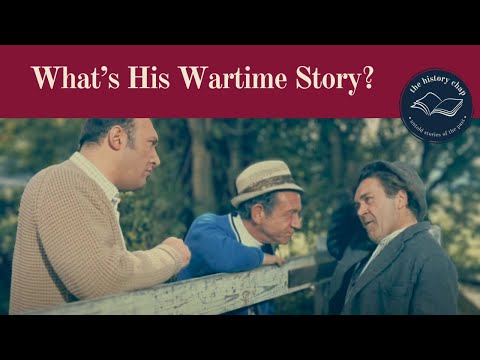
You know him as the bumbling fool who made you laugh in sixteen Carry On films. But behind that goofy grin and those unforgettable characters lies a secret history so extraordinary it sounds like a Hollywood script. Peter Butterworth was a real-life war hero, a prisoner of war who dug tunnels with a soup spoon, and a member of the elite intelligence unit MI9. His story remained hidden for decades after his death.
Born in 1915, Butterworth was a pilot in the Fleet Air Arm when World War II broke out. On June 21, 1940, just weeks after Dunkirk, his plane was shot down over the Netherlands. He survived, but spent the next five years as a POW. What he did during those years would become the stuff of legend.
Initially held near Frankfurt, Butterworth wasted no time attempting escape. In 1941, he helped dig a tunnel using nothing but a soup spoon. After six months of backbreaking work, seventeen prisoners crawled to freedom. Butterworth remained on the run for three days before Hitler Youth members recaptured him. It was a daring feat that foreshadowed his future role in two of history’s most famous breakouts.
Transferred to Stalag Luft III, the camp immortalized in The Great Escape and The Wooden Horse, Butterworth became part of something remarkable. He met Talbot Rothwell, and the two formed a comedy duo that entertained fellow prisoners. Without any acting experience, Butterworth discovered his gift for slapstick—the very style that would later make him a Carry On favorite. The two men remained lifelong friends, and Rothwell would eventually write many of the Carry On scripts.
But the real drama was unfolding beneath the surface. In October 1943, three prisoners escaped through a tunnel—not Butterworth himself, but he was instrumental in making it happen. The camp was designed to thwart escapes, with seismic detectors and distant fences. The prisoners’ solution? A wooden vaulting horse, carried daily into the yard, hiding a digger inside. Butterworth was one of the men selected to vault over that horse for hours on end, creating constant vibrations that rendered the German detectors useless. He also performed raucous comedy shows to mask the sounds of digging.
After 114 days, the escape succeeded. All three men made it back to Britain. Eric Williams later wrote the book that became The Wooden Horse. Butterworth’s war wasn’t over, though. He played a similar support role in the mass breakout of March 1944—the real Great Escape—organizing noisy shows and hiding tunnel dirt under theater seats. Only three of the seventy-six escapees reached home; fifty were executed on Hitler’s orders. Butterworth’s luck held—he remained a prisoner until 1945.
Recently declassified records reveal his final secret: Butterworth was a member of MI9, the intelligence agency tasked with organizing prisoner escapes. He encrypted coded messages from POWs and became a skilled forger. After the war, he used his wartime stage experience to launch an acting career that would span sixty-nine films. Ironically, when he auditioned for The Wooden Horse—a film about an escape he helped make possible—he was rejected for lacking a heroic physique.
Butterworth married actress Janet Brown in 1946, and they remained together until his death in 1979. His wartime friend Talbot Rothwell became the chief writer for the Carry On series and introduced him to producer Peter Rogers. From 1965 onward, Butterworth became a fixture in the franchise, creating characters like the greedy farmer Mr. Fiddler in Carry On Camping and the frantic Brother Belcher in Carry On Up the Khyber.
Yet for all his comedy fame, his most remarkable role was the one he never spoke about—the quiet hero who dug tunnels, forged documents, and risked everything so others could taste freedom. Peter Butterworth: the man who made millions laugh, and whose secret war story only now is being told.
But the story doesn’t end with his death. In 2011, Janet Brown passed away and was laid to rest beside him at Danehill Cemetery in East Sussex. For decades, his family knew only fragments of his wartime service. It was only after the release of MI9 files at the National Archives that the full picture emerged. Historian Dr. Will Butler pieced together the remarkable truth: Butterworth had been a key operative in the very organization that orchestrated the escapes he supported.
His role as a forger was particularly crucial. MI9 agents learned to replicate official German documents, and Butterworth’s skills proved invaluable. He forged identity papers, travel permits, and even military passes for fellow prisoners. These documents were often hidden in care packages or smuggled through elaborate networks. The risk was immense—discovery meant execution.
Yet Butterworth never sought recognition. After the war, he rarely spoke of his experiences. His son, Tyler Butterworth, later recalled that his father would occasionally mention the camps but always with a shrug, as if it were no big deal. The man who made millions laugh had a core of steel, forged in the crucible of Stalag Luft III. He carried that quiet strength into his comedy, perhaps explaining why his bumbling characters always seemed to have a spark of resilience.
In the 1960s, when Talbot Rothwell wrote the Carry On scripts, he drew on their shared camp humor. The absurdist gags, the slapstick timing, the irreverent attitude—all were honed in the most unlikely of comedy clubs: a POW camp. Rothwell once said that if you could make men laugh while they were starving and terrified, you could make anyone laugh. That philosophy became the backbone of the Carry On franchise.
Butterworth’s most famous scene in Carry On Up the Khyber—the dinner party that continues despite the walls crumbling around them—was a direct nod to the British stiff upper lip he witnessed during the war. As the shells fell outside, the prisoners would put on their best clothes and perform, refusing to let the enemy dictate their spirits. That scene, played for laughs, was actually a tribute to that unbreakable resolve.
Today, historians continue to uncover more about MI9’s operations. The unit was so secret that even its existence was denied for years. Butterworth’s files, marked ‘Most Secret,’ reveal a meticulous operative who took his duties seriously. He received commendations for his work, though they were never publicly acknowledged. His family only learned the full extent of his heroism when the files were declassified.
In 2018, a blue plaque was unveiled in his hometown of Bramhall, Cheshire, commemorating his dual legacy: comedy legend and war hero. It reads simply: ‘Peter Butterworth, 1915–1979, Actor and MI9 Operative.’ For those who knew him, it was a fitting tribute to a man who never boasted, never sought the spotlight off-screen, and always preferred to let others shine.
His story serves as a reminder that heroes come in many forms. Some wear capes, others wear clown shoes. Peter Butterworth wore both, and he wore them with equal grace. The next time you watch a Carry On film and laugh at his antics, remember: that bumbling fool was once a man who stared down the Gestapo and won.
But there’s one more twist to this tale. In the 1970s, Butterworth was approached by a journalist writing about the Great Escape. He politely declined to comment, saying only that ‘a lot of good men didn’t come back.’ He never attended reunions, never gave interviews about the war. For him, the real heroes were the fifty who were executed. He carried their memory in silence, and perhaps that silence was the greatest tribute of all.
There is, however, one small footnote to this remarkable life that has recently come to light—and it involves the Carry On films themselves. In 1971, while filming Carry On Camping, Butterworth found himself working alongside a young stunt coordinator named Alf Joint, a man who had served as a parachute instructor during the war. During a break in filming, the two men fell into conversation about their wartime experiences. Joint later recalled that Butterworth casually mentioned he had once been in a camp where the prisoners built a wooden horse to hide a tunnel. Joint, who had read Eric Williams’s book, nearly dropped his tea. He asked Butterworth why he had never said anything about it. Butterworth simply shrugged and said, ‘Nobody ever asked.’
That exchange stayed with Joint for decades. In 1998, long after Butterworth’s death, Joint finally went public with the story in a documentary about the real Great Escape. He described Butterworth as ‘the most modest man I ever met—a genuine hero who thought his own part in it was too small to mention.’ The revelation stunned the audience, many of whom had only known Butterworth as the bumbling fool from the Carry On films.
Yet the most poignant detail emerged from Butterworth’s own family. His daughter, Emma, remembered that as a child she once asked her father what he had done in the war. He paused, then said, ‘I made people laugh so they wouldn’t cry.’ She didn’t understand it then. She understood it perfectly when, years later, she read the MI9 files and realized the scale of what he had survived.
Butterworth’s story also intersects with another Carry On legend in a way that seems almost too neat. Kenneth Connor, his frequent co-star, had served in the Royal Artillery during the war and was one of the entertainers in ‘Stars in Battledress.’ The two men never discussed their wartime service on set. They simply understood each other—two veterans who had chosen comedy as their peacetime weapon.
Today, the wooden horse from Stalag Luft III is long gone, but a replica stands in the museum at the former camp site in Żagań, Poland. Visitors often pause before it, unaware that one of the men who vaulted over it for hours on end would later make them laugh in a completely different way. History has a strange sense of humor, and perhaps that is exactly how Peter Butterworth would have wanted it.
His legacy, then, is twofold: the laughter he brought to millions on screen, and the freedom he helped bring to a handful of men who never forgot him. In the end, both were acts of defiance—against the enemy, against despair, against the silence that so often swallows the stories of quiet heroes.
And that, perhaps, is the truest measure of the man: he never asked to be remembered, and yet here we are, still telling his story.
But perhaps the final word should go to the men who served alongside him. In a 1989 interview, Eric Williams—the man whose escape Butterworth helped make possible—was asked about the unsung heroes of Stalag Luft III. He said, ‘There were men like Peter who never got their names in the papers. They were the backbone of every escape. Without them, none of us would have seen home again.’ Williams passed away in 1993, but his words endure.
So the next time you watch Carry On Camping and laugh at Mr. Fiddler’s greedy schemes, spare a thought for the young pilot who once vaulted over a wooden horse for hours, his ears cocked for the sound of German boots. He was making noise to save lives—and he never stopped making noise until the very end.
Peter Butterworth died in 1979, but his story refuses to stay buried. Like the tunnels he dug, it keeps breaking through to the surface, reminding us that the funniest people often carry the heaviest secrets. He was a clown, a hero, and a master of disguise—both on screen and off.
And what about you, dear reader? The next time you laugh at a bumbling fool on screen, will you wonder what battles they fought when the cameras weren’t rolling? What hidden stories might the people who make us smile be carrying in silence?
Report this article
Select a reason for reporting:






