You’ve heard the story of 1917 a thousand times. Starving workers, righteous fury, the storming of the Winter Palace. But what if the men who lit the fuse weren’t starving peasants at all? What if some of them were directors of the Federal Reserve Bank of New York?
This is not a fringe conspiracy. It’s documented in State Department files, congressional testimony, and the biographies of Wall Street magnates. The evidence sits there, patient and damning, waiting for anyone willing to follow the money rather than the mythology.
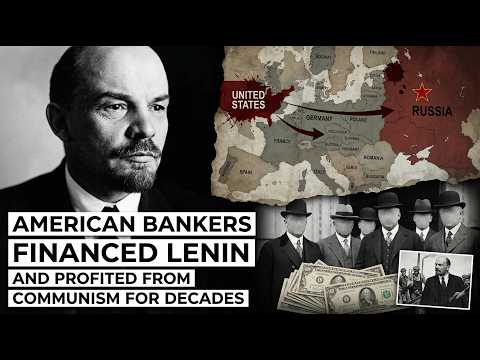
To understand why American capital had any interest in the Russian Revolution, you have to understand what Russia looked like to the Western financial world in the years leading up to 1917. The Russian Empire under Tsar Nicholas II was the last great feudal economic holdout of the modern age. A continent-spanning nation of 170 million people, drowning in natural resources, but structurally frozen in a political arrangement that made it almost impossible for foreign capital to operate freely.
The Romanov dynasty ruled by divine right and had no intention of surrendering control of Russia’s markets to outside investors. At the same time, Russia was the most overtly anti-Semitic nation on Earth. Jewish citizens were confined to a geographic zone called the Pale of Settlement, barred from most professions, and subjected to periodic waves of organized massacres known as pogroms.
Tens of thousands of Jewish families fled to the West between the 1880s and 1910s, carrying with them a burning generational hatred of the Tsar. One of those families produced Jacob Henry Schiff.
Schiff, operating from his desk at Kuhn, Loeb & Company in Lower Manhattan, was arguably the most powerful Jewish banker in the world at the turn of the 20th century. He financed American railroad expansions, sat on major corporate boards, and was a central figure in the passage of the Federal Reserve Act. And he had a personal, deeply felt obsession with destroying Tsarist power in Russia.
This is important context because Schiff is often painted either as a secret Bolshevik conspirator or as a completely innocent philanthropist. The truth is more complex. What Schiff wanted was not communism. He was a committed capitalist with no sympathy for socialist ideology. What he wanted was the collapse of the Romanov dynasty, specifically because of its persecution of Russian Jews.
As early as 1905, following the horrific Kishinev pogrom, Schiff began channeling money into organizations working to destabilize Tsarist Russia. The most documented effort involved the Russo-Japanese War of 1904-1905. Japan needed capital, and Schiff’s firm extended loan after loan to the Japanese government, totaling roughly $200 million across five bond issuances—equivalent to $5.4 billion today.
Schiff publicly stated his motivation: to bleed the Tsar’s treasury and weaken the Russian war machine. The Japanese emperor awarded him the Order of the Rising Sun. But the financial assault didn’t stop with Japan. During the same war, Schiff funded the printing and distribution of revolutionary Marxist propaganda, delivered to tens of thousands of Russian prisoners of war held in Japanese camps.
Russian-speaking agitators, trained in New York, traveled to those camps and spent months indoctrinating Russian officers and soldiers in anti-Tsarist ideology. When those men returned home after the war, they returned as seeds of revolution—pre-radicalized, pre-organized, and deeply hostile to the regime they had just fought for.
Historians now credit some of the unrest of the 1905 Revolution directly to those returning prisoner agitators. By 1917, the political landscape had shifted in ways that made the earlier narrative of one banker funding anti-Tsarist revolution much harder to track.
When the February Revolution of 1917 toppled Nicholas II and replaced him with Alexander Kerensky’s provisional government, Schiff’s reaction was jubilant. This was what he had been working toward for over a decade. He publicly celebrated. He extended loans to the Kerensky government. He cut a cable congratulating them on finally delivering Russian Jews equal citizenship.
And then, in November of that same year, Lenin’s Bolsheviks overthrew Kerensky. Schiff’s reaction was immediate and unambiguous. He cut off all financing. He demanded repayment of loans. He began funding anti-Bolshevik organizations. Whatever role Schiff played in destabilizing Tsarist Russia, he did not consider it a successful outcome when Lenin took power. He considered it a betrayal. He died in 1920, largely horrified at what had emerged from the chaos he helped create.
That distinction matters, but it does not change what happened. Because while Schiff was recoiling from the Bolsheviks, other American financial figures were doing something quite different. And those figures are far less well known than Schiff, which is precisely why the story tends to stop at his doorstep rather than continuing much further.
Let us talk about Leon Trotsky and what he was doing in the Bronx. In January of 1917, Trotsky arrived in New York City with his wife and two young sons. He had been expelled from France and then from Spain, and had eventually been shipped to America essentially because the Allied powers in Europe were afraid of him. He was one of the most effective anti-war agitators in the socialist world, and with Russian troops still desperately needed on the Eastern Front, the last thing Britain and France wanted was Trotsky running loose in Western Europe.
In New York, Trotsky settled his family into a three-bedroom apartment in the Bronx, not far from Crotona Park. He worked during the days at the offices of a small Russian-language revolutionary newspaper called Novy Mir. In the evenings, he gave speech after speech at venues across Manhattan, drawing enormous crowds of working-class Russian and Jewish immigrants. He gave more than 30 public addresses in fewer than 10 weeks.
But here is what Trotsky himself wrote in his autobiography about those months in New York. He wrote that on many occasions, a chauffeured limousine was placed at his disposal by a wealthy acquaintance he identified only as Dr. M. His wife and children were taken out driving by this man’s wife. His sons were delighted. And Trotsky described the chauffeur specifically as a magician.
Most historians have identified Dr. M as Julius Hammer, the founder of Allied Drug and Chemical, a co-founder of the Communist Party USA, and the father of the man who would eventually become one of the most consequential American businessmen of the 20th century. Julius Hammer was a committed Marxist who ran a successful pharmaceutical company and who had deep, well-documented connections to the Bolshevik network in America.
His son, Armand Hammer, would later go on to become the primary commercial intermediary between the United States and the Soviet Union for decades. But we will come back to that.
The point is this. Trotsky was not living in New York in poverty. He was meeting people. He was being supported. His passage through the social and financial infrastructure of New York’s radical community brought him into contact with networks that had money, connections, and interests in the Russian political situation.
When news reached New York in mid-March of 1917 that Tsar Nicholas had abdicated, Trotsky immediately tried to return to Russia. He boarded the Norwegian steamer Christianiafjord on March 27th with his family and roughly 275 fellow revolutionaries. The ship made its first port call at Halifax, Nova Scotia, where British naval intelligence promptly had Trotsky and five of his associates removed from the vessel and taken to an internment camp at Amherst.
The British knew exactly who he was. They were not going to let this particular man walk back into Russia with a revolutionary agenda and a stated intention to take Russia out of the war. And here is where the story becomes very difficult to explain through conventional historical channels.
Because within days, enormous diplomatic pressure began building to secure Trotsky’s release. Telegrams arrived at Halifax from Jewish attorneys in New York City. The Canadian Deputy Postmaster General made inquiries. British military figures weighed in on both sides. And the head of British secret intelligence in America at the time was a man named Sir William Wiseman who—and this detail is not trivial—occupied an apartment in the same building directly above the apartment of Edward Mandell House, President Woodrow Wilson’s closest personal advisor and de facto shadow foreign minister.
Wilson himself intervened to ensure that Trotsky had valid travel documents. Professor Anthony Sutton, a research fellow at the Hoover Institution at Stanford University who spent years excavating State Department files and diplomatic records on this subject, documented that Wilson provided Trotsky with an American passport specifically to enable his return to Russia to, in Sutton’s phrasing, carry the revolution forward.
State Department bureaucrats who were trying to tighten passport controls were quietly overruled. Trotsky was released from Amherst on April 29th, 1917. He arrived in Petrograd on May 4th carrying $10,000 in travel funds the origins of which remain disputed. He joined the Bolsheviks in July. By November, he was Commissar of Foreign Affairs in Lenin’s new government. Nobody in the Wilson administration was ever held accountable for any of this.
Now let us cross the Atlantic and follow the other train. Because while Trotsky was making his way to Russia from the west, Lenin was making his way to Russia from a very different direction.
Vladimir Ilyich Lenin had been living in exile in Zurich, Switzerland for years. When news of the Tsar’s abdication reached him, he was described by those around him as stunned, then frantic. He needed to get back to Russia immediately, but getting from Switzerland to Russia in April of 1917 was not a simple matter.
To go through France or Britain meant asking Allied powers who regarded him as a German agent to give him a transit visa. To go through Germany meant asking an enemy power, a nation still at war with Russia, for the same. The second option was the one that happened.
The arrangement was negotiated through several intermediaries. The German government, specifically the office of Chancellor Bethmann Hollweg and State Secretary Arthur Zimmermann, was deeply interested in using Lenin as a weapon. Their strategic logic was blunt and cold. If Lenin could be delivered back to Russia, he would work to take Russia out of the war. A Russia knocked out of the Eastern Front would free over a million German soldiers to be redeployed westward.
The key intermediary was a man named Alexander Israel Helphand, who operated under the alias Parvus. Helphand was one of the most extraordinary figures of early 20th century radical politics. A committed Marxist revolutionary in his youth, a comrade to both Lenin and Trotsky, who had gradually transformed himself into something far stranger. A war profiteer, an arms contractor, a millionaire socialist who lived in scandalous luxury while theorizing about proletarian revolution and feeding intelligence to the German High Command.
He was based in Copenhagen and served as the crucial link between the German Foreign Office and the Bolshevik network. Zimmermann supervised the details. The German General Staff signed off on the logistics. And on April 16th, 1917, a train carrying 32 people including Lenin, his wife Nadezhda Krupskaya, Grigory Zinoviev and Karl Radek departed from Bern Central Station.
The train passed through Germany in what has become known to history as the sealed train. The carriages were in theory sealed, meaning German authorities could not enter them, but the train itself traveled openly through German territory under explicit German government protection.
Max Warburg, the head of the Hamburg branch of the great Warburg banking family, was involved in arranging financial transfers in support of this operation. The Warburg family straddled multiple worlds simultaneously. Max ran the German family bank M.M. Warburg & Company in Hamburg. His brother Paul Warburg was one of the primary architects of the United States Federal Reserve System and sat on the Federal Reserve Board in Washington. His brother Felix Warburg was a partner at Kuhn, Loeb & Company in New York, married to Jacob Schiff’s daughter.
The Warburg network was a thread running through the highest levels of both Allied and German financial power simultaneously. When Paul Warburg’s connection to his brother’s role in financing Lenin became publicly known in American newspapers, Paul quietly resigned from the Federal Reserve Board without public comment.
Estimates of the total German funding channeled to the Bolsheviks through these and other conduits varied considerably. Some historians place it at between 50 million and 80 million gold marks, equivalent to several hundred million dollars today. The money flowed through a Stockholm bank called Nya Banken, whose director Olof Aschberg openly called himself the Bolshevik banker.
Documents from United States military intelligence reproduced in congressional records show transfer instructions, account numbers and the names of intermediaries in excruciating detail. The German Foreign Ministry’s own internal records, examined by historians including British academic Z.A.B. Zeman who published a scholarly study on the subject in the 1950s, confirm that substantial sums were transferred to Bolshevik-affiliated accounts through these channels.
Germany’s motives were purely military. This part of the story is, in broad terms, well accepted by mainstream historians. Germany funded Lenin to destroy the Russian war effort and it worked. Lenin signed the Treaty of Brest-Litovsk in March of 1918, ceding enormous portions of the former Russian Empire to German control and taking Russia entirely out of the war. From Germany’s perspective, the investment had paid off spectacularly. From Russia’s perspective, the humiliation was total.
But the German funding is only part of the picture. Because while Germany was maneuvering from the east, something very peculiar was happening from the west. And it involves a man whose name belongs in the same sentence as the October Revolution but almost never appears there. His name was William Boyce Thompson.
Thompson was, by any measure, a titan of American capitalism. A Montana-born mining promoter and stock operator who had made an enormous fortune through copper mining ventures and stock market operations largely for the Guggenheim family interests. By 1917, he was a director of the Federal Reserve Bank of New York. He moved in the highest circles of American finance, was close to the Morgan banking network, and had absolutely no expressed ideological sympathy for socialism of any kind.
In the summer of 1917, Thompson offered to personally pay the entire cost of an American Red Cross mission to Russia. He offered to fund all expenses out of his own pocket. He was given the title of colonel, as were most of the mission’s members. When one observer looked at this group of 40-some commissioned officers dressed in Red Cross uniforms and noted there was not a single enlisted man among them, he dubbed them the Haitian Army, with the implication being that the officer-to-enlisted ratio suggested this was not exactly a medical mission.
The American Red Cross mission to Russia in 1917 did not distinguish itself for its humanitarian work. What it distinguished itself for was political maneuvering. Thompson, alongside his deputy Raymond Robins, initially poured money and organizational effort into supporting Alexander Kerensky’s provisional government. They helped create and fund a propaganda operation called the Committee of Civic Education in Free Russia, which was essentially a sophisticated influence campaign aimed at persuading ordinary Russians to continue fighting the war. Thompson personally donated $1 million of his own money to this effort.
When the Kerensky government fell to the Bolsheviks in November of 1917, Thompson did not pack his bags and leave. He reconsidered his position. Based on his own first-hand observation of the Russian political situation, Thompson concluded that Lenin’s government was going to survive and that the commercially rational thing to do was to engage with it rather than fight it. He began making the case to anyone who would listen—in Petrograd, in London, in Washington—that the Bolshevik government should be recognized and worked with.
And then, in December of 1917, something extraordinary happened. Thompson cabled the Morgan banking house in New York requesting that funds be made available. The cable reply from J.P. Morgan Jr., documented in Thompson’s own biography by Herman Hagedorn and confirmed in United States State Department files, read in full: “Your cable second received. We have paid National City Bank $1 million as instructed.” — Morgan.
The cable was date-stamped the 8th of December, 1917, just weeks after the Bolshevik seizure of power. That million dollars was deposited at the Petrograd branch of National City Bank. And here’s the detail that makes this entirely impossible to explain away. The Petrograd branch of National City Bank was the only financial institution in all of Russia, foreign or domestic, that was exempted from the Bolshevik nationalization decree. Every other bank in Russia was seized by the state. National City Bank Petrograd was not. It was as though an invisible hand had reached into the mechanics of the Bolshevik financial administration and carved out a single protected pocket for one American bank.
Anthony Sutton, whose 1974 book Wall Street and the Bolshevik Revolution drew on State Department files, diplomatic records, congressional testimony, and personal biographies to reconstruct these connections, put it plainly. He wrote that the mission was, in fact, a mission of Wall Street financiers to influence and pave the way for control of the Russian market and resources. He argued that neither Thompson nor Robins was a Bolshevik and that their socialist-inflected public statements were covers for more commercial objectives. They were fighting for access. They were betting on whoever they believed would win and positioning themselves to extract value from that winner’s Russia.
This interpretation is disputed by some historians. Thompson’s official biographer argues that the newspapers of the time jumped to the conclusion that Thompson had given money to the Bolsheviks directly when, in fact, his documented donations were to Kerensky’s organizations. The precise destination of that December 1917 million dollars remains a subject of historical debate.
What is not debated is that the money was transferred, that it was sent to a bank that somehow survived the nationalization of the entire Russian banking sector, and that Thompson spent the following weeks traveling through London and meeting with the British War Cabinet personally arguing that the Allied powers should cease their opposition to the Bolshevik government and begin working with it.
Thompson then returned to the United States and gave an interview to the Washington Post in February of 1918 in which he stated directly that he had given money to the Bolsheviks in order to undermine the militarist regimes of Central Powers. He said it publicly. He said it in a newspaper, and nothing happened to him.
Now, step back for a moment and consider the full picture that is forming. You have Jacob Schiff and Kuhn, Loeb spending years and enormous sums destabilizing Tsarist Russia through Japan and through revolutionary propaganda networks. You have Max Warburg and Parvus coordinating the German government’s funding of Lenin’s passage back to Russia and financing Bolshevik operations through Stockholm. You have Sir William Wiseman, the head of British intelligence in America, who would later go on to become a partner at Kuhn, Loeb himself, interceding to secure Trotsky’s release from Canadian custody. You have President Wilson, advised by Edward House, who was physically adjacent to Wiseman, ensuring that Trotsky’s travel documents are in order. You have William Boyce Thompson, Federal Reserve director and Morgan-connected financier, personally funding the Red Cross mission to Russia, then shifting his support toward the Bolsheviks after Kerensky falls, then cabling the Morgan house for a million dollars, then lobbying Allied governments to recognize Lenin’s regime.
These are not random coincidences. And the question that Sutton spent years trying to answer is the obvious one. Why would the most committed capitalists on Earth pour money into a communist revolution?
The answer, when you follow the logic of it rather than the ideology of it, is both simple and deeply unsatisfying. Because revolutionary Russia represented, to the eyes of certain Western financiers, the largest potential market in the world suddenly thrown open. The Tsarist system had been a closed shop. Foreign capital could not freely operate. Russian resources were locked behind Romanov political control. A new government, any new government, would need foreign capital to survive. A new government, especially a radical one that had just blown up the old order and had no diplomatic recognition, no credit, no allies, and no technical expertise in modern industrial management, would be desperate. And desperate governments grant concessions.
This is not speculation. This is what actually happened. Armand Hammer, the son of Julius Hammer, who had hosted Trotsky in New York and whose family had deep connections to both the American Communist Party and to Soviet financial networks, traveled to the Soviet Union in 1921, ostensibly to deliver medical aid during a famine that was killing millions of people. He met Lenin personally. Lenin, who understood immediately what this young American businessman represented, made him an extraordinary offer. Become the primary commercial intermediary between Soviet Russia and the Western capitalist world. Hammer accepted.
Over the course of the next decade, Armand Hammer held concessions for asbestos mining in the Ural Mountains. He opened a pencil factory in Moscow that became the largest supplier of pencils in the Soviet Union. He represented 38 American companies in their dealings with the Soviet state, including Ford Motor Company and United States Rubber. He imported grain and exported furs, caviar, and the seized art treasures of the Romanov dynasty, which the cash-hungry Soviet government sold to him for kopecks on the ruble. He returned to the United States in 1930 with a fortune and a collection of Fabergé eggs. He was never prosecuted for any of it.
But Hammer was, in a sense, simply the most visible example of a much broader pattern. Standard Oil, the Rockefeller enterprise, signed agreements to supply the Soviet government with technical assistance for oil exploration. Ford Motor Company built plants. International Harvester, which had provided $200,000 to the American Red Cross mission before it even left for Russia, maintained commercial relationships with the Soviet state throughout the 1920s. The commercial logic was always the same. Ideology is something that countries declare, but trade is what countries need. And whoever was first through the door when the Soviet economy opened up would control extraordinary amounts of business.
It is worth noting at this point something that has been almost entirely scrubbed from the popular understanding of this period. The Bolsheviks, upon taking power, issued one of the most dramatic sovereign debt repudiations in recorded history. In January of 1918, they formally refused to honor any of the debts incurred by the Tsarist government or the Kerensky Provisional Government. This wiped out the investments of hundreds of thousands of foreign creditors, primarily French and British investors who had poured billions into Russian government bonds over the preceding decades. The total value of repudiated debt was staggering.
Yet certain American financial interests, specifically certain banks with Petrograd branches, were conspicuously not harmed by this repudiation to the same degree as their European counterparts. National City Bank’s Petrograd branch, as already noted, was not nationalized. And within years, the same banking houses that had participated in the revolutionary moment were negotiating commercial arrangements with the new Soviet state.
The Bolsheviks understood the game perfectly. Lenin himself said, in one of his more candid moments, that the capitalist would sell the rope by which they would be hanged. What he did not add, though he certainly knew it, was that some of the capitalists had also helped pay for the people who were going to do the hanging.
Here is what makes this story not merely historically interesting, but genuinely important to understand. Nobody was punished. Not Thompson, not Schiff, who died in 1920 with his international reputation largely intact. Not Paul Warburg, who resigned from the Federal Reserve quietly and continued his financial career. Not the Morgan banking house, not the Kuhn, Loeb partners, not Wilson’s advisers, not the officials who released Trotsky from Canadian custody, not the State Department figures who issued him travel documents against the explicit concerns of their own colleagues.
This impunity was not an accident. It was a product of the fact that the people who might have been prosecuted were the same people who structured the financial systems, influenced the political systems, and in some cases directly advised the executive branch of the United States government. When Senator Overman’s committee investigated Bolshevik activities in the United States in 1919, the testimony and documents it accumulated pointed directly at some of these financial connections. The committee acknowledged what it was seeing and then more or less went silent. The subject became, in the words of one observer at the time, taboo.
It is important to be honest about the limits of what the evidence definitively proves versus what it strongly suggests. Mainstream historians, including serious scholars like Hassan Malik, whose book Bankers and Bolsheviks draws on previously inaccessible Russian and Western banking archives, have argued that the Bolsheviks were primarily self-funded through the seizure of Tsarist assets, church wealth, and the property of the Russian nobility, and that foreign financial contributions, while real, were marginal compared to these domestic sources. Malik also argues that foreign investment in pre-revolutionary Russia actually weakened the Romanov government in the long run by creating debts and dependencies that radicalized the population further.
Careful historians are also right to note that Sutton’s broader framework, which eventually drew him toward theories about Yale secret societies controlling both communism and fascism as a kind of Hegelian dialectic, went considerably further than the documentary evidence could support. There’s a meaningful distinction between the specific documented financial connections, which are real and disturbing, and the maximalist interpretation that claims the entire Soviet project was a Wall Street creation, which is both overstated and not supported by the primary sources.
But here is what the evidence does clearly establish and what cannot be argued away. Multiple wealthy American financiers, operating from the top of the United States financial system, made deliberate decisions to send money into the Russian revolutionary situation in 1917. Some of that money provably ended up supporting the infrastructure that helped Lenin’s government consolidate power. The American government, through its highest office, took actions that directly aided the return to Russia of one of the architects of the Bolshevik coup. Senior American financial figures then lobbied European governments to recognize and do business with the revolutionary regime. American corporations moved in within years of the revolution to profit from the new Soviet economic order. And the thread connecting all of these events was not ideology. It was access, markets, resources, contracts.
There is something almost cosmically ironic about this. The great ideological conflict of the 20th century, the one that would define the Cold War and justify trillions of dollars in military spending, the one that would be sold to the American public as a fundamental clash between capitalism and communism, between freedom and tyranny, that conflict emerged partly from the maneuverings of capitalists who helped birth the very system they would later claim to be fighting. The Soviet Union, for all its genuine horror and genuine misery, was in part a creation of the same financial world it claimed to oppose. And the people who helped make it possible walked away clean, wealthy, and largely forgotten by the history they had helped to write.
The sealed train that carried Lenin across Germany was not just a German intelligence operation. It was also, in a very real sense, the product of a much broader financial architecture that had been working for over a decade to crack open the Romanov system. Germany wanted a military dividend. American capital wanted a commercial one. What neither of them anticipated, or if they anticipated it, what they greatly underestimated, was that Lenin was not anyone’s puppet. He was not going to deliver the open Russian market that Western investors dreamed about. He was going to build a totalitarian state, nationalize everything, repudiate the debts, and use the contradiction of being financed by capitalists as proof of capitalism’s fundamental cynicism.
And in that sense, at least, Lenin won the argument. Even if his revolution killed millions, enslaved generations, and ended in the rubble of 1991. He had identified something true and terrible about how power actually moves in the modern world. It does not move through ideology. It moves through money. And money has no loyalty to any ideology at all.
The people who funded Lenin did not do so because they believed in communism. They did it because they believed in access. They believed that whoever won the chaos of 1917 Russia would need them, and some of them were right. Armand Hammer was right. The concessions came. The deals were signed. The art treasures left Russia in crates. The pencil factories opened. The Ford tractors crossed into the Soviet Union.
What they did not fully reckon with was the cost that ordinary Russian people, and eventually much of the world, would pay for the experiment they helped fund. That cost was measured in tens of millions of lives, in gulag archipelagoes, in forced collectivizations that starved entire regions, in 70 years of an empire built on terror. The bankers paid nothing. The Russian people paid everything.
And the most extraordinary thing about all of it, more extraordinary than the sealed train, more extraordinary than the Morgan cable, more extraordinary than Trotsky riding in a limousine through the Bronx, is that this story exists entirely in the documentary record, in State Department files and congressional transcripts and the biographies of the men themselves. It has been written about by a Stanford research fellow. It has been discussed in academic journals. The primary sources are declassified and in many cases freely accessible online. The story is not secret. It is simply inconvenient. And inconvenient stories, as every student of power eventually learns, have a way of finding themselves quietly removed from the syllabus.
The next time someone tells you that communism and capitalism are polar opposites, that they represent fundamentally different visions of humanity locked in permanent conflict, remember the sealed train. Remember the Morgan cable. Remember the Bronx limousine. Remember the pencil factory in Moscow. And then ask yourself the question that this entire story ultimately demands. If the most powerful capitalists on Earth helped build the great enemy of capitalism, what does that tell you about what these men were actually fighting for? And what does it tell you about who the real enemy has always been?
If you made it this far, you already know the kind of channel this is. We follow the money. We follow it wherever it leads. If you want to keep going down this particular rabbit hole, make sure you subscribe and leave a comment. I read every single one of them. And if this story made something click for you, share it with someone who thinks they already know how the 20th century happened. Because as it turns out, the real story is always stranger than the one we were taught.
So here’s my question for you: if the men who built the Federal Reserve and the men who funded the Bolsheviks were sometimes the same men, what does that say about who is really writing the history we learned in school—and what else might they have quietly edited out? Let me know in the comments below.
Report this article
Select a reason for reporting:






