The C-47 shuddered violently, its metal belly torn open by a German anti-aircraft shell. Inside, paratrooper Willie Green’s parachute had deployed prematurely, blocking the jump door as the plane spiraled toward the earth. In the red-lit chaos, Jake McNiece—a Mohawk-sporting rebel with a reputation as wild as his war paint—fought to clear the exit before they all burned. This was supposed to be a routine jump over Normandy, but nothing about Jake’s war was ever routine.
Jake McNiece was the soldier America was afraid to send to war—a brawler, a rule-breaker, a man who refused to salute officers and solved disputes with his fists. Yet the Army kept him because, as one commander put it, “There will come a time when you’ll be very grateful to have McNiece near you.” That time had come.
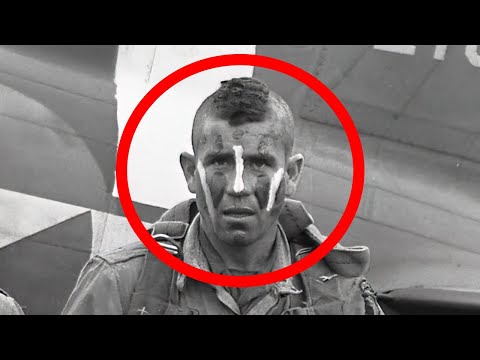
Born into the Great Depression, Jake started working at ten, learned to fight for what he wanted, and never backed down from anyone—not even the Devil, according to a teacher’s note. When World War II erupted, he traded his firefighter’s exemption for a paratrooper’s wings, drawn to the elite unit that promised direct combat. “I wanted to look him in the eye,” Jake later said of the enemy. He got his wish.
But first, he had to survive training. Out of a thousand men, only ten would earn their wings. Jake’s rebellious streak nearly got him kicked out—he brawled with a mess officer, was transferred to a unit of misfits dubbed the “Filthy Five,” and reveled in their filthy reputation. Yet his tactical brilliance and fearless leadership kept him in the fight. When his unit shipped to England, they became the “Filthy Thirteen,” a band of brothers who painted their faces and shaved Mohawks, ready to leap into the unknown.
On the night of June 5, 1944, Jake and his men boarded a C-47 bound for France. The sky was clear, but the calm didn’t last. Anti-aircraft fire erupted, and Jake’s plane was hit. He jumped just before it exploded, watching many of his comrades die. Half the Filthy Thirteen would never see home again. Yet Jake landed in the chaos of Normandy, gathered survivors, and led them on a mission that would change the course of history: seize and hold the bridges over the Douve River.
For three days, Jake’s makeshift unit—now forty strong—held the bridge against relentless German assaults. When American bombers mistakenly destroyed the bridge, Jake and his men emerged from the dust, unscathed and unbroken. They pushed deeper behind enemy lines, turning every engagement into a nightmare for the Axis. “If they’re afraid of us as crazy paratroopers, then we’ll look even crazier,” Jake’s father later reflected.
Jake McNiece would go on to jump into Holland, fight in the Battle of the Bulge, and earn the French Legion of Honor. But his story was only beginning—a tale of rebellion, courage, and the thin line between madness and heroism. The Filthy Thirteen had arrived, and the world would never forget them.
But the bridge at Douve was only the first chapter of Jake’s war. In the weeks that followed, the Filthy Thirteen became a ghost unit—appearing where the Germans least expected them, striking hard, and vanishing into the hedgerows before the enemy could regroup. They were no longer just soldiers; they were a legend spreading through the ranks on both sides of the line.
German officers began issuing warnings about the painted madmen with Mohawks who fought like demons and never took prisoners—or so the rumors claimed. The truth was more complicated. Jake’s men fought dirty, but they fought smart. They used the terrain, the darkness, and the sheer terror of their reputation as weapons.
One night in late June, Jake led a patrol deep into German-held territory near Saint-Lô. They were hunting for intelligence—maps, orders, anything that could give the advancing Allied forces an edge. The patrol moved through the flooded marshes, their faces streaked with war paint, their footsteps silent on the wet earth.
What they found was not a supply depot or a command post. It was a farmhouse where a German colonel had set up a forward observation post. Through the window, Jake counted twelve men, a radio, and a wall covered in maps. “Too many to fight,” whispered one of his men. Jake grinned. “Then we don’t fight them. We scare them.”
They waited until the colonel stepped outside for a cigarette. Jake and two others emerged from the shadows, their faces grotesque in the moonlight. The colonel froze, his cigarette falling from his lips. Before he could shout, Jake had a knife at his throat and a hand over his mouth.
Inside the farmhouse, the German soldiers were confused, then terrified, as painted figures appeared in every doorway and window. Not a shot was fired. The entire observation post surrendered without a single casualty on either side. Jake’s men walked twelve prisoners back to American lines that night, along with a briefcase full of German battle plans.
The intelligence was rushed to division headquarters. It revealed a planned counterattack that could have shattered the American position. Because of Jake’s patrol, the attack was anticipated and crushed before it began.
Yet recognition never came easily to the Filthy Thirteen. Their methods were unorthodox, their discipline questionable, and their commander—a man who still refused to salute and called officers by insulting nicknames—was an embarrassment to the brass. They were heroes the Army didn’t want to admit it needed.
When a staff officer suggested that Jake be court-martialed for his latest infraction—stealing a jeep to visit a French farmhouse where he’d heard there was fresh bread—his company commander intervened. “You want to court-martial the man who just saved your division?” the captain asked. The charges were quietly dropped.
By mid-July, the Filthy Thirteen had been in combat for over a month without relief. They were exhausted, their uniforms in tatters, their bodies covered in cuts and bruises. But their spirit remained unbroken. Jake kept them together with a mixture of fear, respect, and the promise of more chaos to come.
Then came orders that would send them into a different kind of hell—the Dutch countryside, where Operation Market Garden was about to unfold. Jake gathered his men in a bombed-out barn, their faces still painted, their Mohawks now growing into shaggy crests.
“They’re sending us to Holland,” he said. “Another jump. Another fight. And you know what that means?” He paused, scanning their faces. “It means more Germans to scare the hell out of.”
The men laughed—a harsh, tired sound. They were ready. They were always ready. The Filthy Thirteen were about to write another chapter in their bloody legend, and the world was watching.
The jump into Holland was different. The sky was a pale, watery gray, and the drop zones were scattered across flat, canal-crossed farmland that offered no cover. Jake stood in the door of the C-47, his face streaked with paint, his Mohawk now a ragged crest. “Remember,” he shouted over the engine’s roar, “we’re not here to hold ground. We’re here to raise hell.” Then he leapt into the void.
They landed near Eindhoven, tasked with securing bridges and disrupting German communications. But the enemy was ready. Within hours, the Filthy Thirteen were pinned down by machine-gun fire from a farmhouse. Jake, crouched behind a stone wall, assessed the situation. “We need to get inside that house,” he muttered. “But we’re not going through the front door.”
Under cover of a mortar barrage from another squad, Jake led four men around the back, crawling through a drainage ditch that stank of manure and mud. They emerged behind the farmhouse, and Jake kicked in the rear door. The Germans inside—six of them—were caught completely off guard. “Boo,” Jake said, and his men opened fire.
The fight was over in seconds. But the noise drew more Germans. A truckload of infantry arrived, and Jake’s small group was suddenly outnumbered. He ordered a retreat, covering his men as they fell back toward the rest of the platoon. “Go! I’ll catch up!” he yelled, firing his Thompson in short, controlled bursts.
What happened next became another legend. Jake, alone and nearly surrounded, ran out of ammunition. Instead of surrendering, he picked up a fallen German’s rifle and charged the enemy truck, screaming at the top of his lungs. The Germans—convinced they were facing a madman—hesitated. That hesitation was all Jake needed. He threw a grenade into the truck’s cab and dove into a ditch as it exploded.
When his men found him, he was sitting in the mud, covered in dirt and blood, grinning. “Told you I’d catch up,” he said. The Filthy Thirteen had taken the farmhouse and held it until reinforcements arrived.
But Market Garden was a failure. The bridges were too far, the enemy too strong, and the British paratroopers at Arnhem were being annihilated. Jake’s unit was ordered to hold a stretch of road near Nijmegen, a thankless task that meant digging in and waiting for the German counterattack.
It came at dawn—a full battalion of SS infantry, supported by tanks. Jake’s men had no armor, no air support, and barely enough ammunition. But they had their reputation. As the Germans advanced, they heard the Americans shouting insults and laughing—a sound that, in the cold morning air, seemed utterly insane. The Filthy Thirteen had learned that fear was a weapon, and they wielded it with precision.
The Germans attacked three times. Each time, they were thrown back by a wall of fire and a chorus of jeers. Jake moved along the line, slapping helmets, shouting encouragement, and occasionally firing a rifle himself. “They’re breaking!” he called out. “One more push and they’ll run!”
He was right. By noon, the SS battalion was retreating, leaving behind burned-out tanks and dozens of dead. Jake’s men had held the line. But the cost was high. Of the forty men who had jumped into Holland, only twenty-three were still standing. The rest were dead or wounded, evacuated to field hospitals.
That night, Jake sat alone by a campfire, staring into the flames. One of his men, a young private from Kentucky, approached him. “Sergeant,” he said, “why do you do it? Why do you fight like that?” Jake looked up, his face still painted, his eyes tired. “Because if I don’t,” he said quietly, “who will?”
The private nodded and walked away. Jake watched him go, then turned back to the fire. The war was far from over. There was still the Bulge, still Bastogne, still more jumps and more fights. But for now, there was only the fire, and the silence, and the men who had survived.
The winter of 1944 brought Jake and his men to the frozen hell of Bastogne. Surrounded by the German army, low on ammunition and hope, the Filthy Thirteen were ordered to hold the line. “They’ve got us surrounded,” Jake said with a grim smile. “The poor bastards.”
For days, they endured artillery barrages and infantry assaults, their painted faces now smeared with frost and dirt. When a German envoy demanded surrender, Jake’s reply was blunt: “Nuts.” The word became a rallying cry, echoing through the snowy woods.
After the war, Jake returned home a changed man. He worked as a firefighter, raised a family, and rarely spoke of the war. But the legend of the Filthy Thirteen lived on, inspiring books and films. In 2012, France awarded him the Legion of Honor. “I just did what I had to do,” he said, shrugging off the praise.
Jake McNiece died in 2013, at the age of 93, leaving behind a legacy of courage, rebellion, and the unbreakable spirit of the paratrooper. His story reminds us that heroes are not always polished or polite—sometimes they are the ones who break the rules to win the fight.
What would you have done in Jake’s boots, facing impossible odds with nothing but guts and a Mohawk?
Report this article
Select a reason for reporting:






