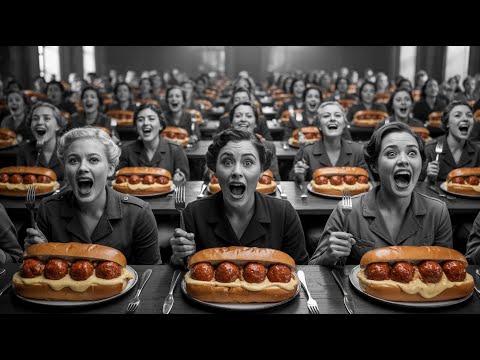
August 15th, 1945. The war in Europe had been over for three months, but for 47 German women sitting in a mess hall outside Harrisburg, Pennsylvania, the consequences were still unfolding. Captain Dorothy Richardson stood before them holding official documents from the War Department, preparing to announce their repatriation to Germany. None of them knew that this ordinary Tuesday would become the day everything changed.
These women—radio operators, nurses, clerks—had arrived at Camp Riverside in February, captured during the final desperate months of Germany’s collapse. They ranged in age from 18 to 35, their faces reflecting six months of transformation they were still trying to understand. Greta Schroeder, 24, clutched a small notebook where she practiced English. Beside her, Anneliese Vogel, 21, twisted the fabric of a donated blue dress. Further back sat Mina Keller, 28, the unofficial translator who had spent six months bridging the gap between prisoners and guards—and witnessing things that contradicted everything she thought she knew about enemies and allies.
Captain Richardson cleared her throat. The room fell silent. Outside, a warm August breeze carried the smell of cut grass. Inside, 47 women held their breath, waiting to learn when they would be sent back to a Germany that no longer resembled the country they had left.
What none of them knew was that in approximately four hours, a local restaurant owner named Giuseppe Romano would arrive at the camp gates carrying something that would change several of their lives forever.
But first, they had to get through this meeting.
February 9th, 1945. Snow fell heavily as a military transport truck rumbled through the gates of Camp Riverside. Inside, huddled for warmth, sat 23 German women captured three weeks earlier in Belgium. They had spent the journey across the Atlantic in the cargo hold of a Liberty ship, then another week being processed through Ellis Island.
Greta pressed her face against the truck’s canvas covering. The landscape looked nothing like Germany. Everything seemed bigger—the roads wider, the buildings more spread out. But what struck her most was how untouched everything appeared. No bomb craters, no burned-out buildings, no rubble-filled streets. The war had never touched this place.
When the truck stopped, the women stumbled into the snow with a mixture of defiance and exhaustion. Greta’s stomach cramped with hunger. Their last meal had been thin soup and hard bread eighteen hours ago. She had grown accustomed to the constant gnawing sensation, the lightheadedness that came with not having enough food.
Anneliese climbed down behind her, nearly losing her balance. At 21, she should have been in her prime, but months of inadequate nutrition had left her thin and weak. Her uniform hung loosely on her frame. Mina Keller was the last to exit, helping two younger women who were struggling with the cold. As the former translator, she had been given slightly better rations, but even she had lost considerable weight.
Captain Richardson, who had arrived two days earlier to oversee the camp’s conversion, watched the women assemble. She had been briefed on their condition but was still shocked. These were not the fearsome Nazi soldiers of propaganda posters. They were exhausted, hungry young women who looked like they might collapse at any moment.
The camp’s medical officer, Lieutenant Sarah Chen, stood beside the captain with growing concern. She had examined male German prisoners before, but something about seeing women in this condition affected her differently. These could have been her sisters, her friends, her students.
Guard Sergeant Miguel Santos called out orders in English that none of the prisoners understood. Mina stepped forward hesitantly, her university English rusty but functional. “I can translate,” she said quietly. Her accent was thick, but her words were clear enough. It was the first bridge built between captors and captives.
The processing took four hours—medical examinations, documentation, assignment of barracks, distribution of camp regulations printed in German that most of the women were too exhausted to read. By the time they were dismissed to their quarters, it was nearly midnight.
The women collapsed onto the metal cots, most not even bothering to remove their boots. Sleep came quickly despite the unfamiliar surroundings.
Greta woke to the sound of a bell ringing. Pale winter sunlight filtered through the barracks windows. For a moment she forgot where she was, then reality returned with crushing weight. She was a prisoner in America, thousands of miles from home with no idea when or if she would ever see Berlin again.
The other women stirred slowly, stiff from sleeping on the thin mattresses. A guard appeared at the door—a young woman in uniform who smiled apologetically. “Breakfast in 30 minutes,” she said in English, then waited for Mina to translate.
The word breakfast triggered something in Greta’s stomach, a desperate hunger that had become her constant companion. She wondered what prisoners of war were fed in America. Probably the same thin soup and stale bread they had been eating for months.
Thirty minutes later, the women filed into the mess hall and stopped.
The smell hit them first. Bacon. Real bacon. The kind Greta had not smelled since before the war. Coffee. Actual coffee, not the roasted grain substitute they had been drinking for years. Toast. Eggs.
Her eyes widened as she saw American soldiers moving through a serving line, their trays piled with more food than she had seen in months. The prisoners were directed to a separate section, but when they reached the serving counter, the same abundance awaited them.
Two eggs. Three strips of bacon. Two slices of toast with butter. A small bowl of oatmeal. A cup of coffee. A glass of orange juice.
Greta stared at her tray, certain there had been a mistake. This was more food than her family’s weekly ration in Berlin had been in the final months before her capture.
Anneliese stood frozen, her tray trembling in her hands. Tears began streaming down her face. Behind her, another woman started crying, then another. Within moments, half the prisoners were weeping at the sight of a simple American breakfast.
Mina translated quietly for the confused guards. “They have not seen this much food in a very long time.”
Greta carried her tray to a table but could not bring herself to eat. She kept thinking about her mother and sister in Berlin, about the neighbors who had been surviving on potato peels and hope.
She stared at the eggs congealing on her plate, and her mind drifted back to Berlin in the winter of 1943. She remembered the morning her mother had divided a single potato among four people for breakfast, carefully cutting it so each slice was exactly the same size. Her younger sister, Katrine, only 14 at the time, had cried—not from hunger, but from shame that she wanted more.
That was when Greta had volunteered for the Women’s Auxiliary Corps, believing that military service would mean she would eat and her family would have one less mouth to feed. The rations had been better at first—real bread, sometimes meat, vegetables that actually had substance. But as the war dragged on and Allied bombing intensified, even military rations had dwindled. By the time of her capture, her daily allocation had been reduced to a piece of dark bread barely larger than her palm, a cup of weak soup, and occasionally a small piece of cheese or a withered potato.
Anneliese’s memories of Hamburg were similar, but somehow worse. She remembered the night her apartment building had been destroyed in a bombing raid, how she and her mother had spent three days in a shelter with no food at all. When they finally emerged, the Red Cross had distributed thin soup that tasted like hot water with a rumor of vegetables. People had fought over the distribution, desperate and animal-like in their hunger.
She remembered reporting to her radio operator station and feeling faint during her shift, the room spinning because she had not eaten anything substantial in two days. Her commanding officer had noticed and shared half of his own ration with her—a gesture that had probably saved her from collapsing. He had been killed two weeks later when the communications building took a direct hit. She had survived only because she had been running an errand at the time.
Mina’s experience in Cologne had been different, but equally devastating. As a university-educated woman from a middle-class family, she had watched the slow erosion of civilization through the lens of food. First, restaurants closed. Then cafes stopped serving real coffee. Bakeries ran out of white flour, then any flour. Markets that had once overflowed with produce stood empty except for the occasional delivery of turnips or beets.
She remembered her father, a professor of literature, trading his beloved books for food on the black market. First editions of Goethe and Schiller exchanged for a loaf of bread or a few eggs. The shame in his eyes had been worse than the hunger. He had died during the winter of 1944, and Mina had always believed it was as much from heartbreak as from malnutrition.
Now she sat in an American prison camp staring at more food than her father had seen in the last year of his life.
Three weeks into their captivity, the camp administrators made a decision that would change everything. The prisoners needed work assignments, both to keep them occupied and to contribute to the camp’s operations. Mina, with her English skills, was assigned to help in the kitchen under the supervision of Sergeant James Washington, a 42-year-old career soldier from Georgia who had been cooking for the army for nearly 20 years.
Mina approached the kitchen with trepidation that first morning. She expected to find carefully rationed supplies, portions measured out with precision—the kind of scarcity management she had witnessed in every German military facility.
Instead, she walked into a storage room that made her stop breathing.
Sacks of flour stacked to the ceiling. Crates of potatoes. Boxes of canned goods. Containers of sugar, salt, cooking oil. Fresh vegetables delivered daily. Meat in quantities she could not comprehend.
Sergeant Washington noticed her staring. “You okay, miss?” he asked, his southern accent thick, but his tone kind.
Mina struggled to find words in English. “This is all for the camp? How many soldiers here?”
Washington chuckled. “About 200 personnel total, including you ladies. Why?”
Mina did calculations in her head. In Berlin, these supplies would have fed 2,000 people for a month, maybe longer. Here, they would be consumed in weeks.
She spent that first day in shocked silence, watching Washington and his staff prepare meals with a casual abundance that seemed impossible. They threw away potato peels thick enough to make soup. They used butter as if it were ordinary, not the precious commodity that Germans had been substituting with lard and margarine for years. When Washington cracked a dozen eggs to make scrambled eggs for the guards’ breakfast—not measuring or conserving, just cooking—Mina had to excuse herself and step outside.
The propaganda made sense now in a terrible way. She had been told that America was suffering, that their economy was collapsing, that their people were starving while their soldiers fought overseas. She had been told that Germany was winning because German efficiency would overcome American excess.
But standing in that kitchen, she understood the truth. America was not suffering. America had so much food that they could feed their prisoners better than Germany had fed its own soldiers.
That evening, Mina returned to the barracks and found Greta and Anneliese sitting together. She sat down beside them and spoke quietly in German. “I worked in the kitchen today.” They looked at her expectantly. “We were lied to about everything,” Mina said simply. “The food I saw today, the supplies in storage—it is more than some German cities had in the entire last year of the war.”
Greta’s face went pale. “What are you saying?”
Mina met her eyes. “I am saying that we were starving while fighting a country that has never known hunger. I am saying that our leaders sent us to fight an enemy they knew we could never defeat.”
The silence that followed was heavy with the weight of understanding.
Private Tommy DeLuca had been drafted into the army two years earlier, fresh out of high school in Brooklyn. He had expected to see combat, to fight Germans in Europe or Japanese soldiers in the Pacific. Instead, he found himself stationed at a prisoner of war camp in Pennsylvania, guarding women who looked barely older than his younger sister.
It was not the war he had imagined, but it was the war he got.
He noticed Anneliese during the third week. She sat apart from the others during recreation time, staring at nothing in particular with an expression of profound sadness. Tommy recognized that look. His grandmother had worn the same expression after his grandfather died—a kind of grief that went beyond words.
On impulse, he reached into his pocket and pulled out a small package wrapped in wax paper. His grandmother had sent him biscotti in her last care package—traditional Italian cookies twice baked until they were hard and perfect for dipping in coffee. Tommy had been saving them, rationing them out to make them last, but looking at Anneliese’s hollow face, he made a decision.
He approached slowly, not wanting to startle her. “Excuse me, miss,” he said.
Anneliese looked up, her expression wary. Tommy held out the package. “Cookie,” he said simply, making an eating gesture. “For you.”
Anneliese stared at the offering like it might be a trap. In her experience, guards did not give prisoners gifts. There was always a price, always an expectation. But Tommy just smiled and set the package on the bench beside her. “My nonna made them. Biscotti. Very good.” He walked away before she could respond, leaving her alone with the unexpected gift.
Anneliese waited until he was gone before carefully unwrapping the wax paper. Inside were six golden-brown cookies, each one studded with almonds. She picked one up and sniffed it cautiously. It smelled like vanilla and butter and something else she could not identify. She took a small bite and her eyes closed involuntarily. The cookie was crunchy and slightly sweet with a richness that came from real butter and eggs. She had not tasted anything like it in years.
She ate one cookie slowly, making it last as long as possible, then she carefully rewrapped the rest and took them back to the barracks. That evening, she broke each remaining cookie into pieces and shared them with Greta, Mina, and three other women. Each piece was tiny, barely a bite, but they savored them like rare treasures.
“An American guard gave these to me,” Anneliese said quietly. “He asked for nothing in return.”
Greta examined her small piece of biscotti. “Perhaps they are not what we were told they were,” she said finally.
Mina nodded. “Perhaps we were not what we thought we were, either.”
The cookies were gone in minutes, but the gesture lingered much longer.
That evening, the three friends lingered in the bakery long after closing, the way they always did when memory pulled them back to Camp Riverside. Greta refilled their cups and set a plate of fresh strudel between them. Outside, the Philadelphia streetlights flickered on, one by one.
“Do you ever wonder what happened to the ones who went back?” Anneliese asked quietly. “Helga, the others.”
Mina stirred her coffee. “I wrote to Helga for years. She married a schoolteacher in Frankfurt. Her letters always ended the same way—’Tell the girls the bread here is still gray.'” She smiled sadly. “She never once regretted going home.”
Greta looked toward the window, toward the street where a young woman had just asked for a meatball sandwich. “We each chose a different Germany,” she said. “Hers was a country to rebuild. Ours was a country to remember—and to feed.”
Anneliese raised her cup. “To Giuseppe, then. And to Sergeant Washington, who taught us that a full table is a kind of peace.”
They drank, and the bell above the door stayed quiet, and the strudel grew cold between them. Some gifts, they had learned, are never fully repaid—only passed forward, one sandwich, one cookie, one loaf at a time.
So here is the question we leave with you: if a single act of kindness can outlive a war, what small kindness are you carrying forward today?
Report this article
Select a reason for reporting:






