August 28, 1941. The Gulf of Finland. A massive armada of over 200 Soviet ships crept through mine-infested waters, packed with thousands of desperate soldiers and civilians. They were fleeing the advancing German army, but the sea offered no safety—only a new kind of hell.
Just hours into the voyage, a thunderous explosion shattered the silence. The transport Ella, carrying over 1,000 wounded men, struck a mine and began to sink. Within minutes, another ship hit a mine and disintegrated. The nightmare had begun.
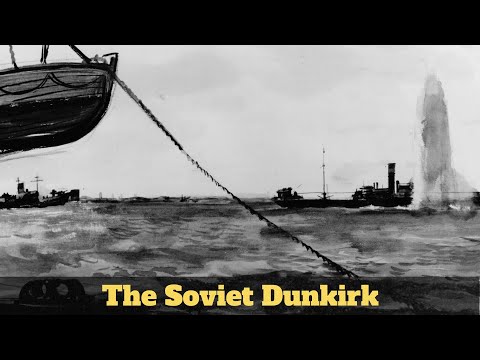
This was the Tallinn evacuation—the Soviet Union’s own Dunkirk, but far more deadly. As German bombers swooped down and mines tore hulls apart, the sea became a graveyard. Sailors and soldiers watched in horror as comrades were swallowed by the icy waves, their screams drowned by explosions.
“The whole shore is a flame,” recalled one witness. “It is strange that during a bright sunny day, the harbors are darkened by smoke.” The chaos at the pier had been just as brutal. Panicked crowds stormed the transports, trampling the weak underfoot. German artillery shells rained down, turning the harbor into a inferno.
Admiral Vladimir Tributs, commander of the Baltic Fleet, had begged for permission to evacuate. But Stalin’s regime punished any sign of weakness with death. Only at the last moment did Moscow relent. By then, the Germans were at the city’s edge.
The evacuation plan was desperate: thread through a narrow, mined channel under constant air attack. The Soviets lacked enough minesweepers—only 10 modern ones for over 200 ships. The result was catastrophic. Ship after ship struck mines, sinking in minutes. The destroyer Yakov Sverdlov exploded with a column of fire 250 meters high, taking most of its crew to the bottom.
German bombers returned at dawn, pummeling the defenseless transports. The Kazakhstan, packed with 5,000 people, was hit but miraculously stayed afloat. Its captain, blamed for the chaos, was later executed. Many others were not so lucky.
By the time the nightmare ended, over 11,000 were dead. Yet nearly 17,000 reached Kronstadt—a bittersweet victory. The Baltic Fleet survived, but at a terrible cost. The Tallinn evacuation remains one of WWII’s most harrowing naval disasters, a story of courage and incompetence in equal measure.
But the story did not end when the anchors dropped at Kronstadt. The survivors who staggered ashore—hollow-eyed, oil-stained, many still trembling from the concussions of near misses—carried with them fragments of a catastrophe that Soviet censors would spend decades trying to bury. The wounded were rushed to hospitals already overflowing with casualties from the Leningrad front. Sailors who had lost their ships were hastily reorganized into naval infantry brigades and thrown into the trenches south of the city, where the German noose was tightening with each passing day.
Admiral Tributs himself faced a reckoning. Though he had saved the fleet’s core—the cruiser Kirov and several destroyers—the loss of so many transports and the slaughter at Cape Juminda demanded a scapegoat. Yet Stalin, ever suspicious of his admirals, chose not to shoot Tributs. Instead, the admiral was kept in his post, a living reminder that failure at sea would not be forgiven twice. His memoirs, published years later, would describe the breakout in carefully sanitized terms, omitting the chaos, the friendly fire, the abandoned men on the piers.
The Germans, for their part, were astonished by the scale of the Soviet loss. Finnish coastal batteries reported the waters off Juminda choked with wreckage—life rafts, wooden beams, the bodies of soldiers still clutching their rifles. For weeks afterward, fishermen along the Estonian coast would haul in nets tangled with corpses. The Gulf of Finland had become a mass grave, and the Baltic Fleet would not venture out in force again for nearly three years.
Yet in Leningrad, the survivors of Tallinn became the backbone of a new kind of war. The sailors who had watched their ships sink now fought as infantry, their black uniforms earning them the nickname chernaya smert—the Black Death. German soldiers learned to fear these men who advanced with the reckless fury of those who had already lost everything. The guns of the Kirov, still smoking from the evacuation, were turned landward, pounding German positions day and night.
Back in Moscow, the High Command quietly drew lessons from the disaster. The shortage of minesweepers was partially addressed, and future evacuations—at Odessa, at Sevastopol—would be conducted with greater care. But no official inquiry was ever held. No report was published. The men who had been left behind on Tallinn’s piers, the thousands who had drowned within sight of safety, were simply erased from the record.
Only decades later, with the collapse of the Soviet Union, would historians begin to piece together the truth. Declassified documents revealed the bitter arguments between Tributs and his superiors, the ignored warnings about the minefields, the paranoia that had forced the fleet onto the most dangerous route. The Tallinn evacuation, they concluded, was not a tragedy of circumstance but of politics—a disaster made inevitable by a system that valued obedience over competence.
And yet, for the seventeen thousand who did reach Kronstadt, the nightmare had a strange epilogue. Many would live to see Berlin fall, to march through the ruins of Hitler’s capital. They would carry with them the memory of that August night—the burning shore, the exploding ships, the comrades who never made it across. In the years that followed, they would gather quietly on the anniversary, raising glasses to the dead of Juminda, and whisper the old bitter joke that had haunted the Russian navy for a century: What is the first thing Russia does when war is declared?
The answer, they knew, was never simple. Sometimes it scuttled the fleet. Sometimes it sacrificed it. And sometimes, against all odds, it saved just enough to fight another day.
The reckoning in Leningrad came faster than anyone expected. Within weeks of the Tallinn survivors landing, German forces had sealed the city’s landward ring, and the naval infantry brigades—formed from sailors who had lost their ships—found themselves fighting in the suburbs of Pushkin and Kolpino. Men who had trained to fire twelve-inch guns now crouched in muddy trenches with rifles, holding ground that had no strategic value except that Stalin had forbidden its surrender.
Among them was Petty Officer Sergei Volkov, a twenty-three-year-old from the destroyer Gordy, which had limped into Kronstadt with its hull torn open. He had spent three days in the water after his ship was abandoned, clinging to a hatch cover before a minesweeper hauled him aboard. Now he commanded a squad of eleven sailors, none of whom had ever dug a foxhole before August.
“They gave us rifles with five rounds each and told us to hold the line,” he recalled decades later, in an interview that was never published during his lifetime. “We held it for six hours. Then the Germans brought up a flamethrower.”
The Black Death brigades earned their reputation in those first desperate weeks. They counterattacked without orders, charged machine-gun nests with bayonets, and refused to retreat even when encircled. German intelligence reports from the period note with grudging respect that Soviet sailors fought “with the ferocity of men who have already died once.”
But ferocity could not stop the cold. By November, the Gulf of Finland was freezing over, and the ships that had survived Tallinn sat icebound in Kronstadt harbor. The Kirov, its guns still capable of firing, became a floating battery, its crew sleeping in shifts to keep the boilers running. The destroyers Minsk and Leningrad, both damaged in the breakout, were patched with steel plates scavenged from sunken hulks and returned to service as transports, ferrying supplies across Lake Ladoga when the ice road opened.
Admiral Tributs, meanwhile, was summoned to Moscow in October. He expected arrest—or worse. Instead, he found himself in a smoke-filled office facing Admiral Kuznetsov, who slid a single sheet of paper across the desk.
“Read this,” Kuznetsov said.
It was a German naval intelligence assessment, captured from a sunken U-boat. It described the Tallinn evacuation as “a Soviet triumph of desperation” and noted that the Baltic Fleet, despite its losses, remained “a force in being that cannot be ignored.” The German admiralty had concluded that the Soviet fleet’s survival at Kronstadt would tie down Axis naval resources for the foreseeable future.
“You lost half your destroyers and forty transports,” Kuznetsov said quietly. “And you saved the fleet. Stalin has read this report. He has decided—for now—that you are more useful alive than dead.”
Tributs returned to Leningrad a week later, his uniform still bearing the salt stains of the evacuation. He never spoke publicly of the disaster. But in his private quarters, he kept a small notebook in which he recorded the names of every ship lost and every officer who had gone down with them. The notebook survived the war; his widow donated it to the naval archive in 1972, where it remained classified for another two decades.
The men on the piers of Tallinn, the ones left behind when the last gangway was cut, met a different fate. Captured by the advancing Germans, most were dead within weeks—shot for partisans, starved in transit camps, or worked to death in Estonia’s peat bogs. Of the roughly one thousand left behind, fewer than forty survived the war. Their names were never added to the official casualty lists, which counted only those who had embarked on the ships.
The war moved on, as wars do, grinding memory into myth. Leningrad held through the terrible winter of 1941–42, and the sailors of Tallinn became legends in the trenches—men who had stared into the Gulf’s black water and refused to drown. “They fight like devils,” a German officer wrote in a letter home, captured months later. “But they are devils with nothing left to lose.”
By 1944, the Baltic Fleet was ready to sail again. The siege was broken, and Soviet ships returned to the waters off Juminda—this time as hunters, not prey. The minefields that had slaughtered the convoys were cleared, and the wreckage of the Ella, the Yakov Sverdlov, and dozens of others was left to rust in the silt. Divers later reported that the seabed was carpeted with bones.
Admiral Tributs lived to see victory. He was promoted, decorated, and eventually retired to a quiet apartment in Moscow, where he wrote his memoirs with the careful omissions of a man who knew what could not be said. He died in 1977, never having publicly answered the questions that haunted the survivors.
The Soviet government, to the end, maintained that Tallinn was a triumph of will over circumstance. No monument was ever erected at Cape Juminda. No official day of remembrance was declared. The dead were absorbed into the vast, anonymous ledger of the Great Patriotic War, their sacrifice acknowledged only in the whispered stories of old men.
Yet the sea remembers. Fishermen still pull up rusted helmets in their nets. Storms occasionally wash bones onto the beaches of Gogland. And on quiet August nights, when the wind blows from the east, the old sailors say you can hear the explosions—faint, distant, like thunder beneath the waves.
What is the first thing Russia does when war is declared? The joke has no punchline anymore. Only ghosts. Only the question, waiting for someone to answer.
What do you think—was Tallinn a triumph, a tragedy, or both? Share your thoughts below.
Report this article
Select a reason for reporting:






