You walk into St. George’s Chapel at Windsor Castle, past the tombs of kings and queens, past centuries of British monarchy carved in stone. And then, somewhere beneath your feet, down in the catacombs, lies the body of a boy who should never have been there. A boy born under the African sun, whose first language was Amharic, whose father was crowned king of kings in a mountain cathedral, and who died in a cold terraced house in Leeds at the age of 18, thousands of miles from everything he loved. His name was Prince Alemayehu, the only legitimate son of Emperor Tewodros II of Ethiopia. More than 140 years after his death, Ethiopia is still asking for him back. The British monarchy keeps saying no.
This is the story of how a 7-year-old prince was taken from a burning mountain fortress, paraded as a curiosity across the British Empire, educated into isolation at the finest schools in England, and quietly erased into a corner of a royal chapel where even his own family cannot reach him today.
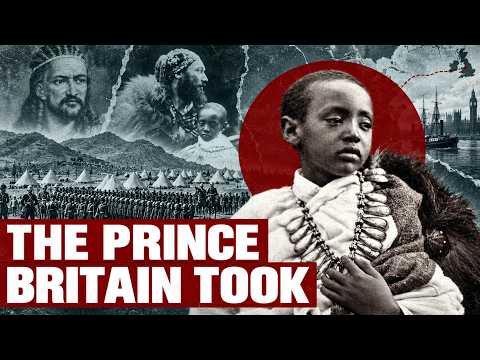
To understand how Alemayehu ended up in a Windsor crypt, you have to understand his father first. Tewodros II was not just some African king the British bulldozed on their way through the Victorian century. He was a reformer, a visionary, a man who dreamed of dragging Ethiopia into the modern world a full generation before the European powers would carve up the rest of the continent at a conference table in Berlin.
Born around 1818 under the name Kassa Hailu, he was the son of a minor regional chief in northwestern Ethiopia. He had no obvious claim to the imperial throne. What he had was ambition, military genius, and a conviction that his country, fractured into feuding warlord fiefdoms for nearly a century, needed one strong hand to pull it back together.
That century of chaos had a name. The Ethiopians called it the Zemene Mesafint, the Era of the Princes. The central government had essentially collapsed back in 1769. For roughly 90 years, no one truly ruled Ethiopia. Regional lords ran their own armies, their own courts, their own private wars. The emperor, when there was one, was a puppet with a crown.
Kassa Hailu looked at that mess and decided he would end it. And remarkably, he did. Through a series of brutal, brilliant military campaigns through the early 1850s, he beat his rivals one by one. He defeated Ras Ali the Second, the strongest of the regional overlords. He subdued the northern provinces. And then, on the 11th of February, 1855, in a mountain church, he was anointed and crowned by the Coptic Metropolitan Abuna Salama. He took a new name that was supposed to echo prophecy and legend: Tewodros II, King of Kings of Ethiopia.
From that moment onward, he was no longer a provincial strongman. He was the emperor. And he had plans. He broke the provinces into smaller districts and installed his own appointed governors. He tried to tax the church, something no Ethiopian ruler had dared to do before. He attempted to abolish slavery. He paid his soldiers a regular salary, so they would not have to feed themselves by looting villages. He wanted an educated, salaried civil service. He wanted a modernized army with European firearms and tactics. And above all, he wanted Ethiopia to be respected by the great powers of Europe as an equal.
But Tewodros had a problem. He had conquered Ethiopia faster than he could govern it. The nobles he had chained and humiliated hated him. The church resented his taxes. Regional rebellions kept flaring up like brushfires. By the mid-1860s, his army had shrunk to a fraction of what it had once been. He was also, by many accounts, increasingly erratic. He could speak with poetic eloquence one moment and order the massacre of villagers the next.
And when his dream of modernization kept bumping up against the realities of a poor, divided country, he reached outward. He turned to Europe. Specifically, he turned to Britain. In 1862, Tewodros wrote a letter to Queen Victoria. He wanted an alliance. He wanted European craftsmen and arms makers to come to Ethiopia and help him build a modern army. He wanted recognition as a fellow Christian monarch standing against the Islamic Ottoman threat on his borders.
The letter was carried to London. It was read. And then, in one of the most consequential diplomatic blunders of the entire Victorian century, it was simply filed away and ignored. No reply came. No acknowledgement. Nothing.
For months, Tewodros waited. For a proud man who considered himself the equal of any crowned head in Europe, the silence was more than an insult. It was a public humiliation at the hands of the woman he had treated as a sister sovereign. By 1863 and 1864, his patience ran out. If the British would not answer his letters, he would make them answer.
He arrested the British consul in Ethiopia, Captain Charles Duncan Cameron. Then he arrested several European missionaries. Then diplomatic envoys who were sent to negotiate for their release. Soon he had around three dozen Europeans chained up at his mountain fortress of Magdala in the Ethiopian Highlands, roughly 420 miles inland from the Red Sea coast. They were his bargaining chips, his leverage, his way of forcing the British Empire to finally take him seriously.
It worked, in a sense. London took him seriously, just not in the way he had hoped. By August of 1867, the British cabinet voted for war. And what followed was one of the strangest, most expensive, most logistically absurd military campaigns of the entire 19th century.
The expedition was placed under the command of General Sir Robert Napier, a seasoned engineer and veteran of the Indian Rebellion. Napier was given, by various counts, around 12,000 fighting soldiers, backed up by a vast support operation of tens of thousands of camp followers, laborers, animal handlers, and auxiliaries. The grand total of men and beasts assembled from India alone has been documented at around 62,000 men and over 36,000 animals, including a detachment of 44 war elephants brought to haul the heavy artillery across the Ethiopian Highlands.
There were new breech-loading Snider-Enfield rifles. There was a special pier built at Zula on the Red Sea coast, where the force would land in December of 1867. There was a railway laid down across the coastal plain. The British press called it a punitive expedition. The Treasury called it ruinously expensive. But off it went.
What saved Napier was not his firepower. It was politics. By the time the British force reached the foothills below Magdala in April 1868, Tewodros was already a broken man. He had almost no army left. Most of his old regional rivals, the chiefs he had chained and taxed and humiliated for a decade, had either defected to the British or quietly cleared the roads for them. One of those rival nobles, a man named Kassa Mircha, would eventually seize the imperial crown himself and become Emperor Yohannes the Fourth. For now, he simply watched Napier march through his territory and did nothing.
The British met Tewodros’ remaining forces on the plain of Aroge at the foot of the Magdala plateau on the 10th of April, 1868. It was less of a battle than a slaughter. Ethiopian warriors with spears and muzzle-loading muskets charged uphill into fields of fire from the new Snider rifles. Hundreds died in minutes.
Three days later, on the 13th of April, British forces stormed the fortress gates of Magdala itself. Inside the fortress, Tewodros knew it was over. He had already released his European prisoners days earlier in a last attempt to buy mercy. It did not come. As the British troops breached the final gate, Tewodros raised a pistol to his own mouth and pulled the trigger. The pistol, by one of the most bitter ironies in all of 19th century history, had reportedly been a personal gift to him from Queen Victoria years earlier, back when he still thought the British might be his allies. He died rather than be paraded as a prisoner of the empire.
And so, when the British soldiers finally burst into the inner compound, they found the body of the emperor they had marched 400 miles to capture lying on the stone floor, dead by his own hand. Then came the looting.
Napier gave his men permission to pillage Magdala before they burned it. For days, British and Indian soldiers tore through the churches, the palace, the treasury, and the libraries of the mountain fortress. They took gold crowns and ceremonial crosses and jeweled chalices. They took around 349 religious manuscripts, some of them irreplaceable medieval texts of the Ethiopian Orthodox Church. They took sacred wooden tabots, altar tablets that in Ethiopian tradition represent the Ark of the Covenant and are so holy they are not supposed to be seen by lay eyes at all. They took the imperial crown itself. One staff member of the British Museum had even been embedded with the expedition specifically to catalog and claim items of scholarly interest. By the time Napier was ready to leave, it took reportedly 15 elephants and nearly 200 mules just to carry out the loot.
And then they set fire to Magdala. The fortress Tewodros had built, the palace he had ruled from, the city on the mountain, was burned to the ground. Today, more than a century and a half later, very little of it remains. His great cannon, called Sebastopol, still sits on the plateau as a rusting monument to a dead king’s broken dream.
But the greatest prize the British took from Magdala was not a crown or a cross. It was a child. In the ruins of the fortress, in the wreckage of his father’s empire, the British found Prince Alemayehu. He was 7 years old.
He was born on the 23rd of April 1861 at Magdala itself. His full name was Alemayehu Simeon Tewodros. He was the only legitimate son of the emperor, which, in Ethiopian imperial succession, made him a potential heir to the throne. He had grown up watching his father try to hold an unraveling country together. Now his father was dead on the floor of a burning palace, and British soldiers were standing over him speaking a language he did not understand.
Alemayehu was not alone. His mother was there, too. Empress Tewabech Wube, sometimes called Queen Tiruwork in European sources, was the second wife of Tewodros, mother of his heir, and a woman from one of the great noble families of the north. She had married Tewodros without love, by most accounts. She considered herself to have married beneath her station, and she had held her new husband at a cold, formal distance for years. But now, in the ruins of Magdala, she was a widow with a young son, surrounded by British troops, and she had decisions to make.
Initial reports suggested she agreed to let Alemayehu travel to Britain with the expedition, while she herself returned to her ancestral lands in Simien. Then, suddenly, she changed her mind. She would go with her son. She would not let him make this journey alone.
She never made it to the coast. The empress was already ill when the march began. She had been weakened by the stress of the siege, the shock of her husband’s suicide, and the uncertainty of what was coming next. On the long trek down from the Ethiopian Highlands toward the Red Sea port of Zula, her condition collapsed. She died on the 16th of May 1868, a little over a month after the fall of Magdala.
The British troops gave her full military honors. Her body was carried away to be buried at the Monastery of the Holy Trinity, following Ethiopian tradition. Her clothing, her jewelry, her personal effects were packed up and sent back to Britain along with the rest of the Magdala loot. Her shawls, her silver anklets, her embroidered dress—some of these items can still be found today in the storerooms of the Victoria and Albert Museum in London, cataloged as objects labeled with her name, kept behind glass thousands of miles from the country where she lived and died.
Her son now stood alone on the road to the coast. He was seven. His father had killed himself. His mother was dead. He had no family left to protect him. And the British now had full custody of a boy who, had history unfolded differently, could have grown up to become the next king of kings of Ethiopia.
The man who took charge of the orphaned prince was one of the most peculiar characters of the whole Victorian imperial scene. His name was Captain Tristram Charles Sawyer Speedy. Speedy was a towering English adventurer, a soldier of fortune and explorer who had spent years in Ethiopia before the British expedition even began. He spoke Amharic, Tewodros’ native language, fluently. He had known Tewodros personally in the years before the breakdown of relations. He often wore Ethiopian clothing, and sometimes went by an Amharic nickname, Basha Felika, meaning something like Commander Swift.
In the chaos of the expedition’s aftermath, Speedy was assigned to serve as Alemayehu’s personal guardian. The young prince and his towering, bearded, Amharic-speaking caretaker boarded a ship together in June of 1868 and sailed north toward Europe. On a stop in Malta on the 27th of June, a photographer named Leandro Preziosi took one of the earliest surviving portraits of Alemayehu—a solemn 7-year-old boy dressed in Ethiopian clothing, standing beside the enormous figure of Speedy.
The ship reached England in July. By the 16th of July 1868, Alemayehu was on the Isle of Wight. Captain Speedy had a home there, and the island happened to also be the location of Queen Victoria’s beloved summer residence, Osborne House. Victoria had taken a personal interest in the orphaned prince from the moment she heard of his situation. She had him brought to meet her almost as soon as he arrived.
In her journal that evening, she wrote her first impressions of the boy, describing him as “a very pretty, slight, graceful boy of seven with beautiful eyes and a nice nose and mouth.” She noted that he could already say one or two words in English. She was clearly moved by the sight of this bewildered African child, dressed in strange clothes, who had just lost both his parents and his country.
From that day forward, Alemayehu became something like a protected curiosity at the heart of the British royal family. Victoria made financial arrangements for his upkeep. She asked after him constantly. She allowed Speedy to bring him to visit at Osborne House and at Windsor Castle. She mentioned him often in her diaries over the years that followed.
That same month on the Isle of Wight, a very different kind of attention was paid to Alemayehu. Julia Margaret Cameron, one of the pioneering photographers of the 19th century, had her studio nearby at Freshwater. She photographed the prince and his guardian. Another photographer, Jabez Hughes, also captured them. Those photographs survive today in the Royal Collection and the National Portrait Gallery.
And if you look at them, you see something that no written description can quite convey. In every single image of Alemayehu, from the earliest portraits in Ethiopian dress to the later photographs of him in Victorian school uniforms, there is a particular quality to his face—a watchfulness, a guardedness. He is never smiling. He is always slightly apart, as though he knows the camera is not really for him, as though he is being presented rather than seen.
The British writer and poet Lemn Sissay, himself of Ethiopian descent, once observed that there is no happiness in any one photograph of Prince Alemayehu. Looking at those images, it is very hard to disagree.
For a few years in the late 1860s and early 1870s, Alemayehu’s life was unsettled in the most literal sense. Speedy got married to a woman named Cornelia, and then was posted to India. Alemayehu went with them. There is correspondence suggesting he was reasonably happy during this period, treated almost like a son by the Speedys, surrounded by a mixed cultural environment that was neither Ethiopia nor England, but at least was not freezing cold or socially suffocating. He was in the warmth. He had Speedy, the only consistent adult in his life since his mother died, right beside him.
But the British government back in London had other ideas. There was discussion of Speedy taking a further posting to the Philippines, and the Treasury effectively vetoed Alemayehu going with him. The decision was made that the prince needed a proper English education in England, befitting what Victorian officials thought a prince ought to receive. Speedy’s informal arrangement with the boy was broken up.
Alemayehu was sent back to England, and from this point on, his life becomes an unbroken series of displacements from one educational institution to another, with the stability of Speedy’s household stripped away. He was first enrolled at Lockers Park School, a preparatory school in Hertfordshire. From there, he moved to Cheltenham College in the west of England, where he came under the care of the headmaster Thomas Jex-Blake.
Cheltenham was one of the elite public schools of the Victorian era, built to produce Church of England clergymen, army officers, and colonial administrators. Alemayehu arrived there as a dark-skinned foreign prince in a system designed to turn out a very particular kind of English gentleman. By many accounts, he struggled badly with the cold English weather. He was sick often. Pneumonia, bronchitis, respiratory problems haunted him through the English winters in a way they had never bothered him in the highlands of Ethiopia.
When Jex-Blake was appointed headmaster of Rugby School in 1875, Alemayehu moved there with him. At Rugby, one of his tutors was Cyril Ransome, a serious young academic who would later become a professor of history, and whose son, Arthur Ransome, would grow up to write the famous children’s novels of the Swallows and Amazons series. For a while, Alemayehu seemed to find in Ransome something like the kindly presence he had lost when Speedy went away.
In 1878, at the age of 17, Alemayehu was sent to the Royal Military College at Sandhurst. The idea seems to have been that he would be trained as an officer, perhaps groomed for some ceremonial role within the British Imperial system. Sandhurst was a disaster for him. By every surviving account, he was deeply unhappy there. Modern researchers have suggested racism was almost certainly a factor. He was dark-skinned, foreign-born, visibly different from every other cadet. And in Victorian Britain, that marked him for a hundred small daily cruelties, even in the most refined institutions.
He was described as isolated and sometimes arrogant, which is a word that often attaches to young people who build walls around themselves because they are being hurt. He had, by all accounts, a hankering to return home—a persistent longing to go back to Ethiopia that he could not seem to shake. But Ethiopia by 1878 was ruled by Yohannes IV, the former rival of his father, a man who had no obvious reason to welcome the son of Tewodros back onto Ethiopian soil. There was really nowhere for him to go.
By 1879, Sandhurst had become unbearable. He left the military college and went to stay with his old Rugby tutor, Cyril Ransome, at a house at 1 Hollin Lane in the Leeds suburb of Far Headingley.
What happened next is the part of the story that is most heavily contested. The official version is this. Within about a week of arriving in Leeds, Alemayehu caught a severe cold. The cold developed into pleurisy, an inflammation of the lining around the lungs that in the pre-antibiotic 19th century was often fatal. He lingered for roughly six weeks. The best doctors available were brought to his bedside, including Dr. Clifford Allbutt, a distinguished Leeds physician who would later become one of the most eminent medical minds of his generation. Captain Speedy came briefly to see him. Nothing worked.
On the 14th of November, 1879, Prince Alemayehu died at 1 Hollin Lane. He was 18 years old. Some accounts record the cause as pneumonia, others as pleurisy. In the end, the two conditions ran together.
There are, however, uncomfortable things in the record that have made some researchers and some members of the modern Ethiopian community suspicious. The scholar Alula Pankhurst, a leading historian of modern Ethiopia and the son of the pioneering Richard Pankhurst, has reported that in his final weeks, Alemayehu himself apparently believed he was being poisoned. He is said to have refused to eat. Whether this was a lucid fear or the delirium of a dying teenager is impossible to know now.
The timing is also worth noting. Captain Speedy had received a regular stipend from the British government for Alemayehu’s care, essentially a foster parent allowance. When Alemayehu turned 18 and legally became an adult, that stipend stopped. The arrangement by which Alemayehu had been shuffled from Speedy’s household to Jex-Blake’s care to Ransome’s house was in part a consequence of the financial logic of the British state.
None of this proves anything sinister. It may be nothing more than tragic bad luck, but it has fueled a lingering sense, both among his descendants and among Ethiopian writers today, that Alemayehu’s death cannot be fully disentangled from the system that had taken responsibility for his life.
The funeral was held on the 21st of November, 1879. Queen Victoria herself was devastated. In her journal that day, she wrote that she was “very grieved and shocked to hear by telegram that good Alemayehu had passed away this morning.” She mourned him publicly as if he were part of her own extended family. She ordered that he be buried at Windsor Castle in the catacombs of St. George’s Chapel, which is normally reserved for the royal family and the highest ranks of British society.
His funeral was attended by Cyril Ransome, his final tutor; by Captain Speedy, the man who had been his guardian for over a decade; by Stafford Northcote, the sitting Chancellor of the Exchequer; and by General Sir Robert Napier himself—the very man who had led the expedition that had killed Alemayehu’s father, destroyed his home, and brought the orphaned prince to England in the first place.
There is a plaque at Windsor to his memory. The inscription on it reads a line from the Gospel of Matthew: “I was a stranger and you took me in.” Even in death, the words chosen for him framed him as a guest in a foreign land rather than a prince in his own.
The question of what happened next, legally and politically, has only grown more painful with time. The British kept the loot. The crown of Tewodros II was taken back to London. In 1925, King George V personally handed it to the future Emperor Haile Selassie during a visit to England as a gesture of goodwill, but the vast majority of the Magdala plunder remained scattered across British institutions.
The British Museum holds the sacred tabots, the altar tablets, which the museum has quietly pledged never to display because they are too holy to be looked at by lay eyes. The British Library holds hundreds of looted Ethiopian manuscripts. The Victoria and Albert Museum holds dozens of items, including Empress Tewodros’ own clothing and jewelry. Westminster Abbey holds a tabot that was given to it by an officer named Arbuthnot who had served on the expedition. Royal collections, private collections, country houses, dozens of smaller museums all over Britain and Europe hold pieces of what was taken from a single mountain fortress in 1868.
Ethiopia has been asking for it all back since the 20th century. In 2007, Ethiopia’s then president Girma Wolde-Giorgis formally wrote to Queen Elizabeth II requesting the return of Prince Alemayehu’s remains. The request went nowhere.
In September of 2021, there was finally a small breakthrough. A private collector handed over a significant group of Magdala objects to the Ethiopian ambassador at a ceremony in London. In November of 2021, those artifacts were formally unveiled at the National Museum in Addis Ababa in what was described as the single largest restitution of Ethiopian cultural property from Britain in modern times. It was progress, but it was also a reminder of how much else is still held. And it was no answer at all to the question of the boy in Windsor Castle.
In 2023, the issue returned to international attention when the family of Alemayehu, through a descendant named Fasil Minas, publicly asked for his remains to be returned. Buckingham Palace responded with a statement to the BBC. The palace said it was very unlikely that it would be possible to exhume Alemayehu’s remains without disturbing the resting place of a substantial number of other people in the catacombs of St. George’s Chapel. The authorities at the chapel, the palace added, were sensitive to the need to honor Prince Alemayehu’s memory, but they also had the responsibility to preserve the dignity of the departed. Ethiopian delegations, the palace noted, had been welcomed to visit the chapel over the years.
The answer, in effect, was still no. Fasil Minas told the BBC it was not right for an Ethiopian prince to be lying in a country he was not born in. The royal historian Hugo Vickers, defending the palace position in the British press, argued that Queen Victoria had generously taken the prince in and that moving his bones now would be pointless.
The two sides of the argument sit roughly where they have sat for 140 years. The British position is one of custodial care. The Ethiopian position is that Alemayehu was never a guest. He was a captive—and even in death, he still is.
So, what do we take from all of this? On one level, this is a story about one individual child and the particular, specific tragedy of his life. He was born in a palace in April 1861. He was orphaned at seven. He was transported halfway across the world. He was photographed, pampered, studied, educated, isolated, and ultimately buried in a crypt beneath a chapel where tourists shuffle past every day without knowing he is there.
He never saw Ethiopia again after the age of seven. He never grew up to rule. He never had children, never married, never got the chance to become the man he might have been. He died in a terraced house in Yorkshire with a fever and a cough, cared for by strangers in a country that had taken everything from him and then handed him back a stipend and a boarding school uniform in exchange. That is one story, and it is enough on its own to make you stop and think.
But on another level, the story of Prince Alemayehu is a window into something much bigger. It is a story about the Victorian imperial project at its most intimate. It is a story about what happens when a global empire reaches down with its enormous hand and lifts up a single human life, treats that life as a token of its own benevolence, and keeps the token on display long after it has stopped breathing.
The British Empire of the 1860s and 1870s loved to tell itself stories about Christian charity, about civilizing missions, about the honorable treatment of defeated enemies. Alemayehu’s life became one of those stories—the orphaned African prince, cared for by the queen, educated at the best schools, buried with full honors beneath a royal chapel. On paper, it looks almost compassionate. In practice, it was something more complicated.
The same empire that paid for his school fees had marched 400 miles to kill his father, had looted his family’s palace, had carried his dead mother’s clothing back to London as a museum curiosity, had taken the sacred objects of his father’s faith and locked them in a basement where even now they are forbidden to be seen. Victorian generosity, when you look closely, almost always had a receipt attached.
There is also a lesson here about what the loss of a single prince can mean to a country. Ethiopia, remember, was one of only two African nations that successfully resisted being colonized by a European power during the scramble for Africa. In 1896, less than three decades after the fall of Magdala, Ethiopian forces under Emperor Menelik II would annihilate an invasion army at the Battle of Adwa and secure Ethiopian independence for another half century. The country Tewodros II had dreamed of—strong, unified, modern, armed to defend itself—began to take shape in the generations after his death under rulers who learned painful lessons from his failures.
Alemayehu, in a parallel timeline, might have been one of those rulers. He had the lineage, he had the name, he had his father’s reputation to inherit and reshape. Instead, he was turned into a Victorian curiosity, and a specific branch of Ethiopian imperial history was simply cut off at the root. The House of Solomon, as Ethiopian tradition called the imperial dynasty, lost a potential king because the British decided that educating him at Rugby was more useful to the empire than letting him go home.
And finally, the story of Alemayehu is a story about what we do with the dead. All over the world, museums, chapels, archives, and private collections hold human remains and sacred objects that were taken from colonized peoples in the 19th and early 20th centuries. The debates about repatriation, about restitution, about the return of looted art and the return of ancestral bones, are debates that are happening right now in cities from Berlin to Washington to Brussels to Paris.
The British Museum is one of the central battlegrounds in that conversation. The remains of Prince Alemayehu at Windsor Castle are a single, very visible, very personal case in a much larger argument about what the global north owes to the global south. When the question is not just about objects, but about people. When the family of a boy, speaking 140 years after his death, says “we want him home,” that is a request that does not have an easy answer.
The current British position is that moving him would disturb other graves. The Ethiopian position is that he should not have been there in the first place. Both of those things can be true at once. What is harder to deny is that the question will not go away just because Buckingham Palace keeps saying no. Every generation of Alemayehu’s family seems to ask it again. And so long as the Magdala tabots sit in storage at the British Museum, so long as his mother’s dress sits in a drawer at the Victoria and Albert, so long as a single Ethiopian prince sleeps under English stone in a crypt he never chose, the question will keep coming back.
Prince Alemayehu was alive for 18 years. He has been dead for over a century and a half. Yet his name is spoken more often today than it has been in decades—in parliaments, in newspapers, in diplomatic cables, in family living rooms in Addis Ababa and in London. In some strange way, the boy who died in Leeds in 1879 is still shaping the modern conversation between Ethiopia and Britain. He is still a prince with influence—just not quite the kind of influence anyone imagined when he was born on a mountaintop at Magdala in the spring of 1861.
His story forces us to ask uncomfortable questions about memory, about power, and about who gets to decide where the dead belong. It asks us to consider whether an act of charity can ever be genuine when it is built on the foundation of a stolen child and a looted kingdom. And it asks us, finally, to look at the photographs of a solemn boy in Victorian dress and see not a curiosity, not a royal pet, not a footnote to empire—but a person, with a name, a homeland, and a right to rest in the soil of the country that made him.
So here is the question that remains, hanging in the cold air of that Windsor crypt: if a family asks for their child back for over a century, and the answer is always no, who is really being protected—the dead, or the institution that holds them?
Report this article
Select a reason for reporting:






