On the 24th of February 1943, a Japanese soldier bound for New Guinea opened his diary and wrote one strange sentence. He had no idea how nearly it would come true. Days later, he was one of nearly 7,000 men aboard eight troop ships steaming out of the harbor at Rabaul behind a screen of eight destroyers. Ships had made this crossing for a year. Most of them got through. This convoy was sailing towards something no man on those decks had been warned was coming—and towards something worse than the battle itself. An order given after the shooting stopped that some of the men who carried it out would be physically sick to obey.
What did that soldier write? And what happened out there that most accounts of this story quietly leave out?
For most of a year, the sea lane from Rabaul to New Guinea belonged to Japan. Ships left Simpson Harbor, hugged the dark coast of New Britain, slipped through the Vitiaz Strait, and unloaded men and guns almost as they pleased. The Allies went after them the way the manual said you attacked a ship: from high up, a bomber holding level at 14,000 feet, while the vessel far below simply turned out from under the falling bombs. The bombs took long seconds to arrive. The ship had all the time in the world to move.
Across the back half of 1942, Fifth Air Force crews claimed hits on roughly three of every hundred bombs they dropped at shipping. The rest threw up white towers of water and killed nothing.
Then came January. In the first week of 1943, a convoy of five transports and five destroyers ran for Lae, carrying the troops of Major General Toru Okabe. The Allies threw everything they owned at it. More than 400 sorties over several days. A single Australian flying boat caught one transport alone in the dark and sank it. A second was hit and run aground. Two ships. That was the entire result of all those missions. The convoy reached Lae, put its soldiers on the beach, and those soldiers marched inland to fight the Australians at a place called Wau.
The lesson was written in plain arithmetic. You could fly hundreds of missions and barely scratch a convoy. And every man you failed to drown would be shooting at your own infantry inside a week. If Japan could keep feeding Lae by sea, the whole campaign for New Guinea might tip the wrong way.
Something had to change. As it happened, the change was already sitting in a hangar, half-built, ignored by nearly everyone but the man building it. That man was not a bomber officer. He was a 43-year-old former enlisted sailor named Paul Irvin Gunn. And every young pilot in the theater called him Pappy because he was old enough to be their father and behaved like it.
Gunn had joined the Navy back in 1918 as a mechanic and made himself into a flyer good enough to earn his wings as an enlisted aviator, a rare thing in that service. He left after 21 years, sailed to Manila, and built a small airline in the Philippines out of a handful of beach transports. Then the war arrived and took all of it. When the Japanese overran the islands, they swept up his wife and his four children and locked them inside a camp at Santo Tomas in the heart of occupied Manila. Gunn flew out on a crowded bomber in the last days. His family did not get out at all.
What he chose to do with that loss is the reason his name survives. Gunn turned up in Australia wearing the bars of an army captain attached to the Fifth Air Force and its new commander, a sharp and restless general named George Kenney. Kenney had a problem he could not solve. Gunn had a lifelong habit of solving problems no one had handed him.
One day, Kenney found this middle-aged captain in a hangar, bolting salvaged fighter machine guns into the nose of an attack plane with no authorization from anybody. A different commander might have had him disciplined. Kenney gave him a workshop and a free hand instead. The assignment was blunt: take a B-25 Mitchell, a medium bomber that normally carried a bombardier crouched behind a glass nose, and turn it into a machine that could kill ships from so close it could not miss.
Gunn tore the bombardier and his glass nose out completely. In the hole, he mounted four .50 caliber Browning machine guns pointing dead ahead, then strapped two more to each side of the fuselage in blister packs. Eight heavy guns, all fixed, all firing forward, all worked by the pilot’s thumb on the control column. 500 rounds for each of them. He loaded the belts so that tracer, armor-piercing, and incendiary rounds streamed out together. And to the men on the receiving end, the whole nose of the aircraft seemed to be on fire.
The airplane was never really the point. The point was what eight guns did to the deck of a ship. A destroyer’s anti-aircraft gunners stood in the open behind thin steel shields. For years, a bomber coming in low had been a gift to those gunners, a fat and slow target sliding straight down their sights. Gunn’s Mitchell turned that math inside out. It arrived spitting a solid wall of fire that swept the length of a deck before its bombs ever dropped. And it killed the men at the guns before they could lay a hand on their triggers. That was the whole idea. It was brilliant and it was merciless and nobody who understood it pretended otherwise.
It very nearly did not fly. Loaded down with steel and ammunition, the first conversion was so nose heavy the engineers swore it would never leave the runway. Back in the United States, North American’s own experts looked at the concept and told Kenney flatly that it could not work. Gunn shifted the guns, moved a fuel tank, packed weight into the tail to balance it, and then flew the thing himself to prove all of them wrong.
After that, he had to teach men to fight with it. Through the last cold weeks of 1942 and into February, the pilots of the 90th Bomb Squadron practiced on the rusting carcass of a wrecked freighter grounded on a reef outside Port Moresby. Each man ran at it over and over, holding the nose low, hammering it with the guns, then releasing a 500-pound bomb at the last possible instant so it skipped across the water and slammed into the hull. One crew misjudged the height, clipped the reef’s mast, and died on the reef. This was not a safe skill they were learning. It was a lethal one they were betting their lives on.
While Gunn built his gunships, the codebreakers built the trap. In the third week of February, Allied signals intelligence began pulling Japanese radio messages out of the air that spoke of a major convoy gathering at Rabaul. The destination was Lae. The expected arrival was the first days of March. Kenney knew the enemy was coming before the enemy had even cast off its lines.
An Australian officer handed him the plan to meet it. Group Captain William Garing had flown against ships in the skies over Europe, and he pressed for something the theater had never tried. Not a trickle of separate attacks arriving one after another the way January had gone and failed. Instead, every kind of aircraft over the convoy at the same moment from every altitude and every direction at once, so that a ship twisting away from one attacker turned straight into the guns of the next. It was to be a single overwhelming perfectly timed blow.
And it was not an American show alone. Australian Beauforts, Australian Bostons, American heavy bombers, American medium bombers, American strafers, American fighters, all rehearsed together until the timing lived in the pilot’s hands.
Two things were now moving toward each other across that sea. A weapon the Japanese had never imagined, and nearly 7,000 men sailing straight at it, one of whom had already written down in a diary no one would read for weeks what he feared was coming.
The convoy sailed on the last night of February, straight into a wall of tropical storm that swallowed it whole and hid it from the sky. For two days, it crawled westward along the New Britain coast at 7 knots, unseen, while the soldiers waited in the heat below its decks. One of them kept writing in his diary as the ships felt their way through the weather.
We will come back to what he wrote and to how the sea answered it at the very end.
The storm broke on the 1st of March. That afternoon, an American Liberator on a long patrol found a tear in the cloud and looked down through it. And there they were: eight transports, eight destroyers, a long gray column steaming across the Bismarck Sea toward the strait. The crew radioed the position back and hung at the edge of the weather, watching. The jaws of the trap were open.
The first blow landed on the 2nd of March, and it fell from high up. The four-engined B-17 Flying Fortresses found the convoy that afternoon and bombed it from medium altitude. Most of the bombs missed as they always had, but one struck home. The transport Kyokusei Maru, loaded with ammunition, fuel, and well over a thousand men, took a direct hit, broke apart, and went down fast. Two destroyers raced in, dragged hundreds of men out of the water, sprinted ahead to land them in the night, and turned back to rejoin the convoy. Those rescued men were the lucky ones, though not one of them would have used the word. They were very nearly the only large group from that entire convoy who would ever set foot on New Guinea.
That night, the Australians tried to finish it in the dark. A few Beaufort torpedo bombers found the ships and loosed their torpedoes, and every torpedo failed to run true. The convoy steamed on through the strait and out into the open water of the Huon Gulf.
The sun rose on the 3rd of March. The morning of the 3rd of March is the reason this battle has a name. A little after nine, close to ninety Allied aircraft gathered over a headland on the New Guinea coast and swung north together as one great formation. The convoy was in open sea now, past the shelter of the strait, roughly fifty miles from the nearest land. There was nowhere left for it to hide and no time left for it to run.
The heavy bombers struck first from medium height. Their bombs forced the ships to scatter and turn hard, which tore apart the tight formation that had let the destroyers cover one another with overlapping anti-aircraft fire. That was the exact moment the whole plan had been built around.
Down on the deck, skimming so low they seemed to be dragging their shadows across the swell, came the Australian Beauforts of Number 30 Squadron. Thirteen of them spread line abreast, closing at full throttle. To the Japanese lookouts, they had the shape and the approach of torpedo bombers. And so every captain did the one thing he had been drilled to do against a torpedo attack: he swung his ship bow-on toward them to shrink the target and steer between the tracks. It was the worst move he could have made. The Beauforts were carrying no torpedoes. They carried four 20mm cannon and a battery of machine guns in the nose. And by turning to face them, the destroyers had laid their long decks open flat and broadside right along the line of fire.
The Australians raked them from stem to stern. Gun crews were cut down where they stood. Bridges were swept clean. Superstructure and signal rigging came apart in the hail. And then into the smoke and the wreckage came Pappy Gunn’s gunships.
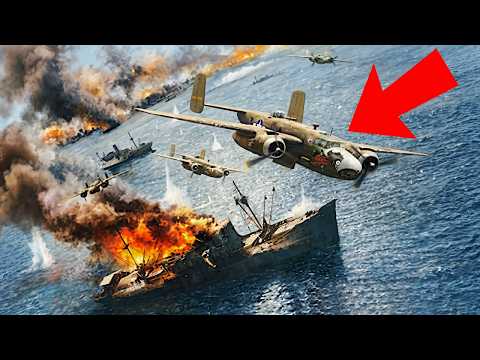
Major Edward Larner led them down the chute. Twelve B-25 Mitchells with eight .50s packed in each nose, coming in at masthead height, engines howling, every forward gun alight. One pilot, John Henebry, went through it at better than 250 miles an hour and would never forget the sight of decks crowded shoulder-to-shoulder with soldiers. The gunships scoured those decks the way the Beauforts had, then released 500-pound bombs point-blank into the hulls from so close that missing was almost impossible.
Behind them came more medium bombers, these from the 38th Bomb Group, attacking at mast height as well, and the low A-20 strafers after that. There was no answer to it. A ship that heeled over to dodge a bomb from above rolled its flank under the strafers. A ship that held steady to fight back was swept flat. Every choice was the wrong choice. That was the design.
The flagship died first. The destroyer Shirayuki took the opening strafing run straight across her bridge and almost every man standing on it went down at once. The convoy’s commander, Rear Admiral Masatake Kimura, was among the wounded. Then a bomb found her magazine and the explosion blew the stern clean off the ship. She was abandoned and scuttled where she lay.
The destroyer Tokitsukaze, carrying the commanding general of the 18th Army himself, took a bomb in the engine room and went dead in the water. Another destroyer came alongside to lift her crew off as she drifted. The destroyer Arashio, hit hard and out of control, slewed across the sea and smashed bodily into the Navy transport Nojima. Both of them were finished in that one collision. The transport Teiyo Maru absorbed four direct hits and nearly a dozen near misses and burned from end to end.
George Kenney said afterward that it was all but over twenty minutes after it started. Twenty minutes. A convoy that had needed three days to cross the sea was broken in the time it takes to boil a kettle of water.
It did not come free for the men who did it. One Flying Fortress was ripped apart in the air. And as its crew floated down beneath their parachutes, Japanese fighters banked around and machine-gunned them in their harnesses and in the water below. Three American Lightnings dove in to stop the slaughter and shot several of the enemy out of the sky. And all three of those Lightnings were lost doing it. That killing of helpless men would echo through the hours that came next. Though, as we will see, it does not come close to explaining all of what followed.
Through the afternoon, the Allied aircraft came back in waves and worked over the burning, drifting hulks that had been a convoy. By nightfall, it had stopped being a fighting force and become a field of wreckage.
If you want this one told straight, including the two things almost every version of it buries, what the crews were ordered to do once the ships were gone, and the number the high command invented afterward and then refused to take back, subscribe now because that is exactly where this is headed.
After dark, the American patrol boats came nosing out from the New Guinea shore to hunt whatever was left. They found one transport still afloat and burning, the Oigawa Maru, and fed torpedoes into her until she went under. The last of the eight transports was gone.
The 4th of March was cleanup. The destroyer that stopped to take off another ship’s survivors was caught in the open and sunk. The crippled Tokitsukaze finally slipped beneath the surface. Of the sixteen ships that had steamed proudly out of Rabaul, twelve were now on the bottom of the sea. All eight transports, four of the eight destroyers. The four surviving destroyers ran for home, crammed with rescued men. And on a nearby island, an Australian patrol later hunted down a handful of survivors who washed ashore and in their gear recovered a full Japanese army list. A complete order of battle that became an intelligence windfall in its own right.
Nearly 7,000 soldiers had sailed for Lae. Depending on which careful account you believe, somewhere between 800 and 1,200 of them actually reached it, and most even of those were the men pulled half-drowned off the Kyokusei Maru on the very first day. The rest were dead or adrift in the swell or riding a destroyer back to the harbor they had started from with nothing to show for the voyage. The fighting heart of a Japanese division had been poured into the Bismarck Sea and lost.
On the other side of the ledger, thirteen Allied airmen died in the entire battle. Thirteen.
Because the killing did not end when the ships went down. Scattered across miles of open water were thousands of Japanese survivors hanging onto rafts and lifeboats and loose wreckage. Over the next two days, Allied aircraft and patrol boats went back out and attacked those men in the water. This was not a handful of enraged flyers acting on their own. It was ordered from the command level and the orders were carried out. The reasoning behind it was cold and it was specific. Lae was close. Any soldier who reached that shore would be handed a rifle and thrown straight back into a battle that was grinding down Australian and American infantry. A man floating in the water today was a man in the firing line the following week.
The commanders had also just watched Japanese fighters gun down a bomber crew hanging in their parachutes. And some of them framed what they were ordering as nothing more than answering in the same coin. But an honest telling cannot stop there and let it rest. By the flyers’ own later accounts, the strafing of survivors had already begun before that bomber was shot down. Revenge was the story fitted onto it afterward. It was not the true cause and it was not the whole of it.
What the record also holds is that a great many of the men ordered to do this loathed it. The Australian official history calls it grim and bloody work that the crews had little stomach for, and records that some of the Beaufort men were physically sick in their cockpits as they flew it. One squadron sat down in its own report that the missions were distasteful. A few Australian crews quietly decided that they simply would not carry the orders out. These were not men who had misplaced their humanity. They were men trapped inside a war that had already thrown away its own rule book on every side, and they understood exactly what was being asked of them.
It is worth saying plainly from the safe distance of eighty years that deliberately killing shipwrecked men is a violation of the laws of war, whatever tactical logic is dressed around it. It is worth saying just as plainly that the men in those cockpits did not invent the savagery of that theater and had watched the enemy practice it on their own friends only hours before. Both of those things are true at once. Any film that offers you just one of them is selling you a comfortable lie.
And there is a second lie folded into this story. And this one was told from the very top. As the reports climbed the chain of command, the victory swelled in the telling. The official communiqué announced 22 ships sunk, cruisers among them, and put the Japanese dead at 12,792 men counted to the last body. Newsreels rounded it up to 15,000. It was a staggering figure, and it was false.
The convoy had never contained 22 ships. It had held 16. Twelve of them were sunk and the dead numbered far closer to 3,000 than to 13,000. When American analysts back in Washington quietly reconstructed the real numbers later that year, the headquarters in the Pacific refused to correct the record. It stood by the inflated count and turned on the people who dared to question it.
And the strangest part is that it never needed to lie. The truth, twelve ships and a wrecked division for the price of thirteen airmen, was already one of the most lopsided air victories of the entire Pacific War. It was made into a taller legend anyway. And the legend quietly buried a piece of what actually happened.
And here is the last thing the title of this story does not tell you. The gunships did not do it alone. The plan was drawn up by an Australian. The first wave that shattered the destroyers’ defenses was flown by Australians. Australian air crews sat inside the American aircraft. The heavy bombers that scattered the column and sank the first ship were a wholly separate force. The mast-height bombers that drove the killing blows into the hulls mattered every bit as much as the strafing that swept the decks. And some of those bombers were ordinary B-25s, not Pappy Gunn’s conversions at all.
The eight-gun Mitchell was the sharpest single tool in the box. It was not the box. None of that makes it less remarkable. It only makes it true. The gunship was the thing the Japanese had never faced and could not answer. The reason a low-level attack that should have been suicide instead walked up and down their decks at will. But the victory belonged to a whole machine that Kenney had assembled out of many parts. And the strafer, for all its genius, was one of those parts.
The enemy grasped the meaning of all this far faster than the newsreels did. A Japanese naval officer named Masatake Okumiya, a man who had lived through the worst of Guadalcanal, wrote afterward that the losses in this single battle were, in his word, fantastic. He did not mean it as praise. He meant it in the older sense of the word, as something beyond belief. He and the rest of the high command drew from it a conclusion that reshaped the war in New Guinea. They would not send large convoys to Lae again. They could not afford to. The price the Bismarck Sea had just charged was more than the Empire could pay twice.
From that day forward, Japan fed its armies in eastern New Guinea through a thin straw. By submarine, by fast destroyer dashes in the dead of night, by coastal barges creeping from headland to headland in the dark. It was never enough. Across the length of the campaign, Japanese officers themselves later estimated they lost something on the order of 20,000 men simply trying to move them along that coast. The soldiers who did struggle through to the front often arrived sick, half-starved, and stripped of their heavy weapons. Lae itself fell to Australian troops that September.
For all it achieved, the weapon at the center of it was no masterpiece of engineering. It was a field improvisation, and it flew like one. The recoil of eight heavy guns firing at once shook the airframe hard enough to spring its rivets. The nose-heavy balance made it a brute to handle. The officer who wrote the after-action report admitted the eight guns were only about half the firepower the aircraft really wanted. And the tactic itself was murderous to the men who flew it, threading a bomber between ships’ masts and point-blank gunfire at the height of a moving truck. Edward Larner, who had led the gunships down through the smoke on the 3rd of March, was dead within two months. Killed not by the enemy, but in a crash. The weapon that made legends was not gentle with its own.
What Pappy Gunn had cobbled together did not end in the Bismarck Sea. The low-level attack became the trademark of the Fifth Air Force. They used it again over the airfields at Wewak, over the great base at Rabaul, over the shipping lanes of the South China Sea in the last year of the war. Gunn himself flew back to the United States and stood in front of the same engineers who had told him his idea was impossible. And before long, the factories were turning out purpose-built B-25 gunships on the assembly line, bristling with cannon and rows of forward guns that had been designed in from the start. The contraption he had welded together in a hangar had become official doctrine, stamped out by the thousand.
Gunn kept flying and he kept getting hurt. Late in 1944, over the invasion beaches of Leyte in the Philippines, he was torn open by fragments from an exploding bomb and spent the liberation of the islands flat on his back in a hospital bed in Australia. He was still in that bed when word finally reached him that his wife and his four children had walked out of the Santo Tomas camp alive after three years behind its wire. He had gone to that war, when you strip everything else away, to get them back. And in the end, he had.
Gunn lived through all of it and went home to the Philippines and the flying life he had always loved. In 1957, he took off into a tropical storm in a small beach transport, the very kind of aircraft he had once built his airline around, and it came down in the weather and killed him. The storm took him in the end after the whole Japanese empire had failed to. It is a quiet and strange epitaph for a man who had spent a war flying straight through the worst that anyone could throw at him.
And now at last, that soldier with the diary. Days before his convoy ever left to make its run, while his ship was still feeling its way toward Rabaul, he had written down a single line about a dream. He was later packed aboard one of the eight transports, the Teiyo Maru. And the Teiyo Maru was one of the ships that burned and went to the bottom on the 3rd of March.
Some days afterward, his diary washed up on the shore of Goodenough Island, and the men who found it had it translated. This is what he had written: “Last night I dreamed I saw a dragon rising out of the sea.”
He had no way of knowing how nearly it would come true. Japan sent eight troop ships to New Guinea wrapped in a screen of eight destroyers carrying the better part of an army. And something did rise out of that sea to meet them, low and fast, and made of aluminum and machine guns. A thing that not one man on those crowded decks had ever been warned was coming. By the time it had finished its work, the sea had taken very nearly all of them.
So here is the question the legend never asks: if the true numbers were already a victory for the ages, why did the men at the top need a bigger lie—and what else did that habit of lying cost the war?
Report this article
Select a reason for reporting:






