In the annals of World War II, few weapons struck as much fear into the hearts of Allied soldiers as the German Tiger tank. But behind the machine was a man whose story has been largely forgotten—a man who may have been the greatest tank ace in history. Kurt Knispel was not your typical Nazi hero. He was a rebel, a nonconformist, and a lethal warrior whose tally of destroyed enemy tanks exceeded 168, yet his name remains obscure. This is the story of a soldier who fought for his country but despised its ideology, a man whose incredible skills on the battlefield were matched only by his refusal to bend to authority.
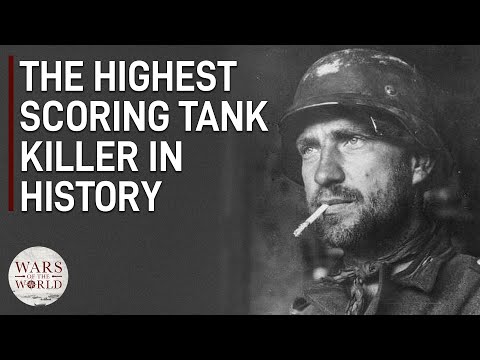
Born in 1921 in the Sudetenland, Kurt Knispel grew up in a region that would become a flashpoint of World War II. His early life was unremarkable, but his decision to join the German army in 1940 set him on a path to legendary status. Initially trained as a gunner, Knispel quickly demonstrated an almost supernatural ability to spot and destroy enemy tanks. His superiors were amazed, but his rebellious nature often put him at odds with the military hierarchy.
Knispel’s first taste of combat came during Operation Barbarossa, the invasion of the Soviet Union. His skill as a gunner was evident from the start, knocking out a T-34 with a shot that many dismissed as luck. But as the war progressed, it became clear that Knispel’s marksmanship was no fluke. He developed a reputation for being untouchable, often emerging unscathed from battles that decimated his comrades. Yet, his disdain for authority and his refusal to conform to the Nazi ideal of a soldier would cost him dearly.
One incident in 1942 would forever mark him. While transiting through Poland, Knispel witnessed a concentration camp guard beating a prisoner. He intervened, pulling a pistol on the guard and striking him in the face. This act of humanity was seen as insubordination by his superiors, and from then on, he was viewed with suspicion. Despite his heroics on the battlefield, Knispel was denied the promotions and accolades that others received.
As the war dragged on, Knispel’s kill count continued to rise. He was eventually given command of a Tiger tank, and later a King Tiger, where his skills truly shone. His most famous feat was destroying a T-34 at a range of nearly two miles—a shot that seemed impossible. Yet, even as he racked up victories, his rebellious nature persisted. He wore his hair long, sported a goatee, and even had a tattoo—all violations of military regulations.
By 1945, the war was closing in on Germany. Knispel found himself fighting in the same region where he was born, now facing the might of the Soviet army. On April 28, 1945, he destroyed his 168th tank, but his own tank was soon hit. Wounded by mortar fire, he was evacuated to a field hospital, where he died just hours later. The war in Europe ended ten days after his death.
Kurt Knispel’s final tally is a subject of debate. Some historians argue that his true score is much higher, as he often let inexperienced crew members take the final shot to boost their morale. If shared kills are counted, his total may approach 200, making him the greatest tank ace in history. Yet, his story remains largely unknown, overshadowed by more prominent figures who fit the Nazi mold.
But the numbers only tell part of the story. What made Knispel truly exceptional was not just his ability to destroy tanks, but the way he did it—and the way he carried himself while doing so. He was a soldier who fought with a rifleman’s instincts inside a thirty-ton steel box, reading the terrain and the enemy with an intuition that his comrades described as almost supernatural.
Veterans of his unit recalled that Knispel could spot a camouflaged Soviet tank at distances where others saw only a shadow in the treeline. He had learned rudimentary Russian growing up in the Sudetenland, and this linguistic edge occasionally proved useful when his unit captured prisoners or needed to interrogate locals. But it was his eyes that made him legendary.
One account describes Knispel destroying a T-34 after noticing the faint glow of a crew member’s cigarette in the darkness. Another tells of him identifying the telltale dust plume of a Soviet armored column long before anyone else in his company had registered anything at all. His commander once remarked that Knispel seemed to see the battlefield in a way no one else could.
Yet for all his lethal efficiency, Knispel never gloried in the killing. He counted only the tanks he was certain he had destroyed, refusing to inflate his score for the sake of propaganda. And when he had the chance to inspire his less experienced crewmen, he would deliberately cripple an enemy tank and then allow a junior gunner to finish it off. It was a gesture of mentorship, not vanity—a way of building confidence in men who would need every ounce of it to survive.
This generosity of spirit extended beyond his own crew. In one documented incident, Knispel refused a direct order from a Waffen-SS officer to fire on a retreating Soviet tank because civilians were clustered around it. The refusal could have cost him his life. Instead, his reputation and the respect of his comrades shielded him from any real punishment. He was, in the words of one fellow tanker, ‘a soldier’s soldier—not a Nazi’s soldier.’
As 1944 wore on and the German army found itself in retreat on both the eastern and western fronts, Knispel’s skills became ever more valuable. His unit was rushed to Normandy after the Allied landings, where the King Tigers faced overwhelming air superiority and a landscape that negated their advantages. Even Knispel could not save his battalion from near-total destruction. They lost every one of their new tanks within two months.
Re-equipped and sent back to the eastern front, Knispel found the situation no less dire. The King Tiger, for all its armor and firepower, was a logistical nightmare—too heavy for many bridges, too wide for narrow roads, and too slow to keep pace with the retreating German forces. And now the Soviets were fielding heavy Stalin tanks that could match the King Tiger in a stand-up fight.
Yet Knispel fought on. Not out of fanaticism, but out of a sense of duty to the men beside him. He had long since stopped believing in the cause; what remained was loyalty to his crew. And so he climbed back into his tank, day after day, as the Third Reich crumbled around him.
In the final months of the war, Knispel’s reputation as a tank commander had spread far beyond his own unit. New crews arriving at the front would ask to be assigned to his company, hoping to learn from the man who seemed to have a sixth sense for survival. He was, by all accounts, an exacting teacher—impatient with carelessness, generous with those who listened.
But the war was no longer a place for teaching. The German army in early 1945 was a shadow of the force that had swept through the Sudetenland seven years earlier. Fuel was scarce, replacement parts were almost nonexistent, and many of the men now manning the King Tigers were barely out of their teens, rushed through training that Knispel had once taken for granted.
He adapted. Veterans recalled that he would spend his evenings drilling young gunners on the finer points of range estimation, using nothing more than a battered set of binoculars and a distant tree stump as a target. ‘He could make you see things you didn’t believe were there,’ one of them later said. It was a skill that saved lives—and it was a skill that Knispel was determined to pass on, even as his own time was running out.
The fighting in Czechoslovakia in the spring of 1945 had a desperate, surreal quality. German units were no longer advancing or even holding; they were simply trying to survive, to stay ahead of the Soviet juggernaut long enough to surrender to the Western Allies. For Knispel, the irony was bitter. He was fighting on the soil of his birth, the land that had been taken from his family after the First World War, and now it was being taken again—this time from the country that had claimed it.
He spoke to his crew about it only once. According to one account, as their King Tiger rumbled through a village near the Moravian border, Knispel pointed to a church spire and remarked, in his usual dry tone, that he had been baptized there. Then he fell silent. No one dared ask what he was thinking.
By late April, the battalion was down to a handful of operational tanks. Supply lines had collapsed entirely; crews were cannibalizing wrecks for fuel and ammunition. Knispel, who had always been meticulous about his tank’s maintenance, was now forced to choose between repairing his transmission and arming his gun. He chose the gun. He always chose the gun.
On the morning of April 28, the order came down to counterattack a Soviet armored spearhead threatening the unit’s withdrawal route. It was a mission that bordered on suicide—a handful of King Tigers against a force that outnumbered them five to one. But there was no alternative. If the spearhead wasn’t slowed, the entire battalion would be encircled and destroyed.
Knispel briefed his crew in the cramped turret, his voice calm and measured. He told them exactly what he expected of them, and then he told them something he had never said before: that he was proud to have served with them. The young gunner, barely nineteen, later recalled that it was the only time he ever saw Knispel show anything resembling sentiment.
They rolled out of the treeline at first light, engines growling, the King Tiger’s massive bulk throwing up clouds of dust and mud. The Soviet column was exactly where Knispel had predicted it would be, strung out along a narrow road that wound between two low hills. He took the first shot himself—a T-34 that exploded before its crew even knew they were under attack.
What followed was a fighting withdrawal that lasted nearly three hours. Knispel’s tank accounted for at least six enemy vehicles, but the Soviets kept coming, their numbers seemingly inexhaustible. The King Tiger’s armor held, but the machine was growing sluggish, its engine overheating, its tracks worn down to the metal.
And then, as the battalion finally began to pull back, a Soviet self-propelled gun scored a hit on the King Tiger’s running gear. The tank ground to a halt, immobilized and exposed. Knispel gave the order to abandon the vehicle, and his crew scrambled out through the hatches, dragging their wounded with them.
It was then that a sniper’s bullet found the commander of the neighboring King Tiger, who had come to help. Knispel, seeing the man fall, took command of the remaining tank and ordered the survivors to mount up. They fought on for another hour before that tank, too, was knocked out.
The retreat that followed was a blur of mud, smoke, and mortar fire. Knispel, wounded in the shoulder, was half-carried by his gunner through a field of shattered trees. He was still giving orders, still directing the survivors toward the rally point, even as his strength faded.
They reached the field hospital just after nightfall. The doctors did what they could, but the wound was worse than it had appeared—shrapnel had torn through his lung. Kurt Knispel died a few hours later, ten days before the war in Europe ended.
He was thirty-three years old. The grave, if it ever existed, was lost in the chaos of the final collapse—another detail that history allowed to slip away. No propaganda film celebrated him, no medal ceremony honored his name. The regime he had served but never believed in simply vanished, and with it went the memory of the man who had outshot them all.
In the decades since, historians have sifted through unit records and veterans’ testimony, piecing together the fragments of Knispel’s story. His confirmed tally of 168 stands as the highest of any tank commander in history—and if the shared kills and unconfirmed destructions are counted, the number climbs closer to 200. Yet the more remarkable figure is not the tanks he destroyed, but the prisoners he saved and the orders he refused.
Kurt Knispel reminds us that courage on the battlefield and moral courage are not the same thing—but the rarest soldiers possess both. He was, in the end, a man who fought for his comrades rather than his country, and who chose mercy when it cost him everything.
Should history remember Kurt Knispel as a hero, or does his service in the German army forever complicate that word? What do you think—let us know in the comments below.
Report this article
Select a reason for reporting:






