What if the greatest love stories Hollywood ever sold were never love stories at all? Behind the spotlights, beyond the gossip columns, some of Tinseltown’s most celebrated marriages were carefully constructed arrangements — alliances of convenience, survival, and sometimes genuine affection, all designed to hide a truth the studios would have killed to keep buried.
These were the lavender marriages: unions between gay stars and their beards, between ambitious men and women who understood the rules of a game where exposure meant ruin. Some were business contracts. Some were lifelong friendships. And some were real partnerships twisted into something else by the relentless machinery of fame.
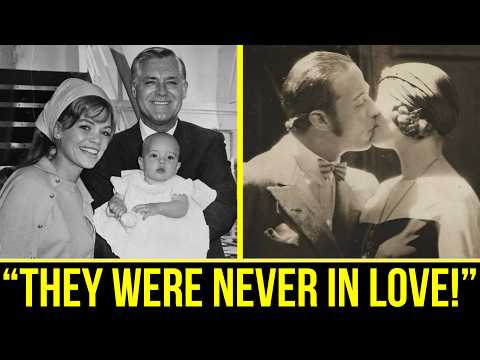
From Cary Grant’s multiple trips down the aisle to the secret lives of Broadway legends, the files have been sealed for decades. Now, they’re about to be opened.
Carrie Grant and Diane Cannon. By 1965, Grant had already survived four weddings and endless questions about his closeness to Randolph Scott. Cannon was 33 years younger — beautiful, ambitious, and exactly what the public expected. Their daughter, Jennifer, arrived in 1966, giving the marriage a reality no one could dismiss. But the relationship collapsed in just three years, with Cannon later describing a controlling husband and an unhappy household. Was it a cover? Jennifer has repeatedly rejected that claim. The fairest verdict: not fake, but forever tangled in a mystery Hollywood never solved.
Marlene Dietrich and Rudolf Sieber. They married in 1923 and stayed legally bound until his death over 50 years later. But the marriage stopped looking traditional almost immediately. Dietrich pursued intense relationships with both men and women; Sieber maintained his own long-term partner. Neither demanded a divorce. For Dietrich, the union offered stability and protection in an industry that sold her as an irresistible mystery. For Sieber, it preserved loyalty without demanding dishonesty. Calling it fake would ignore the affection. Calling it conventional would be equally misleading. It was a permanent alliance — two people protecting each other while accepting private freedoms Hollywood could never have explained.
Charles Laughton and Elsa Lanchester. Behind the eccentric humor and public affection, Elsa said she learned a truth only after the wedding: Charles told her he was homosexual. According to her account, that explained why they never had children and why their private life developed differently from the image audiences imagined. Yet she stayed with him until his death in 1962 — more than three decades of artistic collaboration, emotional loyalty, arguments, and mutual dependence. This was no quick studio ceremony for a newspaper photograph. It was a complicated union where secrecy and genuine companionship existed at the same time.
Cole Porter and Linda Lee Thomas. At first glance, the perfect society couple. He was a brilliant composer with charm and growing fame; she was elegant, wealthy, and socially connected. They married in 1919 and remained together until her death in 1954. Porter’s relationships with men were widely described in biographies, and Linda reportedly understood. Their marriage provided social acceptance in an era when exposure could have destroyed his career. But what made the arrangement unusual was the affection beneath it. Linda encouraged his work, improved his social position, and cared for him after the riding accident that left him in lasting pain. Many call it a marriage of convenience — but loveless would be inaccurate. It was a devoted partnership that simply didn’t follow the romantic script.
Liza Minnelli and Peter Allen. Few weddings connected more show business royalty. Liza, daughter of Judy Garland and Vincente Minnelli, married Australian entertainer Peter Allen in 1967. Garland herself had helped Allen’s career after seeing him perform, bringing him into the family’s dazzling but complicated world. The marriage lasted until 1974, but Minnelli later described discovering Allen with another man. Allen eventually lived publicly as a gay man and built a celebrated stage career before his death in 1992. It’s tempting to describe the entire marriage as a planned cover. Yet Minnelli’s later account suggests she entered it believing the relationship was real. The concealment may have protected Allen professionally, but that doesn’t mean both partners understood the arrangement from the beginning. Their story reveals the painful side of these marriages — sometimes the so-called cover was also a spouse’s private heartbreak.
Judy Garland and Mark Herron. Even before the ceremony, this relationship was surrounded by instability. Garland met actor Mark Herron during a difficult period in her career and personal life. They married in 1965 but separated after only a few months, with the divorce completed in 1967. Herron later had a lengthy relationship with actor Henry Brandon, and numerous accounts have described him as gay or bisexual. That history encouraged writers to classify his marriage to Garland as a lavender arrangement. The evidence, however, points toward something more chaotic than a carefully organized studio cover. Garland appears to have been emotionally invested, while arguments, career pressures, and accusations of mistreatment quickly destroyed the union. Unlike the polished publicity marriages of the studio years, this wedding looked like two vulnerable people attempting to build security — and failing almost immediately.
The files are far from closed. The next marriages become even stranger, riskier, and harder to explain — from a 19-year-old bride discovering her husband’s secret to a wedding that thousands of spectators crowded around in Rome, never guessing what lay beneath the spectacle.
Richard Cromwell and Angela Lansbury. Only 19 years old and still finding her place in Hollywood, Angela Lansbury married actor Richard Cromwell in 1945. He was 16 years older — charming, experienced, and seemingly able to offer stability inside an industry that could feel overwhelming to a young actress. The marriage ended in less than a year. Lansbury later explained that she discovered Cromwell was gay only after they had married. Instead of responding with bitterness, she remembered him with sympathy and affection, saying she did not blame him for the situation. Cromwell had worked in films since the early 1930s, when public discovery could have ended an actor’s employment and destroyed his social standing. There is no indication that Lansbury entered the marriage as a knowingly hired cover. She was another person trapped by the same culture of silence — a young bride placed inside a secret she had never agreed to carry.
Leonard Bernstein and Felicia Montealegre. From the outside, their life appeared grand and intellectually glamorous. Bernstein married actress Felicia Montealegre in 1951, and together they raised three children while becoming one of New York’s most admired cultural couples. Bernstein also had relationships with men — a reality discussed in biographies, private letters, and accounts from people close to the family. Felicia apparently understood this part of his life. Although accepting it did not remove the emotional strain, career fear played a major role. A conductor seeking the most powerful positions in American classical music faced enormous danger if publicly identified as gay during the 1950s. Marriage offered social credibility and a stable family image at exactly the moment Bernstein’s influence was expanding. Yet reducing Felicia to a beard would erase their emotional connection. Their letters and family history suggest real love, even as Bernstein struggled between marriage and relationships with men. When Felicia became seriously ill, he returned to care for her. Their union was protective, painful, affectionate, and far more complicated than the word fake suggests.
Tallulah Bankhead and John Emery. Nothing about Tallulah Bankhead’s personality seemed designed for quiet domestic life. She was outspoken, unpredictable, sexually independent, and famous for ignoring the rules that controlled other actresses. Nevertheless, she married actor John Emery in 1937. Bankhead openly joked about her attraction to both women and men, using her own playful language rather than accepting a simple label. Her private relationships were widely discussed in theatrical circles, even when newspapers avoided printing them. The marriage to Emery gave her a temporary appearance of conventional respectability. It also pleased family members who worried about her public image. Yet there is no firm evidence that Emery was officially recruited by a studio or paid to hide anything. Their personalities initially created excitement, but the relationship became stormy and ended in divorce in 1941. This union may have softened public suspicion, but it was probably not a cold business contract — more like an impulsive attempt by two theatrical personalities to create a marriage neither was prepared to maintain.
Katharine Hepburn and Ludlow Ogden Smith. Years before trousers, movie stardom, and decades of speculation about her private life, Katharine Hepburn married Philadelphia socialite Ludlow Ogden Smith. The wedding took place in 1928, when she was a young actress fighting to establish an independent identity. Hepburn even persuaded Smith to change his name temporarily because she disliked the idea of being known publicly as Katharine Smith. That small decision revealed who controlled the direction of the relationship. They divorced in 1934 but remained on friendly terms. Smith supported her early career and reportedly helped her financially, suggesting their bond was not an empty publicity performance. Later, writers examined Hepburn’s intense friendships with women and her long relationship with Spencer Tracy, producing competing theories about her sexuality. No solid evidence proves that Smith entered a planned lavender arrangement. The marriage is better understood as an early unsuccessful partnership involving a woman who valued independence more than the traditional role expected of a wife.
Cary Grant and Betsy Drake. After three failed marriages and years of carefully controlled publicity, Cary Grant met actress Betsy Drake aboard a ship returning from England. Their quick connection led to marriage in 1949 — the beginning of what would become Grant’s longest legal union. For the public, Drake appeared to have finally domesticated Hollywood’s most polished bachelor. Behind closed doors, the relationship was far less ordinary. Both became interested in psychotherapy, hypnosis, and eventually psychedelic-assisted treatment. Drake also stepped away from the standard movie star path, preferring writing, study, and personal exploration. Because rumors about Grant and Randolph Scott had followed him for years, later commentators frequently classified every Grant wedding as camouflage. Yet Drake never publicly described herself as a knowingly selected beard. She spoke instead about a complex husband, emotional distance, and a marriage that gradually stopped working. The couple separated in the late 1950s and divorced in 1962. Their relationship may have strengthened Grant’s heterosexual public image, but that does not prove it was created solely for that purpose. What Hollywood sold was a simple rescue story — the right woman had finally settled the famous bachelor. The reality was a long, psychologically complicated partnership between two people who kept changing.
Cary Grant and Barbara Hutton. At the height of wartime glamour, this pairing looked almost too perfect to be accidental. Grant was one of cinema’s most elegant leading men, while Barbara Hutton was among the richest women in the world. When they married in 1942, newspapers treated the ceremony like a royal event. Grant reportedly refused a financial settlement when they divorced three years later, leading the press to nickname him ‘Cash and Cary’ in admiration rather than suspicion. The absence of a financial demand supports the idea that the marriage involved genuine affection. Still, the union provided valuable protection for both partners. Grant’s private life was already attracting whispers, while Hutton’s divorces and emotional struggles had made her a constant target. Together, they created an image of sophistication, romance, and social power. Later, lavender marriage lists often present the wedding as if studio executives had designed it to quiet rumors about Grant. No surviving contract or direct testimony proves that claim. Hutton herself continued speaking warmly about him after the separation. Their marriage may have been useful to their reputations, but usefulness does not automatically equal deception.
Cary Grant and Virginia Cherrill. Before he became the untouchable symbol of sophisticated Hollywood, Cary Grant married actress Virginia Cherrill in 1934. She was already famous for playing the blind flower seller opposite Charlie Chaplin in City Lights, making them one of the era’s most photogenic young couples. Their marriage lasted only around 13 months. The divorce became unpleasant, with Cherrill accusing Grant of controlling behavior and emotional cruelty. Grant denied the darkest interpretations, but the public conflict destroyed any illusion of a perfect romance. Because this was his first marriage and because later rumors surrounded his friendship with Randolph Scott, some writers have looked backward and called Cherrill an early beard. The timeline makes the theory tempting. Grant and Scott had shared homes, posed for unusually intimate publicity photographs, and developed a domestic friendship that newspapers treated playfully. Yet playful photographs are not proof, and Cherrill never confirmed that she knowingly joined a lavender arrangement. Her divorce claims described an unhappy husband, not a secret contract. The marriage served Hollywood’s preferred image of Grant as a desirable heterosexual leading man. That benefit was real. The idea that the studio manufactured the entire relationship remains speculation.
Tyrone Power and Annabella. 20th Century Fox reportedly fought against this 1939 wedding — why would a studio sabotage its own cover? Annabella was the woman the studio did not want him to marry. That fact alone makes the lavender label collapse. Power’s later marriages to Linda Christian and Deborah Minardos were spectacular or tragically brief, but neither proves a contract. Even a bisexual man can sincerely love his wife.
Danny Kaye and Sylvia Fine. She wrote the material that made him a star. They married in 1940 and stayed legally bound until his death in 1987. Rumors about Kaye and Laurence Olivier persist, but calling Sylvia a hired beard erases her enormous contribution and five decades of complicated loyalty.
Katharine Cornell and Guthrie McClintic. Forty years of theatrical partnership. Historians widely accept that both were gay, yet their devotion to each other’s work was unmistakable. Their marriage was a real alliance built on ambition, trust, and shared achievement.
Hollywood hid many truths — but modern storytellers create new falsehoods when they treat every rumor as solved. Which marriage surprised you most, and which case deserves a deeper investigation?
Report this article
Select a reason for reporting:






