He was known as the Angel of Death, the man who decided who would live and who would die with a flick of his wrist. Dr. Josef Mengele, the psychotic Nazi doctor of Auschwitz, was the most hunted man in the world. Yet, for decades, he eluded capture, living a life of luxury and impunity in South America while his victims’ cries for justice echoed across continents.
In 1958, Buenos Aires was a haven for Nazi war criminals, and Mengele was among them, sipping coffee in cafes and mingling with the elite. But his comfortable exile was shattered in 1959 when West Germany demanded his extradition for mass murder and horrific medical experiments on children. “This frightened him and made him feel insecure in Buenos Aires,” and he had every reason to be afraid.
Israeli agents were already on his trail, having captured Adolf Eichmann, the architect of the Final Solution. In a safe house, Eichmann was interrogated: “Where is Mengele?” But Eichmann claimed ignorance, even though the two had met several times at the ABC café. Mengele, the snob, looked down on Eichmann as a low-class bureaucrat, while he himself mingled with intellectuals and the right-wing elite.
Mengele’s obsession with genetics and his twisted quest to create a superior Aryan race led to unspeakable atrocities at Auschwitz. He injected chemicals into children’s eyes, performed surgeries without anesthesia, and dissected live twins. “He was a surgical killer, but also a monster,” recalled Eva Kor, a survivor. Eva and her twin sister Miriam were among the 3,000 twins subjected to Mengele’s experiments; only 200 survived.
After the war, Mengele fled Auschwitz just ten days before the Red Army liberated the camp. His arrogance saved him: he refused the SS blood-type tattoo, a mark that would have condemned him. Captured by the Americans, he was released because he lacked the tattoo and had plausible papers. He hid in Bavaria under a false name, then escaped to Argentina in 1949 with the help of his wealthy family and loyalists like Hans Sedlmeier.
In Buenos Aires, Mengele lived openly, even appearing in the phone book. But Eichmann’s capture in 1960 changed everything. The Mossad, led by Isser Harel, launched a parallel manhunt. Agent Zvi Aharoni was sent to find Mengele, but the trail went cold. “The operation was called off,” Harel said, prioritizing other threats. Mengele, paranoid and depressed, moved to a remote farm in Brazil, where he built a watchtower and kept guard dogs.
In 1985, a mock trial in Jerusalem kept his crimes in the public eye, but it was a German raid on Sedlmeier’s home that finally broke the case. Letters revealed Mengele’s death in 1979: he had drowned after a stroke while swimming at a beach in Bertioga. His family confirmed the burial, and forensic experts exhumed the remains. “The bones belong to Josef Mengele,” DNA tests later confirmed.
Yet, for many, justice was never served. Mengele died a free man, never facing a court. But as historian James Holland notes, “There is some justice in the fact that after Eichmann’s capture, he became a bitter, depressed, and truly unhappy man.” The Angel of Death lived his final years in fear and misery, a fate perhaps fitting for a man whose name will forever be synonymous with evil.
But the story of how Mengele’s remains were finally identified is a tale of forensic science catching up with history. In the early 1990s, the bones were sent to a laboratory in England, where scientists ground a small sample into powder and extracted just enough DNA to run a comparison. “The results were conclusive. The bones belonged to Josef Mengele.” The Angel of Death, whose name had haunted the nightmares of survivors for nearly half a century, was finally, irrefutably, dead.
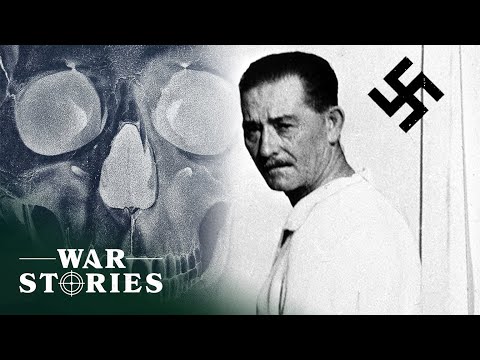
Yet even that was not the end of it. The Mengele case had one more strange twist in store, one that speaks to the bizarre afterlife of his legend. In 1985, when the news of his death first broke, the Brazilian authorities had exhumed a skeleton from a grave outside the municipal cemetery in São Paulo, where the poor were typically buried. The family had led investigators there, and the skull was displayed before the cameras in a macabre spectacle. “It was lifted up in front of the cameras in a brutal and horrifying way,” Holland recalls. The world watched as the man who had once decided who lived and who died became a grisly exhibit himself.
But the questions refused to die. For years after, conspiracy theorists insisted the body was not Mengele’s, that he had faked his death and was still alive somewhere in the jungles of Paraguay or the mountains of Chile. It was not until the DNA evidence emerged in the 1990s that the skeptics were finally silenced. “Science had finally caught up with the Mengele case,” Holland says. The bones were his, beyond any shadow of doubt.
What struck Holland most, however, was not the forensic triumph but the pitiful nature of Mengele’s final years. The man who had strutted across the ramps of Auschwitz in his polished black boots and immaculate white coat, handsome and powerful, had ended his days as a paranoid old man in a modest cottage on the outskirts of São Paulo. “He had this terrible nervous habit of chewing on the ends of his mustache,” Holland notes. “He chewed it so much that he ended up with a ball of hair.”
It was a far cry from the Hollywood image of the Nazi fugitive living in a castle in the jungle, with barking dogs at his feet and speedboats on the river. The reality was a lonely, frightened man who had once performed a hernia operation on a calf at a Brazilian farm, inadvertently revealing to the workers that he was no ordinary Swiss farm manager. “You realize you are someone else entirely,” one of them recalled thinking.
For Eva Kor, who had survived Mengele’s experiments as a child and later led the mock trial against him in Jerusalem, the confirmation of his death brought a strange mixture of emotions. She had testified, along with 105 other survivors, against a man who was not even in the courtroom. “It was perhaps the closest thing to making a person feel like an animal, like nothing, like a piece of trash or a piece of meat,” she said of her time in Auschwitz. And yet, she had lived. She and her sister Miriam had survived, while the rest of their family had perished.
When Mengele examined her and her sister in the camp, he had looked at their fever chart and laughed. “Too small, too small, and too weak to work. What a pity. She is too small. She has only two weeks to live.” Eva understood that much German. But she and Miriam had defied his prediction, surviving until the Red Army liberated the camp in January 1945.
For Holland, the Mengele story is ultimately about the failure of justice and the persistence of memory. “The most notorious Nazi fugitive in the world would never face justice for his crimes,” he says. The victims deserved a trial, and the Mossad’s inability to deliver Mengele to a courtroom remained a source of frustration. Isser Harel, the man who had masterminded Eichmann’s capture, would sometimes apologize for not bringing Mengele to justice.
But Holland is less forgiving. “When I write my memoirs, I will not apologize,” he says. “There is no punishment severe enough for a person like Mengele. Even if he had been caught and hanged, the moment the noose tightened would not be justice for what he did.”
Still, there is a small measure of comfort in how Mengele’s life ended. After Eichmann’s capture, he became a bitter, depressed, and deeply unhappy man, haunted by the fear that he too would be snatched from the streets and hanged. “I think in many ways I pity people like Josef Mengele,” Holland admits. “Because they have a distorted perception of what is right and what is wrong. I don’t think they escaped punishment without a price. I think they lived miserable lives full of guilt.”
Mengele died a free man, but he did not die a happy one. His last years were spent in isolation and terror, a far cry from the luxurious exile he had once enjoyed. He was buried in a grave outside the municipal cemetery, where the poor were laid to rest, and his name became a byword for evil. “To hell with him,” Holland says simply. And with that, the strange, sordid saga of the Angel of Death comes to its end.
For decades, the world believed Mengele had escaped justice entirely. But the truth, as it emerged, was far more mundane and far more damning. “He died a pitiful death, drowning in shallow water after a stroke,” Holland says. The man who had once held the power of life and death over thousands met his end in a clumsy accident, unnoticed and unmourned.
His family, who had protected him for years, tried to cover up his death. They buried him under a false name and refused to speak of him. But the letters found in Hans Sedlmeier’s home exposed the lie. “They denied everything at first,” Holland notes. “But the evidence was overwhelming.”
When the DNA results came back in 1992, the last doubts vanished. The bones were Mengele’s. The Angel of Death was dead and gone. Yet the question remains: was justice ever truly served? “He never stood in a courtroom. He never heard the verdict. He never faced his victims,” Holland says. “But he lived his final years in fear, and that is something.”
Eva Kor, who forgave Mengele publicly in 1995, saw it differently. “Forgiveness is not for the perpetrator. It is for the victim,” she said. She chose to let go of her hatred, not for his sake, but for her own peace.
So the story ends not with a hanging, but with a whimper. Mengele died alone, a forgotten old man in a foreign land. His name will forever be a synonym for evil, but his victims’ stories of survival and forgiveness shine brighter. “The world is still trying to make sense of it all,” Holland reflects. “But one thing is certain: the Angel of Death will never be forgotten.”
What do you think? Did Mengele’s miserable end constitute a form of justice, or did he escape the punishment he truly deserved? Share your thoughts in the comments below.
Report this article
Select a reason for reporting:






