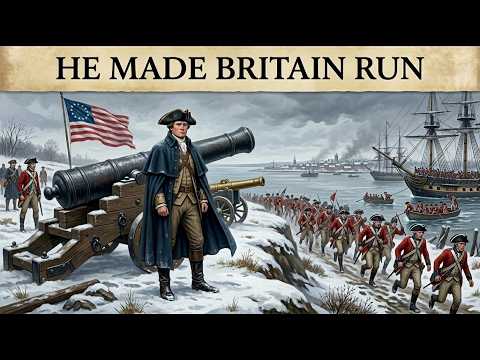
The frozen lake cracked like a gunshot, and Henry Knox knew that one wrong step would send a 2,500-pound cannon—and every man around it—straight to the bottom. It was January 1776, and the temperature hadn’t climbed above zero in days. Knox, a 25-year-old bookseller from Boston, was leading a caravan of ox-drawn sledges across the ice of upstate New York, hauling 60 tons of captured artillery 300 miles to save a revolution that was running out of time.
Every officer in the Continental Army had told him it couldn’t be done. But Knox wasn’t just any bookseller. He was a man who had taught himself military engineering by devouring every book in his own shop, and he was about to prove that expertise doesn’t require credentials—just stubborn refusal to quit.
Five years earlier, Knox was running the London Bookstore on Cornhill Street, a small shop that smelled of leather and printer’s ink. He was a big man—over six feet, well over 200 pounds—with hands better suited to swinging a hammer than turning pages. He’d dropped out of school at 12 to support his family, and everything he knew about the wider world, he’d taught himself by reading.
And he read everything. Histories of ancient battles, French treatises on fortification, technical manuals on artillery science. He worked through John Muller’s Treatise of Artillery until the spine cracked, studying ballistic trajectories, the chemistry of black powder, and cannon design. His customers had no idea that the cheerful shopkeeper helping them find the latest volume of poetry was quietly becoming one of the most knowledgeable self-taught military engineers in the colonies.
When war broke out at Lexington and Concord in April 1775, Knox closed his shop, took his wife Lucy’s hand, and slipped out of Boston past British sentries. According to legend, Lucy hid his sword sewn into the lining of her cloak. Whether true or embroidered, the point stands: Henry Knox left his books behind and walked toward the sound of cannons.
By July, George Washington had arrived to take command of the Continental Army, and he had a problem. His men surrounded Boston, but the British controlled the harbor and could resupply at will. Without heavy artillery, Washington couldn’t bombard the British positions or threaten the warships. The siege would grind on until his volunteer army simply dissolved—enlistments expired in December, and gunpowder was so scarce that at one point there were fewer than nine rounds per man.
Washington needed a decisive move. Knox had an idea. Fort Ticonderoga, captured months earlier, was packed with heavy weapons—cannons, howitzers, mortars—just sitting there, hundreds of miles from the army that needed them. Knox proposed going to Ticonderoga and hauling them overland to Cambridge. In winter. Through the wilderness.
Washington said yes. On November 17, 1775, he gave Knox a commission as colonel of the Continental Regiment of Artillery and sent him north. Knox was 25 years old. He had never commanded troops in the field or supervised a large-scale logistical operation. But he had read a great many books about exactly these kinds of problems, and he carried with him a confidence that bordered on recklessness.
He brought along his 19-year-old brother William, and the two of them rode out of Cambridge with a small escort, heading north through Connecticut and into the wilds of New York. The journey took about two weeks on horseback. Knox arrived at Ticonderoga in early December, and what he found there confirmed everything he had hoped.
The fort was a treasure chest of military hardware. He walked the frozen ramparts with William beside him, inspecting each weapon, checking bore sizes, testing carriages for rot, and making meticulous notes in a small leather journal. He selected 59 pieces of artillery in total: heavy 24-pounders capable of smashing fortified walls, 18-pounders for field batteries, smaller nine- and six-pound guns, several large mortars, howitzers, and a single massive Coehorn mortar.
Altogether, the weapons and their ammunition weighed roughly 60 tons. Some individual cannons weighed more than 2,500 pounds—about as much as a modern car. Now he had to move all of it 300 miles through the dead of winter.
His plan was methodical. He hired local teamsters and contracted for 42 sledges, each heavy enough to carry a cannon. He arranged for 80 yoke of oxen to pull them. He commissioned the construction of a large flat-bottom scow to ferry the weapons down Lake George, and he mapped a route south to the Hudson River near Albany, then southeast across the Berkshire Hills into Massachusetts.
The first stage was Lake George itself—33 miles of frozen water. The ice was treacherous. Some stretches were solid enough to bear a loaded sledge; others were slushy and unstable. On one occasion, a cannon broke through and sank. Knox’s men had to fish it back out of the freezing water using ropes and brute strength. They recovered it, but the incident rattled everyone.
Knox did not have the luxury of waiting for perfect conditions. Washington needed these cannons as soon as possible, and every week of delay was another week closer to the spring thaw that would turn the mountain roads into impassable mud. He had to move forward through conditions dangerous enough to kill him and too dangerous to guarantee success. That tension defined every single day of the Noble Train.
By mid-December, the weapons had made it down Lake George and were being loaded onto sledges for the overland portion. Knox pushed his caravan west and south toward the Hudson, arriving in the Albany area around Christmas. The river crossing was another nightmare—the freeze had been inconsistent, and Knox waited anxiously for the temperature to drop. When the ice finally looked thick enough, they began sending the sledges across one at a time, men walking ahead with axes, testing the surface and listening for the groaning that signaled thin ice.
Once across the Hudson, the real trial began. The Berkshire Mountains stood between Knox and Boston—steep, forested hills with roads that barely deserved the name. They were frozen dirt tracks, narrow and deeply rutted, winding through thick hemlock and pine and over exposed ridges where the wind came screaming across the hilltops with nothing to slow it down.
In some stretches the road was too narrow for the sledges, and Knox’s men had to chop down trees on either side just to make room. The snow lay deep in the hollows and had been packed into slick ice on the exposed ridges, treacherous footing for both oxen and men. Going uphill was backbreaking but straightforward—double the teams, move slowly, keep the sledges from tipping. On Westfield Mountain, one of the steepest climbs, the caravan spent an entire day moving less than a quarter mile.
Going downhill was terrifying. A loaded cannon sledge on a steep descent is essentially an uncontrollable battering ram. Knox’s crews devised a method of wrapping chains and heavy ropes around tree trunks at the top of a descent, lowering the sledges down the slope in controlled stages, one agonizing yard at a time. Even so, sledges broke loose and careened down slopes. Chains snapped under the strain. One cannon reportedly slid off the road entirely and tumbled into a ravine, and the men had to rig ropes and pulleys to drag it back up.
A lesser leader would have abandoned the heaviest pieces on the mountainside and pressed on with what was manageable. Knox refused. He had promised Washington 60 tons of artillery, and he intended to deliver 60 tons of artillery.
Temperatures in the Berkshires often dropped well below zero, and frostbite was common. The oxen grew exhausted and had to be swapped out in shifts. The entire operation depended on local communities, and Knox proved as skilled a diplomat as he was a logistician. He paid fair prices for food and lodging, treated farmers with respect, and convinced skeptical townspeople that the strange caravan of cannons creaking through their village was their best hope for ending the war.
Through it all, Knox wrote long letters to Washington and to Lucy, describing the journey in vivid detail. To Lucy, he wrote with tenderness about missing her, and with pride about the scale of the operation. To Washington, he was more businesslike but no less emotional, reporting delays and near disasters with the same precision he used to describe the specifications of a 12-pound cannon. Underneath it all ran a current of absolute conviction that these cannons would change the course of the war.
The caravan crossed the final stretches of Massachusetts in late January 1776, rolling through Springfield, Brookfield, Worcester, and Framingham before reaching the outskirts of Cambridge. Knox rode ahead to report to Washington. His arrival was cause for celebration and mild disbelief. He had done what nobody thought possible: 59 artillery pieces, 60 tons of equipment, transported 300 miles through the worst terrain and weather the northeast could throw at a convoy. The weapons arrived on sledges pulled by exhausted oxen, covered in ice and road grime, but intact. Not a single man had been killed.
Washington wasted no time. The target was Dorchester Heights, a ridge of high ground south of Boston overlooking both the city and its harbor. On the night of March 4, 1776, under cover of a diversionary bombardment using some of Knox’s newly arrived cannons, more than 2,000 Continental soldiers moved onto the heights. They carried prefabricated wooden frames on their backs, dragged Knox’s cannons up the slopes with ropes and ox teams, and packed barrels with earth and sand. The ground was frozen too hard to dig trenches, so they built above-ground defenses instead.
By dawn on March 5, the British looked up and saw something that should not have existed: a fully fortified artillery position bristling with the same heavy guns Henry Knox had dragged 300 miles through the wilderness. British General William Howe was stunned. He reportedly said the rebels had done more in one night than his own army could have accomplished in a month.
Howe considered an assault, but a massive storm blew in and made an amphibious attack impossible. By the time the weather cleared, Washington’s position was even stronger. On March 17, 1776, the British garrison boarded their ships and sailed out of Boston Harbor—more than 9,000 troops, along with over a thousand loyalist civilians, heading for Halifax. The siege of Boston was over.
Washington credited the artillery on Dorchester Heights as the decisive factor. Knox’s cannons had not just ended the siege—they had proven that this ragged, undersupplied rebel army could actually win against the most powerful military force on Earth. That mattered enormously in the spring of 1776, when the question of independence was still being debated in Philadelphia. The delegates who would eventually sign the Declaration of Independence needed evidence that the war was winnable. Boston gave them that evidence.
Henry Knox did not stop at Boston. Washington kept him close for the rest of the war, and Knox became the Continental Army’s Chief of Artillery. He was at Trenton, commanding the guns during the Christmas night crossing of the Delaware. He was at Princeton, Brandywine, Germantown, and Monmouth. He was at Yorktown in 1781, where his batteries pounded the British fortifications until Cornwallis surrendered. The bookseller who had taught himself artillery science from imported French manuals directed the bombardment that won American independence.
After the war, Knox became the nation’s first secretary of war, overseeing the creation of the United States Military Academy at West Point. Lucy was beside him through all of it. She had lost her family, crossed enemy lines, and endured years of separation during the campaigns. The Knox marriage was one of the great partnerships of the revolution.
Henry died in 1806 at the age of 56, from complications after swallowing a chicken bone—a death completely unworthy of the life that preceded it. What survived him is not a statue or a monument, though both exist. What survived is the proof that expertise does not require credentials, that courage does not require a uniform, and that the right person in the right moment can bend the course of history through sheer stubborn refusal to quit.
The Berkshire Mountains are still there. The frozen route between Ticonderoga and Boston is still traceable on a map—300 miles of terrain that should have stopped a 25-year-old bookseller with no military experience and 60 tons of iron on wooden sledges. It did not stop him. And because it did not stop him, a city was freed, a war became winnable, and a country that did not yet exist took its first real breath.
Knox’s cannons still sit in museums and parks across New England. Some bear the marks of their journey—scratches and dents in the iron from being dragged across frozen rivers and lowered down mountain roads on chains. Most people drive past the historical markers without a second thought. But now you know what happened on those roads in that winter, when a bookseller and a train of cannons changed everything.
So here’s my question for you: what’s the most impossible logistical feat you’ve ever heard of—and would you have bet on a 25-year-old bookseller to pull this one off? Drop your answer in the comments below.
Report this article
Select a reason for reporting:






