The rumble of engines grew louder, and Second Lieutenant Audie Murphy felt the frozen ground tremble beneath his boots. Through the mist, six German Jagdpanther tank destroyers emerged like steel beasts, their long guns swiveling toward the thin American line. Behind them, 250 infantrymen in white camouflage advanced in perfect skirmish order, a wave of death sweeping across the snow-covered fields.
Murphy, just 19 years old and commanding a shattered company of 40 men, knew the odds were impossible. But he also knew he was the only thing standing between the German onslaught and the vital bridges of the Colmar Pocket. What happened next would become one of the most legendary stands in military history.
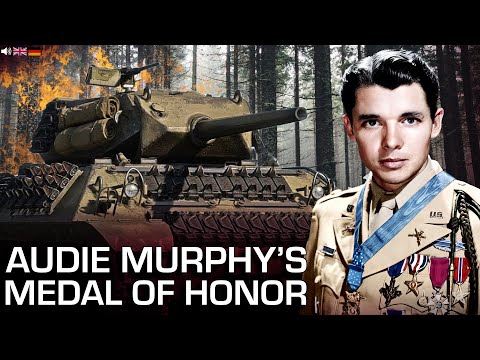
The situation deteriorated in seconds. The rear tank destroyer was hit, erupting in flames. The second M10 slid into a ditch, its gun useless. “We were alone,” one survivor recalled. “Just us and Murphy against the whole German army.”
Murphy ordered his men to fall back to a secondary line in the woods while he stayed behind, fully exposed, to call in artillery fire. Hundreds of German soldiers poured out of the treeline, their machine pistols chattering. Tank shells shattered branches around him, but he kept the field telephone pressed to his ear.
When the burning tank destroyer became the only target left on the field, Murphy did the unthinkable. He climbed onto its flaming hull, exposing himself to a hail of bullets and shells, and manned the .50 caliber machine gun. “I saw him do the bravest thing I’ve ever seen any man do in combat,” Lieutenant Vicefenning remembered. “He was completely exposed, silhouetted against the snow, with fire under him that threatened to blow the destroyer to bits.”
For over an hour, Murphy held off the entire German force, alternating between firing the machine gun and calling artillery down on his own position. Twice, tank rounds slammed into the M10, engulfing it in smoke. Both times, he miraculously reappeared and kept firing.
His ammunition finally exhausted, Murphy climbed down, blood soaking his leg from a reopened wound, and made his way back to his men. He refused evacuation. Instead, he reorganized the company and led a counterattack that swept the Germans back into the woods.
For his actions that day, Audie Murphy would receive the Medal of Honor. But the battle was far from over—and the cost of his bravery would haunt him for the rest of his life.
The days that followed the fight at Holtz Wihr blurred into a haze of cold, exhaustion, and relentless patrolling. Company B, now barely a shadow of its former self, was pulled back from the line and folded into a rest area near the rear. Replacements trickled in—boys with fresh faces and clean uniforms who had never heard a Jagdpanther’s gun roar. Murphy watched them arrive with a quiet, distant look that his men had come to recognize.
“He didn’t talk much about what happened on that tank destroyer,” Sergeant Brawley later said. “But you could see it sitting behind his eyes. Like he was still up there, waiting for the next shell.”
The paperwork, however, did not wait. Within days, reports of the stand near Holtz Wihr had climbed the chain of command, each retelling growing more astonishing than the last. Officers who had never met Murphy read the accounts and shook their heads in disbelief. A single lieutenant, wounded, alone on a burning vehicle, had broken the back of a German counterattack.
The recommendation for the Medal of Honor moved quickly through the 3rd Infantry Division’s headquarters. General John W. O’Daniel, who had already watched Murphy’s star rise through Sicily, Anzio, and the fields of southern France, signed off without hesitation. But the process was not merely administrative—it required witnesses, sworn statements, and the cold precision of military bureaucracy, even in the middle of a war.
One afternoon in early February, a clerk arrived at Company B’s position with a stack of forms and a list of names. Murphy was asked to sit and recount the events of January 26th in his own words. He did so reluctantly, chain-smoking and staring at the wall, offering the barest facts. When the clerk pressed him for details—how many Germans he had faced, how long he had held the position—Murphy shrugged.
“I don’t know,” he said quietly. “I was busy.”
It was this modesty, this refusal to inflate his own deeds, that struck everyone who met him. The men who had been there knew the truth. They had seen him silhouetted against the flames, had heard the steady rhythm of the .50 caliber, had watched him climb down bleeding and refuse to leave. But Murphy himself seemed almost embarrassed by the attention.
Meanwhile, the war ground on. The Colmar Pocket was finally reduced by early February, the German foothold in France erased after weeks of brutal winter fighting. The Allies pressed toward the Rhine, and the end of the war in Europe crept closer with every passing day. But for Murphy, the fighting was not yet finished.
In March, he was pulled from the line and sent to a hospital in the rear for treatment of his leg wound—the same one that had reopened on the tank destroyer. He hated every minute of it. “I’m fine,” he insisted to the doctors, who ignored him and ordered bed rest. He wrote letters to his men, asking about the company, about the replacements, about whether they were being taken care of.
It was during this hospital stay that the news arrived. A clerk handed him a telegram, and Murphy read it twice before setting it down on the blanket beside him. He said nothing for a long moment. Then he lit a cigarette and stared out the window at the gray European sky.
“They’re giving me the Medal of Honor,” he finally said, as if reporting a change in the weather.
The doctors wanted him to stay for weeks. Murphy gave them days. He discharged himself against medical advice, just as he had done after the gangrene, and hitched a ride back toward the front, where the 15th Infantry was grinding its way into Germany itself. The war was clearly in its final act now, and he had no intention of sitting it out in a hospital bed.
By spring, the fighting had lost none of its ferocity, even if the outcome was no longer in doubt. German resistance was fanatical in places, crumbling in others, and Murphy moved through it all with the same quiet, watchful competence that had kept him alive this long. His men noticed that he seemed older now, the boyish face hardening into something leaner and more distant.
Then, in the first days of May, came the announcement they had all been waiting for. The war in Europe was over.
Murphy was on a train bound for the Riviera, a few days’ pass in his pocket, when he heard the news crackle over the carriage radio. He later called it the most memorable day of the entire war—not the tank destroyer, not the Medal, but that single moment of silence after years of noise.
The ceremony came a month later, near Salzburg, Austria. On June 2nd, 1945, a shy young man from Hunt County, Texas, stood before a gathering of generals and photographers to receive the highest honor his country could bestow. Lieutenant General Alexander Patch pinned the medal and leaned in close.
“I wonder if you’re as nervous as I am,” Patch whispered.
“Yes, sir,” Murphy replied. “I’m afraid I am.”
It was a moment of ordinary human frailty from a man who had just been immortalized, and somehow it captured him perfectly. He accepted the Legion of Merit that same day, shook the hands offered to him, and posed for the photographs with the same tight, uncomfortable smile. He never once mentioned the burning tank destroyer to the reporters who crowded around him.
When he finally sailed home in August 1945, just days before his twenty-first birthday, he was no longer simply a soldier. He was a national symbol, and America was eager to embrace him. Parades, interviews, and offers of every kind awaited him on the dock. But the man who stepped off the ship looked less like a hero than a tired kid who wanted to go home.
What none of the cheering crowds could see was what he had carried back with him. The war had ended, but for Audie Murphy, the fighting on the inside was only just beginning.
The years that followed were a strange campaign fought far from any battlefield. Murphy threw himself into acting, churning out more than forty films, mostly Westerns, where he could play the quiet, stoic hero he had once been in real life. But the roles never silenced the memories. He slept with a pistol under his pillow for the rest of his life, haunted by the faces of men he had killed and friends he had lost.
His 1955 autobiography, To Hell and Back, became a bestseller, and he starred as himself in the film adaptation—a rare and uncomfortable honor. Yet the fame only deepened his isolation. He struggled with addiction to sleeping pills, suffered nightmares, and withdrew from the spotlight whenever he could. Still, he never turned away from his fellow veterans.
“On Veterans Day in the 1950s, Audie was asked what the most memorable day of the war was for him,” a reporter recalled. Murphy’s answer was not the tank destroyer or the Medal. “I heard the announcement that the war in Europe was over,” he said. “There’s nothing that could top that for me.” He paused, then added softly, “I saw a lot of good men come and go, and a lot of them are still there.”
On May 28, 1971, a twin-engine Aero Commander took off from DeKalb Airport in Georgia, bound for Martinsville, Virginia. It never arrived. The plane crashed into a mountainside in bad weather, killing all six on board. Audie Leon Murphy was just 45 years old.
He was buried with full military honors at Arlington National Cemetery on June 7, 1971. At his earlier request, the gold lettering reserved for Medal of Honor recipients was omitted from his headstone. He preferred the plain inscription of an ordinary soldier—a final, quiet act of humility from a man who had given everything for his country and asked for nothing in return.
Today, a memorial stands near Holtz Wihr, marking the spot where a 19-year-old lieutenant held off an entire German advance. But the true monument is the story itself—one of courage, sacrifice, and the heavy price of heroism. What do you think we owe to the men and women who carry such invisible wounds home from war?
Report this article
Select a reason for reporting:






