The train screeched to a halt, and the doors slid open to reveal a scene straight out of a nightmare. “Come on, take whatever you can carry. You have the right to take a hundred Reich marks and no more.” The words echoed in the cold morning air as thousands of Jews were herded onto waiting trains, their faces etched with fear and confusion. They had no idea where they were going—only that their lives would never be the same.
This was the spring of 1940, and Adolf Hitler’s war machine was unstoppable. In just six years, he had crushed all opposition, annexed Austria, dismantled Czechoslovakia, and invaded Poland. Now, his sights were set on France. The French high command, utterly unprepared for the speed of the German tanks, watched in horror as their supposedly unbreakable front collapsed in just five days. Paris fell without a fight on June 14, and nearly eight million French fled before the enemy’s advance.
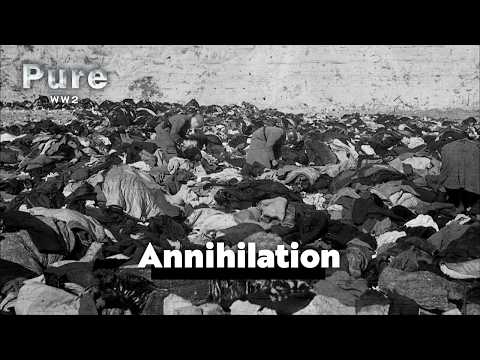
But Hitler’s ambitions went far beyond military conquest. In the wake of victory, France was split in two: three-fifths occupied by the Germans, the rest a so-called “free zone” governed from Vichy. It was here that the first steps toward annihilation were taken—not by German pressure, but by French initiative. “The French statute of Jews of October 3rd, 1940, was undertaken without direct German pressure,” one historian notes. “It was the product of Vichy’s own policies.”
Marshall Pétain, the hero of Verdun, was no reluctant collaborator. He personally aggravated the statute’s provisions, barring Jews from professions, education, and public life. “Pétain was an anti-Semite,” the historian continues. “The French statute was historically speaking much more racist than the Nuremberg laws.” In the unoccupied zone, foreign Jews were rounded up and interned in camps like Gurs, originally built for Spanish Civil War refugees. Pierre Laval, Pétain’s deputy, proudly told the German ambassador, “Look what we’re doing. We’re solving the Jewish problem in our country just as you are in yours.”
Meanwhile, the Nazis were concocting their own twisted solutions. In 1940, their policy was expulsion, not extermination. The Madagascar Plan envisioned deporting four million Jews to the French island—a genocide by another route. But when Britain refused to fall, the plan collapsed. Instead, Jews were pushed east, into the ghettos of Poland. In Warsaw, 130,000 people were crammed into a few hundred hectares, sealed behind walls and barbed wire. “The living conditions in the ghetto were gradually dehumanizing the Jews,” a survivor recalls. “Fifteen people lived in one room. In the daytime, they were out in the streets looking for work or for food.”
The Nazis exploited this suffering with chilling cynicism. Propaganda films like The Eternal Jew juxtaposed images of starving ghetto Jews with wealthy Jews at parties, warning, “Watch out. Jews don’t look like this. They look like this.” The message was clear: Jews were parasites, disease carriers, a plague to be eradicated. “The aim of these films was to give an image of the Jews which would later justify the politics of extermination.”
By the summer of 1941, the Nazis were ready to take the next step. Hitler turned his gaze east, toward the Soviet Union. “The attack on the Soviet Union was the ultimate act of hubris,” one expert says. “They believed they would destroy the Russian armies in three or four weeks.” But this was no ordinary war. It was a war of annihilation—a racial war against “Jewish Bolshevism.” Himmler assembled the Einsatzgruppen, mobile killing squads tasked with eliminating Jews and communist leaders. “Your mission in the Soviet Union will be the elimination of the Jews,” he told them.
The first massacres were carried out with brutal efficiency. In Lithuania and Ukraine, local populations, eager to settle old scores, joined in the slaughter. “A Lithuanian with an iron bar was hitting a man on the skull. In three-quarters of an hour, he had beaten 50 people to death,” a witness recalls. “The local people there, their behavior was incredible. They were applauding each death.”
But the Einsatzgruppen soon discovered that shooting women and children was taking a toll on their men. “At their first shootings, they didn’t know what to do. Sometimes they were even sickened by it,” a historian notes. Yet within weeks, they had developed a system: one group guarded the victims, another led them to the pits, and a third did the killing. “They developed a sort of anatomical know-how that permitted them to kill cleanly with a shot to the back of the neck.”
By August 1941, the orders had changed. No longer were they killing only adult male Jews. “At the first mass shooting of women and children, there were more than 3,000 killed in a single day,” the historian continues. “That’s when it turned into pure genocide.”
And then came Babi Yar. On September 29, 1941, the Jews of Kiev were ordered to assemble by the Jewish cemetery. “Jews of Kiev and its region, on the 29th of September, you will assemble with your personal effects, money, papers, and warm clothing,” the poster read. “Any absentee will be punished by death.” Over 33,000 men, women, and children were marched to a ravine and shot over two days. “I remember they were just overcome with horror when they got to the edge of the pit and saw all the bodies,” a witness recalls. “A lot of them started screaming.”
The news of Babi Yar spread, but the world struggled to believe it. An Israeli newspaper reported the massacre, then issued a correction: “We apologize. We made a mistake and added a zero. In fact, there were 3,300 victims.” The truth was too horrific to comprehend. But the Nazi machine was just getting started.
By the time the snows came, the killing had become routine. “One report said we’ll still need them till the end of winter,” a commander noted, referring to the few skilled Jewish laborers kept alive in the ghettos—carpenters, tailors, mechanics whose usefulness bought them a few more months of breath. But the reprieve was never mercy. It was bookkeeping.
In Berlin, the bureaucracy of death moved with the same precision as the armies in the east. Adolf Eichmann, a mid-level SS officer with a talent for timetables, was tasked with organizing the deportations. He had studied the rail networks of Europe the way a chess player studies the board. “The Jews will be sent to the east, pushed across the Urals,” the plan went. “They can rot. They can die. But they will be outside the German sphere of influence.” No one in the room asked what would happen when there was nowhere left to push.
On October 16, 1941, more than a thousand Jews from the Ukrainian city of Lubny were marched to the edge of town. Johannes Hähle, a photographer attached to a propaganda company, raised his camera. The images he captured—women clutching children, old men staring blankly at the earth—would survive the war. The victims did not.
It was around this time that a new phrase entered the Nazi vocabulary: Sonderbehandlung. Special treatment. It appeared in reports from the east with increasing frequency, a euphemism so bland it could have referred to a hotel upgrade. In practice, it meant a bullet to the back of the head, or a pit filled with lime, or a truck whose exhaust was piped back into the cargo hold.
The men of the Einsatzgruppen were not monsters in the conventional sense. They were teachers, lawyers, shopkeepers—ordinary Germans who had been told, again and again, that they were fighting a war of survival. “You can’t afford to be compassionate,” Himmler told them. “That is the mentality of the Einsatzgruppen.” And so they killed, day after day, until killing became as unremarkable as breathing.
But even Himmler was troubled by the toll it took. In Minsk, he had watched an execution and nearly fainted. A police officer who was present wrote that Himmler’s face went white, that he gripped the edge of the pit and ordered the survivors finished off. Yet within days, the order had gone out: women and children were now to be included. “That’s when with the children it turned into pure genocide,” a historian explains. “They’d separate the mother and child and take one each.”
The ripple spread outward. In town after town, the killing units retargeted their victims. No longer just adult men. No longer just communists. All Jews. Every Jew. The statistical reports from Einsatzkommando 3 grew shorter, more clinical. Where once they had listed men, women, and children separately, now they simply wrote: “All the Jews in each area.”
By late 1941, the question was no longer whether the Jews of Europe would be destroyed, but how. The answer was already being built—not in the east, but in the quiet Polish countryside, where construction crews were pouring concrete and installing showerheads that would never release water.
The first extermination camp, Chełmno, began operations in December 1941. Gas vans—trucks whose exhaust was funneled into sealed compartments—carried Jews from the Łódź ghetto to the forests of Rzuchów. “They were told they were going to a labor camp,” a survivor later testified. “They were given soap and a towel. Then the doors closed.” Within minutes, the screaming stopped.
At Auschwitz, Rudolf Höss experimented with Zyklon B, a pesticide originally designed to kill lice. On September 3, 1941, six hundred Soviet prisoners of war and two hundred fifty Polish Jews were locked in the basement of Block 11. When the pellets were dropped, the men died in agony. Höss was pleased. “I had the feeling that I was witnessing something monstrous,” he later wrote, “but I was too deeply enmeshed to think about it.”
By early 1942, the Wannsee Conference had formalized what the Einsatzgruppen had already begun. The “Final Solution” was no longer a vague ambition—it was a logistical blueprint. “The Jews are to be evacuated to the east,” the protocol read, “and utilized for labor. Those who survive will be treated accordingly.” The phrase “treated accordingly” meant only one thing.
Trains rolled into the camps day after day, crammed with families who had been told to bring warm clothing and sturdy shoes. “We didn’t know where we were going,” a survivor of the Warsaw ghetto recalled. “We only knew we had to go.” On the ramps, SS officers made their selections with a flick of the wrist. Left for work. Right for the gas.
In the ghettos, the Jewish councils faced an impossible choice: comply with the deportations and hope to save a remnant, or resist and risk annihilation. “We had no weapons, no allies, no time,” a resistance fighter wrote. “But we had our dignity.” In April 1943, the Warsaw Ghetto Uprising erupted. For nearly a month, a few hundred poorly armed fighters held off the SS. When it was over, the ghetto was burned to the ground.
The world watched, but did little. The Allies debated rescue plans, debated bombing the railways, debated everything but action. “We are not in a position to help,” one British official noted. “The only way to save the Jews is to win the war.” And so the killing continued—at Treblinka, at Sobibór, at Bełżec. By the war’s end, six million were dead.
But the story does not end with numbers. It ends with a question. When the Einsatzgruppen commander stood at the edge of the pit and told his men that compassion was a luxury they could not afford, he was speaking to something dark in all of us. The machinery of genocide was built not by monsters, but by ordinary men who chose to obey. What would you have done—when the knock came at four in the morning, when the train doors slid open, when the pit yawned before you?
Would you have looked away? Or would you have shouted into the silence?
Report this article
Select a reason for reporting:






