For centuries, wars had been fought on land and at sea, but in the early 20th century, a new technology was quickly showing its potential as a military capability: the aeroplane. Land-based aircraft were easily transported and employed on the battlefield, but using them as an aerial force whilst at sea would need a step change in naval thinking and technology—the aircraft carrier.
Prior to World War One, the naval wing of the Royal Flying Corps had been developing its aerial capabilities, and the Royal Navy was doing its best to provide ships capable of launching, recovering, and servicing their aircraft whilst at sea. This had largely been provided by cruisers and battleships that had been converted to accommodate seaplanes launched from catapults but then winched back on board using cranes.
By the time war broke out, the naval wing of the Royal Flying Corps had separated from the British Army air wing to become the Royal Naval Air Service, and they had grown to include over 700 men and a fleet of 93 aircraft, as well as six airships and two balloons. Due to the limitations of seaplanes aboard ships, most of their wartime roles consisted of land-based aircraft carrying out fleet reconnaissance, coastal patrols, and defense against attacking enemy naval forces.
The Admiralty were desperately needing a way to get their very latest wheel-based aircraft out to sea. To attempt to satisfy this requirement, they looked at acquiring half-built ships and repurposing their hulls. HMS Argus, which was originally being built for Italy as an ocean liner, and HMS Eagle, which was being built as a battleship for Chile, were ideal, and so they were repurposed into aircraft carriers.
As well as acquiring foreign ordered ships, they also looked at the incomplete Courageous-class battlecruiser HMS Furious and fitted a flight deck in place of a forward gun turret, and later removed her rear gun turret for an aft flight deck. Whilst these ships served quite well as aircraft carriers, they did have their limitations, not least because they were never intended to be aircraft carriers.
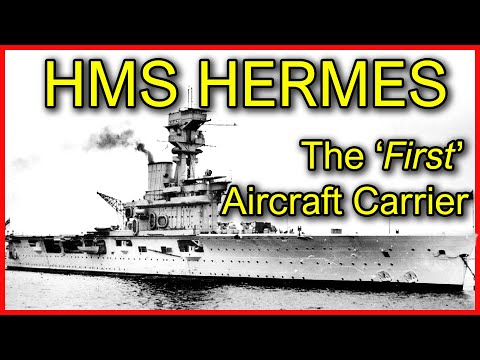
And so, in April 1917, the Admiralty placed an order for a ship to be designed from the keel up as the world’s first purpose-designed and built aircraft carrier. The accolade of being the world’s first, however, is contested with the Japanese carrier Hosho, which although started construction later, was commissioned into service first.
Her initial design was in a constant state of flux and at first was based upon the design of a seaplane carrier: a full-length flight deck running between two islands fore and aft for launching aircraft, and a submerged slipway at the stern for the recovery of seaplanes. The recovered aircraft would then be towed into the hangar deck where aircraft lifts would be able to transport them back up onto the flight deck.
In January 1918, following the addition to the design of a rotating bow catapult to assist the launch of aircraft into any wind direction, she was finally allowed to begin construction on the banks of the River Tyne at the Armstrong Whitworth shipyard. Her keel was laid down on the 15th of January 1918. The world’s first purpose-built aircraft carrier was under construction.
However, there was still a war going on, and the Admiralty was under pressure to complete its other aircraft carrier conversion projects. Alongside the keel of Hermes at the Armstrong Whitworth Tyneside yard, HMS Eagle was nearing readiness for launch, and much of the yard’s workforce and resources were allocated to Eagle. This meant that the progress on Hermes was frustratingly slow, but it did enable further modifications to be made to her design.
By summer of that year, the submerged slipway had been removed altogether, and there was much debate and argument over what the ideal configuration of armament should be. Due to this continued uncertainty, the Admiralty ordered that construction above the hangar deck levels should be halted until agreement was reached on what the best configuration of an aircraft carrier should be. Further design changes would be made, such as aircraft lift sizes moving from two islands to a single island, and yet more changes to her armaments.
But finally, on September 11th, 1919, HMS Hermes was launched, and immediately suspended construction. The shipyard in which Hermes was built was to close at the end of 1919, and so the Admiralty requested that the incomplete carrier be towed at Devonport where she would be fitted out, and she arrived there in January 1920.
The suspension of construction was also to allow for lessons to be learned from the sea trials and flight tests of HMS Argus and HMS Eagle. It was decided to position the island’s superstructure to the starboard side, as it was discovered that following an aborted landing attempt, pilots would usually prefer to turn their aircraft to port. A sizable tripod mast housing the fire control systems for the ship’s armaments was built on top of the island.
By the time Argus and Eagle had completed their respective trials, the design of HMS Hermes was finalized. She had a length of 600 feet, a beam of 70 feet 3 inches, and a draft of 23 feet 3 inches when at deep load, giving a total displacement of 12,900 tons. Powered by Parsons geared steam turbines at a total power output of 40,000 shaft horsepower, she was able to reach a speed of 26.2 knots during her sea trials, and when traveling at 16 knots she had a range of 4,480 nautical miles.
Her original design allowed her to carry and operate 15 aircraft, housed in a hangar deck 400 feet long, 50 feet wide, and 16 feet high, and they would be moved to the 570-foot-long flight deck using two 36 by 36.6 ft lifts. An additional large crane was situated behind the island to assist with aircraft movements. After much debate and alterations, her armaments were six 5.5-inch Mark I guns, three on the port side and three on the starboard side, and on the flight deck she had four Mark V four-inch anti-aircraft guns.
Her sea trials began in August 1923 under the command of her first commanding officer, Captain Arthur Stopford, and after successfully completing these she was commissioned into service on the 18th of February 1924. Soon after she was assigned to the Atlantic Fleet.
The early months of HMS Hermes’s career was still very much a trial in all but name—not just of her own operational effectiveness, but also that of her aircraft—and she spent a number of months carrying out flight trials of the Fairey III D reconnaissance biplanes. Following these trials and her participation in the fleet review at Spithead on the 26th of July in the presence of King George V, she was sent for a small refit, following which she sailed for Malta, arriving on the 22nd of November to take up her role as part of the Mediterranean Fleet.
There she would embark Fairey Flycatcher fighters of 403 Flight and Fairey III D reconnaissance aircraft of 441 Flight before carrying out flying exercises alongside HMS Eagle. On the 17th of June 1925, Hermes set sail for the China Station, having a change of command en route where Captain Stopford was replaced by Captain Cecil Talbot, and arrived in Hong Kong on the 10th of August 1925, making her first foreign port visit to Amoy in the November.
Following this successful first trip to the Far East, she returned to Malta in early 1926 for a refit and a change of aircraft complement. 441 Flight was transferred to HMS Eagle, and 440 Flight and 442 Flight came aboard with their Fairey III Ds. Following some brief exercises in the Mediterranean, Hermes—now under the command of Captain Ralph Elliot—returned to the Far East, arriving in Hong Kong on the 11th of October 1926 for a year of routine training, and following being relieved by HMS Argus she was back in Britain by the autumn of 1927 for a refit at Chatham Dockyard, having one of her four-inch guns removed as well as 440 Flight replaced their Fairey III Ds with Fairey III Fs.
Captain Jeffrey Hopwood now assumed command of Hermes, and she once again set sail for the China Station. In September 1931, Hermes had sailed up the Yangtze River to the inland port of Hankow to assist the Chinese government in surveillance of massive flooding in the area. Coincidentally, American aviator Charles Lindbergh and his wife were also carrying out a survey in the area using their Lockheed Sirius float plane. Hermes’s captain offered the use of the ship as a base whilst they were in the area, but on the 2nd of October, as the carrier’s large crane was lowering the float plane back into the water, it was hit by a large swell and turned over. They were quickly rescued, but the aircraft was damaged and needed to be taken to Shanghai to be repaired.
On the 22nd of July 1933 she was back in the UK, and in the September of that year she underwent a major refit which lasted almost a full year, during which her armament was revised and she also had her arresting gear and machinery upgraded, in time to receive nine Fairey Seal torpedo bombers of 824 Naval Air Squadron. By the 4th of January 1935, Hermes was back in the Far East under the command of Captain the Honourable George Fraser, spending time in Hong Kong and also in Singapore carrying out extensive training using their torpedo bombers, and by the 3rd of May 1937 she was back in the UK—this time to be placed in reserve.
She was assigned to the Reserve Fleet on the 16th of July 1938 and became a training ship at Devonport, but this reserve role wasn’t to last long as tensions in Europe were rising. In August 1939, with war just a few weeks away, she was called back into action, and following a short refit and the appointment of a new commanding officer, Captain Fitzroy Hutton, she was recommissioned on the 24th of August 1939.
On the 1st of September, 814 Naval Air Squadron arrived on board bringing their 12 Fairey Swordfish torpedo bombers, and by the middle of September Hermes was carrying out anti-submarine patrols in the Western Approaches. By October this was deemed to be an ineffective task and also too high a risk for the carrier fleet, having lost HMS Courageous on the 17th of September to a U-boat attack, and so HMS Hermes was re-tasked to Dakar off the west coast of Africa, and having paired up with the French battleship Strasbourg, she began patrols of the Atlantic looking for German blockade runners.
On June 29th 1940, under a new command of Captain Richard Onslow, Hermes was ordered to take part in a blockade of Dakar. France had fallen to the Germans a few days earlier, and the governor of French Senegal had declared the colony’s allegiance to the German-supported Vichy French regime. It was feared that if the Germans took control of the French fleet at Dakar, it could be used to attack Allied shipping in the Atlantic. One such ship was French battleship Richelieu, one of the most modern in the French fleet and completed only a few days before the German victory over France. She fled to Dakar in order to keep her from German control, but now it seemed that was inevitable.
So on the night of the 7th of July, Hermes launched one of her boats on a mission to attack Richelieu with depth charges. At the same time, Fairey Swordfish from 814 Naval Air Squadron would attack with torpedoes. It was a partial success: the depth charges failed to detonate, but there was a hit from a torpedo which damaged one of Richelieu’s propellers, putting her out of action. Hermes came under French retaliatory fire but was able to escape the area with no damage.
Unfortunately though, a few days later she would be badly damaged in a deadly accident. She was sailing for British Sierra Leone and the port city of Freetown when, on the night of the 10th of July in heavy rain, she collided with the armed merchant cruiser HMS Corfu. Such was the impact, three sailors on board Hermes were injured, one of which would die as a result of his injuries. The crew of Corfu were ordered to abandon their ship, and as the two vessels were locked together they were actually able to walk from one ship to the other.
The bow of HMS Hermes had been crumpled for 30 feet—almost 10 meters—but she was still watertight, and so at a reduced speed she managed to limp the rest of her journey to Freetown. HMS Corfu, being towed stern first by Shoreham-class sloop HMS Milford, arrived three days later. For an inspection in Freetown, Hermes was sent to South Africa in the naval base of Simon’s Town near Cape Town for full repairs, not arriving back in Freetown until late November.
Following re-entering service, she was used largely for patrols looking for Axis shipping, and on occasion specific hunting missions such as for the German heavy cruiser Admiral Scheer, spent in the early months of 1941 off the south coast and east coast of Africa, as well as patrolling between Ceylon (present-day Sri Lanka) and the Seychelles islands—only interrupting these duties in May and June to visit the Persian Gulf to support British operations in Basra, Iraq.
Following another refit in January of 1942, Hermes was sent to Ceylon to take up her role as part of the Eastern Fleet, and after receiving back on board her complement of Fairey Swordfish she was once again carrying out anti-submarine patrols, this time alongside Australian destroyer HMAS Vampire off the east coast of Africa.
The island of Madagascar was under the control of the Vichy French, and the Allies were becoming very concerned about its ability to hinder Allied shipping. Of particular danger was the increase in activity by the Imperial Japanese Navy, and there were concerns that Madagascar could be used as a strategic base for the Japanese. Plans were therefore drawn up by the British for an invasion and capture of Madagascar, and the first action being Operation Ironclad, planned for early May.
Following a raid on Colombo by the Japanese on the west coast of Ceylon, Hermes and Vampire were sent to Trincomalee on the Ceylon northeast coast to begin preparations for Operation Ironclad, and after arriving off the coast of Trincomalee the Swordfish aircraft of 814 Naval Air Squadron were flown ashore and she docked to begin her preparations.
On the 9th of April 1942, an advanced warning was received of an imminent attack by the Japanese on Trincomalee. To avoid the loss of Hermes and Vampire, who were now sitting ducks in port, they immediately put to sea and headed south. There was no time for Hermes to regain her aircraft of 814 Naval Air Squadron.
As the two ships were sailing past Batticaloa, they were spotted by a Japanese reconnaissance plane who immediately radioed their position back to the main fleet. This radio message was also heard by the British, and the two ships were ordered to immediately return towards Trincomalee at full speed where land-based fighter cover would be provided. The RAF scrambled six Fairey Fulmar fighters of 273 Squadron based at RAF China Bay to come to their aid, but this was no match for the Japanese onslaught. They launched 85 Aichi D3A dive bombers along with nine Mitsubishi A6M Zero fighters, and of these 32 Japanese bombers located the British and Australian ships and the attack commenced.
Hermes may have been without her defensive aircraft, but she did open up with her anti-aircraft guns and maneuvered wildly in a desperate attempt to defend herself, but ultimately this was futile against a skilled and ruthless onslaught. The attacking bombers scored multiple direct hits, including one to the bridge, killing all who were there—including Captain Onslow.
After approximately 15 minutes of the onslaught, Hermes was listing dramatically to port and there was no longer any hope the stricken carrier might survive. Twenty minutes after the attack began, she sank, taking with her 307 of her crew. HMAS Vampire didn’t escape either; her captain and eight of her crew were also killed as she too sank some ten minutes after Hermes. The survivors were picked up by hospital ship Vita.
Hermes began life as a bold new concept of air power at sea, and her early designs set in motion a journey towards the awesome capabilities of the aircraft carriers of today. She would not be the last ship to carry the name Hermes—her successor, the Centaur-class aircraft carrier HMS Hermes, was launched in 1953 and would go on to see service in the Falklands War of 1982.
So what do you think—was HMS Hermes a tragic waste of a pioneering design, or a necessary sacrifice that paved the way for modern naval aviation? Share your thoughts in the comments below.
Report this article
Select a reason for reporting:






