On October 14, 1942, a burning Spitfire fell out of the sky over Malta. The pilot climbed out and dropped toward the sea near St Paul’s Bay, wounded in the heel and elsewhere, his plane torn by gunfire.
He was 20 years old. In a little over four months he had become the top-scoring Allied fighter pilot of the entire battle for Malta. The men of his squadron called him “Screwball.”
Social media posts like to call him a British fighter pilot. He did fly for Britain’s Royal Air Force.
But George Beurling was not British. He was a Canadian, and his own country’s air force had turned him away.
So how did a rejected kid from Quebec end up as the deadliest Allied pilot over the most bombed island on Earth? And why did his story end, not in a dogfight, but in a burning plane at an airport in Rome?
It starts in Verdun, Quebec, now part of Montreal. George Frederick Beurling was born there on December 6, 1921.
He was obsessed with flying almost from the start. He took the controls of an airplane for the first time at about 12. He flew solo at 14.
At 15 he left school. By 17 he had his licence, and in 1939 he won an aerobatics contest in Edmonton, Alberta.
He was also restless. As a teenager, he tried to get to China to fly for the Chinese air force. He was arrested at the United States border and sent home.
Then war came to Canada, and Beurling did the obvious thing. He went to the Royal Canadian Air Force.
The RCAF said no. He did not have enough schooling.
It was a strange verdict on a young man who had been flying since he was a child. But the answer stood. Beurling, who had left school at 15, could not get into his own country’s air force.
He kept looking. He tried to join the air force of Finland, but his parents would not give permission.
So he went to Britain. He sailed to Glasgow to sign up with the Royal Air Force, only to discover he had forgotten his birth certificate. He had to go all the way back to Canada to get it.
In September 1940, the RAF finally accepted him. A year later, he graduated as a Sergeant Pilot.
That is the first thing the viral posts get wrong. Beurling flew in a British uniform because Britain was the air force that would take him. He was, and always remained, a Canadian.
Early in 1942 he was flying Spitfires with No. 41 Squadron RAF. In May he shot down his first two enemy fighters, a pair of Focke-Wulf Fw 190s.
He also collected his first reprimand. On May 3 he attacked without permission. It would not be the last time Beurling broke formation to go hunting on his own.
Then a chance came. A pilot was needed to replace someone being sent overseas, and Beurling volunteered.
He did not know where he was going. He only found out when his ship reached Gibraltar.
The destination was Malta.
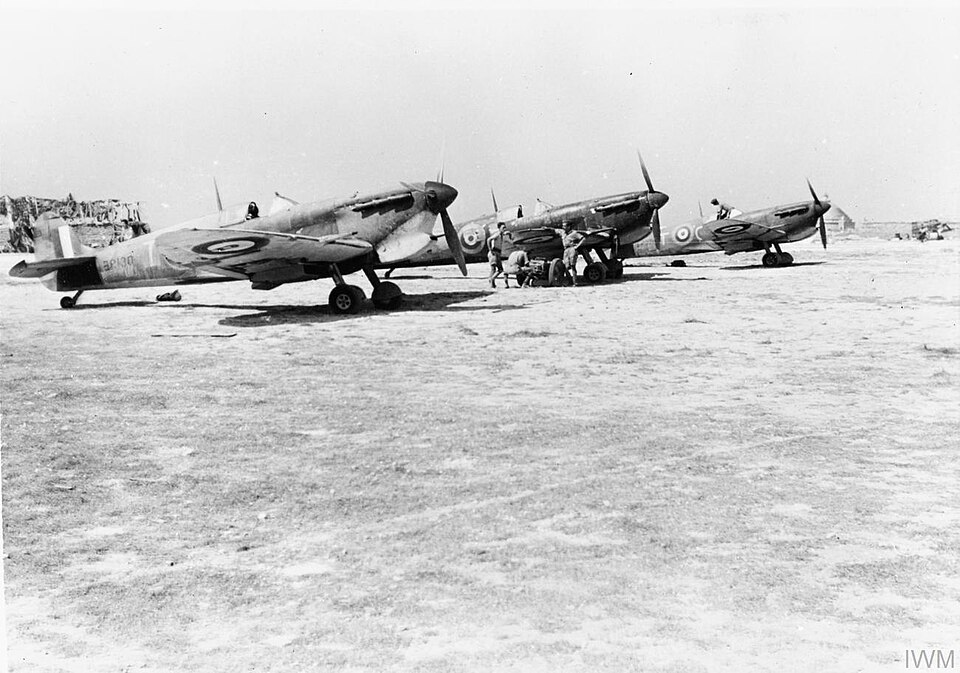
In 1942, that was one of the worst places in the world to be a fighter pilot. The small island sat right across the supply route between Italy and North Africa. The Axis powers wanted it neutralized, and they set out to blockade and bomb it into submission.
Malta became known as the most bombed place on Earth, per square mile. In March and April 1942, more bombs fell on the island than fell on London during the entire Blitz.
On April 15, 1942, the whole island was awarded the George Cross for the bravery of its people. The siege went on. Supply convoys were torn apart at sea: that August, only five of the 14 ships in one convoy reached Malta.
On June 9, 1942, Beurling took off from the deck of the aircraft carrier HMS Eagle and flew his Spitfire to Malta. He joined No. 249 Squadron RAF at Ta Kali airfield. He arrived as a Flight Sergeant.
The squadron soon learned he was not like the others.
The first thing they noticed was his eyes. His squadron commander, Percy “Laddie” Lucas, said Beurling “could spot an aircraft from the ground quicker than a Maltese could spot it.”
Lucas described them as strange blue eyes. “The eyes of a killer, in some ways,” he said.
The second thing they noticed was his manners at the table, or the lack of them.
Malta in 1942 was crawling with flies. When the pilots sat down to eat, the insects settled on every plate.
Beurling had a solution. He would put his plate on the floor, wait for the flies to gather, and then stamp on it.
According to Lucas, he “seldom got less than about 40” at a time. And each time he did it, he would announce the result: “The screwballs!”
“He used to do that every other day,” Lucas later recalled, “and it didn’t take long before he’d picked up the nickname of ‘Screwball’ Beurling.”
That is Lucas’s version, and he was there. Other accounts say “screwball” was simply a word Beurling liked to use, even in the middle of a fight. Whatever its origin, the name stuck.
For the first few weeks, though, the strange Canadian with the killer’s eyes did not seem to be doing much killing at all.
Then came July.
On July 6, 1942, in a huge fight with Italian aircraft, Beurling shot down two Macchi C.202 fighters and a Messerschmitt Bf 109. Within days he was an ace.
His secret was not daring alone. It was patience. Lucas wrote that “He fired only when he thought he could destroy.”
“Two hundred and fifty yards was the distance from which he liked best to fire,” Lucas added. That was close, a range at which many pilots would already be breaking away.
Beurling had trained himself hard at gunnery during his early days in the RAF. Range, deflection, the curve and drop of a bullet’s path: he drilled them until they were automatic. Over Malta, it paid off.
Even other aces were impressed. The RAF pilot Ginger Lacey put it simply: “There are not two ways about it, he was a wonderful pilot and an even better shot.”
And Beurling was honest about it. Lucas said he “never made a claim for a plane shot down unless he was completely certain of it.” As Lucas put it, “For Beurling the confirmed kill was the thing.”
His biggest day on Malta came on July 27, 1942.
Over the neighbouring island of Gozo, Beurling shot down four enemy aircraft: two Italian Macchis and two German Bf 109s. One of the men he brought down was Furio Niclot Doglio, a celebrated Italian ace, who was killed. Niclot’s wingman, Faliero Gelli, was captured.
Even in this, Beurling’s own standard held. One of the Macchis was only credited to him after a report came in from Gozo confirming the crash. His cannon had jammed during the fight.
A famous photograph from that summer shows him at Ta Kali, standing beside the rudder of one of the Macchis he shot down that day.
The medals followed fast. In July 1942 he was awarded the Distinguished Flying Medal. The citation read: “Sergeant Beurling has displayed great skill and courage in the face of the enemy.”
On July 30 he was commissioned as an officer, a Pilot Officer. He reportedly said he “really did not want to be commissioned because of the saluting and all the other things.”
A Bar to his DFM followed in September, and the Distinguished Flying Cross in October.
Off duty, he was a contradiction. He was religious. He did not smoke or drink.
One commander remembered that he “was crazy about children” and would hand out peanuts to the kids waiting outside a cinema near Ta Kali.
In the air, he was a loner. He broke formation to chase targets on his own and was repeatedly reprimanded for it.
His superiors disliked his lack of team discipline. They also could not argue with his results.
But Malta was wearing him down. He suffered from dysentery and was badly underweight. Over the island he was shot down four times.
The fourth time was October 14, 1942.
That day, radar tracked eight Junkers Ju 88 bombers coming in with a heavy fighter escort. Beurling went after the bombers.
Return fire from a Ju 88 hit him. By one account, a Bf 109 joined in.
“An explosive bullet nicked my right heel,” he later wrote. Of the fight, he said simply: “I picked up about 30 bullet holes.”
His Spitfire caught fire. He bailed out and came down in the sea near St Paul’s Bay, where a high-speed rescue launch picked him up. He was taken to the military hospital at Mtarfa.
It was his last flight over Malta.
By then, depending on which record you read, he had been credited with somewhere between 26 and 28 enemy aircraft over the island. Most sources settle on about 27. No Allied pilot in the defence of Malta scored more.
When his Distinguished Service Order was announced in November 1942, the citation summed it up in one line: “This officer’s skill and daring are unexcelled.”
But even leaving Malta nearly killed him.
At the end of October 1942, he was put aboard a Liberator transport leaving Malta. As it came in to Gibraltar, the plane crashed into the sea.
Beurling, his leg still in a cast, got out and swam to shore. He was one of only three survivors.
He had survived the most bombed island on Earth. He had survived being shot down four times. Now he had walked away from a crash that only three people survived.
Canada, the country whose air force had rejected him, now wanted him back.
He was sent home to sell war bonds. Verdun threw him a parade.
He met Prime Minister William Lyon Mackenzie King. The newspapers loved him.
Beurling hated it. He was no politician.
The tour was meant to sell bonds and make heroes. Then, in front of an audience, Beurling said the thing nobody wanted to hear: he enjoyed killing people.
The air force was badly embarrassed. The tour, as one magazine later put it, disliked him as much as he disliked it.
He wanted to fly again. On September 1, 1943, he finally transferred to the Royal Canadian Air Force, the same service that had once said no. He flew with No. 403 Squadron and then No. 412 Squadron, and scored his last victory on December 30, 1943.
The old problems followed him. He still flew like a lone wolf, still clashed with authority. In April 1944 he returned to Canada, and in October 1944 he left the air force.
He finished the war credited with about 31 victories, more than any other Canadian pilot of the Second World War. Sources differ slightly on the exact figure.
Peace did not suit him. He drifted. Years later, he said he would “give 10 years of my life” to live his six months on Malta in 1942 over again.
In 1948 he found one more war. The new Israeli Air Force recruited him to fly P-51 Mustangs.
On May 20, 1948, Beurling and another former Malta pilot, Leonard Cohen, were ferrying a Noorduyn Norseman to Israel when it crashed at Rome’s airport and caught fire. Both men were killed. Sabotage was suspected, but it was never proven.
He was 26 years old.
Even his burial was unsettled. His coffin sat in a warehouse in Rome for three months under a small plaque that got his rank wrong: “Colonel Giorgio Beurling.” He was buried in Rome’s Protestant Cemetery.
In 1950 his body was moved to Israel and reburied in a military cemetery at the foot of Mount Carmel, near Haifa.
Today Canada remembers him as its top fighter ace of the war. He was inducted into Canada’s Aviation Hall of Fame in 1974. On Malta, a corner of the National War Museum at Fort St Elmo in Valletta is dedicated to him.
He wore British wings because his own country would not give him a chance. He was Canadian from the day he was born in Verdun to the day he died in Rome.
A school dropout the RCAF turned away became the deadliest Allied pilot over Malta, and the country that rejected him ended up claiming him as its greatest ace.
Tell us in the comments: do you think the RCAF made a mistake by turning Beurling away, or would his lone-wolf style have caused trouble in any air force?
Report this article
Select a reason for reporting:






