In the pitch-black mountains of Afghanistan, a six-man patrol from a unit most Americans couldn’t locate on a map was about to change the rules of war. As a US liaison officer stared at a satellite map dotted with red pins—each marking a coalition unit that had clashed after dark—he realized none belonged to the men he was tracking. Their thermal signatures had been flickering at the edge of the Shahi Kot hills, then vanishing. Not because they stopped moving, but because they had learned to stand so still that the rocks themselves swallowed their heat.
Somewhere out there, six Australians from a regiment of fewer than 200 based in Perth were sitting motionless above a valley that had already swallowed an American company. Taliban fighters moving supplies through that valley had a different name for it: the Valley of the Watched Dead. Men disappeared from checkpoints at night without a single shot heard. What did this small regiment possess that allowed them to dominate a mountain range the size of a European country in darkness—against an enemy who had spent two decades fighting Soviet armor on those same peaks and had never been defeated by the night?
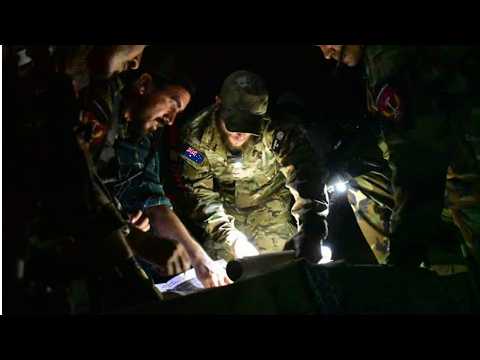
The problem in early winter 2001 was that no one who entered Afghanistan truly understood what darkness meant in that country. American planners had fought in deserts, forests, and cities lit by streetlights and burning vehicles. But the Hindu Kush mountains at 3,000 meters were a different kind of dark. Cold itself became a weapon, and sound traveled through the valley floor like a rifle shot.
Coalition casualty reports from the first months told a brutal story: about two out of every three deadly engagements occurred between dusk and dawn. That was when Taliban and al-Qaeda fighters moved weapons, repositioned mortar teams, and slipped between cave complexes carved into the mountains since the war against the Soviets. Standard night vision gave most conventional units an effective range of no more than 150 meters in open desert—far less among rock fields and shadows. In the mountains, that distance shrank to under 100 meters, meaning an enemy machine-gun team could dig in and aim before any patrol knew they were there.
When contact happened at that range in total darkness, soldiers had two or three seconds to spot a muzzle flash, find cover, and return fire. In those fleeting moments, men died who should never have died.
In Western Australia, the commander of the Special Air Service Regiment watched the casualty numbers with a very different reaction. He saw no reason for caution. He saw reason for the kind of war he had spent three decades quietly mastering—first in the jungles of Borneo and Vietnam, then in the deserts and mountains of counter-terrorism training that no one outside the regiment had ever heard of.
When Australia sent its forces to the coalition, the SASR did not participate as a symbolic gesture. One squadron—just over 150 fighters including support elements—was given a mission that looked almost reckless on paper: long-range reconnaissance and direct action. Strikes deep into terrain that even the mujahideen who had fought there for a decade respected as unforgiving.
American planners at Bagram, upon hearing the scope of the Australian mission, were openly skeptical. One senior operations officer, sitting across from the Australian squadron commander, put it bluntly to a room full of coalition staff: “Gentlemen, with respect, you’re talking about sending platoon-sized patrols into terrain that swallowed entire Soviet battalions at night, without any air cover or quick-reaction force we’d insist on for our own men. This isn’t aggression. This is a funeral with extra paperwork.”
The Australian didn’t raise his voice. Those in the room later described the moment as one of the quietest turning points of the entire campaign. He said something close to this: “You’re right that the enemy has fought here longer than we have. But they have never faced an enemy trained specifically to be invisible in this exact type of terrain. We won’t outgun them. We’ll outwait them. And by the time they realize we’re already inside their perimeter, it will be too late to change anything.”
Some officers in that room later admitted they thought his words sounded like bravado. Within six weeks, no one in the briefing room was using that word anymore.
The equipment the Australians carried looked deceptively similar to standard coalition gear at first glance. But the differences were enormous once patrols were on the ground. Image-intensification goggles paired with lightweight thermal monoculars gave individual fighters the ability to detect human heat signatures beyond 400 meters in clear conditions—more than double the effective range most conventional units operated at. That gap between 400 and 150 meters was the difference between starting a fight on your own terms and walking into an ambush on someone else’s.
Suppressed 5.56mm rifles with infrared laser designators—invisible to the naked eye but bright through night vision—allowed patrol members to share targeting information across the formation without a single word and without revealing a muzzle flash that could be traced back to its source. Each fighter carried nearly 40 kilograms of gear into mountains that regularly exceeded 3,000 meters, where the air itself held about a third less oxygen than at sea level. Every kilogram grew heavier with each step upward.
Radios were used sparingly, in short encrypted bursts only, because Taliban fighters had learned early in the campaign to monitor coalition frequencies and respond to any transmission. So the Australians developed a signaling system relying almost entirely on hand signals and small infrared flashing patterns mounted on helmets—visible only through night vision and invisible to anyone without it.
Late January 2002: a series of hills south of Shahi Kot valley. A six-man SASR patrol—whose call sign has never been released—was inserted before dusk and spent four hours covering less than three kilometers across broken rock slopes, because every meter had to be crossed without moving a single stone that might make a sound carrying down the valley floor.
Their target was a suspected weapons cache and rest site believed to house a mid-level Taliban logistics cell responsible for moving mortar shells from supply points in the south. Intelligence estimated 8 to 12 armed fighters at the site, fortified within natural rock cover that had already defeated two previous reconnaissance attempts by other coalition elements earlier that winter.
The patrol commander—a soldier the regiment has only publicly identified by rank and the first letter of his name—later described the approach in terms that appeared in a partially declassified after-action report. He wrote that the patrol covered the final 200 meters to the observation post in total silence, moving slower than walking pace, each man watching only the infrared flash of the fighter ahead of him. Because in that terrain, a single misstep on loose rock could undo four hours of perfect discipline in one second.
They reached their position just after 2 a.m. For the next ninety minutes, they did nothing but watch—confirming exactly what intelligence had suggested, pinpointing precisely where each armed fighter was sleeping, resting, or standing guard. Then, without the enemy firing a single warning shot, the patrol moved.
What happened over the next eleven minutes became legend within the SASR long before it was ever mentioned publicly. The site was secured, the cache confirmed and marked for later destruction, and every fighter at the location was either captured or dealt with—without a single Australian injury, and without the enemy getting off one coordinated shot in response.
An American combat controller attached to a nearby surveillance element—whose job was specifically to call in air support if the Australians needed extraction under fire—later filed a report that circulated informally in coalition special operations circles for years. He said the entire engagement felt less like an assault and more like flipping a switch. One moment the site existed as it had for weeks; the next, it was gone. From his position through his thermal scope, he lost sight of the Australian soldiers for stretches during the approach because they moved in a way that cut their heat signatures against the surrounding rock.
That report, more than any official statistic, is what began to change the minds of American planners at Bagram. Because it didn’t come from Australian public affairs—it came from an American who watched it through his own equipment and still found it hard to explain what he saw.
That single operation became a template the regiment refined and repeated with growing confidence over the following months. Patrols increased steadily through February and March 2002 as the broader coalition build-up for what would become Operation Anaconda accelerated. Australian reconnaissance teams were assigned some of the most sensitive terrain in the entire Shahi Kot valley—high ground that American planners considered essential to control, yet too exposed and fortified to approach by conventional means.
Not every American commander was immediately convinced the approach could scale beyond a handful of small, carefully chosen raids. The friction that surfaced behind closed doors at Bagram in the weeks before Anaconda became the subject of more than one post-war academic study. Intelligence-sharing in particular became a genuine point of tension. Some elements of the US command structure were initially reluctant to integrate Australian reconnaissance reports directly into the broader targeting picture for the coming offensive, treating them as supplementary rather than essential.
It took direct intervention from coalition special operations command to broker closer integration between American and Australian planning cells in the final weeks before the attack—ensuring field knowledge that SASR patrols had spent two months gathering was folded into the operational plan rather than treated as marginal. Once that integration happened, the value of what those patrols had quietly collected became impossible to ignore.
Operation Anaconda itself, which began in early March 2002, is remembered by the public for the intensity of daylight fighting that conventional and US special forces faced in the valley floor—combat that proved far harder than pre-battle intelligence estimates had suggested, and which produced a difficult, costly week of fighting. What received far less public attention at the time, and for several years afterward, was the role Australian patrols played on the high ground surrounding that valley throughout the operation.
Providing continuous surveillance of enemy movements and supply routes that conventional forces below simply could not see from their positions. On more than one night during the operation, Australian patrols occupying elevated observation posts spotted Taliban and al-Qaeda fighters attempting to reposition mortar teams or reinforce forward positions under cover of darkness. The information was passed up the chain of command in near-real time and used to direct precise airstrikes on movements that would otherwise have gone completely unnoticed—until they began affecting coalition forces in the valley floor the next day.
One patrol spent nearly 60 consecutive hours at a single concealed position overlooking a suspected enemy supply route, enduring temperatures that dropped below freezing at night. They moved only when absolutely necessary, rotating eating and rest so that surveillance of the road below never lapsed. The information gathered from that position, according to later operational summaries, contributed directly to strikes that produced significant enemy casualties and the destruction of at least one confirmed weapons cache—all without the patrol itself ever being detected by the fighters moving beneath them.
There was a second engagement, less famous even within the regiment than the 60-hour overwatch above the supply road, but it was the moment operators who served on that deployment describe as the one where American doubts finally dissolved. In early April 2002, weeks after the main phase of Anaconda ended, while small pockets of enemy fighters continued trying to reposition through the same mountain corridors, a four-man Australian patrol was tasked with locating a suspected command node believed to be coordinating the movement of Taliban remnants through a narrow pass south of the main valley.
American planners considered the target low-priority and the terrain far too exposed for a small patrol to approach without being seen. According to reports, one liaison officer told the Australian planning cell directly that he expected the mission to be cancelled once the patrol was in the field and realized the site couldn’t be reached without ready daytime air support. The patrol quietly disagreed and went anyway.
They spent nearly nine hours covering less than four kilometers of broken ground, transitioning to a crawl during the final approach. They moved only when the noise of wind or distant vehicle engines from a supply road below could mask the sound of movement over loose stones. When they finally reached a position with direct line of sight to the target, they confirmed two separate fighting positions that original intelligence had entirely missed—plus a concealed vehicle staging area under camouflage netting that no previous aerial sortie had detected.
Rather than simply report and withdraw, the patrol commander made the decision to stay in position through the following day. The patrol watched the compound in full daylight from a hide so close they could hear the fighters below talking without any amplification equipment. They finally withdrew after nightfall the next day, carrying an intelligence package so precise that a subsequent strike, coordinated days later, destroyed both fighting positions and the vehicle—all without a single coalition soldier having to set foot near the target.
The liaison officer who had predicted the mission’s failure later admitted, in a conversation that became a quiet legend among Bagram planning staff, that he had been wrong about the terrain, wrong about the timeline, and wrong about what four men willing to lie motionless on frozen rock for more than a day could achieve—something a full strike force couldn’t have accomplished on its own.
The cumulative effect of months of this kind of operation began changing enemy behavior across the region in ways coalition intelligence analysts could measure directly. Signals intercepts through spring 2002 recorded a marked increase in Taliban and al-Qaeda communications specifically warning fighters against moving at night in areas where coalition special operations elements were known or suspected to be operating. Those conversations, as intelligence officers noted at the time, were unusually specific in their reference to Australian units through rough description—even when the precise unit identities remained unclear to the fighters themselves.
Local Afghan sources working as coalition informants reported that some Taliban commanders had begun restricting nighttime supply operations almost entirely in certain valleys. They preferred accepting the greater risks of moving in daylight under potential aerial surveillance rather than risk walking into an invisible ambush after dark. A genuine inversion of the tactical logic that had favored nighttime movement for insurgents throughout the war’s first year.
US special forces soldiers who worked alongside Australian patrols during this period—and who later spoke about the experience once operational security permitted—consistently used a particular phrase to describe what they witnessed. A phrase that eventually reached press coverage of the Australian contribution to the campaign. They called the Australians “shadow warriors,” not because of any official designation, but because American soldiers who worked beside them said that watching an SASR patrol disappear into the terrain at dusk and reappear at a completely different location hours later—with no trace of how they had crossed that ground undetected—was the closest thing they had ever seen to a unit becoming part of nature itself.
None of this came without a cost—a cost measured in ways that never appeared in official casualty statistics. The physical strain of sustained patrols at high altitude, carrying gear approaching a third of a fighter’s body weight across broken terrain, produced injuries the regiment’s medical staff handled quietly and steadily throughout the deployment. From severe frostbite on exposed skin during long static observation periods in freezing temperatures, to the kinds of chronic joint damage that stayed with some operators for the rest of their careers.
The psychological weight of extended isolation—sometimes days on end for a six-man patrol entirely dependent on each other’s discipline in an area where a single mistake could mean the difference between a successful extraction and a fight for survival against numerically superior enemy forces—was a burden the regiment’s support structures took seriously long before the wider Australian Defence Force publicly acknowledged the psychological cost of special operations. Several fighters who took part in that first Afghanistan rotation later spoke, carefully and without revealing specific operational details, about carrying the weight of that isolation home with them long after their mission ended. A reminder that the reputation the regiment earned in those mountains was built on the backs of individuals who paid a real and lasting price for it.
Overall, the pattern that dominated during that first deployment told a story that coalition analysts at higher headquarters found increasingly difficult to explain away as mere coincidence. Over roughly nine months the squadron spent in Afghanistan during that initial mission, Australian patrols conducted dozens of long-range reconnaissance and direct action missions in terrain that conventional planners had pre-classified as high-risk or entirely unsuitable for small dismounted patrols. The vast majority of those missions achieved their specified objectives—whether confirming a target location, destroying a weapons cache, or capturing individuals of intelligence value. And the regiment returned from that mission without a single fighter killed in action.
A statistic senior coalition officers privately described as almost unbelievable given the nature of the terrain, the altitude, and how frequently those patrols operated near numerically superior enemy forces. Ammunition consumption rates were consistently lower compared to conventional units operating in similar terrain—not because Australian patrols avoided contact, but because the focus on surveillance, patience, and precisely directed operations meant that when contact did happen, it occurred on the patrol’s pre-selected terms.
Where a conventional clearing operation might require an extended engagement supported by heavy fire to secure a single site, an SASR patrol working from a concealed observation post for hours or days could achieve the same result with a fraction of the ammunition and without exposing itself to the same risks. The enemy’s own adaptation to what the Australians were doing became, in its own way, a form of confirmation of their success. Taliban and al-Qaeda commanders operating in the eastern provinces began altering their basic logistics patterns—specifically in response to the threat of invisible surveillance.
They shifted supply movements to daylight hours in some sectors despite the increased risk of aerial detection, because the alternative—moving at night through terrain that might already be under observation by patrols that couldn’t be detected—had become, in their assessment, the greater danger. Documents seized and detainee interrogations later in the war indicated a firm belief among some fighters that certain valleys were simply not safe to move through after dark, regardless of how carefully a route was chosen. A belief that took root as part of local folklore among fighters who had never personally encountered an Australian patrol but had heard enough secondhand accounts from units that had.
This kind of psychological deterrence—the ability to shape enemy behavior across an entire region without necessarily requiring direct engagement in every instance—is difficult to measure in conventional after-action reports, but coalition intelligence officers at the time considered it one of the deployment’s most significant achievements, if also the least visible. By the time the SASR’s initial Afghanistan deployment ended and the regiment returned home in late 2002, its approach to night operations in high-altitude, high-latitude terrain had become something coalition special operations units sought to study and replicate where possible.
American, British, and other allied special operations elements that later rotated through the same terrain incorporated lessons drawn directly from Australian patrol techniques into their pre-deployment training—particularly regarding silent movement over rock and scree, thermal signature management in cold terrain, and the discipline of long static surveillance without position compromise. The regiment itself returned to Afghanistan in later years of the war, continuing to reinforce a reputation that by then needed no explanation within the coalition special operations community.
Even as the wider Australian public at home remained largely unaware of what their country’s smallest and most secretive military units had achieved in those mountains. As for official recognition, it came in the restrained way it almost always does for units operating in deep secrecy. Commendations were awarded, but the citations explaining precisely what individual soldiers did to earn them remained—and in many cases still remain—restricted from public release. An official acknowledgment that the full story of what happened on those ridges may not be told in complete detail for decades, if ever.
The regiment’s return to Afghanistan in later years of the war only deepened that reputation rather than testing it for the first time. As the conflict evolved through the mid-2000s into a long, grinding counter-insurgency fight, Australian special operations elements continued to be assigned some of the most demanding reconnaissance and direct action tasks in the eastern and southern provinces. Often working alongside American and British special operations units in combined task forces where national boundaries mattered less than whether a patrol possessed the training to move through a given piece of terrain undetected.
Younger operators who rotated through those later operations inherited a body of institutional knowledge built directly on what the first squadron had learned the hard way in the winter and spring of 2001 and 2002. From fine observations about how sound traveled differently across rock types and soil underfoot, to detailed internal guidance on managing thermal signatures during long static surveillance in sub-zero conditions, to hard-won lessons about organizing water and food consumption during patrols lasting days at altitudes where the body burns calories far faster than at sea level.
None of this was ever published officially in any manual available outside the regiment. Instead it passed between generations the way truly dangerous and valuable knowledge always does within small elite units: through direct mentorship. Through patrol commanders debriefing junior operators in exhaustive detail after every mission. And through a culture that treated every near-miss and every hard-learned lesson as a debt owed to the next patrol that would face the same mountains.
American and British special operations elements that rotated alongside Australian patrols in those later years consistently sought out joint training opportunities built specifically around them—skills the SASR had proven decisively in that first deployment. Official and unofficial exchange programs saw US Green Berets and British special forces operators train alongside their Australian counterparts in silent movement techniques across loose rock, discipline in long static surveillance without position compromise, and the layered use of thermal and image-intensification optics combined rather than relying on either system alone.
Some of those lessons eventually seeped further afield—into broader coalition special operations training doctrine for high-altitude and cold-weather operations, which persisted beyond the Afghanistan campaign itself and shaped how allied special forces engaged similar terrain in later conflicts. It became common knowledge within a narrow but professional and significant community that if a mission required moving a small patrol through difficult mountain terrain undetected, the Australians had already solved most of the hard problems associated with it years before anyone else had to.
As for official recognition, when it came, it arrived in the modest way it almost always does for units operating in deep secrecy. Commendations were awarded, but the citations detailing precisely what individual soldiers did to earn them remained—and in many cases still remain—prohibited from public release. An official acknowledgment that the full story of what happened on those hills may not be told in complete detail for decades, if ever.
Some of the men who served on that first rotation spoke, cautiously and in very general terms, about what the experience meant to them personally. Always refusing to discuss specific operations that remain classified, but sometimes willing to reflect on the underlying philosophy that helped them get through it. One veteran, speaking years later without revealing his name, offered a description of the regiment’s approach that was later translated in Australian defence circles as a summary of their fighting spirit. He said the mountains had never belonged to anyone, and that the idea of the enemy owning the darkness simply because they had lived there longer was a story fighters told themselves to feel safe. The patrol’s mission was never to fight that story directly, but to prove it had been untrue from the start—quietly and repeatedly.
What makes the story of the SASR’s first Afghanistan deployment important, beyond its tactical achievements, is the fundamental principle it proved to every professional military force that later studied it. Superior technology alone did not explain what happened in those mountains. By 2002, many coalition partners had night vision and thermal equipment similar to what Australian patrols carried. What set the SASR apart was decades of deliberate, obsessive investment in training soldiers to treat darkness and difficult terrain not as obstacles, but as an operating environment to be mastered beyond any opponent’s capability.
A philosophy built long before Afghanistan, honed in the harsh remote training grounds of Western Australia, and evolved through operational experience dating back to Borneo and Vietnam. It produced a regiment that, when tested against an enemy who believed for a generation that the mountains belonged to them after dusk, proved that ownership of ground in modern warfare belongs not to those who know it best, but to those who have trained most seriously to move through it unseen.
American commanders who arrived in Afghanistan expecting to lead the coalition’s most capable night operations left with a lasting respect for a far smaller ally that had quietly proven otherwise. The phrase “shadow warriors,” coined by those soldiers without any official sanction, stayed with the regiment for the rest of the war and beyond—spoken with a mixture of professional admiration and genuine bewilderment by men who watched them work and still cannot fully explain how they did it.
It is worth noting how impossible that outcome would have seemed to anyone outside the regiment before the campaign began. A coalition built around the most heavily armed militaries in the world—possessing satellites, attack aircraft, and technologies against which any Australian capability paled—found itself repeatedly outmatched in the most important field in those mountains by a squadron smaller than a single US infantry company, operating with excellent but not fundamentally superior equipment to half a dozen other coalition partners in the same terrain.
The difference was never about the equipment, and everyone who served alongside the regiment in that campaign eventually reached the same conclusion—some reluctantly, others with genuine admiration. It was about a training culture built over decades that refused to treat darkness, altitude, and unfamiliar terrain as conditions merely to be survived, but as an ideal environment in which the regiment’s soldiers felt at home.
The mountains of the Shahi Kot valley do not remember names, and most of the men who earned that reputation will never have their identities publicly revealed for what they did there. But somewhere in classified files that may not be opened for another fifty years, there exists the full story of how fewer than 200 Australians, trained in a desert half a world away, taught the most powerful military alliance in history that darkness was never an advantage belonging to the enemy. It was simply about who had trained long enough to exploit it first.
Every American soldier who served alongside them in those mountains came home carrying the same quiet question, one that found no satisfying answer in the years that followed: how exactly did the Australians do what they did? And the men who could explain it never felt any need to.
What do you think made the real difference in those mountains—the technology, the training, or something harder to name? Share your thoughts below.
Report this article
Select a reason for reporting:






