General Douglas MacArthur stood on the balcony of Lennon’s Hotel in Brisbane, the tropical heat pressing down like a weight. Below him, the street thundered with the sound of boots—thousands of Australian soldiers marching in perfect rhythm. It was March 1942, and the Pacific War hung by a thread.
MacArthur had just fled the Philippines, leaving 90,000 men behind. Japan seemed unstoppable. Singapore had fallen, Darwin had been bombed, and invasion seemed imminent. Washington had written off the Pacific, prioritizing Europe. Australia, with only 7 million people and its best troops fighting 12,000 miles away, stood alone.
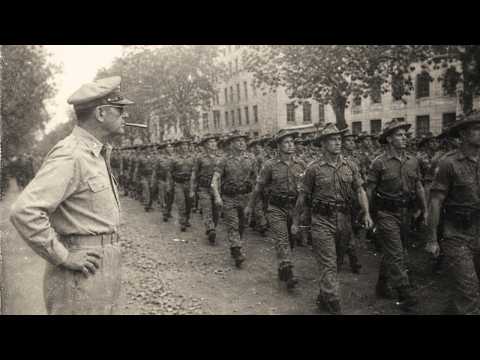
MacArthur had heard reports about these Australians, but this was his first real look. He expected colonial troops, perhaps broken by recent defeats. What he saw instead made him lean forward on the railing, his aide waiting anxiously.
These were not parade-ground soldiers. Their skin was dark from the sun, their uniforms stained with sweat and dirt. They moved with a loose, fluid rhythm, rifles balanced like extensions of their bodies. Their eyes scanned the streets, alert even in formation. Many bore scars, campaign ribbons from the Middle East. They were the Rats of Tobruk, veterans of desert warfare, now returned to defend their homeland.
MacArthur studied every detail—the way they carried themselves, the quiet confidence in their stride. He had commanded soldiers his whole life, but something about these men was different. They had been tested and had not broken.
Then he turned to his aide, Major General Richard Sutherland, and spoke words that would echo through history: “By God, it takes infantry to win a war. Give me enough of these men and I will roll the Japanese back.”
It was not his usual dramatic rhetoric. According to Sutherland, MacArthur meant every word. In that moment, his entire strategy shifted. He abandoned the defensive Brisbane Line, demanded the return of Australian divisions from the Middle East, and began planning offensive operations.
Within hours, he cabled Washington: “The Australian troops available are of excellent quality and superior to any militia forces I have previously observed.” The message stunned officials who had expected MacArthur to confirm their fears.
But the soldiers themselves were less impressed. Corporal Jack Gaffney of the 2/3rd Battalion later said, “We heard MacArthur liked what he saw. Didn’t matter much to us. We’d already fought the Japanese in Malaya. We knew what was coming. The Americans hadn’t seen them yet.”
They knew the jungle war would be brutal, and they were ready. What they didn’t know was that this moment—a general on a balcony, watching them march—would mark the turning point. The alliance forged that day would carry them through the hell of New Guinea and beyond.
As the last columns passed, MacArthur remained on the balcony, his mind racing. He had seen the truth: Australia would fight, and with these men, he could win.
The days that followed the inspection were a blur of cables, orders, and quiet desperation. MacArthur’s headquarters at the AMP Building on Queen Street became a hive of activity, clerks and officers working through the night by lamplight. The general himself barely slept.
He summoned his intelligence chief, Major General Charles Willoughby, and demanded a full map of New Guinea spread across the table. Willoughby later recalled the scene: MacArthur tracing the Owen Stanley Range with his finger, muttering about Port Moresby and the Kokoda Track.
“If the Japanese take Moresby, they take Australia,” MacArthur said. “We hold that ground or we lose everything.”
But holding it required men, and men required ships, and ships required a Washington that had already decided the Pacific could wait. MacArthur fired off another cable to Marshall, this one sharper than the last. He argued that Australia was not a sideshow—it was the only platform from which America could strike back at all.
Marshall’s reply was terse but telling. He promised to review the allocation of shipping. It was not a victory, but it was a crack in the wall.
Meanwhile, the Australian troops who had marched past the balcony were already moving north. The 7th Division began embarking for New Guinea within weeks, their desert tan still fading. Among them was Sergeant Archie Butterworth, who had watched MacArthur from the ranks and wondered if the American general’s praise meant anything in the mud.
The answer came at Milne Bay in August 1942. Japanese marines landed under cover of darkness, expecting an easy victory against what their intelligence called demoralized colonial troops. Instead, they walked into a meat grinder.
Butterworth’s section held a beach position through eighteen hours of relentless assault. He was wounded twice—once in the shoulder, once in the leg—and refused evacuation until relief arrived. For his actions, he received the Distinguished Conduct Medal.
When news of Milne Bay reached Brisbane, MacArthur called it “the first outright defeat of a Japanese land force in the Pacific.” He ordered the citation read aloud to his entire staff. The message was unmistakable: these were the men he had seen on that balcony, and they had proven him right.
But the cost was mounting. The Kokoda Track became a byword for suffering. Australian militia battalions—boys who had trained with broomsticks—found themselves fighting elite Japanese troops in a jungle so thick that daylight barely penetrated. They fought for every ridge, every creek crossing, every muddy slope.
Private Thomas Derrick, who had marched in Brisbane and written to his mother about the Yank general, was now crawling through leech-infested mud on hands and knees. He would later win the Victoria Cross for holding a position alone for six hours, but in those dark days he thought only of survival.
MacArthur followed the campaign from Brisbane, poring over maps and dispatches. He grew thin and gray. Visitors to his office noticed he had stopped giving grand speeches. Instead, he asked quiet questions about supply lines, casualty figures, and the condition of the men.
One evening, his wife Jean found him staring out a window at the Brisbane skyline. “They’re holding, Jean,” he said softly. “By God, they’re holding.”
It was the closest he came to admitting doubt.
By September, the tide on the Kokoda Track began to turn. The Japanese, starving and ravaged by disease, had pushed to within thirty miles of Port Moresby—close enough to see the lights of the town at night—but they could go no further. The Australians, reinforced by the returning veterans of the 7th Division, began to push them back.
The fighting was savage and intimate. Men killed each other at ranges of ten yards, in mud so deep they could barely lift their rifles. The Australians learned to move in small patrols, to use the jungle as cover, to strike without warning and vanish again. These were the lessons MacArthur had glimpsed on that Brisbane balcony—the hard, quiet competence of men who had already survived the worst.
In Washington, the cables from Brisbane began to shift the conversation. Marshall, who had once dismissed the Pacific as a holding action, started asking different questions. How many divisions could MacArthur sustain? What shipping did he need? The numbers were still small compared to Europe, but the direction had changed.
Then came the news that stunned the world. In late September, a Japanese submarine surfaced off the coast of Oregon and fired shells at a forestry station. The attack did almost no damage, but the psychological effect was enormous. For the first time, the American mainland had been struck.
MacArthur seized on the moment. He cabled Marshall with uncharacteristic bluntness: “The enemy is probing everywhere. If we do not strike back soon, we will be fighting on our own shores. Australia is not a defense line—it is a springboard. Give me the tools and I will use it.”
The response was slow, but it came. In October, the first shiploads of American equipment began arriving in Brisbane—tanks, artillery, aircraft. Not enough, never enough, but more than before. MacArthur ordered them moved north immediately.
The Australians noticed the change. Corporal Gaffney, now fighting in the mountains, heard a rumor that American tanks had arrived. “Tanks?” he said to his mates. “Bloody hell. About time someone remembered we’re here.”
But the tanks were not for the Kokoda Track. They were for the coast, for the battles to come. MacArthur was already thinking ahead, planning the counteroffensive that would carry the Allies from New Guinea to the Philippines and beyond.
He had not forgotten his promise. “I shall return,” he had said in Darwin, and those words had become a mantra. But now, watching the reports from the front, he understood that returning would require more than American power. It would require the kind of soldiers he had seen marching in Brisbane—tough, unbroken, and willing to pay the price.
In late October, MacArthur made a rare visit to the front lines in New Guinea. He flew to Port Moresby in a B-17, the heat inside the plane so intense that his staff officers stripped to their undershirts. When he stepped onto the airfield, the first thing he saw was a group of Australian soldiers, filthy and hollow-eyed, just back from the track.
One of them, a young lieutenant, recognized him. “General,” he said, “we’ve been waiting for you.”
MacArthur looked at the man’s worn face, his tattered uniform, the rifle he held with the casual grip of long familiarity. He remembered the balcony, the marching columns, the words he had spoken.
“No,” MacArthur said quietly. “I’ve been waiting for you.”
He spent the day touring the positions, asking questions, listening more than he spoke. That evening, as the sun set over the Owen Stanley Range, he stood with his staff on a ridge overlooking the track. The jungle stretched out below, dark and endless.
“They held,” he said to Sutherland. “They held when no one else could have.”
It was not a speech. It was a simple statement of fact, and it carried more weight than any grand rhetoric ever could.
The months that followed saw the Australians and Americans fight side by side through the fetid jungles of Buna and Gona, where the lessons of Brisbane were paid for in blood. MacArthur’s headquarters grew into a city of tents and Quonset huts, a nerve center for a counteroffensive that Washington had once deemed impossible.
He kept a photograph on his desk—the Brisbane march, soldiers frozen mid-stride. Visitors sometimes asked why. “Because they taught me what infantry means,” he would say, and the conversation would end there.
When the war finally ended, the balcony at Lennon’s Hotel had long since been forgotten by most. But the men who marched past it never forgot. They returned to farms and cities, to families and quiet lives, carrying the knowledge that they had been seen—truly seen—when it mattered most.
Decades later, a young Australian officer stood at MacArthur Place in Brisbane, reading the plaque. An elderly veteran nearby noticed him. “You know what he said that day?” the old man asked. “He said we could win. And we did.”
The officer nodded, and the two stood in silence, bound by a moment neither had witnessed but both understood. The war had been won by many things—by steel and strategy, by luck and sacrifice—but also by a general who looked down from a balcony and recognized the truth.
What moments of recognition have shaped your own understanding of courage and partnership?
Report this article
Select a reason for reporting:






