On the afternoon of December 7, 1941, a football game on American radio was interrupted for a few seconds. Most listeners went on with their Sunday. But 6,000 miles away, in a room in Tokyo, a man with headphones wrote down every word. That was his job. He had been doing it for years. And on that particular afternoon, he and a handful of men like him were the only people in the Empire of Japan permitted to hear what America actually sounded like.
Japan had just won the greatest naval victory in its history. Everyone knew that. It was on every front page in Tokyo by breakfast. But the entire war plan—every ship, every pilot, every calculation—rested on one assumption that no bomb could test. It rested on what the Americans would say the morning after. So they listened.
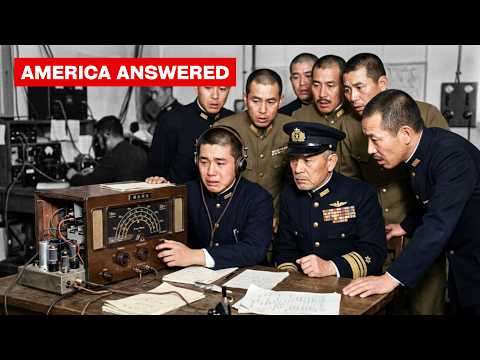
And what came back through the static over the next four days answered the question completely, accurately, and on time. Nobody in Tokyo could do anything with it. This is the story of the most important intelligence report of the Second World War and the reason it sat in a folder while 2 million men died.
The anchorage at Hashiima is a stretch of gray water in the inland sea, sheltered by low green islands. And in the last hours of December 7, 1941, Tokyo time, it holds the largest concentration of battleships in Asia. Riding at anchor, boilers banked. The combined fleet’s heavy squadrons are here because there is nothing yet for them to do and because the men who command them still believe—most of them—that the war will eventually come down to a day when these ships form a line of battle and settle everything in a few hours of gunfire.
The flagship is Nagato. She is 21 years old, nearly 40,000 tons standard displacement. Eight 16-inch guns in four turrets and a pagoda mast rising above bridge and a stack of platforms and rangefinders that makes her silhouette unmistakable in any recognition manual in the world. When she was commissioned, she was the most powerful warship afloat. Japanese schoolchildren could draw her from memory.
Deep inside her, below the armored deck, there is a room with charts on the tables and clocks on the wall. There are two clocks. One is set to Tokyo. The other is set to a harbor 6,000 kilometers away on the far side of the Pacific Ocean. A harbor that almost no one in the room has ever seen with his own eyes. The distance between those two clocks is where the entire war now lives.
At the center of the room is a man of 57. He is short, thick through the shoulders and chest. He carries himself with the compact stillness of a man who was once a gymnast and never entirely stopped standing like one. His hair is gray at the temples and cut close. His uniform is immaculate, and when he reaches for a chart or a pencil or a cup, the left hand that comes forward is missing two fingers. They were taken from him on the 27th of May, 1905, aboard the armored cruiser Nisshin at the Battle of Tsushima when he was 21 years old and a newly commissioned ensign. A Russian shell burst near his gun position. It tore away his index and middle fingers and opened his left thigh. He was carried below. He kept the hand. He also kept the memory of what that battle meant.
Tsushima was the day a European fleet was annihilated by an Asian one. The day the Russian Baltic Squadron ceased to exist in the space of an afternoon. The day that taught an entire generation of Japanese naval officers a lesson they would carry for the rest of their lives. The lesson was this: Wars between great powers are decided by one battle. Find the enemy fleet. Concentrate everything. Destroy it in a single engagement. Everything else is preliminary.
That doctrine has a name in the Japanese Navy: Kai Kessan, the decisive battle. It is not a theory. It is a creed that shapes ship design, gunnery, training, officer promotion, wargaming, budget allocation. Every officer standing in this room was raised inside it.
The man with the damaged hand does not fully believe it anymore. His name is Yamamoto Isoroku, and he is commander-in-chief of the combined fleet. He spent the 1930s arguing, sometimes bitterly, with his own service. He argued that the battleship was finished, that the aircraft carrier had replaced it, that the future belonged to the airplane, and that the enormous new super-battleships Japan was building in secret would be as useful in the coming war as a samurai sword hanging on a wall. He said this to admirals who had built their careers on gun ranges. He was not popular.
And he spent those same years arguing something else, something that made him considerably less popular than the carrier question ever did. He argued that Japan must not fight the United States. He did not argue it as a pacifist. He argued it as an accountant—because Yamamoto Isoroku had been there.
From 1919 to 1921, he lived in Cambridge, Massachusetts, studying at Harvard University. From 1926 to 1928, he served in Washington as naval attaché at the Japanese embassy. Between and around those postings he traveled—and he traveled the way an intelligence officer travels, which is to say with his eyes open and his mouth mostly shut. He crossed the American continent. He saw the oil fields of Texas stretching in rows to the horizon, pumping out of the ground more petroleum in a season than the Japanese Empire possessed in its entire strategic reserve. He saw Detroit, where automobiles came off moving assembly lines in a volume that had no equivalent anywhere on Earth. He saw the steel towns and the rail yards and the grain belt. He did not come home impressed by American culture. He came home impressed by American capacity. There is a distinction there, and it is the whole distinction.
In the autumn of 1940, Prince Konoe Fumimaro, then prime minister, asked him directly what would happen if Japan went to war with the United States and Britain. Yamamoto’s answer survives, and it is one of the most quoted sentences in the history of the Pacific War—and it is almost always quoted with the second half cut off. He said that if he was told to fight he would run wild for the first six months or perhaps a year, and then he said the rest of it: that for the second year and the third year he had absolutely no confidence.
Six months, perhaps a year. It was not modesty. It was not a soldier’s ritual caution. It was arithmetic—and he had done the arithmetic personally, standing in Texas, standing in Michigan. The government heard the first half of the sentence.
So Yamamoto did what a professional officer does when the political decision has been taken over his objection. He designed the only kind of war that his own sentence permitted. If Japan could not win a long war against the United States, then Japan must not fight one. And if Japan could not fight a long war, then the entire operation had to be built around producing something other than military victory. It had to produce a decision—a decision made not in a shipyard or on a flight deck, but inside the minds of 130 million people on the other side of the Pacific Ocean.
The design he arrived at was this: Strike the United States Pacific Fleet at its anchorage in Hawaii. Do it without warning of the kind that permits preparation. Do it so completely that the Americans lose their capacity to interfere in the Western Pacific for a year or more. In that year, seize everything—the Philippines, Malaya, Singapore—build a defensive perimeter of island bases across thousands of kilometers of ocean, garrison it, and make the cost of breaking it look on paper unbearable. Then wait. And here is the load-bearing assumption, the one the entire structure rests on: Wait for the Americans to add it up and decide it is not worth it. Wait for a divided, isolationist, comfortable, commercially minded republic—a country that had spent two decades telling itself it had been tricked into the last European war and would never be tricked again—to look at the price tag of a trans-Pacific campaign and choose to negotiate.
The ships in Hawaii were the target. The ships were never the objective.
Now ask the obvious question. On what evidence did the men in Tokyo build the belief that America would choose to negotiate? The answer is not guesswork. It is not racial contempt, although there was plenty of that in the war councils. It is not wishful thinking, although there was plenty of that, too. The answer is that they had been listening.
For years, in rooms scattered across Tokyo and beyond, Japanese personnel had sat with headphones on, turning dials through the static of the shortwave bands, pulling American voices out of the air and writing down what they said. The Domei News Agency ran monitoring desks. Domei was Japan’s national wire service, and by this point it operated under the control of the Ministry of Communications—which meant it was simultaneously a news organization, a propaganda instrument, and an intelligence collector. Its monitors listened to foreign broadcasts, and its transcripts went to the government. The Foreign Ministry maintained its own listening arrangements. So did the Navy. The Cabinet Information Bureau, established in December 1940 to centralize control over everything Japanese citizens were permitted to read and hear, sat above the whole apparatus.
And there is a detail here worth pausing on, because it defines the entire character of what is about to happen. For ordinary Japanese people, listening to foreign broadcasts was not merely discouraged. Domestic receivers sold in Japan were restricted in what bands they could reach. Access to shortwave was controlled. Listening to enemy radio was the kind of thing that could bring the special higher police to your door. So the flow of foreign information into Japan was not a river. It was a pipe—a narrow pipe with a valve on it. And the valve was held by the state.
Everything the United States said in public on the open air arrived in Japan through that pipe, into a small number of rooms, onto a small number of desks, in front of a small number of men who wrote it down. And for years, what came through that pipe was music to the ears of the war party. Because American radio in the late 1930s and in 1940 and 1941 was full of a sound that made Japan’s strategy look not merely plausible but obvious. It was the sound of a country arguing with itself about whether to care. Senators denouncing foreign entanglements. Congressmen who had voted again and again to keep the United States out of Europe’s war and out of Asia’s. Neutrality legislation, debate over whether to sell weapons to Britain and then over whether to lend them and then over whether the lending was itself a betrayal of the American public.
And above all, there was the movement. The America First Committee was founded in 1940. At its height it claimed hundreds of thousands of members. It filled auditoriums. It filled Madison Square Garden. It was not a fringe. It included students and industrialists and clergymen and Midwestern farmers and a substantial fraction of the United States Congress. Its most famous voice belonged to a man of 39 named Charles Lindbergh, who in 1927 had flown alone across the Atlantic Ocean and become arguably the most famous private citizen in the world. Lindbergh toured. Lindbergh spoke. Lindbergh told Americans in that flat Minnesota delivery that this was not their war and that they were being maneuvered into it. His speeches were broadcast. His speeches were transcribed. His speeches were read in Tokyo.
Now hold two things in your mind at once. Every one of those broadcasts was true. The isolationism was real. The division was real. The Congress that would have to declare any war really was full of men who had spent years promising their constituents that they would never vote for one. And the conclusion Tokyo drew from all of it was reasonable. A nation of merchants and farmers divided against itself, protected by two oceans, unwilling to bleed for territory it could not locate on a map, would not spend years and hundreds of thousands of lives clawing back a chain of coral islands in the Western Pacific. Present it with a catastrophe in a single morning. Present it with a perimeter that would cost a fortune to break. And it will calculate the way a merchant calculates, and it will come to the table.
The intelligence was accurate. The inference was logical. The logic ran clean. There was one thing nobody had tested. Nobody had tested what those American voices would sound like after the catastrophe actually arrived. You cannot test that. There is no way to run the experiment in advance. The only way to learn the answer is to strike the blow and then listen—which is exactly what is about to happen.
So the answer arrived. It was not the one Tokyo expected.
The transcripts piled up in folders, unread by men who could not afford to read them. The radio told the truth, but the government had spent years making itself deaf to anything but victory.
Yamamoto’s six months ran out at Midway. The carriers he warned about were waiting. The code was broken. The ambush was set.
“We have met with a serious reverse,” Nagumo signaled. The words were filed, not debated.
By the time the emperor’s voice crackled over NHK in August 1945, the pipe was finally open—but too late. The war that was meant to bend America had instead forged it into an instrument of absolute victory.
And Yamamoto’s arithmetic, written in Texas and Detroit, was proved right to the last decimal. The black tears still rise from the Arizona. The lesson remains: you can listen perfectly and still refuse to hear.
What would you have done with that folder, if it had landed on your desk?
Report this article
Select a reason for reporting:






