The cockpit exploded in a hail of shrapnel, and in an instant, Flight Sergeant Ron Middleton’s world went dark—literally. His right eye was gone, his jaw shattered, his body pierced by jagged metal. The Stirling bomber, now a crippled beast, plunged toward the earth. For most men, that would have been the end. But Ron Middleton was not most men.
With blood filling his mouth and consciousness slipping away, he refused to let go of the controls. At 800 feet, he clawed his way back from the brink, wrestled the bomber level, and—alongside his gravely wounded second pilot—completed the bombing run over the Fiat works in Turin. Then came the impossible choice: divert to safety, or attempt the four-hour flight home to England. Middleton didn’t hesitate.
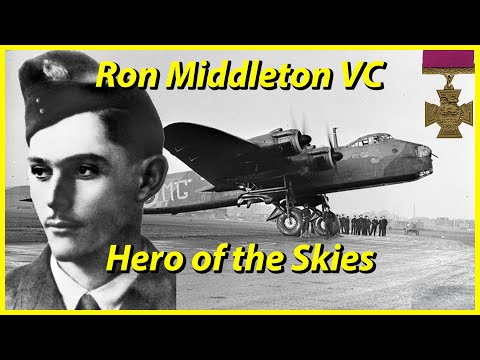
“I’ll make the English coast. I’ll get you home,” he rasped, over and over, as the damaged Stirling limped across the Alps and over occupied Europe. For four excruciating hours, he flew in agony, barely conscious, his body failing but his will unbroken. His crew watched in stunned silence as their pilot, a man who should have been dead, defied every limit of human endurance.
Middleton was no stranger to defiance. Born in Sydney in 1916, he’d grown up on the rugged pastoral stations of New South Wales, where hard work and discipline were as natural as the scorching sun. He enlisted in the RAAF in 1940, trained in Canada, and by late 1942 was a seasoned bomber captain with 28 missions behind him. His 29th would be his last—but not before he etched his name into legend.
As the English coast finally appeared through the shattered windscreen, Middleton turned the aircraft parallel to the shoreline and ordered his crew to bail out. Five men parachuted to safety. Two hesitated, hoping to coax him into a crash landing. But Middleton, his strength nearly spent, knew the risk to civilians below. He waved them off, steered the Stirling out over the Channel, and whispered his final promise: “I’ll get you home.” The last two crewmen jumped, but tragically drowned in the freezing waters. Middleton, too weak to escape, went down with his aircraft.
His body washed ashore months later. He was posthumously awarded the Victoria Cross—the first RAAF member to receive it in World War II—for a devotion to duty described as “unsurpassed in the annals of the Royal Air Force.” But the story of how a blind, broken pilot defied death for four hours is only part of the legend. The rest lies in the hearts of the men he saved, and in the question that still haunts: what gives a man the strength to sacrifice everything for a promise?
The answer, perhaps, lies in the quiet moments before the storm. Middleton was not a man of grand speeches or dramatic gestures. He was a jackaroo from the Australian outback, a cricketer, a teammate, a leader who led by example. His crew called him “Ron,” but behind his back, they called him “the old man”—a term of affection for a pilot who was barely twenty-six but carried himself with the weight of a veteran.
That night, as the Stirling droned over the Alps, the crew had already noticed something different about him. He was calm, almost serene, even as the flak burst around them. “Steady, boys,” he’d said over the intercom. “We’ll be home before you know it.” It was a promise he intended to keep, no matter the cost.
When the shell tore through the cockpit, the blast threw the aircraft into a violent dive. The second pilot, Flight Sergeant Haider, was also badly wounded—his face a mask of blood—but he managed to grab the controls alongside Middleton. Together, they pulled the Stirling out of its death spiral, the engines screaming in protest. The bomb aimer, Pilot Officer Roy, later recalled the moment: “I looked up and saw Ron’s face. Half of it was gone, but his hand was steady on the yoke. I knew then we had a chance.”
After the bombs were released, the crew faced a new horror: the long flight home. The Stirling was riddled with holes, one engine sputtering, the altimeter unreliable. Middleton’s navigator, Pilot Officer Skinner, plotted a course that would avoid the heaviest flak belts, but it meant flying over the icy expanse of the North Sea in winter. There was no question of diverting to Switzerland or Sweden—Middleton had made that clear before takeoff. “We don’t abandon our aircraft,” he’d told them. “We bring it home.”
For four hours, the crew watched their pilot deteriorate. His voice grew weaker, his breathing more labored. Yet every few minutes, he would key the intercom and repeat his mantra: “I’ll make the English coast. I’ll get you home.” The words became a lifeline, a thread of hope that kept them from panic. Even when the wireless operator, Pilot Officer Skinner, suggested they might need to ditch, Middleton refused. “Not yet,” he whispered. “Not while I can still fly.”
As dawn approached, the English coast appeared through the shattered windscreen—a thin gray line that meant survival. Middleton turned the Stirling parallel to the shoreline, his movements slow and deliberate. “Get ready to jump,” he ordered. Five men clipped on their parachutes. Sergeant Cameron, the mid-upper gunner, hesitated. “Sir, you can’t fly this thing alone.” Middleton’s reply was barely audible: “I won’t be alone. Go.”
One by one, they jumped. The last two, Sergeant Mackey and Sergeant Jeffrey, lingered by the hatch. They begged him to come with them, to take his chances in the water. Middleton shook his head. “Too low,” he said. “I’d take you with me.” He gestured toward the coast. “Go. That’s an order.” They jumped, but the freezing Channel waters were merciless. Both men drowned before rescue could reach them.
Middleton, alone now, turned the Stirling away from the coast. He could have tried to land in a field, but the risk to civilians was too great. He aimed for the open sea, the aircraft’s engines coughing their final breaths. At 3:15 a.m., the Stirling hit the water off Dymchurch. The impact was heard by a coastguard, who raced to the scene, but found only wreckage and silence.
Weeks later, a body washed ashore at Shakespeare Beach in Dover. The uniform was torn, the face unrecognizable, but the Victoria Cross ribbon—pinned to his tunic by a crewmate before takeoff—confirmed his identity. Ron Middleton had kept his promise. He had brought his crew home, even if he couldn’t save himself.
The citation for his Victoria Cross read: “His devotion to duty in the face of overwhelming odds was unsurpassed in the annals of the Royal Air Force.” But for the men who survived, the words meant something more. They meant a pilot who flew blind and broken so they could live. They meant a promise kept at the cost of everything.
The news of Middleton’s sacrifice spread slowly at first, then all at once. In the cramped barracks of RAF Mildenhall, the survivors of that November night sat in stunned silence as the citation was read aloud. Five men owed their lives to a pilot who had refused to quit. But the story did not end with the medal.
Sergeant Cameron, the mid-upper gunner, later wrote a letter to Middleton’s parents. “He was the bravest man I ever knew,” he confessed. “I jumped because he ordered me to, but I would have stayed if he’d let me. He gave us a chance when he had none.” The letter, now preserved in the Australian War Memorial, is a testament to the bond forged in that crippled cockpit.
Back in Australia, the news hit Waverly like a thunderclap. Francis and Faith Middleton received the telegram with trembling hands. Their son, the jackaroo who had once chased sheep across dusty paddocks, was now a national hero. But for them, he was simply Ron—the boy who wrote home every week, who promised to visit when the war was over.
His Victoria Cross arrived in a velvet box, a gleaming bronze cross with a crimson ribbon. It was placed on the mantelpiece beside a photograph of a smiling young man in uniform. “He always said he’d come back,” his mother whispered. “He just didn’t say how.”
The war moved on. New bombers replaced the Stirling, new crews took to the skies. But Middleton’s story refused to fade. In 1943, the RAF named a dining hall at Mildenhall after him. In Australia, a street in Gilgandra and a club at RAAF Base Wagga bore his name. Schoolchildren learned his mantra—“I’ll get you home”—as a lesson in courage.
Yet the most poignant tribute came from the men who flew with him. Pilot Officer Roy, the navigator, returned to England after the war and visited Middleton’s grave at St. John’s Churchyard in Beckrow. He stood in the quiet Suffolk churchyard, the wind rustling through the yew trees, and placed a single sprig of wattle on the headstone—a piece of Australia in English soil.
“You kept your promise, Ron,” he said softly. “We all made it home. All except you.”
But Middleton’s legacy was not confined to memorials and medals. It lived on in the hearts of his crew, in the stories they told their children, and in the quiet conviction that ordinary men could do extraordinary things. The jackaroo from New South Wales had become a symbol of something larger than himself—a reminder that courage is not the absence of fear, but the triumph over it.
Decades later, a young RAAF pilot stood before Middleton’s Victoria Cross at the Australian War Memorial. He read the citation, studied the faded photograph, and felt a chill run down his spine. “What gives a man the strength to sacrifice everything for a promise?” he wondered. The answer, he realized, was written in the silence of that museum hall: duty, loyalty, and a love for the men beside him.
The story of Ron Middleton is not just a tale of war. It is a story of what it means to be human—to choose others over self, to keep a promise when it costs everything. And as long as there are those who remember, his final flight will never truly end.
Today, the winds still sweep across St. John’s Churchyard in Beckrow, stirring the yew trees above a simple headstone. Visitors sometimes leave small tokens—a poppy, a sprig of wattle, a note scrawled in hurried handwriting. “Thank you for bringing them home,” one reads. The words are simple, but they carry the weight of five lives saved and one given freely.
Middleton’s story endures not because of the medal, but because of the choice. In an age that often celebrates the loud and the self-serving, he stands as a quiet rebuke—a reminder that true greatness lies in the willingness to lay down everything for others. His final words, whispered into a shattered intercom, echo across the decades: “I’ll get you home.”
And so he did. Not to a runway, not to a reunion, but to the safety of the sea and the memory of a grateful nation. The jackaroo from Waverly never sought glory. He sought only to keep his word. In doing so, he became immortal.
What promise would you keep, even if it cost you everything? Share your thoughts below—because stories like Ron Middleton’s live on only when we tell them.
Report this article
Select a reason for reporting:






