March 10, 1943. Somewhere over the coast of northern France, a formation of American fighters lumbered through the sky like flying whales. From the cockpits of their sleek Focke-Wulfs, German pilots spotted them and could not stop laughing. Fat, ugly, slow to climb—a machine so big and heavy that Luftwaffe pilots joked it looked more like a beer barrel with wings than a fighter built to kill. They called it clumsy. They called it a joke.
What none of them could have known—not the veteran aces circling above, not the ground crews polishing their Messerschmitts—was that inside the cockpit of that same ungainly machine sat eight .50-caliber machine guns capable of firing 6,000 rounds a minute. Enough concentrated lead to tear a fighter plane in half in under two seconds.
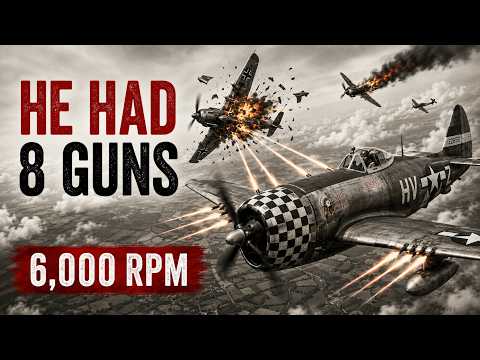
Within eighteen months, the men who mocked this flying barrel would be begging their commanders for warning the moment its engine was heard in the distance. One farm boy from Oklahoma was about to prove, in the most violent way imaginable, exactly what that machine could do.
And on a June afternoon over France, a German pilot would fly alongside the wreckage of an American fighter that should have been dead twenty times over, shake his head in disbelief, and simply fly away.
The formation climbed slowly out of the English coastline that March morning—sixteen of them, engines droning in a low, heavy growl that sounded nothing like the sharp snarl of a Spitfire. From the ground, mechanics watched them go and shook their heads. From the air, any German pilot who caught sight of their silhouette would have seen something almost comical: barrel-shaped fuselages, greenhouse canopies perched too high, wings that looked too small for the bulk they were expected to carry, propellers wider than anything the Luftwaffe had ever put into the sky.
These were Republic P-47 Thunderbolts, the newest American fighter over occupied Europe. And to the men who had spent three years mastering the art of aerial killing over Poland, France, Britain, and the Soviet steppe, they looked like a mistake wearing a cockpit.
Inside those cockpits, the young Americans strapped into the Thunderbolt felt something closer to awe than embarrassment. The instrument panel stretched wider than anything they had trained on back home. The seat sat high beneath a bubble of glass that gave a commanding view in every direction except straight ahead, where the long nose and that enormous fourteen-foot propeller blocked the horizon during taxi and takeoff.
The engine at idle rattled the whole airframe with a low, physical growl that a man felt in his teeth before he ever heard it in his ears. It did not feel like climbing into a fighter. It felt like climbing into a locomotive that someone had, almost as an afterthought, bolted a pair of wings onto.
That first combat sweep, flown on the tenth of March 1943, never even reached the fight. Radio failures scattered the formation before it crossed the French coast, and the mission dissolved into confusion before a single shot was fired. To the pilots of Jagdgeschwader 2 and Jagdgeschwader 26, stationed along the Channel coast and already accustomed to watching American bombers stagger toward Germany in daylight, the failed sweep was one more piece of evidence. The Americans had built something too heavy, too clumsy, too slow to matter.
They were not entirely wrong. Not yet.
What none of them understood was the philosophy baked into every rivet of that ugly machine. In the summer of 1940, as German fighters swept unchallenged across France, the United States Army Air Corps had gone to Republic Aviation’s chief designer with an urgent demand: a high-altitude interceptor that could match the Luftwaffe’s best.
The man given that task was Alexander Kartveli, a Georgian-born engineer who had escaped revolution and war in his own country only to spend his career solving other people’s aviation problems in America. What Kartveli handed back to the army was not the sleek, lightweight fighter anyone had expected. It was a monster.
“It will be a dinosaur,” Kartveli reportedly told his design team. “But it will be a dinosaur with good proportions.”
The prototype, designated the XP-47B, first flew on the sixth of May 1941 with test pilot Lowery Brabham at the controls. It weighed 9,900 pounds empty—65 percent heavier than the fighter it was meant to replace. Mechanics who saw it rolled out of the hangar for the first time asked the same question, half joking and half serious: Does this thing actually fly?
It did fly—and at altitude, it flew like nothing else built during the war. Buried in its fuselage was a Pratt & Whitney R-2800 Double Wasp engine, an eighteen-cylinder radial producing 2,000 horsepower, fed by a turbo-supercharger whose ductwork ran the entire length of the aircraft. While German fighters gasped for air above 25,000 feet, their mechanical superchargers losing power as the atmosphere thinned, the Thunderbolt’s turbo-supercharger kept feeding at sea-level performance at altitudes where enemy engines were already struggling.
Everything about the German approach to fighter design pointed in the opposite direction. The Messerschmitt Bf 109 and the Focke-Wulf Fw 190 had both been built around a single elegant idea: that a fighter should weigh as little as possible so it could climb fast, turn tight, and strike quickly before disengaging. Every extra pound was an enemy to be eliminated at the drawing board.
Kartveli had thrown that entire philosophy out the window. He had built a fighter around the idea that weight itself could become a weapon—that a big enough engine, a strong enough airframe, and enough ammunition could turn brute mass into an advantage no nimble interceptor could counter. It was, in its own way, as radical a piece of engineering as anything to come out of Germany’s aviation industry that year, except nobody watching it struggle through its first clumsy missions could yet see the radicalism underneath the bulk.
Among the young Americans learning to fly this strange new machine in the winter of 1942 was a farm boy from Enid, Oklahoma—a second lieutenant named Robert Johnson. Johnson had grown up dreaming of airplanes on land flat enough to see a storm coming from thirty miles away, chasing crop dusters down dirt roads on his bicycle as a boy. By the time he reached the 56th Fighter Group training at Bridgeport, Connecticut, under the command of a hard-driving officer named Hubert Zemke, he had learned that dreaming about an airplane and taming one were very different things.
Zemke himself had no patience for pilots who treated the Thunderbolt with anything less than total respect. He drilled his squadrons relentlessly—formation flying, gunnery, emergency procedures—until the routines became instinct, because he understood something his younger pilots did not yet grasp: in this particular airplane, hesitation killed faster than any German gun.
The Thunderbolt did not forgive mistakes. It ground-looped on landing if a pilot let his attention wander for even a second. It torque-rolled on takeoff, the enormous propeller trying to twist the entire airframe sideways before the wheels had even left the runway. And in a dive, it built speed with such enthusiasm that pilots discovered a phenomenon nobody had a name for yet—a point where the controls simply froze as shock waves began forming across the wings, the aircraft refusing to respond no matter how hard a man hauled on the stick.
Zemke’s group lost pilots and aircraft during those training months at Bridgeport. Casualties inflicted not by any enemy, but by the sheer unfamiliar violence of the machine itself. Funerals became a grim recurring feature of squadron life before the group had ever crossed the Atlantic. Every young pilot who watched a friend’s coffin loaded onto a truck understood, in a way no lecture could teach, that this airplane demanded to be respected on its own terms—or it would kill you just as surely as any enemy fighter.
Johnson described his first real flight in it years later in words that captured exactly what every new Thunderbolt pilot felt. “It was like strapping yourself to a locomotive,” he said. “The power was unbelievable. You did not fly it. You aimed it.”
By April of 1943, the Fourth Fighter Group—based in England and built around a core of American volunteers who had transferred out of the Royal Air Force’s Eagle Squadrons—was flying regular sweeps over occupied territory in their new Thunderbolts, hunting for a fight the Luftwaffe seemed reluctant to give them. The Germans had their reasons for caution that had nothing to do with fear. Why risk experienced pilots against a fighter that could not turn with a Messerschmitt, could not climb with a Focke-Wulf, and had already proven in its first weeks of operation that it struggled simply to complete a mission without mechanical trouble?
Then on the fifteenth of April 1943, Major Donald Blakeslee, leading the 335th Fighter Squadron on a sweep over Belgium, spotted a pair of Fw 190s far below his formation. Blakeslee pushed his Thunderbolt into a dive from 20,000 feet, chasing the German fighters down through the sky with a determination that ignored every warning about the aircraft’s handling at high speed. The airspeed needle climbed past anything his instructors back home had ever prepared him for, the airframe shuddering under the strain, the ground rushing up faster than his mind could fully process.
By the time he leveled out, he was skimming barely five hundred feet above the rooftops of Ostend—so low and so fast that he nearly flew into the town itself, chimneys and church spires flashing past his wingtips. He caught the trailing Focke-Wulf in his gunsight and fired. The German fighter came apart in the air, scattering wreckage across the rooftops below.
It was the first aerial victory ever scored by a P-47 Thunderbolt, and to the pilots of the Fourth Fighter Group, it felt like vindication after weeks of mockery and mechanical failure. To the Luftwaffe, it barely registered as a warning. One kill against a fighter force that had already destroyed entire air arms across three countries changed nothing in their calculations.
The reports filtering back to German fighter wings that spring still described the American newcomer in dismissive terms: underpowered in a turn, sluggish to climb, a big, heavy target that would eventually be ground down like every other Allied fighter that had come before it.
What those reports could not yet measure was what was happening inside the cockpits of men like Robert Johnson—men who were beginning, mission by mission, to understand that everything they had been taught about air combat might be wrong for this particular airplane. They were not being trained to turn with a Messerschmitt. They were being trained to use seven tons of American steel and eight machine guns as a weapon that no lightweight interceptor could survive being hit by.
Nobody on the German side had connected those numbers yet. Nobody understood what 6,000 rounds a minute meant when it finally found its mark.
That lesson was still weeks away. And when it came, it would not arrive gently. It would arrive over the French countryside in the last week of June, in the cockpit of a badly wounded Oklahoma farm boy who should, by every reasonable calculation, already have been dead.
Through the spring of 1943, Hubert Zemke reached a conclusion that would define how every American pilot in Europe used the Thunderbolt: do not turn with them. Use the weight. Use the power. Use the guns. It would come to be called boom and zoom—dive from altitude, fire once from close range with all eight guns converging, then climb away before the enemy could turn and give chase.
On the 26th of June 1943, Robert Johnson took off with forty-eight Thunderbolts of the 56th Fighter Group, escorting B-17s home from a raid near Paris. Near Forges-les-Eaux, sixteen Fw 190s dropped out of the sun. Twenty 20mm cannon shells and more than two hundred machine-gun rounds found his Thunderbolt in the first few seconds. The canopy shattered, hydraulic fluid sprayed into his eyes, and a fire started behind the firewall.
He reached for the canopy release and found it welded shut by a cannon shell. Trapped at 27,000 feet in a burning aircraft, Johnson leveled the wings and pointed the nose toward England. Three of four main longerons had been shot through. The engine ran rough, missing and shuddering.
Then a lone Fw 190 found him. The German emptied his cannon, then his machine guns, into an aircraft that refused to fall. He pulled alongside the shattered cockpit, studied the wreck flying beside him, shook his head slowly—and flew away.
Johnson brought the Thunderbolt down at Manston. Ground crews counted over two hundred holes. A cannon shell had detonated inches from his head; another had exploded against the armor plate behind his seat. He was back in a cockpit within days.
On the 8th of October 1943, Oberst Hans Philipp—206 victories, one of the Luftwaffe’s most decorated aces—was killed by Thunderbolts of the 56th, a claim widely credited to Johnson. The easy dismissals of April no longer held.
By the spring of 1944, a new paddle-bladed propeller added four hundred feet per minute to the climb, closing the last gap German pilots had relied on. By D-Day, hundreds of Thunderbolts stacked the skies above Normandy. Loaded with bombs and rockets, they became the dreaded Jabo-Tod—death by fighter-bomber.
Johnson finished the war with twenty-seven confirmed victories, scars still marking his face and leg. The German pilot who shook his head and flew away was never identified. What began as a joke about a flying milk bottle ended as one of the most feared silhouettes over occupied Europe.
So here is the question worth asking: when the experts laugh at something new and clumsy, how often are they watching the future—and mistaking it for a mistake? Tell us what you think in the comments.
Report this article
Select a reason for reporting:






