Imagine a family that built a nation from the sand, led it to independence, sat on its throne—and then lost everything in a single night. Not to an invading army, not to a rival kingdom, but to a 27-year-old second lieutenant with a radio and a handful of soldiers. That family was the House of Senusi, and what happened to them afterwards is a story almost nobody tells.
When people talk about Libya, the conversation almost always centers on one man: Muammar Gaddafi. His rise, his eccentricities, his brutal end in 2011. But there’s a ghost that haunts the entire Libyan story. That ghost is the royal family. They didn’t just disappear when the monarchy fell. They were imprisoned. Humiliated. Their homes were burned. Their ancestors’ graves were literally dug up and scattered into the desert. And yet, against all odds, they survived.
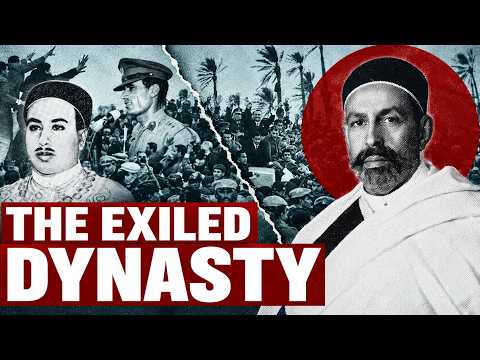
To understand the fall, you first need to understand how the Senusi family rose to power. They weren’t just some aristocratic dynasty that inherited wealth and titles through bloodlines and palace intrigue. They were something far more unusual: a religious order that became a royal house, a Sufi brotherhood that transformed into a sovereign state.
It all began in 1837 in the holy city of Mecca. A scholar from Algeria named Muhammad ibn Ali al-Senusi—a man who traced his ancestry back to Fatima, the daughter of the Prophet Muhammad—founded a new Islamic order. He was deeply troubled by the decline of Islamic thought and the growing weakness of Muslim societies in the face of European colonialism. So he created the Senusi order, a movement that emphasized austerity, moral discipline, education, self-reliance, and above all, resistance to foreign domination.
This wasn’t just a spiritual movement. It was a political and social revolution wrapped in religious language. The Grand Senusi didn’t just build mosques. He built an entire network of zawiyas—lodge communities that served as schools, prayer houses, trade hubs, and military outposts all rolled into one. Think of them as self-sustaining compounds in the middle of the desert, each one functioning like a small city-state with its own teachers, farmers, system of justice, and military garrison.
These weren’t just places of worship. They were nodes in a sprawling network that gave the Senusi something no other group in the region possessed: a functioning infrastructure that spanned thousands of miles of desert.
The Grand Senusi had originally tried to establish his base in Mecca, but the Ottoman authorities didn’t take kindly to a reformist movement that challenged their religious authority. So he moved westward, traveling across North Africa, preaching as he went, gathering followers from Algeria to Egypt. By the early 1840s, he had settled on the central plateau of Cyrenaica in eastern Libya, specifically in the Jabal al-Akhdar region—the Green Mountain. It was a strategically brilliant choice. Cyrenaica was remote enough to be beyond the effective reach of any European or Ottoman authority, but connected enough to the trade routes crossing the Sahara that the Senusi could build a viable economy.
In 1856, the Grand Senusi moved the center of the order even further south to the remote oasis of Jaghbub, which became home to a new Islamic university that scholars described as second only to Al-Azhar in all of Africa. From Jaghbub, the order spread like wildfire across the Sahara. When the Grand Senusi died in 1859, leadership passed to his eldest son, Muhammad al-Mahdi, who expanded the order even further. Under his guidance, the Senusi established roughly 146 zawiyas across North Africa, bringing the majority of Cyrenaica’s Bedouin tribes under the order’s spiritual and political influence.
The Senusi weren’t just preachers. They were administrators, judges, tax collectors, and military commanders. In the vast emptiness of the Saharan interior, where no Ottoman governor could reach and no European power had yet dared to tread, the Senusi were the de facto government.
Now here’s where it gets really interesting. When Italy invaded Libya in 1911, the Senusi didn’t roll over. They fought—and they fought hard. The Italian occupation of Libya turned into one of the most brutal colonial wars in African history, and the Senusi were at the center of the resistance. The most famous figure in this fight was Omar Mukhtar, a teacher and guerrilla commander who became known as the Lion of the Desert. Mukhtar was a member of the Senusi order, and for nearly two decades he waged a devastating guerrilla war against the Italian army in the mountains and deserts of Cyrenaica.
The Italians responded with unspeakable brutality. Under Mussolini’s orders, General Rodolfo Graziani launched a campaign of mass deportation, concentration camps, and aerial bombardment against the Libyan civilian population. Historians estimate that between 40,000 and 100,000 Libyans died during the Italian pacification campaign. Many of them in internment camps where disease and starvation ran rampant. Omar Mukhtar himself was captured in 1931 and publicly hanged in the town of Suluq near Benghazi in front of 20,000 forced spectators. It was meant to break the Libyan resistance forever.
But the Senusi survived. Their leader at the time, a young man named Muhammad Idris, had gone into exile in Egypt in 1922 when it became clear that the Italians intended to crush the order completely. For nearly two decades, Idris waited, organizing his followers from Cairo while the Italians tightened their grip on his homeland. And then the Second World War changed everything. When the British fought their way across North Africa against the German and Italian forces, Idris saw his moment. He reformed the Senusi army and allied with the British, fighting alongside them as they rolled up the Axis positions in Libya. It was a gamble that paid off spectacularly.
When the war ended and the United Nations deliberated over Libya’s future, it was Idris who emerged as the logical choice to lead the newly independent nation. On December 24, 1951, Libya declared its independence, and Muhammad Idris was crowned King Idris I—the first and only king of Libya.
Now, the early years of Libyan independence were anything but glamorous. This was one of the poorest countries on Earth. The entire national budget was propped up by foreign aid and rent payments from Western military bases, most notably Wheelus Air Base near Tripoli, which was at one time the largest American military facility outside the United States. The country had almost no infrastructure, limited education, and a scattered population of fewer than 1.2 million people spread across a territory larger than the entire state of Alaska.
But then, in June of 1959, everything changed. In 1956, King Idris had granted oil exploration concessions to major foreign companies, including Esso, Mobil, and Texas Gulf. It was a desperate gamble for a country that could barely keep the lights on. And then the gamble paid off beyond anyone’s wildest imagination. Esso—the company that would later become Exxon—confirmed the discovery of massive petroleum deposits at Zelten in Cyrenaica. Almost overnight, Libya went from being one of Africa’s poorest nations to one of its richest.
More oil fields were found across both Cyrenaica and Tripolitania, and foreign oil companies flooded into the country, paying 50% of their profits directly to the Libyan government in taxes. A 167-kilometer pipeline was built, linking the oil fields to the Mediterranean coast, and Libyan crude began flowing to markets across the world. The transformation was staggering.
Before oil, Libya’s entire economy depended on international aid and rent payments from foreign military installations. The United States was paying handsomely for Wheelus Air Base near Tripoli, which at its peak housed over 15,000 military personnel and their dependents. It had its own hospital, a multiplex cinema, a shopping mall, a bowling alley, and a high school for 500 students. For all practical purposes, it was a self-contained American city on Libyan soil. The British maintained their own bases and roughly 4,500 troops stationed at various strategic points across the country in exchange for an annual economic subsidy of around $9 million in military assistance.
But oil dwarfed all of that. King Idris now sat atop a fortune that made the base rental payments look like pocket change. Government revenues exploded, and with them came massive construction projects, expanded public services, and a rapidly rising standard of living. The University of Libya was founded in Benghazi in 1955. Roads were paved, hospitals were built, and the country was beginning to develop the trappings of a modern state.
But here’s the thing about sudden wealth in a young, fragile nation. It doesn’t solve problems. It creates new ones. The oil money flowed disproportionately to a small circle of tribal elites and royal advisers, and ordinary Libyans watched as the gap between the palace and the street grew wider every year. The inequality was glaring. The money tended to concentrate among a few connected families rather than flowing broadly to the people. And as one American military account from the era noted, this inequality of wealth was magnified dramatically by the oil discovery itself.
Idris himself was never comfortable as a modern head of state. He was a religious scholar by training, a man of the desert, and his temperament was far better suited to the quiet life of a Sufi sheikh than the noisy politics of an oil-rich kingdom. He was aging, his health was failing, and he had no sons of his own to succeed him. The question of succession became a constant source of anxiety.
In 1956, Idris named his nephew Hassan al-Rida al-Senusi as crown prince. Hassan was a capable man who had been educated at Al-Azhar University in Cairo and who took on increasing responsibilities as the king’s health declined. By the late 1960s, Crown Prince Hassan was effectively running the country on Idris’s behalf.
But beneath the surface, discontent was boiling. The rise of Arab nationalism, particularly the charismatic brand promoted by Egypt’s Gamal Abdel Nasser, was electrifying young Libyans who saw Idris as a Western stooge—too close to Britain and America, too far removed from the pan-Arab dream. The king’s reliance on a small circle of advisers, particularly the powerful and deeply unpopular Shelhi family, made things worse. The Shelhis were considered utterly corrupt by many Libyans, and the king’s dependence on them fueled resentment that extended from the streets of Tripoli all the way into the ranks of the Libyan military.
By the summer of 1969, the king could feel the ground shifting beneath him. He was tired, he was sick, and he could see that the military was restless. On August 4, 1969, King Idris signed a formal instrument of abdication, which he handed to the president of the Libyan Senate. The document specified that on September 2, the king would formally step down and transfer power to Crown Prince Hassan. It was supposed to be an orderly, dignified transition.
But history had other plans.
On the night of September 1, 1969, while King Idris was receiving medical treatment at a spa in Turkey, a group of young military officers launched what they called Operation Jerusalem. The ringleader was a 27-year-old second lieutenant named Muammar Gaddafi.
Now, pause on that for a moment. Not a general, not a colonel, not even a captain. A second lieutenant—one of the lowest-ranking commissioned officers in the Libyan military. The fact that a man of such junior rank could topple an entire monarchy tells you everything you need to know about how hollowed out the Idris regime had become.
With a force of just a few dozen soldiers, Gaddafi and his Free Unionist Officers Movement seized control of airports, police stations, government buildings, radio stations, and military barracks in Tripoli and Benghazi. Gaddafi himself took control of the Benghazi barracks while his co-conspirator Omar Meheishi seized the Tripoli barracks and the anti-aircraft batteries. It was a textbook coup executed with remarkable speed and efficiency against a government that barely had the energy to resist. Not a single shot was fired. Not a single person was killed. The entire monarchy collapsed in hours. Not because it was defeated in battle, but because there was simply no one willing to fight for it.
One of Gaddafi’s officers, Khweldi Hameidi, was dispatched to detain Crown Prince Hassan, who was at his residence acting as head of state in the king’s absence. When the soldiers arrived, the Crown Prince offered minimal resistance. That evening, he appeared on Libyan radio and announced what was described as his voluntary abdication, calling on Libyans to support the new government. Whether this was truly voluntary or made under duress is a question that history has never fully resolved.
Gaddafi then made his own announcement over the airwaves. He declared the end of the monarchy, the establishment of the Libyan Arab Republic, and the beginning of what he called a new era for the Libyan people. The Revolutionary Command Council, composed of 12 young officers, took power. King Idris, still in Turkey, learned of the coup from the news. He would never set foot in Libya again.
Now, here is where the story takes its darkest turn. Because what happened to the royal family after the coup was not simply a political transition. It was a systematic campaign of humiliation, imprisonment, and erasure.
Crown Prince Hassan was placed under house arrest, then dragged before a people’s court in 1971 and sentenced to three years. After his release, he endured seven years of total seclusion—no friends, no visitors, his name struck from official records. The regime treated him as though he had never existed.
King Idris died in Cairo in 1983, buried in Medina, thousands of miles from the land he had ruled. One year later, Gaddafi’s men dynamited the tomb of the order’s founder at Jaghbub and scattered his remains into the desert. This was not political persecution. This was cultural annihilation.
Then they came for Hassan’s home, burning it before his family’s eyes and relocating them to shacks on a public beach. His son, Prince Muhammad, took a clerk’s job at the Ministry of Agriculture—the heir to a dynasty, working for the men who destroyed it.
Hassan died in London in 1992. But in 2011, Libyans raised the old royal flag, and in 2014 the government officially rehabilitated the family. Today Prince Muhammad convenes national dialogues from London, and young Libyans march for the 1951 Constitution.
You can burn the house. You can scatter the bones. But you cannot kill what people choose to remember.
So tell us—do you believe Libya’s future lies with a restored constitutional monarchy, or is the past too heavy a burden to carry back? 👑
Report this article
Select a reason for reporting:






