They were the most decorated soldiers of the Third Reich, earning 69 Knight’s Crosses—more than any other Waffen-SS division. Yet their legacy is written not just in medals, but in blood, fire, and infamy. This is the story of the 2nd SS Das Reich Division, a unit that fought on almost every major front of World War II, from the beaches of France to the frozen outskirts of Moscow, and from the tank graveyards of Kursk to the final, desperate battles in the ruins of Vienna.
But how did a handful of independent regiments become one of the most feared and powerful combat formations of the war? And what dark deeds marked their journey? Join us as we trace their path through the war’s most pivotal battles—and uncover the brutal reality behind their legendary status.
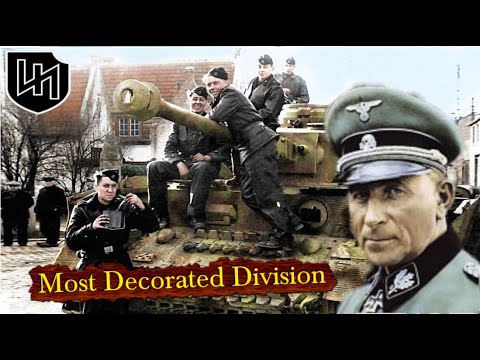
The origins of Das Reich lie in the aftermath of the Polish campaign, when three independent regiments—Germania, Der Führer, and Deutschland—were combined to form a new division. Under the command of Paul Hausser, these experienced soldiers were thrown into the Battle of France in May 1940. They advanced through Holland, reached Rotterdam, and then raced toward Dunkirk, where they fought fiercely to prevent the Allied evacuation. Though they failed to break the Allied defenses, their ferocity was already evident.
After France’s capitulation, the division underwent changes: the Germania regiment was replaced, and its men became the core of the new Viking Division. Das Reich remained in France, preparing for Operation Sea Lion—the invasion of Britain that never came. Instead, they were sent to Romania and then participated in the Yugoslavia campaign, where one of their officers, Fritz Klingenberg, achieved a legendary feat: with only six men, he captured Belgrade, using deception and audacity in one of the most brilliant actions of the war.
Then came Operation Barbarossa. Das Reich was part of Army Group Center, thrust into the cauldron of the Eastern Front. They fought in the bloody battles around Yelnia and Smolensk, pushing toward Moscow. But the Soviet counter-offensive in December 1941 shattered them. By February 1942, the division had lost over 60 percent of its original strength—nearly 10,700 soldiers. It was withdrawn to France, rebuilt as a Panzergrenadier division, and then sent to occupy Vichy France and guard the port of Toulouse.
By early 1943, the situation on the Eastern Front was desperate. After the disaster at Stalingrad, Das Reich was rushed to the sector around Kharkov to stop the Soviet advance. They arrived without time to acclimatize and were immediately thrown into battle. Overwhelmed by Soviet might, they were pushed back to the brink of annihilation in Kharkov. But on February 20, 1943, they joined Manstein’s counter-attack, and for a month they remained on the offensive, turning the tide.
After a brief pause due to the spring thaw, Das Reich prepared for the next major operation: the attack on the Kursk salient. As part of the II SS Panzer Corps, they were the spearhead, alongside Leibstandarte and Totenkopf. With 20,000 troops and 223 armored vehicles, including 14 Tigers and dozens of StuG tank destroyers, they were one of the most powerful divisions in the German army. Under the command of Walter Krüger, they advanced from the south.
The offensive began on July 5, 1943. Initially, they made good progress, but the advance soon slowed. The climax came between July 10 and 15 at Prokhorovka, where Das Reich fought one of its fiercest battles against the Soviet 5th Guards Tank Army. The II SS Panzer Corps prevailed, inflicting terrible casualties, but the German offensive was paralyzed. The Soviets counter-attacked at Orel and in the Donets basin, forcing the Germans to withdraw troops from Kursk to protect their flanks. From then on, Das Reich fought a series of defensive battles along the southern flank of the Eastern Front.
After months of relentless combat, the division was exhausted. It was sent back to France to rebuild, this time as an SS Panzer Division. They were stationed in Montauban, in southern France, to re-equip and train while guarding against a possible Allied landing. But by this time, the division was no longer the hardened force of old—most of its troops were inexperienced recruits, and its armor consisted of 37 Panzer IVs, 55 Panthers, and 30 StuG IIIs.
Then came D-Day. One day after the Normandy landings, Das Reich received orders to move to the front at full speed. The distance was about 700 kilometers, but their journey was hampered by sabotage: British Special Operations Executive agents had blown up railway lines, forcing the division to travel by road. This delayed them and exhausted men and machines. Along the way, they were harried by the French Resistance, and in retaliation, Das Reich carried out brutal anti-partisan actions. It is estimated that around 1,000 civilians were executed by the division on its way to Normandy. The most infamous of these was the Oradour-sur-Glane massacre, where 642 men, women, and children were killed.
Despite the delays, Das Reich finally reached Normandy in mid-June, but not in full strength until July 10. By then, they could only defend critical sectors. They fought in the western part of Normandy, right where the Americans broke through in Operation Cobra at the end of July. After the loss of France, the division was sent back to Germany in October 1944 to recover.
In December 1944, Das Reich participated in the Ardennes Offensive. They achieved initial surprise but ultimately failed due to Allied numerical superiority. After this, they were rushed to Hungary to counter the Soviet advance. There, they took part in the last German offensives of the war, including at Lake Balaton. Rejected once more, they fought a fighting retreat toward Vienna. A small group ended the war in Prague, helping to evacuate civilians, while the main body surrendered to the Americans near Linz.
The history of Das Reich is vast and complex, but this is the condensed story of their combat actions—a tale of elite soldiers, ruthless tactics, and the dark legacy of the Waffen-SS.
Yet for all the medals and the fearsome reputation, the story of Das Reich cannot be understood through battles alone. Behind the Tiger tanks and the Knight’s Crosses lay a unit whose name would become synonymous with atrocity—and whose soldiers would face judgment in the war’s aftermath.
Take the road to Normandy. The sabotage of the railways by the SOE forced the division into a crawling, bloody trek across the French countryside. But the reprisals that followed were not the acts of desperate men under fire—they were systematic. At Tulle, 99 men were hanged from lampposts and balconies in a single afternoon. At Oradour-sur-Glane, the entire village was erased. Men, women, and children were locked in a church that was then set ablaze; those who tried to escape were machine-gunned. The officer responsible, Adolf Diekmann, claimed he had acted on reports of Resistance activity—but no order from Berlin ever sanctioned such slaughter.
These were not isolated excesses by rogue soldiers. They were the logical endpoint of an ideology that had been baked into the Waffen-SS from its earliest days. Das Reich was not merely a combat formation; it was a political instrument, and its men had been indoctrinated to view their enemies—whether Soviet commissars, French partisans, or Jewish civilians—as something less than human.
By the time the division surrendered near Linz in May 1945, the reckoning had already begun. The Americans who took them prisoner were under orders to treat the Waffen-SS as a criminal organization. Many of Das Reich’s officers were handed over to French authorities, who had a long list of charges waiting.
The Oradour trial in 1953 became a national scandal in France. Twenty-one men were convicted, but the sentences were quickly commuted amid political pressure—a decision that sparked outrage across the country and left the survivors of Oradour feeling betrayed by their own government.
Yet the story does not end there. In the decades that followed, veterans of Das Reich gathered at reunions, swapped war stories, and published memoirs that carefully sidestepped the darker chapters. Some former officers even entered politics. The line between soldier and criminal blurred in the fog of memory, and the division’s legacy became a battleground of its own—fought not with tanks, but with books, monuments, and the silence of those who preferred to forget.
And as the last veterans fade away, historians continue to sift through the evidence—the orders, the photographs, the testimony of survivors—trying to answer a question that still haunts Europe: how did ordinary men, fighting for a monstrous cause, become capable of such things?
The answer, perhaps, lies in the very nature of the unit. Das Reich was not a conscript army thrown together in desperation; it was an elite, volunteer force, its ranks filled with men who had chosen the SS and its worldview. From the beginning, they were taught that they were the racial and ideological vanguard of the Reich. That belief did not crumble when the tanks were destroyed or the cities fell—it hardened. In the final months, as they retreated through Hungary and Austria, the violence did not stop. Prisoners were shot, villages burned, and the same ruthless logic that had destroyed Oradour was applied with even greater desperation.
When the end came near Linz, there was no grand last stand. The men of Das Reich simply laid down their arms. Some tried to shed their uniforms and blend into the civilian population. Others surrendered with a strange sense of relief. The war was over, but the accounting had only begun. The Americans, aware of the division’s reputation, treated them as a criminal organization. Yet many slipped through the cracks. The Cold War was dawning, and former SS men suddenly found themselves useful—as interpreters, as informants, as soldiers in a new struggle against the Soviets.
In the years that followed, the myth of the ‘clean Waffen-SS’ took root. Veterans argued that they were soldiers like any other, that politics was the business of others. But the photographs from Tulle and Oradour do not lie. The hangings, the church, the ashes—these are the true monuments of Das Reich, more enduring than any Knight’s Cross.
Today, the division’s legacy is a scar on the European conscience. The medals are in museums, the memoirs are on bookshelves, but the question remains. How do we remember men who fought with courage for a cause that was evil? Can a soldier be brave and a criminal at the same time? The story of Das Reich offers no easy answers—only the uncomfortable truth that ordinary men are capable of extraordinary good and unspeakable evil, often in the same breath.
What do you think? Should the soldiers of Das Reich be remembered as elite warriors, or as war criminals? Or is the truth far more complicated than either label allows? Share your thoughts in the comments below.
Report this article
Select a reason for reporting:






