The afternoon sun baked the dirt strip on Guadalcanal, a raw scar in the jungle that reeked of oil and mud. For thirteen days, American Marines had clung to this island by their fingernails, enduring relentless bombing and shelling. The runway—half-finished, cratered, and barely functional—was the most contested piece of real estate in the Pacific. Then, a low hum from the southeast. Every Marine stopped and looked up. Thirty-one aircraft appeared out of the haze: nineteen Wildcat fighters and twelve Dauntless dive bombers, descending toward the battered strip.
Major General Alexander Vandegrift watched the first Dauntless taxi to a stop. He later wrote four words that summed up everything: “Thank God you have come.” That sentence captured the desperation of those thirteen days—and raised a question history often skips: Who built this runway, and what did it take to keep it open?
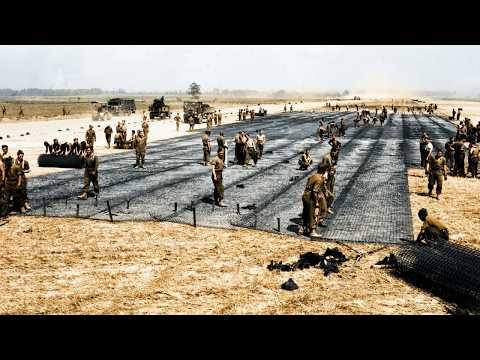
Henderson Field was not much to look at. At 3,800 feet long and 150 feet wide, its surface was a mix of volcanic earth, crushed coral, and mud that turned to soup in the frequent rains. Drainage was nonexistent, and there were no hardstands or repair facilities. The Japanese had started the airfield in July 1942, using 2,500 men and heavy equipment. By August 6, they had finished 2,600 feet and were celebrating with sake, confident of completion within days. The next morning, the U.S. Marines landed.
The field was named for Major Lofton Henderson, a Marine aviator killed at Midway. It was a fitting name for a runway that would demand everything from every man who served on it.
The men sent to finish the job were not conventional soldiers. They were construction workers in uniform—ironworkers, carpenters, electricians, pipefitters, heavy equipment operators. They were the Naval Construction Battalions, known as the Seabees. Their motto: “Construimus Batuimus—We Build, We Fight.” Their informal creed: “Can Do.”
The Seabees were born from a legal problem. Before the war, the Navy relied on civilian contractors, but when the Japanese attacked Wake Island, those civilians were classified as guerrillas and could be executed. Rear Admiral Ben Moreell requested authority to militarize the construction workforce, and on March 5, 1942, the first battalions were established. Recruits came from every corner of American industry—union carpenters, oil field operators, bridge riggers. The average age was 37, many in their 40s. They were the highest-paid enlisted men in the military, and their combat training was adjusted for men who were less impressed by shouting.
By summer 1942, the Pacific War had reached a turning point at Midway, but the Japanese were still formidable. The American strategic problem was range: aircraft had limited reach, and forward airfields were needed to project power. Guadalcanal, 900 miles from Rabaul, was the answer—if the airfield could be taken, finished, and held.
The landings on August 7 met almost no resistance. The Japanese construction troops fled so quickly they left breakfast cooking. The Marines captured generators, trucks, rollers, and a rail system—but little heavy engineering equipment. Most of it was still offshore when Japanese cruisers sank four Allied heavy cruisers on August 8. Only 15% of the division’s engineering equipment made it ashore.
The 1st Engineer Battalion and 1st Pioneer Battalion went to work with captured Japanese equipment and American shovels. Closing the gap in the runway required moving 100,000 cubic feet of earth—by hand, truck, and captured rail cars—in blistering heat. Every man not on watch was on that runway.
On August 20, the first aircraft arrived: 19 Wildcats and 12 Dauntlesses. They landed on a strip that had been repaired that morning after yet another bombing run. As the first Dauntless stopped, Vandegrift told the pilot, “Thank God you have come.” After thirteen days of holding an island everyone back home seemed to have forgotten, it was an answer he had not been sure was coming.
The aircraft that landed that afternoon became the Cactus Air Force, named for the Allied code word for Guadalcanal. The next day, Major John Smith scored the first credited aerial victory, and the Ichiki Detachment shattered itself against the Tenaru River line. A pattern was setting in: the Japanese attacked, they were stopped, and the runway stayed open.
On September 1, the first echelon of the 6th Naval Construction Battalion came ashore—five officers and 387 enlisted men under Lieutenant Commander Joseph Blundon. These were the first Seabees to serve under enemy fire in the entire war. They dug their camp into a narrow coconut grove beside the strip and confirmed what Blundon had already seen from the air: the drainage was inadequate, the surface unstable, the crown insufficient. Every rain left portions of the runway unusable.
They went to work. A twelve-inch crown was cut down the center line to shed water. Poor topsoil was excavated to a depth of twenty-one inches and replaced with gravel, coral, and clay, compacted in layers. Lateral drainage channels were dug along both edges. On September 25, they began laying Marston mat—pierced steel planking, two feet wide and ten feet long, interlocked by hand across the prepared surface.
They worked in heat that averaged over ninety degrees, in humidity that made the air feel like wet cloth, while fighting malaria on rations that were never adequate. Aviation fuel was hand-pumped from fifty-five-gallon drums, one at a time. Ordnance was hand-loaded onto aircraft by men who had to stop, sprint to a slit trench, wait out a bombing run, and then come back and finish the job. There were no fuel trucks, no proper ordnance equipment, and in the early weeks barely enough food.
Everything was improvised by men who had built the real thing in peacetime and understood exactly which corner could be cut and which could not. They were not boys learning a trade. They were experienced professionals applying everything they knew to conditions no professional had previously encountered.
Alongside the main runway, they built an entirely new strip from scratch. Fighter 1, known informally as the cow pasture, was a 4,600-foot grass runway rolled from kunai grass on captured Japanese equipment, completed in early September. Fighter 2 at Kukum Point followed later that autumn. They built a 225-foot bridge across the Lunga River and a 209-foot bridge across the Tenaru, tunnels into Pagoda Hill for radar and radio installations, an aviation fuel tank farm, and twenty-four miles of roads connecting the airfield complex to the supply dumps and perimeter defenses.
They did all of it while taking incoming fire, while drilling as infantry, and while filling bomb craters in the main runway after every raid. The work went on around the clock in rotating shifts. When the siren sounded, men dove into slit trenches cut beside the runway, lay flat while bombs fell within hundreds of feet, and climbed back out to continue working while the smoke was still rising.
The Seabees developed a system for the one task no other construction force had ever needed to master: repairing a functioning airfield under continuous bombardment. They preloaded trucks with gravel and coral before raids, so that when the all clear sounded, the vehicles were already moving onto the surface. They used peaveys—the long-handled tools of the logging trade—to pull the locking pins from damaged Marston mat sections, so entire panels could be dragged aside and replaced in minutes.
Lieutenant Commander Blundon told interviewers after the war that one hundred Seabees could repair the damage of a five-hundred-pound bomb crater on an airstrip in forty minutes. The official Navy history preserves one detail that captures the spirit of those months in a single image. At times during the heaviest bombing, there were not enough shovels to supply all the men working the craters. Men filled bomb craters using their steel helmets, carrying dirt and coral one helmetful at a time into holes that had not existed ten minutes before.
Then came October 13. Vice Admiral Takeo Kurita brought Battleship Division 3 into the waters off Guadalcanal—the battleships Kongo and Haruna, the cruiser Isuzu, and nine destroyers. They arrived off Savo Sound at approximately 0133 on October 14 and opened fire from roughly 17,500 yards. For eighty-three minutes, the two battleships fired 973 fourteen-inch shells into the Lunga perimeter, most of them incendiary and high explosive, designed to ignite aviation fuel and destroy aircraft on the ground.
The bombardment destroyed forty-eight of the ninety aircraft of the Cactus Air Force. It burned nearly all of the aviation gasoline stockpile. It killed forty-one men, including six pilots. It cratered the runway in dozens of places and undid weeks of drainage work in a single night. Survivors called it the bombardment for the rest of their lives, and they meant something specific by the definite article. Men who lived through it described the noise as a physical force that knocked them off their feet in the slit trenches and left them bleeding from the ears.
By dawn on October 14, Japanese cruisers arrived and added 752 eight-inch shells to what the battleships had already done. Within forty-eight hours, the airfield perimeter had absorbed fifty-three separate bombardment events. That morning, fourteen B-17 Flying Fortresses took off through the shell craters on no more than 2,600 feet of available runway.
The Seabees, the Marine pioneers, and every able-bodied man climbed out of the slit trenches and went back to work. Japanese bombers came twice more that day. The crews dove in, waited, climbed out, and kept going. The men had rehearsed the crater repair sequence so many times it had become automatic. Each man knew his role before the all clear sounded. The truck drivers knew which section they were responsible for. The mat layers knew exactly how many panels they needed for a standard crater. Equipment operators had their machines positioned and running before the last bomb had hit the ground.
It was not bravery in any theatrical sense. It was professional competence applied to an environment that had no right to produce professionals, and it worked because it had been drilled into the men until the work ran faster than the fear.
Across four months, through nine naval bombardments, daily air raids, and ground assaults that brought Japanese infantry within 150 feet of the runway, Henderson Field never went down for more than four hours. That figure, preserved in official Navy history, is the single most remarkable fact of the Guadalcanal campaign. The men who kept it open were not warriors in any conventional sense—they were tradesmen who had picked up rifles.
On October 3, 1942, Seaman Second Class Lawrence “Bucky” Meyer, a 25-year-old Seabee, manned a machine gun during a strafing attack and shot down a Zero. He was awarded the Silver Star, the first decorated Seabee of the war. Thirteen days later, Meyer was on a fuel barge transferring aviation gasoline when Japanese dive bombers attacked. He was killed, but the fuel he helped load kept the Cactus Air Force flying.
The campaign ended on February 9, 1943. Japan had lost roughly 683 aircraft and most of its experienced carrier aviators. The 17th Army, which had committed 36,000 men, lost all but 10,650 evacuated. The runway had held.
Henderson Field became the model for every subsequent island campaign. The 40-minute crater repair became a benchmark; preloading repair vehicles became doctrine. By war’s end, the 258,000 Seabees had built more than 400 advanced bases, including 111 major airstrips in the Pacific alone. The airfield on Tinian, built entirely by Seabees, launched the Enola Gay.
Today, Henderson Field is Honiara International Airport. Under its tarmac lies the same ground that a group of 37-year-old tradesmen refused to let go dark in 1942. They did it one helmet full of coral at a time, and they kept doing it until the war moved on. That is the story—not one of glory, but of what wins wars.
So the next time you board a flight from a runway that seems ordinary, remember the men who built it under fire—and ask yourself: what would you have done with a helmet and a hole in the ground?
Report this article
Select a reason for reporting:






