On the morning of D-Day, as the sun began to rise over the Normandy coastline, Don Malarkey found himself face to face with an enemy who could have been his neighbor. The man was a German prisoner of war, but his accent was pure American. “Where are you from, son?” Malarkey asked, half-joking. The answer stopped him cold: “Eugene, Oregon.” In that moment, the war shrank to the size of a small town, and Malarkey realized that the man he was supposed to kill might have once worked across the street from him.
But the story that unfolded in Band of Brothers—the one where Lieutenant Ronald Speirs calmly executes the prisoners after handing out cigarettes—is not the whole truth. In fact, it may be a complete fabrication. The real encounter between Malarkey and the German-American POW was stranger and more poignant than anything Hollywood could invent, and it ended not with gunfire, but with a quiet exchange about regret and a hope that both men would survive the war.
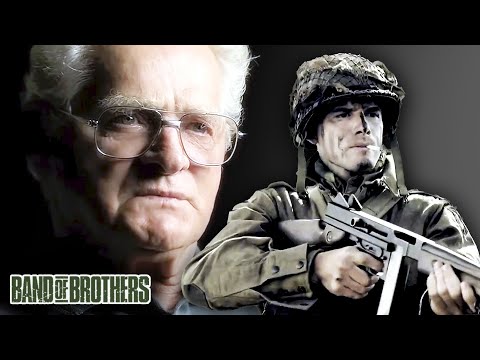
In the series, Malarkey is the one who asks the prisoner where he’s from, and the man replies he’s from Eugene. But in his memoir, Malarkey recalled that it was another soldier who asked, and the prisoner said “Portland, Oregon.” Malarkey, from Astoria, was stunned. “No kidding, Portland,” he said. “I’m from Astoria.” The prisoner then revealed he had worked at Schmidt Steel Company in Portland until 1938, when he returned to Germany after Hitler called all loyal Germans home. Malarkey couldn’t believe it—he had worked at Monarch Forge and Machine Works right across the street.
The filmmakers changed the details, perhaps thinking audiences wouldn’t believe such a coincidence. But the truth was already incredible enough: two men from the same corner of Oregon, toiling in factories a stone’s throw apart, now meeting on a battlefield in France. “Well, now what do you think about that decision now to return to your homeland?” Malarkey asked. The prisoner’s reply was simple and heartbreaking: “I think I made a big mistake.”
What happened next in real life was not an execution. Malarkey said goodbye, telling the man to take care, and walked on. There was no Ronald Speirs passing out cigarettes and then opening fire with a Thompson submachine gun. That scene, as Malarkey himself later explained, was pure fiction—dramatic license taken to introduce Speirs as a fearsome killer. “I don’t know that he really shot these guys down,” Malarkey said in a 2012 talk. He believed that if Speirs had killed prisoners, it happened later, during the attack on Carentan, not on D-Day.
The real story of the prisoner from Oregon ends with uncertainty. Did he survive the war? Did he return to America? Malarkey never tried to find him—he didn’t even know his name. But he hoped the man had lived, that he had gone back to school, found a career, fallen in love, and raised a family. Perhaps, like Malarkey, he had children and grandchildren, and perhaps he lifted them high in the air and prayed they would never know war.
As Malarkey walked away that morning, he had been at war only a few hours, but he had already learned a lesson that training could never teach: the guy trying to kill you could be somebody who once worked across the street from you. Strange thing, war.
But the story of the Oregon prisoner did not end with Malarkey’s footsteps fading down that Normandy road. In the years after the war, the question of what became of the man lingered—not just for Malarkey, but for historians and amateur researchers who stumbled across the anecdote in Easy Company Soldier and wondered. Who was he? Did he go home to Oregon, or did he stay in the land of his father?
The trail, such as it is, begins with what the prisoner himself said. He had worked at Schmidt Steel Company in Portland until 1938, then returned to Germany when Hitler called the Volksdeutsche home. That timeline matters. It means he was in Germany for a full year before the war began, long enough to be conscripted, long enough to be swept up in the machinery of the Wehrmacht. He told Malarkey he joined up in 1941. By D-Day, he had been a soldier for three years—a veteran, not a green recruit.
And yet he surrendered. That detail is easy to overlook, but it is telling. He came up out of a ditch with his hands in the air, one of roughly twenty prisoners taken that morning. He did not fight to the death for the Fatherland he had chosen. Whatever fire had burned in him in 1938, it had dimmed by the time he stood on that road in Normandy talking to a stranger from Astoria.
There is another thread worth pulling. The Volksdeutsche who returned to Germany in the late 1930s were often viewed with suspicion by the Nazi establishment. They spoke German with accents, they had foreign habits, and many of them—despite their enthusiasm—were never fully trusted. Some were placed under surveillance. Others were drafted into labor battalions before ever seeing combat. If the Oregon prisoner was among those who returned in 1938, he may have spent his first years in Germany proving his loyalty to men who doubted it.
That irony would not have been lost on Malarkey. The man had left America to become a true Aryan, and Germany had handed him a rifle and sent him to France to die for a country that never quite accepted him. No wonder he told Malarkey he had made a big mistake.
As for whether he survived the war, the honest answer is that no one knows. The records of Volksdeutsche soldiers are scattered and incomplete, and without a name, there is nothing to search. He could have been killed in the hedgerows of Normandy in the weeks after D-Day. He could have been captured again, or wounded, or sent to the Eastern Front as the German army grew desperate for men. Or he could have simply gone home—first to Germany, then, perhaps, back to Oregon.
Malarkey, for his part, never forgot him. In interviews late in life, his voice would change when he spoke of that morning—not with anger, but with something closer to wonder. Of all the men he met in the war, the prisoner from Portland was the one who reminded him most of himself.
There is a final, quieter possibility that deserves consideration. The prisoner told Malarkey he had answered Hitler’s call in 1938, but he also told him, plainly, that he now believed he had made a mistake. That admission, spoken to an enemy soldier on the morning of the invasion, was not the sort of thing a committed Nazi would say. It was the voice of a man who had been sold a story and had watched it curdle.
If he survived—and there is no record either way—he would have returned to a Germany in ruins, a country that had promised him belonging and delivered only rubble. The Fatherland he had crossed an ocean for lay in ashes, divided by the very powers he had been sent to fight. Whatever he did next, he did it in a land that had no more use for his particular kind of loyalty.
Would he have gone back to Oregon? It is tempting to imagine it—a man stepping off a ship in Portland harbor years after the war, walking past the shuttered shell of Schmidt Steel, wondering if the boy from Astoria had made it home too. But Volksdeutsche who had served Germany often found the door to America closed behind them. Their citizenship, their property, their old lives—all of it had been complicated by the choice they made in 1938.
What remains, then, is not a resolution but a resonance. The scene in Band of Brothers gives the audience a shock—Speirs and his Thompson, the prisoners falling in the road—because television needs a villain and a lesson. But the truth Malarkey carried home was subtler and, in its way, harder to bear. He had looked into the face of the enemy and seen a neighbor, and then he had walked away and never learned what happened to him.
That is the part the series could not show: the not-knowing. The decades of wondering whether the man from Portland had lived, whether he had children, whether he ever told anyone about the morning he met a soldier from Astoria on a road in Normandy. Malarkey carried that question with him longer than he carried a rifle.
And somewhere—in a cemetery in Normandy, or a quiet street in Germany, or a house in Oregon—the answer to that question may still exist, waiting for someone to find it.
Malarkey never did find the answer, and perhaps that is the truest ending of all. He lived to be ninety-two, a husband, a father, a grandfather, a man who built a good life in the decades the war tried to take from him. Yet whenever he spoke of that morning in Normandy, something in his voice softened. He never even knew the man’s name.
Maybe the prisoner from Portland went home to Germany and rebuilt in the rubble. Maybe he found a trade, a wife, a quiet street where no one asked what he had done in the war. Or maybe he never left France at all, and his story ended in a ditch outside Carentan, unrecorded and unclaimed.
The series gave him a bullet and a dramatic death, because television needs closure. But history gave him something harder: a long, uncertain silence, and a stranger from Astoria who remembered him for the rest of his life.
So what do you think happened to the Oregon prisoner after that morning on the Normandy road—did he ever make it home, and would Malarkey have wanted to know the truth? Tell us your thoughts in the comments below.
Report this article
Select a reason for reporting:






