In the scorching spring of 1941, the sands of North Africa bore witness to a military force that seemed destined to rewrite the borders of the world. The German Africa Corps, led by the brilliant and charismatic General Erwin Rommel—the legendary Desert Fox—had arrived like a whirlwind. With a terrifying combination of Panzer divisions and tactical genius, Rommel had brushed aside Allied defenses, sending the British-led forces into a frantic retreat toward the Egyptian border. The Axis goal was clear: seize the Suez Canal, strangle the British Empire’s lifeline to its colonies, and secure the vast oil fields of the Middle East. Standing squarely in the path of this strategic juggernaut was a small, dusty Mediterranean port town called Tobruk.
To the casual observer, Tobruk was nothing more than a cluster of whitewashed buildings surrounded by ancient Italian fortifications and miles of barren, sun-bleached rock. However, in the brutal logic of desert warfare, Tobruk was the golden key. It was the only deepwater port between Benghazi and Alexandria. Without it, Rommel’s supply lines would be stretched to the snapping point, forced to haul fuel and water hundreds of miles across the trackless Sahara. For the Axis to win in Africa, Tobruk had to fall.
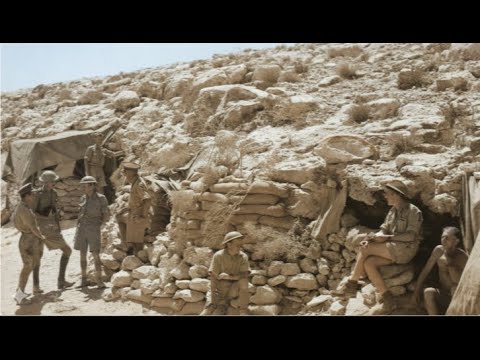
As the main Allied army retreated eastward, the task of holding this vital fortress was handed to the newly formed Australian 9th Division, supported by elements of the 7th Division and a smattering of British and Indian units. Most of these diggers were volunteers—ordinary men from the farms and suburbs of Australia who had never seen a German tank, let alone faced the most feared general in the world. Their orders were as simple as they were suicidal: Hold Tobruk at all costs to buy time for the rest of the army to regroup.
By April 10th, 1941, the trap was sprung. Rommel’s Panzers successfully bypassed the town, cutting off the coastal road and encircling Tobruk from the landward side. The garrison was trapped with their backs to the sea and the desert in front of them crawling with German and Italian steel. The world watched with bated breath, expecting the fortress to crumble within days. The Nazi propaganda machine was already preparing to announce a glorious victory, mockingly referring to the defenders as rats scurrying in their holes.
But the Desert Fox had made a fatal miscalculation. He expected a demoralized enemy ready to surrender. Instead, he had cornered a breed of soldier that thrived on defiance. Behind the barbed wire and the blue line of trenches, the Australians were not cowering. They were sharpening their bayonets. The siege of Tobruk was about to begin, and it would not be a story of a quick conquest but a 242-day epic of endurance that would change the course of the Second World War forever.
As the dust settled on the initial encirclement, the men of the 9th Division found themselves inhabiting a subterranean world. The defensive line around Tobruk was not a solid wall but a series of interconnected concrete bunkers, trenches, and foxholes left behind by the Italians. To the German High Command looking down from the superior vantage points of the escarpment, the Allied defenders were invisible, hidden beneath the rocky earth to escape the relentless heat and the constant shrieking of Stuka dive bombers.
It was Lord Haw-Haw—the infamous Nazi radio propagandist William Joyce—who first coined the term that would echo through history. In his nightly broadcast aimed at demoralizing the Allied troops, he sneered at the defenders, calling them “the poor rats of Tobruk” who were caught in a trap and living like vermin in the dirt. He predicted that these Australian rats would soon be smoked out or starved into submission. It was intended to be a stinging insult, a way to strip the diggers of their dignity and portray them as a broken, cowardly force.
However, Joyce had fundamentally misunderstood the Australian character. Instead of being insulted, the men in the trenches found the nickname hilarious. With the dark, dry humor that defines the Australian soldier, they seized the insult and wore it as a badge of absolute pride. They began to refer to themselves as the Rats of Tobruk. Moreover, they even went as far as to craft makeshift medals and insignias featuring a rat, symbolizing their tenacity and their refusal to be intimidated by the polished might of the Wehrmacht.
To be a rat meant you were tough enough to survive where others perished. It meant you were the grit in the gears of the German war machine. This psychological transformation was backed by a brutal physical reality: the Red Line. This was the outer perimeter of the defense, a series of dug-in posts spaced several hundred yards apart. The Australians turned these positions into a lethal maze. They didn’t just sit in their holes; they perfected the art of aggressive defense. Every night, the rats would emerge from the earth, moving silently through the shadows to scout German positions, cut telephone wires, and snatch prisoners.
The Germans soon learned that the perimeter was alive. The desert, which had seemed so empty, was now filled with invisible eyes and sudden, violent ambushes. Rommel’s troops, accustomed to the sweeping, fluid movements of tank warfare, found themselves bogged down in a static nightmare of sniper fire and night raids. The Desert Fox realized that his prey was not scurrying in fear. The rats were biting back. By embracing the name meant to humiliate them, the Australians had robbed the Nazi propaganda machine of its power and signaled to the world that Tobruk would not be taken by words, nor would it be taken easily by steel.
As the siege dragged into its second month, the Australians decided that if they were to be called rats, they would behave like the most dangerous predators of the night. They initiated a style of warfare that the Germans, accustomed to the grand maneuvers of the Blitzkrieg, found utterly unnerving. It was the birth of the bush ranger tactics—a relentless aggressive patrolling system that turned the no man’s land between the lines into a graveyard for Axis confidence.
Every night, as the sun dipped below the horizon and the desert temperature plummeted, the perimeter came alive. Small groups of Australians would blacken their faces with burnt cork, wrap their boots in sacking to muffle their footsteps, and slip over the parapets. These weren’t large-scale assaults. They were surgical, terrifying raids. They moved with the stealth of ghosts across the moonlit rock, armed with grenades, bayonets, and Thompson submachine guns. Their goal was simple: to ensure that no German or Italian soldier within five miles of Tobruk ever felt safe enough to sleep.
The rats would crawl hundreds of yards on their bellies to find a German listening post or a machine gun nest. In the dead of night, they would strike with explosive violence, clearing trenches in minutes before vanishing back into the darkness. They weren’t just killing soldiers. They were scrounging, stealing vital equipment, sabotaging vehicles, and capturing prisoners for intelligence. One legendary patrol even managed to sneak into a German officer’s mess, stealing their dinner and leaving a polite note of thanks behind.
This constant psychological pressure took a heavy toll on Rommel’s troops. German diaries from the period describe the Australians as primitive and savage, expressing a genuine fear of the silent figures who seemed to emerge from the very sand itself. The German infantry began to suffer from “Tobruk nerves,” a state of constant high alert and exhaustion. They were forced to double their sentries and pull their front line posts further back, effectively ceding control of the night to the Australians.
Rommel, the Desert Fox, was furious. His sophisticated radio interceptions and aerial reconnaissance meant nothing against a man with a bayonet in a dark trench. The Australians had turned the siege on its head. They were the ones who were surrounded, yet they were the ones dictating the tempo of the fight. By dominating the night, the rats proved that the desert belonged not to the side with the most tanks, but to the side with the most iron will. They weren’t just defending a port; they were hunting an army, one midnight raid at a time.
By mid-April 1941, Erwin Rommel’s patience had evaporated. The Desert Fox was used to shattering Allied lines in a matter of hours, not being held at bay for weeks by a band of rats in a dusty port. He decided it was time to unleash the full terrifying weight of the Blitzkrieg. On the night of April 13th, under a pale moon, Rommel launched his most ambitious assault yet: the Easter Battle. His plan was a classic German pincer movement, utilizing the 5th Light Division and a massive phalanx of panzer tanks to punch through the southern perimeter and drive straight to the heart of Tobruk.
The German tanks thundered across the desert floor, their engines a low, menacing growl that shook the earth. They expected the Australian infantry to scatter in terror as almost every other army in Europe had done when faced with the sight of a panzer division. But the rats had developed a revolutionary and incredibly brave tactic to counter the steel tide. The order was simple, but demanded nerves of steel: Stay in your holes, let the tanks pass.
As the panzers reached the Australian wire, they were met not by a retreating rabble, but by a haunting silence. The diggers hunkered down in their deep, narrow foxholes, allowing the massive tanks to roll right over them. To the German tank commanders, it seemed as if the defense had vanished. But the moment the tanks passed the first line of trenches, the Australians sprang into action. They emerged from the ground like ghosts and opened up a devastating wall of fire on the German infantry following the tanks. By separating the tanks from their supporting infantry, the Australians had rendered the Blitzkrieg toothless.
While the Panzers were busy searching for targets further inland, they suddenly realized they were alone. Cut off from their supply trucks and their foot soldiers, the Australian anti-tank gunners, who had remained hidden until the very last second, then opened fire on the exposed rear and sides of the Panzers. The impenetrable German formation became a chaotic mess of burning steel and trapped soldiers. For the first time in the Second World War, the German army’s lightning war had been stopped dead in its tracks.
Rommel watched in disbelief as his elite units were decimated. One German survivor later wrote that the Australians fought with a fanatical determination that defied military logic. By the time the sun rose over the smoking wrecks of the Easter battle, the myth of German invincibility had been shattered. The Desert Fox had finally met his match, and he had tasted his first true defeat at the hands of men who refused to be afraid of a tank.
Survival in Tobruk was not merely a matter of dodging bullets. It was a grueling endurance test against a hostile environment that seemed intent on breaking the human spirit. The rats lived in a subterranean world of heat, dust, and deprivation. Water was more precious than gold, strictly rationed to about a pint a day for washing, shaving, and drinking. This water was often brackish, tasting of salt and petrol, making the morning brew of tea a grim necessity rather than a pleasure.
The diet was a repetitive cycle of bully beef, canned corned beef, and hard biscuits that were so tough they often had to be smashed with a hammer or soaked for hours to be edible. In the blistering midday heat, the temperature inside the tin-roof dugouts could soar to over 50°C. Every surface was covered in a fine, pervasive red dust that got into the eyes, the lungs, and every morsel of food. Then there were the flies—millions of them—swarming over everything, making it a constant struggle to eat a meal without swallowing a dozen insects.
At night, the desert offered no respite as the temperature plummeted, and the men shivered in their thin tropical gear while enduring the “Tobruk Symphony,” the relentless nightly anti-aircraft bombardment by the Luftwaffe’s Stuka dive bombers and heavy Bardia Bill long-range artillery. Yet amidst this living hell, the Australian spirit did not just survive—it flourished with a defiant, irreverent humor.
The diggers refused to let the misery of the siege dampen their wit. They established their own underground newspaper, the Tobruk Truth, affectionately known as the Dinkum Oil, which featured satirical cartoons mocking both Hitler and their own high command. When they weren’t on patrol, they organized louse races, betting their meager cigarette rations on which body louse could cross a tin plate the fastest. They played cricket in the dust using makeshift bats carved from packing crates, pausing only when the whistle blew for an incoming air raid.
This mateship and dark humor were the ultimate psychological armor. To the Germans, who viewed war with a rigid professional seriousness, the sound of laughter coming from the Australian trenches was incomprehensible. It was a form of psychological warfare. By refusing to take the Desert Fox or their own suffering seriously, the rats robbed the siege of its power to demoralize them. They turned their burrows into homes, decorating the walls of their caves with pin-ups and souvenirs stolen from German lines. They were dirty, thirsty, and exhausted, but they were never beaten. Their ability to find a joke in the heart of a sandstorm or a song during a bombardment was the secret weapon that kept the perimeter of Tobruk unbroken for 242 days.
While the rats held the line on land, they were acutely aware that their survival hung by a single, fraying thread: the sea. With the desert road blocked by Axis steel, every bullet, every bandage, and every drop of brackish water had to be brought in through the Mediterranean. This was the domain of the “Scrap Iron Flotilla,” a group of aging Australian destroyers—the Stuart, Vampire, Vendetta, Voyager, and Waterhen—so named by German propaganda because they were supposedly a load of scrap iron past their prime. But these rusted veterans, along with the British Mediterranean Fleet, were about to prove that a ship is only as old as the courage of its crew.
The Tobruk Ferry Service, as the sailors called it, was perhaps the most dangerous naval mission of the war. To avoid the deadly attention of the Luftwaffe’s Junkers and Italian torpedo bombers, the ships had to time their arrivals with precision. They would depart Alexandria under the cover of darkness, racing at full steam across the “bomb alley” of the Mediterranean. They had to enter Tobruk Harbor, unload hundreds of tons of supplies, embark wounded soldiers or prisoners, and clear the harbor before the first light of dawn revealed their positions to the enemy pilots.
The harbor itself was a graveyard of sunken masts and half-submerged hulls, making navigation in the dark a harrowing task. There were no pier lights, no tugs, and often no silence. The Germans would drop flares that turned night into day, followed by a rain of high explosives. Yet, night after night, the scrap iron ships surged into the harbor. They brought in the 25-pounder shells that kept Rommel’s Panzers at bay and took away the men whose bodies were broken, but whose spirits remained intact.
The cost was devastating. The Mediterranean became a sea of fire as ships were hounded by Stukas and U-boats. The HMAS Waterhen became the first Australian warship lost in the conflict, followed by many others who dared the run. But the sailors never faltered. They knew that if they stopped, the rats would starve. There was a unique bond between the grimy, dust-covered infantrymen and the salt-caked sailors. The infantrymen would stand on the docks under fire to cheer the arriving destroyers, and the sailors would toss bags of fresh fruit or real bread—precious luxuries—to the men in the trenches. This lifeline was the reason the siege failed to strangle Tobruk. For 242 days, the scrap iron flotilla defied the Desert Fox and the Luftwaffe, proving that the British and Australian naval tradition was far from being scrap. They turned the Mediterranean into a bridge of iron, ensuring that as long as there was a ship willing to sail, the fortress of Tobruk would never fall.
By November 1941, the siege of Tobruk had become a symbol of defiance that resonated across the globe. For 242 grueling days, the rats had held their ground, turning a minor port into a monumental roadblock for the Axis powers. While the German propaganda machine had predicted a swift collapse, the reality was a humiliating stalemate for Rommel. The Desert Fox had been forced to divert his most elite divisions, vast quantities of fuel, and the lion’s share of his air support just to keep the rats contained. This was energy and equipment that should have been used to drive into the heart of Egypt. Instead, it was being wasted against the unyielding Australian perimeter.
The turning point finally arrived with Operation Crusader, a massive Allied offensive launched by the British Eighth Army to relieve the besieged garrison. As the armored forces of the Allies surged across the desert from the east, the rats inside Tobruk did not simply wait to be rescued. In a final act of characteristic aggression, they launched a massive breakout attempt to meet their liberators halfway. On the night of November 21st, the Australians and their British comrades stormed out of their trenches, capturing several key ridges and pinning down German units that were now caught between two fires.
The fighting was some of the most chaotic and desperate of the North African campaign. In the swirling dust of the desert, tanks and infantry clashed in a confused melee of steel and fire. But the spirit of the rats was unbreakable. By December 1941, the German and Italian forces, exhausted and fearing encirclement themselves, were forced to abandon the siege and retreat westward. The road to Egypt was safe, and the myth of Rommel’s invincibility lay buried in the red dust of Tobruk.
The relief of the garrison was a moment of profound strategic significance. Tobruk was the first major defeat suffered by the German army on land during World War II. It proved that the Blitzkrieg could be stopped by a determined infantry force that refused to be intimidated by tanks or air superiority. The 242-day siege had successfully blunted the Axis spearhead, buying the Allies nearly a year of precious time to build up their strength for the eventual victory at El Alamein.
As the Australians were gradually relieved by Polish and British troops, they marched out of the fortress not as a defeated rabble, but as legends. They were gaunt, their skin was leathery from the sun, and their uniforms were rags. But their eyes held the steady gaze of men who had stared down the Desert Fox and won. The rats had done more than just hold a port. They had shifted the momentum of the entire war in North Africa. They had proven that even in the most desolate corners of the world, courage and mateship were more powerful than any empire’s ambition.
The dust of Tobruk has long since settled, and the sirens of the Stuka dive bombers have been silent for over 80 years. Yet, the legend of the rats remains a cornerstone of the Australian national identity. The 242-day siege was more than just a successful military operation. It was the crucible in which the modern Australian military spirit was forged. When the 9th Division finally sailed away from the desert port, they left behind a legacy that would inspire generations of soldiers and civilians alike, proving that the value of a fighting force is measured not by its equipment, but by its character.
Today, the term “Rats of Tobruk” is a title of ultimate honor. What began as a Nazi insult has become a worldwide symbol of resilience. The rats taught the world a vital lesson: that even the most advanced military machine can be halted by the three M’s—mateship, mastery of the environment, and moral courage. Their story is a reminder that in the face of overwhelming odds, a sense of humor and a bond with one’s comrades can be as effective as a thousand tanks. The mateship displayed in those rat-infested trenches, the willingness to sacrifice everything for the man standing next to you, is now recognized as the gold standard of the Australian soldier.
The strategic impact of their stand cannot be overstated. By denying Rommel the port of Tobruk during the critical months of 1941, the Australians and their allied brothers-in-arms effectively saved the Middle East. They broke the momentum of the Axis advance and gave the Allies the psychological boost they desperately needed during the war’s darkest hour. The veterans of Tobruk returned home to defend Australia against the encroaching threat in the Pacific, bringing with them the hard-won expertise of veteran combat. They were no longer just volunteers; they were the invincibles who had looked the Desert Fox in the eye and seen him blink.
Across Australia, memorials to the Rats of Tobruk stand in parks and town squares, usually featuring a simple, stoic rat. But perhaps the most moving tribute is the Tobruk Memorial in Canberra, which contains a stone from the original fortress. These monuments are not just about the past; they are a challenge to the future. They remind us that when a person is called a rat or vermin by those who seek to oppress them, the greatest response is to thrive, to fight back, and to turn that insult into a victory.
As the last of the original rats pass into history, their story remains as vibrant as ever. They were ordinary men who did extraordinary things in a place that seemed forgotten by God. They proved that a rat in a hole, armed with nothing but a rifle and a joke, could change the course of history. The fortress of Tobruk may have been made of concrete and wire, but its true strength was the iron will of the men who defended it. Their legacy is an eternal lesson in courage: that no matter how dark the night or how fierce the foe, a light that refuses to go out can never be truly defeated.
So, when the world tries to bury you with labels, will you scurry—or will you sharpen your bayonet and rewrite history?
Report this article
Select a reason for reporting:






