On the 2nd of October 1919, a group of soldiers crossed the war-shattered fields of the Somme in search of the dead. Over the next days, weeks, and months, they uncovered more than 1,000 of the fallen. One man for every single yard of ground. But just why was this area so bloody? What happened here during four years of fighting?
This is the story of a single patch of ground—a grid square on a trench map, barely a few hundred yards wide—where the entire war was written in blood and mud.
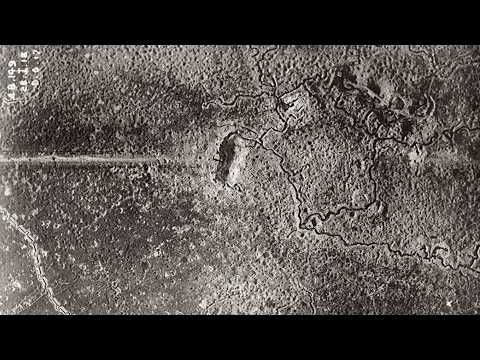
To understand, we must first zoom in on that square. It lies near the village of Thiepval, a place that before the war was home to 300 people, with a church, a café, a baker, a butcher, and a 13th-century chateau. It was peaceful, unremarkable. But when war came, its position overlooking the River Ancre made it a fortress.
The Germans arrived first, turning houses into billets and fields into a labyrinth of trenches. The front line ran along the edge of Thiepval Wood, and between the opposing lines lay no man’s land—sometimes only 85 yards wide. For a time, the Somme was considered a quiet sector. That would not last.
By 1916, the British had taken over, and plans for a massive offensive were underway. On the 1st of July, the Ulster Division attacked from these very fields. They made good progress at first, capturing the formidable Schwaben Redoubt. But the village itself remained in German hands, and by the next dawn, the Ulstermen had suffered 5,000 casualties in a single day.
For four more months, the fighting raged. The battlefield turned into a sea of mud and shell holes. One veteran recalled: “We took over this trench somewhere near Thiepval, and it was full of dead Germans. Some were sitting on the steps of these deep dugouts, some lying on the trench floor. They were all bloated, different colors, pallid gray, green, black.” It was a horror that defied imagination.
By late September, the village was finally taken, but the war moved on. In 1917, the Germans withdrew to the Hindenburg Line, and for a brief moment, Square 25 was quiet. But in March 1918, the Spring Offensive brought them back, and the fighting resumed. It was only in August 1918, with the Allied Hundred Days Offensive, that the area was finally liberated.
When the war ended, the task of recovering the dead began. Graves Registration Units scoured the fields, but many bodies were never found. Today, the fields still give up their secrets—each spring, farmers plow up unexploded shells, bullets, and bones. And at the Thiepval Memorial, 72,000 names of the missing bear witness to the cost.
But this is only the beginning. The story of Square 25 is a story of four years of war in one field—and it is far from over.
To truly grasp what happened here, we must first understand the ground itself. Before the war, Square 25 was a patchwork of small fields, hedgerows, and a few scattered orchards. The village of Thiepval sat on a ridge, its houses clustered around the church and chateau, with the wooded slopes of Thiepval Wood dropping down to the Ancre river valley to the north.
From a military perspective, it was perfect defensive terrain. The Germans recognized this immediately. They dug in deep—literally. Their trenches here were not mere scratches in the earth but fortified works, some with concrete-lined dugouts thirty feet below ground, capable of sheltering entire companies from artillery bombardment.
The British, when they arrived, found themselves staring across no man’s land at a fortress. And yet, for much of 1915, the sector remained relatively quiet. Both sides were content to let the other bleed elsewhere. But the quiet was an illusion. It was the calm before the storm.
When the British planned their great offensive for 1916, Square 25 was chosen as one of the focal points. The objective was simple: break through the German lines and roll up the flank. The reality was anything but simple.
The artillery bombardment that preceded the attack was supposed to destroy the German defenses. Over a million shells were fired in seven days. The village was reduced to rubble, the chateau to a mound of dust. But the Germans had dug deep, and when the guns finally fell silent, they emerged from their shelters, machine guns ready.
On the 1st of July, the Ulster Division advanced from Thiepval Wood. They were met with a hail of fire. Some units managed to reach the German lines, but they were cut off, surrounded, and eventually forced back. By nightfall, thousands lay dead or wounded in the fields of Square 25.
The battle would continue for months, a grinding, attritional struggle that chewed up men and matériel with equal ferocity. The landscape itself became a weapon—shell holes filled with water, trenches collapsed into mud, and everywhere the stench of death.
By the time the Somme offensive ended in November, Square 25 was a wasteland. The village was gone. The wood was gone. All that remained were the trenches, now half-filled with debris, and the bodies of the fallen, many never to be found.
But the story of Square 25 does not end with the armistice. In the years that followed, the battlefield became a place of pilgrimage and mourning. Families from across Britain and the Empire traveled to the Somme, hoping to find the graves of their loved ones. Most found nothing but a name on a memorial.
The Thiepval Memorial, designed by Sir Edwin Lutyens, was inaugurated in 1932. It stands on the site of the old chateau, a massive arch of brick and stone that dominates the landscape for miles around. Beneath it, a cemetery holds the graves of 300 British and French soldiers, while the memorial itself bears the names of 72,000 men who have no known grave.
For decades, the fields around Thiepval returned to agriculture. Farmers plowed the land, planted crops, and tried to forget. But the earth remembered. Every spring, the iron harvest brought forth the debris of war—shells, shrapnel, barbed wire, and sometimes bones.
In the 1990s, a new generation of historians and archaeologists began to take a closer interest in the Somme. They used new technologies—aerial photography, ground-penetrating radar, and LiDAR—to map the old trenches and uncover the secrets of the battlefield.
What they found was astonishing. Beneath the peaceful fields of Square 25, the trench system was still there, preserved in the chalk subsoil like a ghostly blueprint. The LiDAR scans revealed every traverse, every dugout, every communication trench, exactly as they had been in 1916.
Archaeologists also began to excavate. In 2003, a team from the University of Glasgow opened a trench near the site of the old German front line. They found the remains of three soldiers, still wearing their boots and equipment. One was identified by his identity disc as a private from the Royal Sussex Regiment, killed on the 1st of July 1916.
He was buried with full military honors in the nearby cemetery at Connaught, his name finally added to a headstone after nearly ninety years.
But for every soldier found, there are thousands more who remain missing. The Somme still holds its dead, and Square 25 is no exception. The body density maps from 1919 suggested that more than a thousand men were recovered from this single grid square, but the true number will never be known.
Today, Square 25 is a quiet place. The fields are green, the wood has regrown, and the village of Thiepval has been rebuilt. But if you stand at the edge of the wood and look across the fields, you can still see the faint outlines of the old trenches—a slight dip here, a ridge there—reminders of the men who fought and died in this small patch of ground.
The war in Square 25 is over. But its legacy lives on, in the names on the memorial, in the bones beneath the fields, and in the stories that refuse to be forgotten.
The story of Square 25 is not just one of battles and bodies, but of memory. In the century since the guns fell silent, each generation has found its own way to reckon with this ground. The veterans came first, walking the old trenches with maps in hand, pointing out where friends had fallen. Then came the historians, the archaeologists, the curious. And now, the farmers still plow, the tourists still visit, and the earth still yields its grim harvest.
But perhaps the most haunting discovery came not from a shovel or a scanner, but from a simple pencil mark on an old trench map. In 1919, someone—possibly Colonel Messer—scribbled numbers in the corners of Square 25: 150, 513, 125, 463. If those numbers represent bodies recovered from marked graves alone, it means an average of 1.2 men per yard of ground. And that is only the beginning, for the unmarked graves, the vanished, the pulverized—they are uncounted.
One report from October 1919 tells of the 148th Labour Company recovering fifteen bodies in a single day. Twelve remained unidentified. Three had no cross on their grave. They were simply found, lying where they fell, and then buried as unknowns. “No cross found on the grave,” the report states, as if that were the most ordinary thing in the world.
Decades later, in January 1938, another report surfaced—two more bodies recovered from the Somme. One was identified by his identity disc and shoulder titles: Private C. Martin, 1st Battalion Hertfordshire Regiment. He was thirty years old, killed in the Battle of the Ancre, his remains lost for over two decades. The report gives a precise reference: 57 D R 25 B 1575. By returning to the maps, we can find the exact spot—15% along from the bottom of the square, 75% up—where Private Martin was finally found. He was lucky. Most were never identified.
Today, the Thiepval Memorial bears 72,000 names of the British missing. It stands on the site of the old chateau, a massive arch of brick and stone that dominates the landscape. Beneath it, a cemetery holds 300 graves. But the fields around it still whisper of the thousands who were never found.
So what does Square 25 teach us? It teaches that war is not abstract. It is not a line on a map or a date in a history book. It is a single field, a single trench, a single man—and then another, and another, until the numbers become incomprehensible. It teaches that the past is never truly buried. The iron harvest still comes each spring. The bones still surface. The names still wait to be read.
And it teaches that memory is a fragile thing. The trench maps are fading, the veterans are gone, the fields are green again. But if we stop looking, if we stop remembering, then Square 25 becomes just a field—and the men who died there become just numbers.
So the next time you stand in a quiet field, ask yourself: what lies beneath? What stories are waiting to be told? And what will you do to remember?
Report this article
Select a reason for reporting:






