The morning of October 9, 1943, dawned cold and gray over the English countryside. At 3:00 a.m., thousands of American airmen were shaken awake. They stumbled into the darkness, not yet knowing their target, only that they were about to fly into the heart of Nazi Germany. This was no Hollywood set. This was the real thing—a daylight bombing raid so audacious, so dangerous, that it would go down in history as one of the most critical missions of World War II.
This is the story of that mission, told through the lens of a groundbreaking documentary called Target for Today. Filmed with unprecedented access to every level of the operation, it captures the raw, unfiltered reality of the air war over Europe. From the tense briefing rooms to the deafening roar of B-17 Flying Fortresses and B-24 Liberators, you are about to experience the war exactly as these men did.
The stakes could not have been higher. The target: the Focke-Wulf 190 assembly plant at Marienburg, deep in East Prussia—a facility responsible for nearly half of Germany’s fighter production. If the bombers could destroy it, they would deal a crippling blow to the Luftwaffe. But to get there, they would have to fly hundreds of miles over enemy territory, through swarms of German fighters and walls of anti-aircraft fire.
“Men, the going’s going to be rough,” the group commander warned his crews. “You’re going to have to blow your neck in there and stay in there and pitch every minute.” The men listened in silence. Many were veterans of multiple missions; others were about to fly their first. All knew the odds.
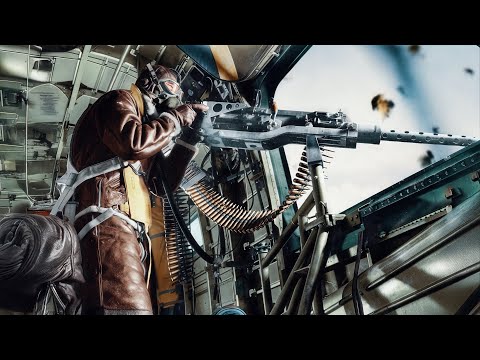
At 10:30 a.m., the formation crossed the Danish coast. Almost immediately, the intercom crackled with warnings. “Enemy fighters at 7 o’clock high!” The sky erupted in chaos. FW 190s and ME 109s dove through the formation, guns blazing. The gunners aboard the Fortresses fired back, their .50-caliber machine guns chattering in short, deadly bursts. “Scratch one heavy 109!” a gunner shouted as an enemy fighter exploded in flames.
But the German pilots were determined. They pressed their attacks from every angle, using rockets and cannons. The air filled with smoke and falling debris. “They came from all over the place,” one crewman later recalled. “They were really trying to shoot us down.” For nearly three hours, the battle raged. The bombers held their formation, fighting off wave after wave of attackers.
Finally, the lead navigator announced the initial point. The bomb bay doors opened, and the bombardier took aim. “Bombs away!” The payload dropped, hurtling toward the factory below. In that moment, the entire mission—the months of planning, the thousands of man-hours, the lives risked—hung on a few seconds of precision.
As the bombers turned for home, the crews could only hope their bombs had found their mark. Behind them, smoke rose from the target area. But the battle was not over. The Germans would not let them leave without a fight. And for the men of the Eighth Air Force, the longest day was far from finished.
The return leg was often the deadliest part of any mission. The bombers were low on ammunition, their formations ragged from the fight, and the German pilots knew it. “Here they come again,” the tail gunner called out, his voice flat with exhaustion. “Three o’clock level, twin-engine.” The ME 110s stayed just out of range, lobbing rockets into the loose formations where the Fortresses had lost their protective stacking.
On the flight deck of the lead ship, the pilot wiped sweat from his forehead and checked his watch. They had been over enemy airspace for nearly five hours. The fuel gauges were edging toward the red. “Navigator, give me a heading for the coast,” he said quietly. “We’re not going to make it home if we don’t cut this corner.” The navigator bent over his charts, his hands still shaking from the cold and the adrenaline.
Behind them, one of the low squadron’s ships had taken a direct hit to its number two engine. It was trailing black smoke, falling out of formation. The crew watched in grim silence as the pilot fought to hold altitude, then as the plane began a slow, wobbling descent toward the North Sea. “Two dinghies,” someone reported. “I see men getting out. Ten of them.” The radio operator was already transmitting coordinates, his Morse key tapping out the position over and over.
By the time the first ships of the formation sighted the English coast, the sun was beginning its long slide toward evening. The fields below were green and peaceful, an almost obscene contrast to the world they had just left. “Fighters, twelve o’clock high,” came the call—and then, a heartbeat later, relief: “They’re ours. P-47s. They’re ours.” The Thunderbolts swept past in a tight formation, waggling their wings in greeting, then took up position to shepherd the battered bombers home.
At the control tower, the men who had stayed behind had been waiting for hours. Every engine heard in the distance drew heads upward. “There they are,” someone breathed. The first Fortress touched down with a squeal of tires and a puff of blue smoke, its fuselage stitched with flak holes, one wingtip missing a few inches of its surface. Then another. And another. The ground crews counted them in, their faces tight with worry, tallying the empty spaces in the formation.
Eighteen dispatched. Eighteen returned. The men of that group would count themselves lucky—lucky in a way that felt almost obscene, because the group flying to Danzig had not been so fortunate. “Twenty dispatched, ten returned,” the report read. The words were spoken without inflection, but they landed like a punch to the gut of every man in the operations room.
And the day was not yet over. The wounded had to be carried from their ships. The dead had to be accounted for. The survivors, still trembling from cold and fear, climbed down from their aircraft and were handed cups of coffee that they could barely hold. “Get them to interrogation,” an officer ordered. “While it’s still fresh. Every detail matters.”
Inside the interrogation room, a young lieutenant from the Anklam force sat across from an intelligence officer, his hands wrapped around a steaming mug. “They first jumped us just off the Danish coast,” he said. “Stayed with us all the way to the target and back. I stopped counting at fifty.” The intelligence officer wrote it all down—the tactics, the markings, the rockets, the way the German pilots had pressed their attacks with a ferocity that bordered on desperation.
Outside, the light was fading. Mechanics swarmed over the returning bombers, patching holes and swapping out damaged engines, already preparing for tomorrow. Because there would be a tomorrow. There was always another mission, another target, another formation to be assembled before dawn.
In the darkened photo lab, the strike photos were already coming up in the developing trays. A photo interpreter hunched over the wet prints with a magnifying glass, his cigarette burning unnoticed in the ashtray beside him. “Look at this,” he said, tapping a print with his finger. “The assembly sheds—gone. Every one of them. That’s the Focke-Wulf line finished.” The men around the table leaned in, and for a moment the exhaustion of the day lifted.
But the numbers on the mission report told a harder story. Twenty dispatched, ten returned. The cost of that single raid was written in empty bunks and unclaimed letters, in the quiet corners of the mess hall where men ate alone. And yet the orders for the next day were already being cut.
The following morning, the crews were roused again at three. The same stumble through the dark, the same powdered eggs, the same ritual of turning in personal papers and escape kits. But something had changed in the men who had flown the day before. They spoke less. They watched the sky more.
At the briefing, the intelligence officer pulled the canvas cover from the target map, and a low murmur ran through the room. Not Germany this time. The red string ran south, down through France, to a cluster of low buildings nestled in a river bend. “Your target for today is the ball bearing plant at Schweinfurt,” he said. “Every anti-friction bearing the German war machine uses begins here. Tanks, aircraft, guns—all of it. If we knock it out, we cripple their production for months.”
A pilot in the front row raised his hand. “Sir, what about fighter cover?” The intelligence officer hesitated. “The range is too great. The P-47s can take you as far as the Belgian border. After that, you’re on your own.” The silence that followed was heavier than any briefing room had known.
Outside, the ground crews worked with a desperation that bordered on fury. The mechanics who had patched the ships overnight had done miracles, but miracles had limits. One crew chief, a wiry sergeant from Texas, ran his hand along a patched wing and swore softly. “She’ll fly,” he said. “But I wouldn’t want to take her into a fight.”
The takeoff was ragged. Ships that had flown the day before coughed and sputtered, engines refusing to catch in the cold morning air. By the time the formation assembled over the field, three ships had already turned back, their crews staring straight ahead in silent fury at the mechanical failures that would keep them on the ground.
The flight south was quiet at first—too quiet. The men scanned the skies, waiting for the first dark specks on the horizon. Then, just past the Belgian coast, the call came. “Fighters, twelve o’clock high! Count them—thirty, forty, more than fifty!”
The first pass came from the front, a wall of FW 190s tearing through the formation with guns blazing. The Fortresses shuddered under the impact. A ship in the low squadron caught fire, its wing folding upward like a broken bird before it spun away, trailing smoke. No one saw any parachutes.
The battle over Schweinfurt lasted more than an hour. The German pilots, knowing exactly what was at stake, threw everything they had at the bombers. “They’re coming from every direction,” a gunner screamed over the intercom. “I can’t keep up—there’s too many!” The Fortresses held their formation, but the cost was mounting with every pass.
By the time the bombers reached the target, the sky around them was littered with falling aircraft. “Bombs away,” the lead bombardier called, his voice hollow. Below, the ball bearing plant erupted in a chain of explosions that could be felt at bombing altitude. The crews watched the smoke rise, knowing they had struck a blow—but at what price?
The return flight was a gauntlet of fire. German fighters pursued them all the way to the coast, and the crews who survived would later speak of it only in fragments. “Twenty dispatched, ten returned,” the operations officer read aloud that evening, his voice barely a whisper. The room was silent.
But the photographs developed that night told a different story. The ball bearing plant at Schweinfurt was destroyed—every building, every machine, every line. The German war machine had lost one of its most vital organs. “It was the greatest example of precision bombing on record,” General Arnold would later say.
The men who flew that day knew the truth: victory and loss were inseparable. They had paid for that photograph with friends, with years of their lives, with the quiet certainty that they would do it again tomorrow.
So here is the question that remains, more than eighty years later: when the price of victory is written in the empty bunks of young men, how do we measure what was truly won—and what was lost?
Report this article
Select a reason for reporting:






