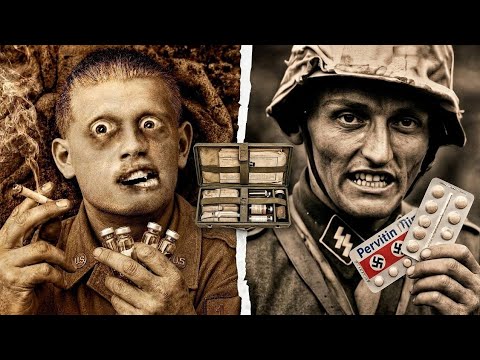
In April 1940, 35 million pills slipped through the gates of German factories and into the backpacks of Wehrmacht soldiers. Within weeks, those same men would cross the Ardennes forest without sleep for three days straight, storm across rivers under heavy fire, and seize French cities in hours. The world watched in disbelief. Allied generals were baffled. French Prime Minister Édouard Daladier screamed into the phone that his commanders must be wrong—it was impossible for the Germans to be 80 kilometers from Paris. It wasn’t willpower. It wasn’t tactical genius. It was chemistry.
What official history took decades to admit is that World War II was the first conflict in human history where an entire army was systematically doped. And that’s just the beginning. The story doesn’t end with amphetamines in the pockets of Panzer soldiers. It ends in concrete bunkers beneath Berlin, in concentration camps where the German navy tested pure cocaine on prisoners, and in CIA laboratories that inherited Nazi experiments and perfected them for decades. This is the story of how drugs didn’t just accompany the most destructive war in history—at decisive moments, they defined it. And it’s worse than you think.
Before we dive in, I want to show you something special. Over the past few months, we’ve been working on a collection dedicated exclusively to one of the most impressive episodes of the conflict: the Battle of Berlin in 1945. We’ve gathered more than 200 historical photographs, unpublished or rarely seen, organized in a photographic collection that lets you visually retrace the last days of the Third Reich. These aren’t the same images that appear over and over in documentaries. We’ve searched for lesser-known photographs showing the streets of Berlin, soldiers, vehicles, destroyed buildings, and scenes captured during those decisive days in 1945.
The Berlin Johannisthal factory. In the southeast of Berlin, where today a technology park stands with bright names on the facades, the rusty remnants of what was once the Temmler factory remain. Brick walls crumble among ferns. The rotten wood of the so-called witches’ house, the original home of founder Theodor Temmler, still stands among older bushes. There is no plaque explaining what occurred here.
The Temmler factory settled in Adlershof in 1933, the same year the National Socialists came to power. A year later, Albert Mendel, the Jewish co-owner of the chemical company in Tempelhof, was expropriated by the regime’s racial laws. Temmler absorbed his share and expanded the business. It was a prosperous time for the German chemical industry—at least for its Aryan members. New substances to alleviate the pains of modern humanity were relentlessly researched.
In 1938, Temmler’s pharmacologist Fritz Hauschild presented results on a molecule that had been under development since 1887, when Japanese chemist Nagai Nagayoshi isolated ephedrine from the ma huang plant. Hauschild had synthesized methamphetamine in pill form. They branded it Pervitin.
The pill first arrived in pharmacies. German families took it with their morning coffee. Housewives going through menopause swallowed it like candy, according to medical records of the time. Young mothers used it to combat postpartum depression. University students consumed it massively before exams. In Munich, a university hall had to be set up exclusively for cases of student overdose—the so-called Pervitin corpses who slept off the intoxication until recovering. Women seeking partners through matchmaking agencies took high doses to overcome inhibitions before first encounters.
But where Pervitin would find its true market was not among Berlin’s housewives. It was in the military.
In the neo-baroque building of the Military Medical Academy on Invalidenstraße in Berlin, where the Federal Ministry for Economic Affairs and Energy sits today, a slender dark-eyed scientist in the spring of 1938 was reading an article by pharmacologist Hauschild in the journal Klinische Wochenschrift. The man’s name was Otto F. Ranke. He was 38 years old and director of the Army’s Research Institute of Defense Physiology.
Ranke had an enemy. It was not the Russians, nor the French, nor the British. It was fatigue.
The physiologist saw in Pervitin something no one else in military spheres had yet considered: a non-ballistic weapon. He organized experiments with 90 medical officers at first, then 150. He divided them into four groups: those who received Pervitin, those who received caffeine, those who received Benzedrine, and those who took placebos. He subjected them to mathematical and logic problems throughout the night. At 4:00 in the morning, the men in the placebo group had their heads on their desks. Those in the Pervitin group were still solving calculations, fresh physically and mentally active, the experiment documents record. Even after more than 10 hours of sustained concentration, they said they felt like keeping the party going.
The results had nuances Ranke chose to ignore. Pervitin did not make the subjects smarter. The quick calculations contained more errors. High-concentration tasks did not improve. But it kept them awake. For Ranke, that was enough. In his own words, without a trace of cynicism: “An excellent substance to awaken a tired unit, a material of high military value.”
Ranke requested that tests be conducted in regular units. The bureaucracy ignored him. While the Army was still debating whether it was better to give white bread or whole grain bread to soldiers, Ranke was already thinking about brain food. He continued working alone. And he took the Pervitin himself.
In his war diary, preserved in the Bundesarchiv Militärarchiv in Freiburg, Ranke recorded his own doses with the same coldness with which he noted the experiments. Two Temmler tablets to relieve the stress of an ordinary work day, more when there were difficult meetings. He used it to overcome exhaustion, to improve his mood. He knew about the dangers of dependence. He ignored them.
The summer of 1939 passed. Medical officers prepared for deployment in Poland by buying Pervitin in pharmacies because it was not yet an official army supply. Ranke watched them without being able to act. Less than a week before the start of the war, he wrote to a surgeon general: “Of course, it is a double-edged sword to give the troops a medicine that cannot be restricted to emergencies.” The warnings came too late.
Poland, September 1939. On September 1st, 1939, the Wehrmacht fell upon Poland. And the medical reports that filled entire folders in the Freiburg military archive during the following months show something no official war report mentioned. The Third Panzer Division, upon crossing the Vistula heading toward Brest-Litovsk, reported: “Often there is euphoria, an increase in the attention threshold, clear intensification of performance, work is achieved without difficulty, a pronounced alertness effect and feeling of freshness. Working all day, lifting of depression, return to normal mood.”
Another report from the reconnaissance units: “All fresh and lively, excellent discipline, slight euphoria and increase in the desire for action, mental stimulation, highly excited, no accidents, prolonged effect. After taking four tablets, double vision and seeing colors.” The mild hallucinations were perceived as pleasant.
A senior lieutenant who participated in negotiations for three days and three nights in Brest-Litovsk, dividing the country between Germans and Soviets, recorded the use of methamphetamine during the talks. His accounts noted its impact on his state of alertness during the negotiations and subsequent military encounters. The medical officer of the 9th Army Corps documented his observations on the use of Pervitin within military units. These archival records from the 1939 invasion indicate that the substance was administered to personnel to maintain operations throughout the duration of missions.
However, there were critical voices within the medical ranks. The army physician of the 6th Army gathered contradictory reports and informed his superiors that Pervitin was not a harmless substance and questioned the appropriateness of its distribution to the troops. Despite these warnings, reports from other sectors such as the 4th Army Corps indicated a continued interest in the substance, concluding that more supplies were required to continue observations on its effects.
The Western Front was sleeping. From the autumn of 1939 until the spring of 1940, the French and the Germans looked at each other from their positions without firing. “We will not shoot unless you shoot first,” read the banners that the soldiers hung on the front. In the small baroque town of Zweibrücken, near the Lorraine border, German soldiers played cards, smoked their daily ration of seven cigarettes, practiced soccer, and helped with the potato harvest. But in their pockets, they carried Pervitin.
Ranke visited the positions and verified that a very large proportion of officers carried Pervitin on them. The favorable effect was confirmed by everyone consulted, both by motorized troops and by members of other units. The prophylactic preventive consumption alarmed him. The problem was no longer whether to introduce Pervitin, but how to regain control of its use.
Meanwhile, in the autumn of 1939, two generals had a decisive meeting. Erich von Manstein, 52 years old, irascible, with permanently flushed cheeks, spoke with tank general Heinz Guderian. The only chance for the Wehrmacht, they reasoned, could lie in pushing a lightning armada of tanks through the supposedly impassable forested mountains of the Belgian Ardennes, reaching the French city of Sedan in a few days, and then charging all the way to the Atlantic coast. The Allies anticipated an attack further north. A sickle cut would take them by surprise.
The German general staff shook their heads at the proposal. Von Manstein was transferred to the Baltic port of Stettin, far from the potential combat zone, so that his idea would not prosper. But on February 17th, 1940, he had a meeting with Hitler, who listened to the plan astonished and approved it immediately. The success of the operation would depend on time, speed, and the element of surprise. And to operate without sleep for several consecutive days required something more than willpower.
On April 13th, 1940, three weeks before the attack in the west, the army medical inspector Anton Voldman submitted a document to Field Marshal von Brauchitsch. Ranke was summoned for consultations, wrote a lecture for the General Staff at full speed, and drafted an instruction booklet for the Wehrmacht.
On April 17th, 1940, an unprecedented document in military history circulated among a thousand troop doctors, several hundred core doctors, and the medical heads of the SS. The so-called stimulant decree was clear in its first paragraph: “The experience of the Polish campaign has shown that in certain situations, military success was crucially influenced by overcoming fatigue in a troop from which great efforts had been demanded. Overcoming sleep can, in certain situations, be more important than the concern for any related damage if military success is threatened by sleep. Stimulants are available for the disruption of sleep. Pervitin has been methodically included in the medical equipment.”
The recommended dose: one tablet per day, at night, two tablets in rapid succession, and if necessary, another dose three or four hours later. In exceptional cases, sleep could be prevented for more than 24 hours. And an attack—was it not an exceptional case? The document was signed by the commander-in-chief of the army, Walther von Brauchitsch. The Wehrmacht was the first army in the world to officially depend on a chemical drug. Ranke, the defense physiologist addicted to Pervitin, was responsible for its regulated use.
At the Temmler factory, dozens of women workers sitting at circular machines that looked like mechanical cakes inspected with fingers gloved in pale white, the tablets that danced on conveyor belts. They could press 833,000 tablets a day. The army had placed a huge order for the army and the Luftwaffe: 35 million in total.
On May 10th, 1940 at 7:00 in the morning, Major General Alfred Jodl outlined the military situation at Hitler’s headquarters in the Felsennest near the old village of Rodert in the Eifel. During the night, German paratroopers dropped from Cologne had taken the strategically important Belgian fort of Eben Emael. It was a decoy attack. The real blow was elsewhere.
Near the Luxembourg border, Panzer Group von Kleist, the largest motorized unit ever assembled in military history, was gathering 41,410 vehicles in total, including 1,222 tanks. And they were all blocked in a 240-km traffic jam that reached all the way to the Rhine. The horse-drawn vehicles of the infantry had mixed into the lanes needed by the armor. It was the longest traffic jam in European history. The Allies could have destroyed them with a handful of bombers, but no one expected an attack there.
During the night between May 10th and 11th, when the tanks finally began to move, the massive distribution of Pervitin had already started. General Johann Adolf Graf von Kielmansegg, who in the 1960s would become commander-in-chief of NATO’s Allied Land Forces in Central Europe, requested 20,000 pills for his first Panzer division. Thousands of soldiers took the substance out of their field caps or received it from their medical officers. They placed it on their tongues and swallowed it with a sip of water. Twenty minutes later, the nerve cells in their brains began to release neurotransmitters. Dopamine and noradrenaline intensified perception and put the soldiers in a state of absolute alertness. The night lit up. An intense cold ran through their scalps. A burning sensation of cold filled them from within. Average blood pressure increased by up to 25%. Hearts thundered in the cylindrical chamber of the chest.
In Martelange, a small border community, the Belgian defenders had entrenched themselves in bunkers on a hillside. In front of them lay several hundred meters of open ground. A frontal attack was suicidal. And that was exactly what the German infantryman did, uninhibited. The Belgians, shocked by such recklessness, fell back. And instead of securing their position as military practice dictated, the completely uninhibited attackers pursued their enemies immediately.
General Guderian had ordered: “I demand that you do not sleep for at least 3 days and 3 nights if that is what is necessary.” And so it was. The Panzer division reported that they had reached the French border. Sedan was before the Germans. Many had not closed their eyes since the start of the campaign.
On the afternoon of the established day, the German artillery fired and waves of dive bombers unleashed their sirens—the so-called Jericho horns—followed by massive explosions. Windows vibrated. And in the German brains, the methamphetamine triggered charge after charge, neuronal pathways constricted, intersynaptic junctions flared. In the course of the following hours, 60,000 Germans, 22,000 vehicles, and 850 tanks crossed the river. “We felt a kind of euphoria, an exceptional state,” a participant would remember. “We were sitting in our vehicles, covered in dust, exhausted and electrified.”
The medical historian Dr. Peter Steinkamp would put it concisely decades later: “The Blitzkrieg was guided by methamphetamine, not to say that the Blitzkrieg was founded on methamphetamine.”
Erwin Rommel was not a tank expert. He came from the infantry, but it was precisely that ignorance about the steel giants and their possible movements that led him to advance in a completely unconventional way. He directed his seventh Panzer division intuitively like a shock of assault troops. On May 17th, 1940, in the early hours of the morning, Rommel, who no longer answered to any of his superiors, was racing along the road from Solre-le-Château in northern France toward Avesnes. By chance, the fifth infantry division, parts of the 18th infantry division, and the first infantry division of the French army had established their bivouac precisely there.
Rommel did not hesitate for a single second. He burst into the middle of them, crushing everything in his path, firing volleys from all sides, and for the next 10 km, he pushed hundreds of vehicles and tanks along with the dead and wounded into the ditches on both sides, advancing with blood-stained tracks, standing between two officers of his general staff in the armored command vehicle, his cap pushed back, directing the attack. Rommel did not stop. His superiors could not give him orders because by the time the written documents reached the battlefield, he was already kilometers further away and without radio contact. He did not seem to have any sense of danger—a typical symptom of excessive methamphetamine consumption.
The French did not know what to do. There were no instructions on how to defend against that. They had never practiced it in maneuvers. The historian and writer Marc Bloch, who fought for his country in May and June 1940, analyzed the collapse of the French troops as a mental defeat: “Our soldiers found obstacles too easily. They let themselves be blocked too easily because our thinking was too slow.”
General Guderian had told his men not to sleep for at least 3 days and nights. In the end, they had been awake for 17 days. A French investigation described the rapid crossing of the Meuse by the Germans and the failure of the French defense as a phénomène d’hallucination collective. In less than 100 hours, the Germans gained more territory than in more than 4 years in the First World War.
On May 20th, 1940, a courier plane from the Ministry of Propaganda landed at the Felsennest headquarters bringing the latest issue of the Wochenschau, the weekly newsreel under the instructions of Goebbels. Hitler went down the hill to the village pub, watched the newsreel three times in a row, and dictated the changes he wanted. The next day, Guderian had occupied Abbeville, an important city on the Somme. All French, British, and Belgian troops north of the sickle cut were cut off from their southern units. Only one Atlantic port remained open: Dunkirk. Guderian could block it in a few days, encircling a million Allied soldiers. The British Empire was on the brink of collapse.
That morning, Air Marshal Hermann Göring had breakfast with Hitler at the Felsennest. Göring, whose opium-addicted morphology was well known in the inner circles of the regime, had had his dose that day before leaving his bedroom. It would be the dose that changed history. Since the stomach wound he received during the assault on the Munich Feldherrnhalle in November 1923, Göring had developed a severe addiction to morphine.
That May morning of 1940, with large, glassy eyes, pupils reduced to tiny dots by the opiate, and a huge ruby brooch gleaming on his chest, Göring decided that the glorious victory over the Allies could not be left in the hands of the arrogant army chiefs. The Luftwaffe had to take the credit. The tanks had to withdraw a bit to leave the field open for the bombers. Hitler, who felt on the same wavelength as Göring in a way he never achieved with the Pervitinized generals, agreed.
At 12:45 hours on May 24th, an order was issued that still puzzles historians: the infamous Dunkirk halt order. When the British realized that the German tanks were stopping, they could not believe their luck. An unprecedented evacuation began immediately. Hundreds of rescue ships—Royal Navy destroyers, motorboats, even seized private paddle steamers and yachts, Thames barges—arrived in unceasing succession. The Allied troops crossed improvised bridges of trucks with planks on top. Guderian could only watch through his binoculars.
Göring’s plan failed from the start. His morphine-soaked brain had overestimated his own Luftwaffe. The Royal Air Force, with bases much closer, deployed its Spitfires and conquered the sky. When Guderian was finally able to enter Dunkirk on June 4th, 1940 at 9:40, he only found the equipment the British left behind: 475 tanks, huge amounts of ammunition, artillery, and 80,000 French soldiers who had not found a place on the British ships. More than 340,000 Allies had escaped. Manstein, the inventor of the sickle cut, later called it a lost victory.
The Battle of Britain began. To force the United Kingdom to surrender from the air, Göring first bombed logistic targets of the Air Force: airfields, hangars, runways, airplanes. The strategy was working. But Hitler committed a serious tactical error. He ordered the attack on London on September 4th, 1940 to demoralize its population after the British bombed the Berlin neighborhoods of Kreuzberg and Wedding. The result was that the enemy airfields were no longer the primary target and the British were able to strengthen their defenses. Soon, it was too dangerous for the Luftwaffe to operate by day.
A bomber pilot described the night situation: “The takeoff was very often late, 10:00, 11:00, and then you were over London or some other English city at 1:00 or 2:00 in the morning, and of course then you were tired. So, you took one or two Pervitin tablets, and then you were fine again. I had many night operations, you know, and of course the commander always has to keep his senses alert. So, I took Pervitin as a preventive measure.”
Among the pilots, Pervitin had nicknames that revealed its function: Pilot salt, Stuka pills, Göring’s pills. A Mediterranean commodore described its effects: “The engine runs cleanly and calmly. I am completely awake. My heart beats thunders in my ears. Why is the sky suddenly so bright? My eyes hurt under the harsh light. I can hardly stand the brightness. Everything becomes immaterial and abstract, remote, as if I were flying above my own airplane.”
In the large building of the Reich Ministry of Aviation on Wilhelmstrasse, built in blocks of pale stone, the Reich war flags with the swastika fluttered above. But inside, the conditions were of chaos, unbridled alcohol and drug abuse, intrigue, and general mismanagement. The state of Ernst Udet, the General Luftzeugmeister, or General Master of Aircraft, was the most telling. Udet, the fighter pilot with the second most victories of the First World War after the Frenchman René Fonck, served cognac during meetings and consumed methamphetamine in massive quantities to counteract the effects of the alcohol. His 22 departments were in a state of indescribable chaos. He liked to escape home, where he had a small private bar decorated with trophies from his travels around the world.
On November 17th, 1941, a note from the German news service announced that Air Marshal General Luftzeugmeister Udet suffered such a serious accident while testing a new weapon that he died of his injuries. In reality, Udet had shot a bullet into his head in his villa on Stallupöner Allee in Westend, Berlin. Next to his deathbed, he had scribbled a final message: “Iron Man, you have abandoned me.” The Battle of Britain was lost. It was the first German defeat in that war.
The most important doctor of the Second World War was never on a battlefield. He was obese, of unkempt appearance, wore a brown gabardine coat, and his name was Theodor Morell. Morell met Hitler in 1936, when the official photographer of the Reich, Heinrich Hoffmann, took him to Berchtesgaden to examine the Führer. Hitler suffered from chronic stomach pains, spasms, flatulence, general fatigue. The regular doctors of the regime had been unable to help him. Morell did. Within a few weeks of treatment with his preparation of Mutaflor, an intestinal bacterial therapy, Hitler improved notably. From that moment on, Morell became Hitler’s personal physician—his unique personal physician, as he demanded to call himself—and he began to administer substances to him.
At first, they were vitamins and glucose, then animal-derived hormones, steroids, organ extracts from cattle from the farms of Ukraine, which Morell processed in his factory expropriated from Jewish owners in Olomouc, testosterone for libido, Orchicrin, a derivative of bull testicles, as a cure for depression, Prostaqrinum, made from seminal vesicles and prostates of young bulls. By the end of 1941, Hitler’s metabolism was subjected to a bombardment of more than 80 different preparations, many of them of uncertain origin. Morell barely diagnosed. Instead, he constantly added new remedies in changing concentrations to what he called his basic medical treatment. The implicit purpose was to keep the Führer functioning at all costs, to prevent his performance from dropping at critical moments.
From the Federal Archives in Koblenz to the Institute for Contemporary History in Munich and the National Archives in Washington, D.C., Morell’s records were studied for decades. The interrogations that the Americans conducted on him for two years after the war before he was released in 1948 produced a psychiatric evaluation that defined the doctor as someone who often gets lost in meaningless trivialities when making his statements and tries to replace the obvious gaps in his memory with fictions, which frequently leads to contradictory information. Morell never fully explained the relevance of his activities.
July 18th, 1943 was a special date in the medical records of Patient A. The situation was extraordinarily tense. The Red Army had won the largest tank battle in history at Kursk, destroying all German hopes of reversing the war in Russia. At the same time, the Allies had landed in Sicily and Italy was about to change sides. Hitler had not slept for a single moment due to the imminent betrayal of the Italian army, as Morell noted: “Body tense as a board full of gas. Very pale appearance, extremely nervous. Very important discussion tomorrow with the Duce.”
In the middle of the night, Heinz Linge, Hitler’s valet, got Morell out of his bed. The Führer was bent over in pain and needed immediate relief. The cottage cheese he had eaten at dinner and the rolls with spinach and peas had disagreed with him. Morell thought feverishly. He needed something that would truly work, something that would blunt Hitler’s severe pain and keep him functioning for the crucial meeting with Mussolini at 15:30. He needed an ace up his sleeve. And in fact, he had it.
In the lower right corner of the clinical file of Patient A for the second quarter of 1943, a substance appears underlined several times: Eukodal. A drug manufactured by Merck in Darmstadt, it had entered the market as an analgesic and cough medicine in 1917 and it was so popular in the 1920s that the term Eukodalism was coined. Its active ingredient is an opioid called oxycodone, synthesized from raw opium. Providing nearly twice the pain relief of morphine, which it had replaced in popularity, this archetypal designer opioid was characterized by its potential to very quickly create a euphoric state significantly higher than that of heroin, its pharmacological cousin. The author Klaus Mann, experimental in many ways, confirmed the special status of the substance: “What I take is called Eukodal, sister Euka. It has a more pleasant effect.”
Morell debated with himself whether to use it. The time of departure for the important meeting with Mussolini was approaching. He knew that Eukodal would cheer up the Führer immediately. But he also knew that after trying it just once, the addiction-prone dictator would be very reluctant to give up this nectar of the gods after just two or three weeks of regular use. Eukodal can make a person physically dependent. Morell made the decision. He injected the new drug subcutaneously.
It was a monumental decision. The immediate transformation of Patient A in the minutes and hours after the application was so striking that no one in his surroundings could fail to notice it. Hitler suddenly seemed in such a good mood that he immediately asked for another dose. Morell initially refused, since there were still some important discussions and decisions to be made before departure. But before leaving for the airfield, he gave him a second intramuscular injection.
The reports of the American Secret Service written after the war and all eyewitness testimonies confirmed that Hitler was exalted in his meeting with Mussolini at the Villa Gaggia near Feltre. The Führer spoke for three hours without pause to his cornered fellow dictator, who did not have a single opportunity to speak, but instead sat impatiently cross-legged on the edge of a chair too large for him, frantically clutching his knee. Mussolini had planned to convince Hitler that it would be better for everyone if Italy exited the war. All he did was rub his aching back and sigh deeply while the artificial and euphoric Führer spoke endlessly about the imminent victory of the Axis. The result: Italy would remain in the war for the time being. Morell noted with self-satisfaction: “The success of the day is to my credit.”
On July 20th, 1944 at 11:14, Morell recorded: “Patient A injection as always.” In the file, the notation is X. Pharmacologically stimulated, Hitler rushed toward the ground floor building where the military meeting of that fateful day was being held. At 12:42, Colonel Claus Schenk Graf von Stauffenberg, who had arrived a bit late, shook hands with Hitler, pushed his brown briefcase under the table as close to his target as was possible. A short while later, he left the room inconspicuously. The explosion was of a brilliant white and yellow. Hitler was thrown from the center of the room to the door, covered in substance X. With the opioid system activated, the dictator was able to experience the explosion as if wrapped in cotton, feeling invulnerable like Wagner’s Siegfried.
“I was a bit dizzy and slightly dazed,” Hitler declared about the attack with a strange indifference that impressed everyone present. When Mussolini arrived on a state visit two hours later, Hitler, after receiving another injection of Eukodal, presented himself before him in freshly polished boots. With ruptured tympanic membranes, dozens of splinters in his body, bleeding from both ears, he went to the train station and waited impatiently for his colleague. Mussolini, astonished by Hitler’s apparent physical integrity, said it was a sign from heaven.
After the attack, Dr. Erwin Giesing, an ear, nose, and throat specialist from a nearby field hospital, arrived at the headquarters. Giesing described the man he found: “The face was pale, slightly swollen, and there were large dark circles under both reddened eyes. The hair was already clearly mixed with gray and quite neglected. The skin of the face was well-shaven, but somewhat withered, which I attributed to fatigue. The speech was abnormally loud and tended to scream. An aged, almost exhausted man, who had to make do with what was left of his strength.”
Giesing’s favorite remedy for treating pain in the ear, nose, and throat area was cocaine—the very substance that the Nazis loathed as a Jewish drug of degeneration. It was not as unusual as it seemed. Few alternatives for local anesthesia were available at that time. Between July 22nd and October 7th, 1944, Giesing administered the substance more than 50 times in the form of nasal and pharyngeal compresses. It was pure, first-class cocaine, the famous Merck cocaine, delivered from Berlin by mail train as a 10% cocaine solution, signed by the SS pharmacist, according to the regulations of the Reich Security Main Office.
Hitler, according to Giesing’s account, stated that with cocaine he felt considerably lighter and more carefree, and that he could also think more clearly. He asked him if this application could be done once or twice a day, even when the ear canals that needed treatment were healed. Giesing agreed. “Please do not turn me into a cocaine addict,” Hitler said in one of the sessions. Giesing replied reassuringly that a true addict snorted dry cocaine. Hitler rejoiced: “I have no intention of becoming a cocaine addict.”
On September 16th, 1944, after a dose from Giesing, Hitler had one of his famous intuitions. He ordered an offensive on the Western Front. Although everyone advised him against the desperate undertaking of a second Ardennes offensive, the dictator refused to listen. The victory would be his. In the autumn of 1944, Eukodal and cocaine had fused in Hitler’s blood into the classic speedball. The sedating effect of the opioid balancing the stimulating effect of the cocaine. The result is an enormous euphoria and a state of rapture felt down to the very last fiber of the body. Hitler was climbing his pharmacological Mount Olympus, convinced that his thoughts were crystal clear and that he could reorder the world at his whim.
In the autumn of 1944, while the fronts were closing in from all sides, in the port city of Kiel, Admiral Hellmuth Heye held meetings regarding a project that the German Navy would prefer to forget forever. Heye commanded the Navy’s small combat units, the K-Verbände—two-man mini submarines, single-pilot torpedoes. In the spring of 1944, he was desperately trying to find a rapidly available medicine that keeps soldiers awake and ready for deployment in individual operations longer than usual. The drug also had to increase the soldier’s confidence and mobilize his strength reserves.
Professor Doctor Gerhard Orsikowsky, naval pharmacologist and head of the Supreme Naval Command of the Baltic, reached the conclusion that the necessary experiment was that of making man a beast of prey through chemistry. Orsikowsky suggested 10 different preparations under the abbreviations DI to DX, drug one to drug 10. They consisted of different amounts of Eukodal, cocaine, Pervitin, and Dicodid, a semi-synthetic morphine derivative. On March 17th, 1944, the pharmacy of the Kiel Naval Hospital produced five tablets of each of the 10 preparations. One day later, 50 soldiers from the Blaukoppel training camp ingested them.
D9 was the most promising: a mixture of Eukodal, cocaine, and methamphetamine—a brutal combination. The preliminary results were disappointing. In all subjects, unpleasant disturbances occurred after taking one or two tablets. Subjects who were previously fresh and rested showed hand tremors during a brief euphoria, and those who were already tired complained of weak knees and muscle tension. A general paralysis of the central nervous system ensued. The desirable euphoria subsided immediately. Decision-making power and intellect were inhibited. Energies deteriorated. Critical faculties diminished. A heavy sweat and a hangover feeling followed. A high degree of fatigue and dejection.
It sounded anything but promising, and yet D9 was administered. The result was a fiasco. Two-thirds of the mini submarine pilots did not survive their reckless operations, but the Navy did not stop. In October 1944, Grand Admiral Karl Dönitz visited the small combat flotillas. It was decided to carry out experiments to establish the tolerability and effectiveness of high doses of cocaine in pill form and high doses of Pervitin in chewing gum. And for that, human guinea pigs were needed.
At the end of November 1944, naval doctor Richard, responsible for the K-Verbände, was admitted through a huge gate into an immense facility. The steel letters above the entrance read: “Arbeit Macht Frei.” Work will set you free. Sachsenhausen concentration camp, 33 km north of Berlin on the outskirts of the small town of Oranienburg, had been opened in 1936, the year of the Olympic Games. Designed as an equilateral triangle, its architectural concept was based on the principle of total surveillance. From the balustrade of the main tower A, painted pastel green and partially timber-framed, a single guard could see the barracks arranged in four arcs around the semi-circular parade ground. A single machine gun could keep all the prisoners covered.
There also existed the so-called shoe testing unit, a 700-m long track composed of 58% concrete road, 10% cinder path, 12% loose sand, 8% mud that was kept constantly underwater, and mixtures of gravel and cobblestones. The prisoners had to test the durability of soles for the German footwear industry during forced marches without interruption. Companies like Salamander, Bata, and Lizer sent their latest models. It is estimated that up to 20 people died on the track each day. The SS called this extermination through labor.
From November 17th to 20th, 1944, the Navy rented the shoe testing unit for a secret command. The first night, at exactly 8:30, the prisoners received high doses of drugs from the naval Dr. Richard. The massive amount of 50 to 100 mg of pure cocaine in pill form, 20 mg in chewing gum, or 20 mg of Pervitin, also as chewing gum. Thirty minutes later the effect began and the march on the test track started. A walk that literally lasted until the end of the night.
The camp inmate Odd Nansen, later co-founder of UNICEF, described the experiments: “Right now, a singular patrol is marching round and round the parade ground endlessly. They are all equipped and they sing and whistle as they walk. That is the pill patrol. They are using them to test a new energy pill. How long can they go on at full capacity with it?”
After the first 48 hours it is said that most had given in and collapsed. Although the theory is that after taking this pill one can achieve the impossible. Experimental subject number three, the 20-year-old Gunter Lehmann, was the only one who was still walking the next morning. He had taken 75 mg of cocaine and completed a total of 96 km without fatigue, as the experimental archives cynically record. At 1:00 in the afternoon, he was sent to the barracks to join the others. All the drugged men waited there until evening, unable to sleep. At 8:00 in the evening the drug experiment was repeated. Another night without sleep for the prisoners.
Richter noted with satisfaction: “With this medication mood and will are largely eliminated. The experimental subjects have clearly been forced into a state that contradicts their predispositions.” The results favored cocaine in chewing gum. Richter’s conclusion: “The young sailors had to chew cocaine gum four days and four nights without sleep permission.” There were no navy doctors among the accused in the Nuremberg doctors trials. After the war, they always claimed to have had nothing to do with the SS, but it was not true.
In December 1944, Dönitz addressed 5,000 members of the Hitler Youth in Dresden. Most were 15 or 16 years old. There were even some aged 10 or 12. Next to the microphone on the podium, they had placed a mini U-boat decorated with garlands of flowers. The Grand Admiral proclaimed that it was Germany’s only hope for a final victory. Countless members of the Hitler Youth signed up. Only there in the ports would they receive the uniforms for these top secret missions with a small gold sawfish embroidered on the cap and board the hastily assembled torpedo vehicles and receive their stimulant pills and their cocaine chewing gum, the contents of which they could only guess. Soon, most of them would drown miserably like kittens in a sack.
Senior Commander Hans-Joachim Rischer described a training mission in the Seehund in which he and his chief engineer received stimulant pills whose contents they could only guess: “We felt somehow euphoric and almost weightless. Everything appeared in improbable colors. Soon, auditory hallucinations set in and the pilot thought he heard otherworldly music. The ship’s fixtures began to glow and change shape and size before their eyes.” Confused, they rose to the surface and wondered for hours. They were completely unable to remember their heading later.
Another pilot received several small red pills with instructions to take them upon fatigue. Without knowing the effects or possible consequences, he took the entire supply preventatively within a very short window. As a result, he remained awake for four consecutive days and nights. A commander described the January 1945 mission: in 7 days without sleep, he and his partner took a high volume of tablets daily. A sad record. When their mini submarine reached the base in IJmuiden in the Netherlands, they tied a white towel to the periscope and sat with their arms around each other on the edge of the conning tower. They surrendered, regardless of whom they were surrendering to, regardless of what happened to them. 7 days without sleep were finally over.
The Reich did not only collapse in the dense claustrophobia of the Führer’s bunker in Berlin. It also sank into the icy waves of the North Atlantic while its navy was chemically pumped with cocaine-based substances tested on concentration camp inmates. There the mini submarines bobbed, submerged, and drifted, and trapped inside were the navy’s young torpedoes of human flesh affected by some of the most potent substances ever administered to soldiers.
In Dachau, SS-Hauptsturmführer Dr. Kurt Plötner of the University of Leipzig worked at the Institute for Practical Military Research under the category of chemical methods for the suppression of will. His experiments were based on work carried out at the Auschwitz extermination camp by Dr. Bruno Weber, director of the Auschwitz Hygienic Bacteriological Research Center, with barbiturates, morphine derivatives, and mescaline. These experiments had been inspired by the Gestapo, which was frustrated by its limited success in obtaining information from imprisoned Polish resistance fighters.
Plötner went further. He secretly dissolved mescaline in coffee or alcohol and began an innocent conversation with the unsuspecting test subjects. After 30 to 60 minutes, the alkaloid had passed into the blood through the mucous membrane of the stomach. The experimental subjects opened up by the drug within informed that in that special area where the interrogation was being conducted, Plötner had direct access to their soul. The perverted strategy worked. When the effect of the mescaline manifested, the researcher could extract even the most intimate secrets of the prisoner if the questions were asked skillfully. They even voluntarily reported on private or personal matters. Mental reservations ceased to exist. Emotions of hatred and revenge could always be brought to light. Deceptive questions were not detected.
The Americans liberated the camp and confiscated Plötner’s documents. It was a treasure for the American Secret Service. Under the leadership of Charles Savage and the Harvard physician Henry K. Beecher, the experiments continued under the code name Project Chatter and other rubrics at the Naval Medical Research Institute in Washington, D.C. Like the Germans, they were concerned with getting to know precisely the way in which these drugs took effect as a practical instrument for their possible use with civilian and military prisoners. The secret American program MK-Ultra, based on Plötner’s initial work, took as its goal mind control. The spelling with a K could be read as a reference to its German origins.
Plötner was never punished for his crimes, but instead lived in northern Germany under the name Herr Schmidt until 1952. In 1954, the year of the World Cup in Switzerland, the medical faculty of the University of Freiburg appointed him extraordinary professor.
In January 1945, the Führer’s bunker building was a concrete mousetrap. The walls were 7.5 m thick, no windows, no direct ventilation. The roof of the work room measured 6 m of reinforced concrete thickness. Hitler worked, slept, and vegetated there in total isolation consumed by his own substance. Eukodal was no longer arriving. The Merck factories in Darmstadt had been hit by Allied bombs on December 19th, 1944, destroying 70% of their facilities. An employee reported: “During this time, most of the workforce, 2,292 Germans and approximately 700 foreigners, were occupied trying to bring order into the chaos of destruction. Productivity was, in general, extraordinarily low since almost 2/3 of the working time was lost in air raids.”
Without the drugs to which his body had become accustomed since the autumn of 1941, Hitler’s nervous system stopped producing endorphins. The balance of dopamine and serotonin suffered along with the sympathetic nervous system. There was no longer a sense of well-being nor protection against the threatening outside world. All that remained was hypersensitivity. Hitler’s tooth enamel deteriorated, his gums dried up, his ruined teeth fell out. His brain, irreversibly damaged by neurotoxins, no longer received stimulation. All the receptors that transmitters would have been able to fill were shut down. He began to dig into his yellow skin with gold tweezers with aggressive and nervous movements to eliminate the bacteria that had supposedly passed through his body’s barriers and were destroying him from within.
Panzer General Heinz Guderian, now chief of the Army General Staff, reported that Hitler had to place his right hand over his left and his right leg over his left to make the trembling less visible when sitting. If he crossed his arms over his chest, his entire torso was set in motion. In March 1945, Morell’s doctors were contaminated. His ampules were useless. A telegram from Morell to the Cossulup factories on March 18th, 1945 stated it clearly: “The testing of ampules in Olmütz proved that all are unusable due to being non-sterile and therefore toxic. Do not use under any circumstances.”
On April 8th, 1945, Morell informed his patient that there were no more Vitamultin bars left. The few substances that remained, preparations with names that almost no one knew, were injected every two days: Strophantosa, Betabion, Harmona. Like the 14-year-old boys who had just been sitting at their school desks and were now operating the anti-aircraft guns, these drugs were thrown to the chemical front.
On April 20th, 1945, Adolf Hitler celebrated his last birthday. Morell’s hands shook and he suffered a fainting spell while trying to give him the birthday injection. Assistant physician Stumpfegger was summoned. The next day, while the Russians bombarded the city center with their Stalin organs, Hitler dismissed Morell. “Do you think I’m an idiot?” he screamed at the dazed doctor. Then he added: “You wanted to give me morphine or a scopolamine morphine injection.” Morell denied the accusation. Hitler did not believe him. He dismissed him. Twenty minutes later, the man who had spent eight years by his side injecting him with 1,100 documented doses over 885 days of treatment, crossed the threshold of the bunker for the last time.
On April 30th, 1945, Adolf Hitler committed suicide. No chemist by his side. No dealer. Without the pharmacological cloak that had wrapped his reality for almost four years. Morell was captured by the Americans in May 1945. They interrogated him for two years, extracting information about the final years of Hitler’s treatment. He was released in 1948 and died in 1948 after a series of seizures. His files remain distributed between the Federal Archives in Koblenz, the Institute for Contemporary History in Munich, and the National Archives in Washington.
The history of drugs in World War II has an epilogue that very few know and which connects directly with Plötner’s experiments in Dachau. In Basel, Switzerland, on April 16th, 1943, chemist Albert Hofmann interrupted his work in the Sandoz pharmaceutical laboratory and went home. There, according to his own notes, fantastic images of extraordinary plasticity and with an intense kaleidoscope-like play of colors took over. Three days later, on April 19th, 1943, he conducted a voluntary self-experiment with the substance he had synthesized: compound number 25 in his experimental series with lysergic acid cataloged as LSD-25. The dose Hofmann took was a quarter of a milligram, what he believed to be an infinitesimally small amount.
Forty-five minutes later, he mounted his bicycle and pedaled home through Basel with his 21-year-old laboratory assistant Susanne Ramstein trying to keep up with him. What followed was the first documented LSD trip in history and one of the most intense. The ground began to bulge, the walls swayed, the room spun. The doctor who arrived found perfectly normal pulse, respiration, and blood pressure while his patient believed he was dead. Hofmann documented that LSD was approximately a thousand times more potent than the Pervitin with which the Wehrmacht drugged its soldiers a few kilometers to the north.
That comparison was not accidental. Swiss researcher Beat Bächtold, who studied the Sandoz laboratory archives, now part of Novartis, for years, reaches a disconcerting conclusion: “LSD did not come from heaven. It was the result of the sober efforts of a pharmaceutical company to develop new medicines. And the company operated in a Switzerland that, locked between the Axis powers between 1940 and 1944, depended economically on its ties with Nazi Germany.” Sales of Swiss products to Germany and its allies actually increased after 1940.
Arthur Stoll, the Sandoz director who supervised Hofmann’s work, had built his company partly on the massive industrial crops of ergot rye in the Swiss Emmental, where young blond girls with braids shot the fungus mycelium into the grain flowers with inoculation guns while Jeeps with Sandoz pennants drove along the steep slopes of the canton. It was large-scale chemical agribusiness in the middle of the war in a country that traded with both sides.
The documents confiscated from Plötner in Dachau showed that the German experiments with mescaline and other psychoactive substances to suppress the will of prisoners were exactly what the Americans needed for their own interrogation programs in the Cold War. Harvard researcher Henry K. Beecher and scientist Charles Savage continued the experiments under the code Project CHATTER at the Naval Medical Research Institute in Washington. And LSD was the missing piece.
In the late 1940s, the CIA began what would end up being MK-Ultra, a program of dozens of subprojects secretly funded through universities and hospitals where volunteers, prisoners, psychiatric patients, and soldiers were dosed with LSD without their knowledge or consent to study mind control. The spelling of the program’s name with a K was for some researchers an intentional reference to its German origins: kontrolle.
In 1996, the Swiss government commissioned 40 historians to write an independent report on the role of Swiss companies during World War II. The final report of the independent commission of experts Switzerland was 525 pages long without counting notes. The conclusion was uncomfortable. Neutrality had been a relative concept. Sales of goods to Germany and its allies had actually increased. The Swiss National Bank had bought gold stolen by the Nazi regime without hesitation.
The line that connects the Temmler factory in Berlin-Johannisthal, the Sachsenhausen camp, the Dachau bunkers, the Novartis archives in Basel, and the declassified files of the National Archives in Washington is long, but it exists.
In the final months of 1944, Hitler’s veins were so destroyed that Morell could barely penetrate them. The skin over the veins—punctured too many times—was inflamed, scarred, and of a peculiar brown shade. Morell had to take a break: “I canceled the injections today to give the previous puncture holes a chance to heal. The left inner elbow is fine. The right still has red spots, but no pustules where injections were given.” In fact, each puncture created a new wound that joined the previous one, producing an elongated and growing scab. What addicts call track marks when one puncture follows the next to form a line.
Hitler became nervous about it. When I gave him the intravenous injection, the Führer thought I was not rubbing the area enough with alcohol, so he frequently developed small red pustules in the needle holes. But Morell had his own explanation: blood low in oxygen from months of sitting in the bunker without daylight or fresh air, and venous, as becomes apparent when applying a tourniquet, and therefore not sufficiently coagulable, and the needle hole remaining red. Hitler insisted that it must be bacteria entering his body with the injections.
The scene had something perfectly circular in its horror. The man who had built a state apparatus based on racial purity, body hygiene, abstinence from poison, and permanent alertness lived his final weeks in an underground bunker without sunlight, with his veins destroyed by thousands of punctures, waiting in the middle of the night for his personal dealer to relieve his intestinal cramps with a synthetic opioid while the sugar from Streuselkuchen was the only dopamine he had left.
In the documents of the Bundesarchiv Militärarchiv in Freiburg, the 9,812 files of the German army still keep the reports of field doctors describing the state of their units in the final months of the war. Soldiers who took Pervitin to be able to flee from the enemy instead of attacking. Tank drivers who changed every 100 km and swallowed pills to keep moving forward without stopping. The drug that had carried the German army from Berlin to the English Channel in 10 days, from Berlin to the Pyrenees, from the Arctic to the Mediterranean, now only served so that the same men four and five years later could flee toward home.
In November 1944, the Temmler factory was still requesting the distribution of raw materials—ephedrine, chloroform, and hydrochloric acid—to produce 4 million additional tablets for armament and war. For security reasons against British bombings, the laboratories had been transferred to the small medieval town of Meisenheim in southwestern Germany to a brewery where the two favorite drugs of Germans in times of war were now manufactured under the same roof: beer and methamphetamine.
Today in the Adlershof Technology Park in southeastern Berlin, among ferns and poplars growing over what used to be brick walls, barely any traces of the Temmler factory remain. The property has been unused for decades. On Invalidenstraße, where Otto Ranke directed the Wehrmacht Defense Physiology Research Institute, the Federal Ministry for Economic Affairs and Energy is now located. The curved golden letters on the mansard roof still read “Scientiae Humanitati Patriae”—to science, to humanity, to the fatherland.
In the former SS barracks in Munich, where the Medical Academy of the German Armed Forces is located today, Dr. Volker Hartmann, a captain in the naval medical corps, works on the history of drugs in World War II. When a company commander in Mazar-e-Sharif during the deployment in Afghanistan asked him for modafinil, a psychostimulant for operations against the Taliban, Hartmann refused: “I didn’t want to be responsible for possibly addicted soldiers, quite apart from the ethical and political significance.” He confiscated it all.
The number of current methamphetamine users in the world exceeds 100 million. Oxycodone, the active ingredient in Eukodal that Morell injected into Hitler, is today the epicenter of the opioid crisis that has killed hundreds of thousands of Americans since the 1990s. The company Purdue Pharma marketed OxyContin, the direct descendant of Hitler’s nectar of the gods, with claims about its low addictiveness that later turned out to be false. And LSD, the substance born in the Sandoz laboratories in Basel in 1943—the same year Plötner was experimenting with mescaline on prisoners in Dachau—is experiencing a new clinical spring today. Trials at Imperial College London show that LSD activates exactly the receptors in the brain, the 5-HT2A receptors, that atrophy as a result of Alzheimer’s. The therapeutic possibilities for dementia, depression, and anxiety disorders are the subject of active studies at universities across three continents.
The history of drugs in World War II does not end in 1945. That is perhaps the most disturbing part of all this. The substances, the methods, the archives, the scientists, the programs—everything continued. The CIA inherited Plötner and continued his experiments. The Allies hired former Gestapo officials to rebuild the German anti-drug police under the original Nazi scheme with the same forms and the same procedures, simply with English names. Harry Anslinger, the director of the American Federal Bureau of Narcotics, openly admired the Third Reich’s drug policy for its strict efficiency and used the German models to build the global prohibition system that dominates the 20th century. The world we inhabit was built in part on these stories.
In the end, the pills that once powered a war machine became the quiet architects of our modern world. The same molecules that fueled the Blitzkrieg now sit in pharmacies, nightclubs, and clinical trials. The line from Temmler to Purdue to the therapist’s couch is unbroken.
Perhaps the most unsettling truth is that the war never really ended—it just changed uniforms. The chemistry of control simply found new markets.
So next time you swallow a pill to stay awake, to focus, to feel better, ask yourself: who is really in charge? The answer might be buried in a bunker under Berlin.
What do you think—are we still fighting the same war, just without the bombs? Let me know in the comments.
Report this article
Select a reason for reporting:






