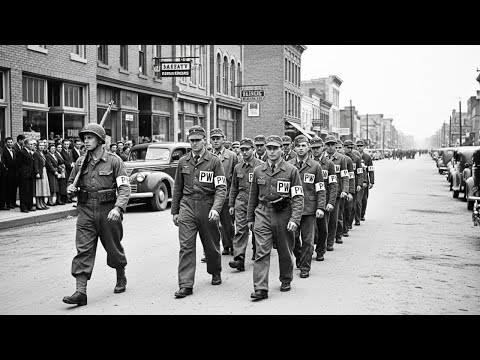
October 12th, 1943. Hearn, Texas. Hundreds of German soldiers stepped off the train, their minds steeled for chains, cages, and angry mobs. Nazi propaganda had painted America as a brutal, decadent nightmare—a place where captured enemies would be starved, beaten, and humiliated. But as the first boots hit the dusty platform, the scent of sizzling bacon drifted from a nearby diner. A jukebox spilled Glenn Miller’s “In the Mood” into the warm air. Children waved from the sidewalks, their faces curious, not hateful. And the guards? They walked behind the prisoners, rifles slung casually over their shoulders, as if they hadn’t a care in the world. For men conditioned to expect misery, this was more shocking than any battle. Why would America treat its enemies like this? And how would it change these men forever?
The crossing had been a gauntlet of fear. Packed into the holds of Liberty ships, thousands of German prisoners taken in North Africa and Sicily braced for the worst. U-boats prowled the Atlantic, and every creak of the hull sounded like death. One corporal later recalled, “We whispered that they would beat us, shave our heads, and lock us underground. Better the ocean than captivity.” But no torpedo found them. Instead, the gray convoy delivered them to a land that seemed to mock their darkest fears.
When the ships docked in ports like Newport News and Boston, expectation collided with paradox. There were no clubs, no shackles—only orderly lines and military police directing them with clipped, businesslike commands. They were herded onto waiting trains, the smell of coal smoke replacing salt air. As the trains rolled inland, prisoners pressed their faces to the narrow windows. Green fields stretched to the horizon. Farmhouses stood intact, laundry flapping on clotheslines. “How could this country be at war?” one private scribbled in a hidden notebook. “Our villages are ash.”
The land itself was a rebuke to everything they had been told. In Texas, the prairie wind carried dust and the drone of cicadas as trains disgorged their human cargo at camp gates. Barbed wire gleamed, guard towers loomed—but the prisoners noticed unsettling details. Barracks with windows. Canteens serving food. Even soccer fields being marked off. “This isn’t a prison,” one sergeant muttered. “It’s a village.” The men were stunned to discover they would be clothed, fed, and housed under rules written not by whim, but by treaty—the Geneva Convention of 1929, a document barely known to most American draftees. Yet the Americans had both the resources and the will to adhere to it.
By late 1943, nearly 300,000 German POWs had arrived in the United States, a figure that would climb to over 370,000 by war’s end. Camps stretched from California deserts to New England forests, but the heartland—Texas, Nebraska, Iowa, Oklahoma—carried the largest burden. The disbelief of those first days never left many of them. “We expected to be treated like beasts,” one wrote later. “Instead, we were treated like men.”
But arrival was only the beginning. The first stop for most captured Germans was not a camp in the open countryside, but a processing center. Forts in Virginia, New Jersey, and Louisiana became funnels where disoriented men were transformed from enemy soldiers into registered prisoners of war. The clang of typewriters echoed through long wooden halls, punctuated by the click of fingerprint ink rollers. Each man was logged, numbered, photographed, and issued a coarse denim uniform stenciled with large black letters: PW. The paradox deepened. Instead of being stripped and shackled, they were given shoes, socks, and even razors. “We could shave every morning,” one prisoner remembered with disbelief. “In the desert, we had lived like animals. In captivity, we looked like soldiers again.” The irony stung—captivity granted them a dignity the collapsing Wehrmacht could no longer provide.
Oversight came from the Provost Marshal General’s Office, a branch of the US Army tasked with managing hundreds of thousands of captives. Camps were laid out like small military towns: barracks in neat rows, mess halls, canteens, and recreation fields. German officers were often kept apart from enlisted men to reduce indoctrination and maintain order. Some captives were singled out for another purpose. At Fort Hunt, Virginia—known only by the cryptic address PO Box 1142—selected prisoners with technical knowledge, U-boat officers, scientists, or high-ranking staff were interrogated in secrecy. They faced long questioning sessions, but even here, survivors noted, brutality was absent. “They questioned us with patience, with tea and cigarettes,” recalled a naval engineer decades later. “It was more unnerving than shouting.”
The majority, however, never saw Fort Hunt. They were sent inland to sprawling camps ringed by barbed wire and watchtowers designed to hold thousands. Trains rumbled through the night, prisoners staring out of narrow windows at a land that seemed untouched by war. Cornfields stretched to the horizon. Towns still lit their main streets at night, while in Germany, blackout curtains smothered every lamp. The numbers alone were staggering. By early 1944, the United States was hosting nearly 350 camps spread across 46 states. Some held only a few hundred men. Others, like Camp Hearne in Texas or Camp McCoy in Wisconsin, housed more than 4,000 prisoners each. The logistical burden was immense, but the system functioned with bureaucratic precision.
Within days of arrival, prisoners discovered routines that mirrored military life: roll calls at dawn, meals in the mess, assigned duties for camp maintenance. Complaints were heard—sometimes even addressed. “We wrote a petition about the bread being too soft,” one POW laughed later. “A week later, it was crustier. Imagine our shock that they listened.” The contrast with Germany’s treatment of captured Americans or Soviets was not lost on the men. Letters from Stalingrad survivors spoke of starvation, disease, and casual execution. Now sitting in wooden barracks with pot-bellied stoves, some felt a shame that gnawed as much as homesickness.
Still, suspicion lingered. Some prisoners whispered that this was a ruse, that leniency would turn to cruelty. But weeks stretched into months, and the routine held—uniforms, rations, even Sunday church services were permitted. Slowly, disbelief hardened into reluctant trust. What came next would take that trust further. For in the American heartland, the paradox sharpened. The enemy would soon be led out of his camp, past barbed wire and guard towers, and into the streets of ordinary towns—without chains.
By the winter of 1943, a rumor swept through the barbed-wire compounds: some prisoners would be allowed outside. Few believed it. In Germany, captives were caged like animals. To walk among civilians was impossible. Yet one frosty morning in Texas, the gate clanged open, and squads of Germans filed out under the watch of a few armed guards. No shackles rattled. Boots crunched gravel freely. The paradox was immediate—they were enemies in uniform, albeit with the large PW stenciled across their chests, and yet they walked through American towns as if they were laborers on holiday.
Guards kept a respectful distance, rifles slung casually—to the astonishment of the prisoners. People barely stared. Farmers tipped their hats. Shopkeepers paused at doorways. A diary from a Bavarian conscript captured the disbelief: “We were marched to town. I thought they would bind our hands. Instead, we strolled. We saw children lick candy canes. A girl waved. It was like waking from a nightmare into another life.”
The sensory shock overwhelmed them. The smell of bacon drifted from a diner. A radio spilled Glenn Miller’s “In the Mood” from a drugstore window. Newspaper boys shouted headlines. In Germany, streets smelled of dust and smoke. Here it was coffee and gasoline. At first, prisoners expected tricks. Would they be paraded for ridicule? But there was no jeering crowd, no humiliation. “The guards walked behind, not before us,” one recalled with awe. “They did not chain us because they trusted us not to run. And strangely, we did not.”
Trust was the hidden weapon. Escape was possible—the fields stretched for miles, and some tried—but most stayed. Where would they go? America was too vast, its people too observant, and the guards, though relaxed, carried authority. The freedom was symbolic, not absolute. Yet for men conditioned to fear brutality, it was staggering. By 1944, tens of thousands of POWs were regularly escorted into towns across Texas, Iowa, Nebraska, and Minnesota to perform labor or even shop at approved stores. Camp administrators reported escape rates of less than one percent—far lower than anyone expected. The absence of chains worked as well as any iron shackle.
Some locals remembered these strange processions for decades. In Nebraska, a farmer’s son later said, “It was odd—the enemy walking by our barn like neighbors. We kids followed them, curious. They didn’t look dangerous. They looked tired.” The paradox grew sharper when the prisoners compared the scene with what they had been told. Nazi propaganda had painted Americans as brutal, decadent monsters. Now they walked past intact schools, saw families shopping, and breathed an air free of fear. One officer muttered bitterly, “If Berlin knew of this, the war would collapse.”
Not all was cordial. Some townsfolk spat or turned away. Veterans groups protested the policy, demanding stricter treatment. Yet overall, the system worked—and it worked because the spectacle of freedom under watchful eyes cut deeper than punishment ever could. Every step down Main Street, every whiff of cigarette smoke or glance at a shop window, chipped away at a worldview forged under dictatorship. The men were still prisoners, but the absence of chains told them more about America than any leaflet dropped from a plane.
If the escorted walks into town unsettled the Germans, the days that followed often reshaped them completely. America did not keep them idle behind wire. Instead, the country put them to work. By 1944, the War Manpower Commission coordinated with the Army to funnel POW labor into the very heart of the US economy. Fields needed harvesting, timber needed cutting, factories needed hands—and with millions of American men overseas, there were gaps only prisoners could fill. The paradox was glaring: men who had once fought to destroy the United States now bent their backs to feed it.
In Texas, cotton rows stretched to the horizon, the smell of damp earth clinging to clothes. In Nebraska and Iowa, prisoners swung hoes in sugar beet fields, sweat mixing with soil. Wisconsin sent them into dense forests, where the rasp of saws and the scent of fresh pine filled their lungs. It was grueling work, but not slavery. Prisoners were paid—not in cash they could carry away, but in script credits redeemable at camp canteens. Chocolate bars, shaving soap, cigarettes, even writing paper became small luxuries. “I earned more cutting sugar beets in Iowa than I had as a soldier in North Africa,” one recalled. “It was absurd, but true.”
By late 1945, more than 425,000 POW laborers in America performed over 45 million man-days of agricultural work. In some counties, German prisoners harvested as much as a third of local crops. Economists later noted that without POW labor, entire harvests would have rotted in the fields. For many farmers, initial suspicion gave way to gratitude. “They saved our farm,” one Iowa woman wrote. “We could not have brought in the corn without them.” Farmers often shared sandwiches, lemonade, or even homemade pie. The Germans tasted white bread rich with butter, sweet jams, and meat sandwiches unlike anything left in their homeland. The irony was sharp: their captors fed them better than their own army had.
A Hessian private remembered tasting an orange for the first time. “In Germany, fruit was gone by ’42. Here, it was like biting the sun.” Others remembered the smell of fresh coffee brewed in thermoses carried to the fields, stronger and richer than ersatz brew back home. Still, mistrust lingered. Some American families glared as the enemy trudged past, resentful that men who had tried to kill their sons now worked their soil. Veterans organizations sometimes protested, accusing Washington of coddling the enemy. Yet the majority accepted the arrangement. The labor was too vital to ignore, and the rules too strict for real danger.
The POWs themselves noted another paradox: freedom of movement within captivity. Working in open fields, they could see the sky unobstructed, smell the seasons, hear the buzzing of locusts or the rustle of cornstalks. Some could have run, but few did. Escape meant starvation or recapture. Work meant food, pay, and time outside the wire. In memoirs decades later, many admitted that labor changed them more than lectures ever could. One wrote, “We learned that America’s strength was not in its weapons, but in its fields. Even its soil was richer than ours. They fed us from abundance we could not imagine.” And when the day’s labor ended, they returned under escort—not to chains or starvation, but to barracks with hot meals, letters from home, and sometimes even the music of Glenn Miller crackling over radios.
But the work was only part of the revelation. Beyond the furrows and forests lay an even greater shock: a nation that opened its libraries, churches, and music halls to men who had sworn to destroy it. At Camp McCoy, German musicians performed Mozart on instruments loaned by locals. At Camp Hearne, prisoners staged plays for guards and fellow inmates. “We thought captivity would be chains,” one soldier wrote to his parents in Bavaria. “Instead, it is as if we live in a school.”
Not every American smiled. Mothers who had lost sons clenched their fists at the sight of enemy uniforms. Black Americans, watching Germans treated with dignity, whispered bitterly about a freedom denied to them at home. “I fought for freedom,” one Black veteran later wrote, “but the German POWs had more of it than I did.” The paradox cut both ways.
When the guns fell silent in May 1945, repatriation came in waves. Many prisoners dreaded departure. “I wished the train would never come,” one recalled. “I had bread, music, even dignity here. At home, there was rubble.” Some returned to Germany determined to rebuild on the model they had glimpsed—open markets, democratic debate, even jazz. Others carried darker memories of America’s racial contradictions.
Fewer than 3,000 escapes were attempted across the entire war, and almost all failed. Violence was rare. What endured was memory: pie on farmhouse tables, jukeboxes humming Glenn Miller, towns that let enemies walk unbound. They had come as conquerors. They left as students. In the end, America’s greatest weapon was not its bombs, but its abundance.
So tell us—if you had been that young German soldier stepping off the train in Texas, expecting chains and finding bacon and Glenn Miller, would you have run… or stayed?
Report this article
Select a reason for reporting:






