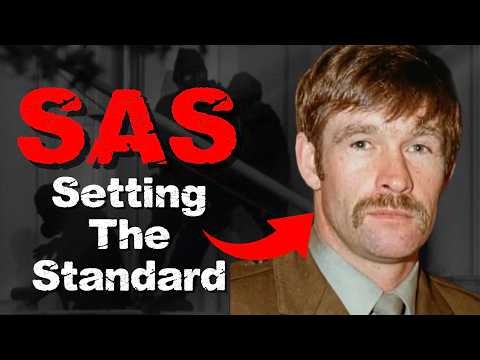
On May 5, 1980, millions watched in awe as black-clad soldiers from the Special Air Service (SAS) appeared on the balconies of the Iranian Embassy in London. One man stepped forward, carrying an explosive charge, and attached it to the armored window. He then retreated, and the man on the balcony was Mel Parry. The Iranian Embassy siege made Parry visible to the public for the first time, but by then, he had already served in various theaters of operation as part of the 22nd SAS Regiment. Today, you’ll discover his story.
Melvyn Parry was born in Mold, North Wales, on December 2, 1946. His father was a chief technician in the Royal Air Force, while his mother was a sergeant in the Women’s Auxiliary Air Force. This exposure to military life pushed him to join the army at a very young age. At fifteen, he enlisted in the All Arms Junior Leaders’ Regiment. He excelled in boxing and rugby, developing a toughness that would accompany him throughout his military career.
He later joined the 7th Parachute Regiment Royal Horse Artillery, part of the 16th Parachute Brigade. His first deployment took him to the southern Arabian Peninsula. British forces were still fighting around Aden, and in 1964, Parry participated in the Radfan campaign. Radfan was a rugged mountainous region where British troops were fighting tribal forces attacking the Aden-Dhala road. Royal Marines, paratroopers, artillery, aircraft, and SAS units were all involved. For Parry, it was an early introduction to the kind of warfare that would dominate his later career: small groups, difficult terrain, and an enemy who rarely fought conventionally.
In January 1966, shortly after his nineteenth birthday, he passed the 22nd SAS selection test. He was still very young, so he joined B Squadron and became part of 9 Troop. Parry was never described in the regiment as particularly polite or gentle. Accounts from those who knew him describe him as physically tough, demanding, and sometimes difficult. He had a thick mustache, a reputation for fighting, and a tendency to stir up trouble. His body bore some evidence of that: he had a bullet wound from Dhofar and a long scar on his face from his time as a security guard.
But he had another side, too. Parry loved books and was said to carry a copy of The Hobbit. He was interested in Roman military history and ancient warrior cultures, and he spent long hours thinking about equipment and how soldiers actually fight.
In 1970, Parry returned to the Arabian Peninsula. This time, he went to Dhofar in the Sultanate of Oman. The Dhofar War became one of the most significant SAS campaigns of the post-war period, though little was publicly known about it at the time. Communist-backed rebels were waging an insurgency, and British soldiers usually referred to them as ‘the enemy.’ They operated from rugged mountainous areas and received support across the border from the People’s Democratic Republic of Yemen.
The SAS role went beyond simply chasing rebels. They began training and leading local irregular forces. They gathered intelligence. They worked with tribal communities. They provided medical assistance. Parry worked within that environment. At one point, he helped deal with a cholera outbreak around Mirbat. He also saw fierce fighting.
On one occasion, he was shot in the shoulder by a sniper. The wound was serious enough that he was evacuated, but he refused to leave. Instead, he insisted on cleaning the wound and leaving it open to heal so he could stay with his comrades.
Another incident in Dhofar became a key reason for the deep respect his men had for him. A fellow soldier was shot in the back and lay exposed under heavy fire. Parry went out to rescue him. He reached the wounded soldier, carried him back, and treated him as well. The soldier eventually survived, but tragically, his injuries were life-changing.
However, the nature of the SAS role began to change during this period. In September 1972, Palestinian terrorists took Israeli athletes hostage during the Olympic Games. The rescue attempt by West German police ended in disaster. Eleven Israeli hostages were killed. Across Europe, governments began to look at the threat of terrorism and hostage situations and how to deal with them.
Britain was lucky. They already had the SAS. The regiment would now begin developing a more specialized counter-terrorism role. The 22nd SAS Regiment established what became known as the Counter-Revolutionary Warfare (CRW) capability. Within that came the Special Projects Team, also linked to the codename ‘Pagoda’. Parry became closely involved.
The questions they had to answer were very practical. How do you breach a fortified door quickly? How do you enter through a window without giving the gunmen time to kill hostages? How do you clear an aircraft, a bus, or a room where hostages and gunmen are only feet apart? What happens when smoke fills the room? What happens when a hostage suddenly moves into the line of fire? And Parry became one of the men who helped find answers to those questions.
He believed that training should be as realistic as possible. Sometimes, that required a lot. One story involves sniper training at 500 yards on a foggy morning. The snipers were preparing to fire when Parry walked between the targets wearing a protective vest and Wellington boots. Then his voice came over the radio. He wanted to know if they were paying attention because he was looking forward to going home for dinner. His idea wasn’t to scare them or anything like that. Parry wanted the men behind the rifles to realize the seriousness of the situations they would find themselves in. Obviously, he wasn’t shot, so the snipers did well.
Another story came during bus assault training. Instead of using only dummies, Parry himself drove the bus wearing body armor. Another soldier took on the role of a live hostage. The snipers firing at the vehicle had to do so with live targets just meters away. It was extreme training, but Parry believed that the first time a soldier experienced that pressure should not be during a real hostage rescue.
Then, in April 1980, the moment they had trained for finally arrived. Six Arab gunmen stormed the Iranian Embassy at 16 Prince’s Gate in South Kensington. They took 26 hostages, including embassy staff, journalists, visitors, and police constable Trevor Lock, who was guarding the building. The gunmen demanded the release of prisoners held in Iran and a safe passage out of Britain.
For several days, the Metropolitan Police negotiated. Five hostages were released. Meanwhile, the SAS prepared. Information about the building was gathered. Surveillance devices were used to locate hostages and gunmen. Entry routes were studied and teams trained on them. And on May 5, everything changed. A hostage was shot and killed, and his body was thrown from the embassy. The decision to assault was made. Control passed from the police to the SAS. Operation Nimrod had begun.
Parry led a four-man team tasked with the front first-floor balcony. Other teams would enter through the roof, rear windows, and other parts of the embassy. Parry’s men moved from adjacent buildings onto the balcony carrying a framed explosive charge. Their target was the armored window, and television cameras were already watching.
Parry stepped forward and placed the charge, then a terrorist above them threw a hand grenade. It landed near the team but did not explode. Parry retreated, the charge was detonated, and the window was breached. The team entered, but chaos quickly ensued. Stun grenades and explosive charges started fires. Smoke filled the building, and visibility became increasingly poor. Hostages and gunmen were mixed in multiple rooms. The assault teams had to move with extreme speed while still identifying each person.
Parry’s balcony team continued to clear the building. By the time Operation Nimrod ended, all hostages had been rescued. Five of the six gunmen were killed, and the last was captured. The entire operation was broadcast live on television. And for the SAS, nothing would ever be the same again.
Parry and several other soldiers received the Queen’s Gallantry Medal. The citation remained unpublished at the time due to the secrecy surrounding special forces, but it praised his bravery and calm, decisive leadership. The operation was a huge success and remains a model for how to handle hostage situations. But that operation was not the end of Parry’s SAS career.
He also served in Northern Ireland during Operation Banner and in other overseas missions that remain classified to this day. In 1984, Parry joined an SAS expedition that attempted to climb Everest from the Chinese side. A strange mission that ended badly when the team was caught in an avalanche, and one of the regiment’s best climbers was killed.
Later in his career, he became a warrant officer. He took command of the Operational Requirements section and became chief instructor at the Counter-Revolutionary Warfare Wing. Parry helped test and develop equipment used by hostage rescue teams. He is closely linked to the development of ballistic shields, an idea perhaps partly inspired by his interest in Roman military history. Parry also designed a multi-purpose survival knife known as the Parry Blade.
He retired from the army in 1990 after an unusually long career in the 22nd SAS Regiment. However, his connection to special operations continued. Parry moved into security consulting and training, advising organizations in Britain and abroad. He worked with Scandinavian special forces and received a merit medal from the Norwegian Army for his contribution to Norwegian counter-terrorism capabilities. He also remained close to the SAS and the Hereford community.
Men who served with him remember a complex character. Bob Shepherd described him as a strong man with a big heart. General Sir Graham Lamb described him as a friend in need, someone who stays when conditions get tough.
Mel Parry died in Hereford on May 21, 2023, after a long illness. He was 76 years old. Hundreds attended his funeral at Hereford Cathedral. His coffin was draped with the Welsh flag. His cap and belt were placed on top.
The Iranian Embassy siege will remain the moment most people associate with ‘Mel Parry,’ but those who knew him realized how important he was in training and developing the regiment. And if you know ‘Parry’ in any way or have any memories of him, please share them in the comments. Anyway, I hope you enjoyed this video exploring the life story of ‘Mel Parry.’ If you liked it, please leave a like, subscribe, and hit the notification bell. Share this video with your friends, and most importantly, leave me a comment. Tell me who or what I should talk about next time, and channel memberships are available if you want to support me in any way. Thank you. Because sometimes history doesn’t need to be rewritten. It just needs to be told correctly.
Those who served alongside him understood that the balcony was only a fragment of the story. “He was the man who stayed when conditions got tough,” General Sir Graham Lamb recalled, a sentiment echoed by every soldier who trained under Parry’s demanding eye.
His legacy lived on in the equipment he tested, the tactics he refined, and the countless operators who owed their survival to lessons he had drilled into them. The Parry Blade remained in use for years, a quiet testament to a mind that never stopped thinking about the soldier in the field.
When the Welsh flag was folded over his coffin, it marked the end of an era. But the regiment he helped shape carried his influence forward, one generation at a time.
So now we ask you: what does true heroism look like—the man on the balcony in the spotlight, or the trainer who prepared him in the shadows? Share your thoughts below.
Report this article
Select a reason for reporting:






