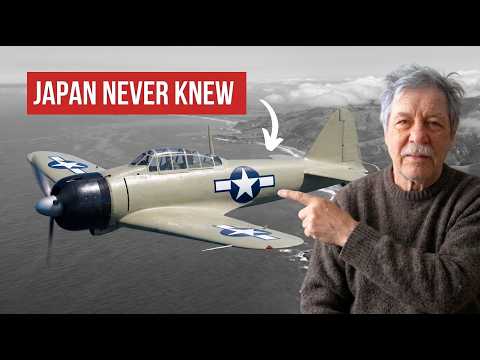
In the autumn of 1942, an American test pilot climbed into the most feared fighter in the Pacific and took off from a field near San Diego. The plane was a Japanese Zero—a real one, not a copy, not a mockup, but the genuine machine, now wearing fresh American stars. It should not have existed. Every Zero shot down was supposed to be wreckage. This one flew again for the enemy, and the men who built it never knew.
Somewhere across the ocean, Japanese commanders were told their fighter was gone. It was climbing over California wearing a white star. How that Zero ended up in California is a story of arrogance, luck, and a truth that was already written before the wreckage was ever found.
When the war in the Pacific began, the Zero was not just good—it was humiliating. American pilots met it over the Philippines, over Wake, over the Dutch East Indies, and came home with the same story, if they came home at all. The Japanese fighter could turn tighter, climb faster, and stay in the air longer than anything the Allies could put up against it. Curtis P-40s, Bell P-39s, and the stubby Brewster Buffalo—one after another—got into a turning fight with a Zero and lost. The plane seemed to have no weakness.
Somebody had warned them. Back in 1940, a retired American airman named Claire Chennault was in China watching Japanese fighters work. He wrote home, describing a fighter with extraordinary speed, climb, and maneuverability. He sent the numbers to Washington. The analysts there read his report and decided he was wrong. The performance he described was, they concluded, an aerodynamic impossibility. They filed it under nonsense.
So when American pilots finally met the thing in December 1941, they were meeting an aircraft their own government had been told about and refused to believe in. The intelligence existed. It just sat in a drawer while men died learning the same lesson by hand.
But not everyone ignored it. There was a naval aviator named John Thach—everyone called him Jimmy. In 1941, he was commanding a fighter squadron out of San Diego, and he got hold of one of those intelligence reports. Most people read the Zero’s numbers and felt discouraged. Thach read them and got to work.
He believed the reports. He assumed the enemy fighter really could outturn and outclimb his own Wildcats. And instead of pretending that wasn’t true, he asked a colder question: If the other guy is more maneuverable than you, how do you kill him anyway?
He worked it out at night at his kitchen table in Coronado, using matchsticks for airplanes. The traditional answer was to turn with your enemy, get on his tail, and shoot. But you couldn’t turn with a Zero. So he threw the traditional answer away. He designed a formation instead: two fighters or two pairs flying side by side with space between them. When a Zero latched onto one of them, that pilot would turn hard toward his partner. The partner would turn toward him, and as their paths crossed, the second pilot would get a clean shot at the enemy chasing the first. It didn’t depend on outturning anyone. It depended on teamwork and timing—and the one thing the Wildcat did have: good guns and a pilot who could shoot.
He called it the beam defense position. Later, another pilot named Jimmy Flatley would give it the name that stuck: the Thach Weave. Remember when this happened? Summer and fall of 1941—before Pearl Harbor, before America was even in the war. The answer to the Zero was being invented on a kitchen table months before most Americans had heard the word Zero at all.
And it worked. We know it worked because of where it was first used for real. June 4th, 1942. The Battle of Midway. Thach was leading a small group of Wildcats when a swarm of Zeros came down on them. His formation was badly outnumbered. By the old rules, they should have been slaughtered. Instead, they fought. When a Zero chased his wingman, the young pilot turned toward Thach, and Thach fired into the belly of the Japanese fighter until it burned. His tiny group held. The tactic that shouldn’t have been possible held against the fighter that supposedly couldn’t be beaten.
Hold on to that date—June 4th, 1942. Because on that exact same day, at the other end of the same enormous operation, a 19-year-old Japanese pilot was about to make the mistake that changed everything and hand the Americans a gift they didn’t even need.
His name was Tadayoshi Koga, a flight petty officer first class, nineteen years old, flying off the carrier Ryujo. While the main Japanese fleet went for Midway, a second force went north to the Aleutian Islands off Alaska and bombed a small American base called Dutch Harbor. Koga flew in that raid. His Zero was one of three in a section, and during the attack, someone on the ground got lucky. A single bullet—small arms fire, nothing exotic—cut an oil line in his engine. That’s all it took. Oil started streaming out.
Koga knew his engine would seize before he could make it back to the carrier, but the Japanese had planned for this. They’d picked out a nearby island, Akutan, as an emergency landing spot and stationed a submarine offshore to pick up any pilot who went down there. So Koga turned for Akutan with his two wingmen following, looking for a flat place to put the airplane down.
He found what looked like a green, level meadow. It wasn’t. It was a bog—soft, wet ground with a skin of grass over the top. And here, Koga made the decision that killed him. Instead of bellying the plane in with the wheels up, he lowered his landing gear for a normal landing. The instant the wheels touched that soft ground, they dug in and stopped dead. The Zero flipped violently onto its back. Koga’s neck broke. He died there, upside down in the mud.
His wingmen circled overhead. Doctrine said you destroyed a downed aircraft so the enemy couldn’t get it. A few strafing passes and the Zero would have burned. But they didn’t do it. The likeliest reason is the simplest and the saddest: they thought Koga might still be alive in that cockpit, and they couldn’t bring themselves to shoot. So they left him. And they left the airplane. And they flew away.
That airplane was almost perfect. The engine was fine. The airframe was intact. The flip had bent the rudder and the wing tips and cracked the canopy, but the Zero—the whole, real, flyable Zero that American analysts had called impossible—was sitting in an Alaskan bog, waiting.
It waited more than a month. The Aleutians are fog and wind and nothing, and nobody knew it was there. Then, on July 10th, 1942, an American Navy patrol plane—a big PBY Catalina flying boat—passed over Akutan, and someone spotted a shape in the marsh. An overturned airplane. They went lower. Japanese markings.
Getting it out was miserable. The first recovery team couldn’t manage it. The ground swallowed equipment. The airplane was stuck in the muck. It took several attempts and finally the right heavy gear to drag the Zero free without tearing it apart. They pulled it out, turned it right side up, cleaned the mud off it, and shipped it first by sea to Seattle, then by barge down to the Naval Air Station at North Island, San Diego. It arrived in August. One of the recovery parties gave Koga a burial on the island before hauling his airplane away.
At first glance, the overturned Zero in the photographs looks like a heap of junk. Look closer and you see it: a propeller, a wing, a whole intact fighter. The junk was a treasure, and the men knew it. For seven months, the Zero had been a ghost. Everybody feared it, and almost nobody in America had examined one that could actually fly. Here was the answer to every question, sitting in a hangar in California.
So they rebuilt it. They straightened the rudder, repaired the wing tips and flaps, fixed the landing gear, patched the canopy, and repainted the whole thing in United States Navy colors with the white star on the fuselage. Then they found out what it could really do.
The man who flew it first was a lieutenant commander named Eddie Sanders. Starting on September 20th, 1942, he took that Zero up again and again—twenty-four flights in about three and a half weeks. He flew it the way you’d test any aircraft, pushing it to the edges to find out where the edges were.
The very first flight told him most of what mattered. Everything the report said about low speed was true. Down low and slow, the Zero was magnificent. It turned inside anything, the controls light and responsive—exactly the fighter that had been terrorizing the Pacific. If you tried to dogfight it on its own terms, you lost. That part was real.
But Sanders found the other half. The half nobody had measured. As the Zero went faster, it changed. Past about two hundred knots, the ailerons—the controls that roll the airplane—got stiff, heavy. Above roughly two hundred fifty knots, rolling the airplane became a wrestling match. The pilot had to haul on the stick with both hands to get any roll at all. And even then, it came slowly, and it rolled far more easily to the left than to the right.
There was one more thing, and it was the big one. The Zero’s engine used a simple float-type carburetor, and that type of carburetor has a flaw. Push the nose down hard into negative G, and the fuel gets flung the wrong way, and the engine chokes and cuts out. Line those three facts up and you don’t have a list of specifications. You have an escape plan.
For the first time, America knew exactly how to get away from a Zero and exactly how to make it fight on terms it would lose. If a Zero is on you, don’t try to turn—you’ll die. Instead, shove the nose down and dive hard, using that negative G. Your engine keeps running. His quits. The range opens. And if he’s still with you, get your speed up above two hundred knots and roll away hard to the right—the one direction his frozen ailerons can’t follow. Do that, and the most maneuverable fighter in the Pacific can’t stay with you.
Picture what that meant to a twenty-two-year-old in a Wildcat who had spent months hearing that the Zero was death in the air. Now he had a card to play. Not a magic trick—a Zero could still kill him—but a real, tested way out, printed and handed to him before he ever saw one. The mystery that had been killing American pilots was turning into a page of instructions.
The Navy wrote it up and pushed it out to the fleet fast. And this is where the famous story begins—the version you’ve probably heard. America captured a Zero, took it apart, found its secret weaknesses, and that discovery turned the air war around. Some versions go further and say it’s the reason the great American fighter that replaced the Wildcat—the Grumman Hellcat—was designed the way it was, built specifically around the flaws found in Koga’s airplane.
It’s a wonderful story. It sounds completely plausible, and a lot of serious people believed it. A Japanese officer and historian, Masatake Okumiya, later said that the loss of that one Zero was no less serious to Japan than the defeat at Midway, that it did much to hasten Japan’s defeat.
There’s just one problem with all of it. The dates don’t work.
Look back at what you already know. Thach invented the weave in 1941, before the war, and used it to beat Zeros at Midway on June 4th, 1942—more than a month before the Akutan Zero was even spotted in its bog, and three months before Sanders flew it. The single best tactic for beating the Zero was already invented, already tested, and already working before America had the captured airplane in hand.
And the Hellcat? Its contract was signed on June 30th, 1941—again, before America was in the war. The prototype first flew on June 26th, 1942, while Koga’s Zero was still upside down in the mud, undiscovered. The airplane the myth says was built around the captured Zero’s weaknesses was already flying before anyone knew that Zero existed.
So the famous story is backwards. The tactics existed first. The airplane existed first. What Koga’s Zero actually did was confirm in precise, measured detail what a few smart people had already figured out—and put hard numbers on it so it could be taught to thousands of ordinary pilots. That’s not nothing. Confirmation matters. But it’s a very different thing from revelation.
Which raises the real question: if the captured Zero didn’t win the air war, what did? The answer comes down to a choice—light or heavy. Jiro Horikoshi stripped the Zero to nothing, leaving out armor and self-sealing tanks to achieve its magic. The Hellcat made the opposite bet: big, heavy, armored, with self-sealing tanks and a huge engine. One airplane was built to win the duel. The other was built to make sure its pilot came back to fight tomorrow.
And that second idea decided the war. Grumman built more than 12,000 Hellcats in roughly two years—over 500 a month at peak. America could build fighters faster than the enemy could shoot them down, and train pilots to fly them. Japan could not. Those superb early Japanese pilots died in Zeros that had no armor and no self-sealing tanks, taking years of irreplaceable skill with them. One side’s experience compounded. The other’s bled away.
The Hellcat reached combat in late summer 1943, and the collision became visible. By June 1944, near the Marianas, Japan sent wave after wave of aircraft at American carriers. Most never got through. The men flying off the carriers gave it a grim nickname: the Great Marianas Turkey Shoot. Two years earlier, the Zero was the hunter. Now Japanese pilots climbed into the same basic airplane and were swept from the sky.
The Hellcat was credited with destroying more enemy aircraft than any other American naval fighter—a wartime ratio usually quoted around 19 to 1. Treat that as the proud wartime figure, not a laboratory measurement. But even shaved down, the picture doesn’t change. That ratio wasn’t built by one airplane found in a bog. It was built by a faster, stronger fighter that brought its pilots home, by tactics invented on a kitchen table before the war, by a training pipeline that never ran dry, and by the brutal arithmetic of a factory that could build 12,000 fighters while the enemy could not replace 1,200 pilots.
The Zero didn’t lose because America stole its secret. It lost because everything around it was built to outlast it. The airplane the Japanese feared losing was never really the source of their advantage. Their advantage was the men. And the men were the one thing they couldn’t rebuild.
So what happened to the Zero that started all this? It kept flying in American hands for a while, teaching pilots what to expect. Then, in 1945, it died the way so many airplanes die—not in battle, but in an accident. Another aircraft taxiing on the ground ran into it and destroyed it. After everything—the bullet over Dutch Harbor, the bog, the month in the fog, the ocean voyage, the careful rebuild—Koga’s Zero was wrecked at home by a ground collision. Pieces of it survive in museums today. That’s all that’s left.
And Koga himself, the nineteen-year-old whose one bad decision—wheels down instead of up—put the airplane in American hands, intact. His body stayed on that Alaskan island for years. In the 1950s, his remains were finally returned to Japan. He didn’t betray anything. He made a split-second choice under a dying engine, the wrong choice by inches. And it handed his enemy the most wanted airplane in the Pacific. And it barely mattered, because the things that beat the Zero were already in motion before he ever took off that morning.
As for Thach—the man who beat the Zero on paper before anyone captured one—he stayed in the Navy, kept inventing tactics, and eventually wore an admiral’s stars. The maneuver he worked out with matchsticks on a kitchen table outlived the war, outlived the propeller fighters it was made for, and got taught to jet pilots decades later. One tired lieutenant, a box of matches, and a refusal to panic did more damage to the Zero than any wreck pulled out of a bog.
Which brings us back to that American test pilot climbing over California in a Japanese fighter wearing a white star. For a long time, the Japanese couldn’t explain how the Americans seemed to know their fighter so well—how the enemy suddenly stopped playing the Zero’s game, dove away when they should have turned, and rolled off to the right at exactly the speed the Zero couldn’t follow. It looked like the Americans had somehow gotten inside their airplane. And in the most literal way, they had. There was a real Zero in San Diego, flown by a Navy test pilot, giving up its numbers.
But that was never the real answer, and it’s why the myth is so seductive and so wrong. Losing that one airplane felt like the explanation, even to the Japanese, because it was a bearable explanation. The enemy stole our secret is a story you can live with. The truth was harder. The truth was that the tactics were invented before the theft. The winning fighter was flying before the theft. And the thing Japan actually couldn’t replace wasn’t a machine at all. It was pilots like Koga.
The Zero in California didn’t hand America the war. It just confirmed—in an Alaskan pilot’s own airplane—a verdict that had already been written.
So here’s the question for you: if you had to bet on what really wins a war—a brilliant machine or the system that builds and replaces the people who fly it—which would you choose?
Report this article
Select a reason for reporting:






