Teeth ripped out to sharpen cheekbones. A facelift so botched that the biggest star in silent cinema couldn’t smile for the rest of her life. And a woman once called the most beautiful face on film, who spent her last twenty years hiding from everyone because she couldn’t stand what she’d done to herself.
Today, cosmetic surgery is a lunchtime procedure—quick, discreet, almost casual. But in the golden age of Hollywood, it was a dangerous experiment, and the biggest stars in the world were the test subjects. Their faces were their fortunes, and they would do anything to keep them. Anything.
Gloria Swanson was one of the first major stars to go under the knife, setting a pattern that every name on this list would follow. In the early days of the industry, she had a rhinoplasty to prepare her profile for the unforgiving close-ups of the silent era camera. The nose job worked—Swanson became one of the highest-paid actresses in Hollywood and one of the most photographed women in the world. But the face that launched her career also became the face she couldn’t stop trying to improve.
As Swanson aged, she reportedly pursued additional procedures to maintain the face that had made her fortune. By the time Billy Wilder cast her as Norma Desmond in Sunset Boulevard in 1950, the parallels between actress and character were hard to ignore. Desmond was a faded silent film star, consumed by vanity, refusing to accept that time had moved on. Swanson spent the rest of her career insisting that Norma Desmond was nothing like her. The audience had its doubts.
Barbara Stanwyck was one of the toughest, most talented actresses of the golden age. She could play a femme fatale, a frontier woman, and a screwball comedian all in the same year. And over the course of her career, her face quietly changed. Stanwyck never confirmed having cosmetic surgery, but longtime observers noticed that her eyes gradually took on a more pronounced almond shape as the decades progressed—a change consistent with the effects of a facelift pulling the skin around the temples.
Her jawline tightened, her brow lifted. By the time she appeared in her final major role in The Thorn Birds in 1983, the face on screen looked subtly but unmistakably different from the one that had starred in Double Indemnity four decades earlier. Whether Stanwyck had work done remains unproven. But in an industry where the pressure to stay young could break anyone, the evidence is on her face.
Raquel Welch was one of the biggest sex symbols in Hollywood history. The image of her in that fur bikini from One Million Years B.C. became one of the most iconic photographs of the 20th century. For decades, she seemed to have beaten the aging process entirely. Welch never publicly confirmed having cosmetic surgery, though speculation followed her for most of her career. In her 70s, she still looked remarkably youthful, and surgeons who hadn’t treated her offered opinions in the press about what might have been done.
By the time she was photographed in her early 80s, shortly before her death in February 2023, the changes were dramatic enough that tabloids used the word unrecognizable. Welch never addressed the rumors. She promoted her own makeup line and credited healthy living. But the gap between the cavewoman in the fur bikini and the woman in those final photographs tells a story that no amount of makeup could explain. Raquel Welch took whatever she did to stay beautiful to the grave.
Zsa Zsa Gabor was famous for her beauty, her nine marriages, and her ability to remain in the spotlight for half a century without ever being entirely clear on what she was famous for. She was also, according to the general consensus of Hollywood historians and gossip columnists alike, one of the most surgically altered women of the Golden Age.
The common belief is that Gabor had her face completely redone during her marriage to hotel magnate Conrad Hilton in the 1940s. Comparing photographs of Gabor in 1939 to photographs from the early 1950s, the transformation is striking. Her nose is different. Her jawline is different. The overall geometry of her face appears to have been comprehensively restructured. Gabor never detailed exactly what she had done—because in her era, that simply wasn’t discussed—but the before and after photographs speak for themselves. And what they say is that the woman the public knew as Zsa Zsa Gabor may have been, at least in part, a surgical construction.
Burt Lancaster was the last person anyone expected on a list like this. He was a former circus acrobat who became the toughest man on screen—the kind of actor who did his own stunts and once said, “I’ve got a couple of thousand bucks in this picture. What’s a neck?” He starred in From Here to Eternity, The Birdman of Alcatraz, and Atlantic City. And over the course of a career that spanned four decades, he had so much cosmetic work done on his face that he eventually confessed to his own director what was real and what wasn’t.
While filming 1900 with director Bernardo Bertolucci in the mid-1970s, Lancaster decided to come clean. He told Bertolucci the truth about his appearance. He had undergone extensive work on his face, teeth, chin, and cheekbones over the course of his career. Some of the alterations were cosmetic choices to help him get certain roles. Others were corrections from injuries sustained during his acrobat years. The cumulative effect, Lancaster admitted, was that almost nothing about his face was the face he’d been born with.
That confession, delivered privately to his director, is one of the most disarmingly honest admissions any Golden Age star ever made. Beverly Hills plastic surgeon Dr. Richard Fleming later confirmed to ABC News that Lancaster had undergone a facelift, adding, “Without cosmetic surgery, gravity always wins.” Lancaster knew that better than anyone. He’d been fighting gravity his whole career—first on the trapeze, then in the surgeon’s chair.
Carmen Miranda was the Brazilian bombshell, the highest-paid woman in American entertainment in 1945. Her face was known around the world. And then she became one of the most visible examples of plastic surgery gone sideways. Miranda was already at the peak of her fame when she decided to have her nose reshaped. She never liked how wide it was, and she wanted it thinner.
The rhinoplasty itself was reportedly fine. The problem came when she followed it up with a facelift. The combination of the two procedures pulled her features into a configuration that looked permanently startled—as if someone had just delivered shocking news, and her face had frozen in the reaction. For a woman whose entire act depended on her face being in constant, joyful, explosive motion, the facelift took away the one thing no surgeon could give back: the ability to look natural.
In her early sixties, Lana Turner reportedly walked into the office of plastic surgeon Dr. Richard Ellenbogen, placed a photograph of herself at age twenty-seven on his desk, and said, “This is what I want to look like.” Turner was the original sweater girl, discovered at sixteen sitting at a soda fountain on Sunset Boulevard. Her entire career was built on how she looked. When those looks started to change, she did what the system had trained her to do. She tried to buy them back.
Multiple facelifts. Increasingly aggressive tightening. Each procedure was supposed to turn back the clock. Each one made the gap between Turner at twenty-seven and Turner at sixty a little more obvious. The result was a face that looked tighter, smoother, and fundamentally different from the one audiences had fallen in love with. No amount of surgical intervention could give her the one thing she actually wanted: to be twenty-seven again.
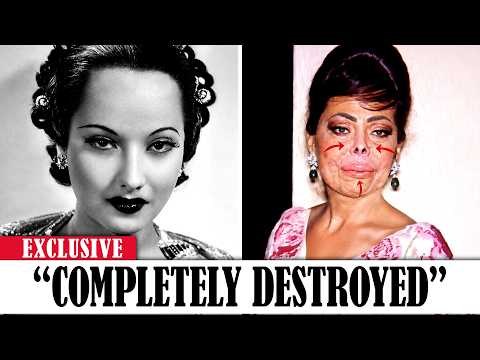
Merle Oberon was one of the most beautiful women in Golden Age Hollywood. She was also hiding a secret that drove her to damage her own face for decades. Oberon was born in India to a mother of South Asian heritage, and she hid her background throughout her career by using heavy cosmetics and skin-lightening products that caused cumulative chemical damage to her skin. Then came a serious car accident that injured her face and required reconstructive procedures.
After the accident, she reportedly began pursuing facelifts aggressively—trying to repair the damage while simultaneously fighting the effects of aging and years of harsh chemical treatments. By her later years, Oberon’s face had been pulled so tight that she could barely move her lips. At public appearances, she struggled to form expressions. The face that had starred in Wuthering Heights had been layered over so many times that what remained was barely functional.
Joan Crawford’s most iconic feature was the result of a cosmetic dental procedure that went horribly wrong—and the surgery that followed made things worse. Crawford had her back molars removed to give her cheekbones a more sculpted shape, a technique several Golden Age stars reportedly used. Then she had her front teeth filed down so temporary caps could be fitted over them. The caps were supposed to improve her smile. They destroyed it instead.
Her front teeth decayed underneath the caps. Her gums became severely infected. And when the swelling finally subsided, she was left with an enlarged, elongated upper lip that bore no resemblance to her original mouth. Crawford’s save was brilliant and calculating. She overlined her lower lip with dark lipstick to match the swollen upper lip, creating a symmetry that didn’t exist naturally. The Crawford mouth became her signature. Thousands of women copied it. Every single one of them was imitating a surgical accident that Crawford had turned into a trademark through sheer force of will.
But Crawford kept going. A facelift and breast augmentation in 1953—which she was unusually candid about. She reportedly told someone, “The face and boobs are new. Only the behind is the same.” Then another facelift and another. Through the 1960s and into the 1970s, she kept returning to the surgeon’s office with the same relentlessness she brought to everything else in her career. By her final public appearances, the legendary expressiveness that had defined her acting had been lifted and tightened into something flatter, smoother, and less alive. The most dynamic face in Hollywood had been surgically frozen into a mask of its former self.
Mary Pickford was America’s sweetheart—the biggest female star of the silent era, co-founder of United Artists, and one of the most powerful people in Hollywood. And then a botched facelift ended everything. In the 1930s, worried about aging out of leading roles, Pickford had a facelift. At the time, the procedure was primitive. Surgeons didn’t work on the deeper muscles or tissues of the face. They simply grabbed the outer layer of skin, pulled it tight, and stitched it in place. The technique regularly produced what surgeons would later call the wind tunnel look. And for early patients who didn’t know the risks, the results could be devastating.
For Pickford, it was catastrophic. The facelift damaged her facial muscles so severely that she could barely move her face. She couldn’t smile. She couldn’t frown. She couldn’t convey the range of expressions that her career had been built on. For a silent film actress, where the entire performance lives in the face—where every emotion has to be read without a single word of dialogue—losing the ability to express was the same as losing the ability to act. A 1930 Photoplay article alluded to the disaster without naming her directly, referencing a persistent rumor about “an actress who suffered a tragic comic sequel to her plastic surgery quest for beauty.” Everyone in Hollywood knew who the article was about. Nobody said it out loud.
Pickford withdrew from public life almost entirely. She spent her final decades largely confined to Pickfair, the legendary estate she’d shared with Douglas Fairbanks, rarely allowing visitors and almost never appearing in public. She accepted an honorary Oscar in 1976, but by then she hadn’t been seen by most of the world in years. America’s sweetheart couldn’t smile anymore, so she stopped letting anyone see her face.
Kim Novak was one of the most captivating faces of the 1950s. She starred in Alfred Hitchcock’s Vertigo, won two Golden Globes, and was Columbia Pictures’ biggest star. And then, decades later, she made a decision she would publicly, explicitly, and painfully regret. Novak had fat injections put into her cheeks. She didn’t want a full facelift—she went to a doctor looking for something minimal, something that would just freshen up what was already there. What she got was a face that looked dramatically different from the one the world remembered.
Her cheeks puffed out, her features shifted. The natural architecture that had made her one of the most photographed women of the 1950s was suddenly gone, buried under the filler. When she appeared at the 2014 Academy Awards, the public reaction was savage. Social media turned on her instantly. Trolls mocked her appearance. Critics who should have known better piled on. People who had never met her wrote thousands of words about what she’d done wrong with her own face. Novak was devastated.
In an interview afterward, she was bracingly, painfully honest about what had happened. “You know when you get insecure and you think somebody can help you? I didn’t want a facelift or anything like that. So I went to a doctor and he put some fat injections in my face. That was the stupidest thing I could have done. First of all, I didn’t need it because I think my face is too round anyway.” New York plastic surgeon Dr. Joel Shahar, who had not treated Novak, later examined photographs and called the work “completely unprofessional and horrible, horrible, horrible.” He noted that the results looked like a nonprofessional facelift that had raised her skin unnaturally.
The backlash drove Novak out of Hollywood almost entirely. She retreated to her ranch in Oregon and largely disappeared from public life. The star of one of the greatest films ever made was punished twice—first by a doctor who gave her a procedure she didn’t need, and then by an industry that mocked her for getting it.
Hedy Lamarr was called the most beautiful woman on film. Walt Disney reportedly used her face as the model for Snow White. She was also a brilliant inventor whose frequency-hopping technology laid the groundwork for Wi-Fi, Bluetooth, and GPS. She held patents. She changed modern communications. And she spent decades trying to surgically preserve the face that had made her famous—until there was almost nothing left of it.
Lamarr reportedly began getting cosmetic work done in the 1960s. She was the first major actress to publicly admit to having had plastic surgery, which was considered scandalous at the time. She had facelifts and a rhinoplasty, and she continued pursuing procedures over the following decades. Her early nose job was actually a success, but Lamarr kept going back. Each procedure was supposed to restore the face that had launched a thousand magazine covers, and each one moved it further away.
Her son Tony later described her final years. “She spent her life alone with no one to ground her or care for her. She got screwed a lot—with her invention, with her husbands, her career. Her own lawyers cheated her.” By the 1980s, Lamarr had retreated from public life. She lived in a small home in Casselberry, Florida, and communicated almost exclusively by telephone. When the Electronic Frontier Foundation tried to honor her for her groundbreaking invention in 1997, she declined to attend. She wouldn’t let anyone photograph her. She died in 2000 at the age of 85. The woman whose face inspired Snow White, whose mind helped invent wireless communication, spent her final two decades alone—talking to the world only through a phone line, never letting anyone see her in person.
Thirteen faces that defined what beauty meant for an entire century. And almost every one of them ended up in a surgeon’s office trying to hold on to something that was always going to slip away. Mary Pickford couldn’t smile. Joan Crawford invented an iconic look out of a surgical accident. Kim Novak called her own procedure the stupidest decision of her life. And Hedy Lamarr, the most beautiful woman on film, spent her last twenty years hiding from the world. The Golden Age sold the idea that beauty was everything—and then charged these women everything they had to keep it.
Which of these stories hit you the hardest—and do you think Hollywood has really changed, or are stars still paying the same price today? Let us know in the comments.
Report this article
Select a reason for reporting:






