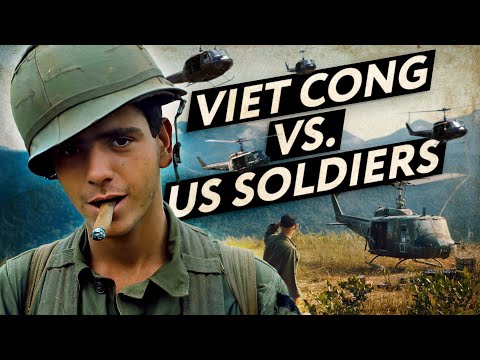
The jungle was silent, but the air crackled with tension. In the summer of 1965, 50,000 American troops landed in South Vietnam, confident that their firepower would crush the Viet Cong insurgency. Instead, they stepped into a nightmare of ambushes, booby traps, and an enemy who seemed to vanish into the foliage.
Backed by B-52 bombers, helicopters, and napalm, the US military expected the guerrillas to crumble. But the Viet Cong adapted, turning the dense jungles and swampy deltas into a deadly labyrinth where American technological superiority meant little.
General William Westmoreland, commander of US forces in Vietnam, faced a daunting challenge. Political constraints prevented an invasion of North Vietnam or the cutting of the Ho Chi Minh Trail in Laos and Cambodia. Instead, he devised a strategy of attrition: search and destroy. The goal was not to hold territory but to inflict such heavy casualties that North Vietnam would abandon its support for the insurgency.
“We’ll take the fight to the Viet Cong and eliminate them in large set-piece battles,” Westmoreland declared. The metric of success would be the body count.
This approach relied on mobility and firepower. US troops would locate enemy formations through intelligence, pin them down, and then call in devastating air strikes and artillery. New weapons like the M16 rifle, M60 machine gun, and M79 grenade launcher gave American soldiers an edge in firepower. Helicopters, especially the UH-1 Iroquois, provided unprecedented mobility, allowing troops to be inserted and extracted quickly.
The first major test came in November 1965 at the Battle of Ia Drang. Air Assault troops inflicted heavy casualties on North Vietnamese regulars, seemingly validating Westmoreland’s tactics. The US claimed a 10:1 kill ratio. But the enemy learned from the experience, reverting to guerrilla tactics that exploited American weaknesses.
“When helicopters spotted us, we had to run for our lives,” remembered North Vietnamese soldier Nguyen Quang Sang. “It was terrifying.”
The Viet Cong perfected the art of ambush, using mines, booby traps, and hit-and-run attacks. They targeted officers and radio operators to prevent air support, and they melted back into the jungle before American reinforcements could arrive. Their logistical needs were minimal; a Viet Cong soldier carried as little as 5 kg of equipment, compared to 40 kg for an American GI.
As the war dragged on, US troops grew frustrated. Patrols often ended without contact, only to be ambushed on the next mission. “You go out on patrol maybe 20 times or more and nothing—just nothing,” one soldier recalled. “Then the 21st time, zap zap zap, you get hit, and Victor Charlie fades into the jungle before you can close with him.”
The psychological toll was immense. The average age of American soldiers was 19, and many were draftees. High officer turnover meant that combat experience was constantly lost. Violence against civilians became more common, further alienating the local population.
By 1967, the war had reached a stalemate. Westmoreland insisted progress was being made, but the body count was inflated, and the bombing of North Vietnam had little effect on its agrarian society. International opinion turned against the US, and domestic opposition grew.
“The ranks of the Viet Cong are thinning,” Westmoreland told the public. “The end begins to come into view.”
But the first months of 1968 would prove him disastrously wrong.
The Tet Offensive shattered the illusion of progress. On January 30, 1968, North Vietnamese and Viet Cong forces launched coordinated attacks on more than 100 cities and towns across South Vietnam, including Saigon itself. The US embassy compound was breached. Guerrillas fought their way into the heart of the capital.
“The city was in chaos,” recalled one American journalist. “Fires burned for days. We had been told the enemy was finished, but here they were, inside the gates.”
Militarily, Tet was a catastrophe for the North. The Viet Cong suffered devastating losses—tens of thousands killed—and never fully recovered. But strategically, it was a masterstroke. The images of fighting in Saigon, of the US embassy under siege, shocked the American public.
Walter Cronkite, the most trusted news anchor in America, traveled to Vietnam after Tet. His verdict, broadcast to millions, was blunt: “It seems more certain than ever that the bloody experience of Vietnam is to end in a stalemate.” President Johnson reportedly said, “If I’ve lost Cronkite, I’ve lost Middle America.”
Johnson announced he would not seek re-election. The war had broken his presidency.
Back in the field, the fighting continued. The Battle of Hue raged for weeks, the ancient imperial city reduced to rubble. Marines fought house to house against North Vietnamese regulars. The body count soared, but the metric no longer mattered. The American public had turned.
In the jungles, US troops sensed the shift. “We were winning every battle and losing the war,” a platoon leader said. “You could feel it. The country was tired. We were tired.”
Westmoreland was recalled to Washington, replaced by General Creighton Abrams. The strategy changed—no longer search and destroy, but clear and hold, protecting the population. But it was too late. The political will had evaporated.
Peace talks began in Paris, dragging on for years. Meanwhile, the fighting continued, a brutal war of attrition with no end in sight.
The Viet Cong and North Vietnamese, though bloodied, had achieved their goal: they had broken American resolve.
In the years that followed Tet, the war became a grinding, bitter affair fought by an American army that knew it was leaving. Desertions rose, racial tensions flared, and drug use spread through the ranks. Soldiers serving their one-year tours counted the days, unwilling to be the last man to die in a war their country had already decided to end.
“It doesn’t matter what we do out here anymore,” a Marine sergeant told a reporter in 1969. “The politicians back home have already given up. We’re just marking time until they bring us home.”
Still, the killing continued. The North Vietnamese rebuilt their forces, funneling fresh troops and supplies down the Ho Chi Minh Trail. Cambodia, officially neutral, was secretly bombed and then invaded in 1970, sparking a new wave of protests across America. At Kent State University, National Guardsmen opened fire on student demonstrators, killing four. The country seemed to be tearing itself apart.
General Creighton Abrams, Westmoreland’s successor, tried to change the war’s character. Instead of chasing body counts, his forces focused on pacification—securing villages, training South Vietnamese troops, and winning hearts and minds. Known as “Vietnamization,” the policy aimed to hand the fighting over to the South Vietnamese army so American troops could withdraw.
But the South Vietnamese forces, though improved, could not match the North’s determination. And the Viet Cong, despite their losses at Tet, remained a shadowy presence in the countryside, intimidating villagers and planting mines along the roads.
The war spilled beyond Vietnam’s borders. In 1970, US and South Vietnamese forces invaded Cambodia to destroy North Vietnamese sanctuaries. In 1971, South Vietnamese troops pushed into Laos along the Ho Chi Minh Trail, only to be routed in a disastrous retreat. Each expansion of the war deepened the disillusionment at home.
“We keep widening the war to end it,” a Pentagon analyst wrote in a memo that later leaked to the press. “But each widening makes it harder to end. We are trapped in a logic of our own making.”
Peace talks in Paris had stalled. The North Vietnamese demanded that the US abandon the Saigon government; the Americans insisted on preserving it. Meanwhile, the bombing resumed, more intense than ever. In December 1972, Nixon ordered Operation Linebacker II, eleven days of relentless B-52 raids on Hanoi and Haiphong. The “Christmas Bombing” killed thousands and finally brought the North back to the table.
In January 1973, the Paris Peace Accords were signed. The US agreed to withdraw all combat troops within sixty days. North Vietnam agreed to release American prisoners of war. The South Vietnamese government, fragile and divided, would remain in place—for now.
For the American soldiers still in the field, the news was surreal. “We were told to pack up and go home,” one GI remembered. “Just like that. No victory parade. No cheering. We just flew out of there and left the South Vietnamese to fight on their own.”
The last American combat troops left Vietnam in March 1973. The war had cost more than 58,000 American lives and over 300,000 wounded. For Vietnam, the toll was far higher—perhaps two million civilians and soldiers dead on both sides. The country lay in ruins.
But the fighting was not over. In 1975, North Vietnamese forces launched a final offensive. The South Vietnamese army, abandoned by its American ally and starved of supplies, collapsed within weeks. On April 30, 1975, North Vietnamese tanks crashed through the gates of the presidential palace in Saigon. The city fell. The war was over.
“The war ended exactly as it had begun,” a Vietnamese historian later wrote. “Not with a treaty, not with a compromise, but with the victory of the determined over the powerful. The Americans had the firepower, but the North Vietnamese had the will.”
For the United States, the legacy was painful and lasting. The war became a national wound, a cautionary tale about the limits of military power and the dangers of fighting a war without a clear objective or public support. In the decades that followed, American leaders would speak of “no more Vietnams,” even as new conflicts in Iraq and Afghanistan echoed the old dilemmas.
For the soldiers who fought, the memories remained. Many carried invisible wounds—the trauma of combat, the guilt of survival, the haunting faces of enemies and civilians alike. Some found peace. Others never did.
“I still dream about it sometimes,” a former infantryman said years later. “The jungle. The heat. The sound of helicopters. And that feeling of walking into a village where you knew you weren’t welcome, where every child might be a soldier and every old woman might have a grenade. We were the strongest army in the world, and we could not win. It took me a long time to understand why.”
He paused, then added, “We were fighting for a country that didn’t want us, against an enemy that wouldn’t quit. And in the end, the only thing we really lost was our innocence.”
The Vietnam War left scars that never fully healed. For America, it was a lesson in humility, a reminder that even the mightiest nation could be humbled by a determined foe. For Vietnam, it was a victory bought with unimaginable suffering.
“We won the war, but we lost a generation,” a North Vietnamese veteran reflected. “The bombs have stopped, but the wounds are still there—in the land, in our bodies, in our hearts.”
Today, Vietnam is a unified country, its cities bustling with commerce, its rice paddies green with harvest. But the memories linger. The tunnels of Cu Chi, the museums of Hanoi, the cemeteries filled with young men who never came home—all stand as silent witnesses to a conflict that reshaped both nations.
And for those who fought, the question remains: Was it worth it?
What do you think? Share your thoughts in the comments below.
Report this article
Select a reason for reporting:






